Opening: A Sneaker Revolution Is Here
The sneaker industry is undergoing a seismic shift. What once belonged exclusively to basketball enthusiasts and dedicated collectors has evolved into a multibillion-dollar cultural phenomenon that touches fashion, music, sports, and identity itself.
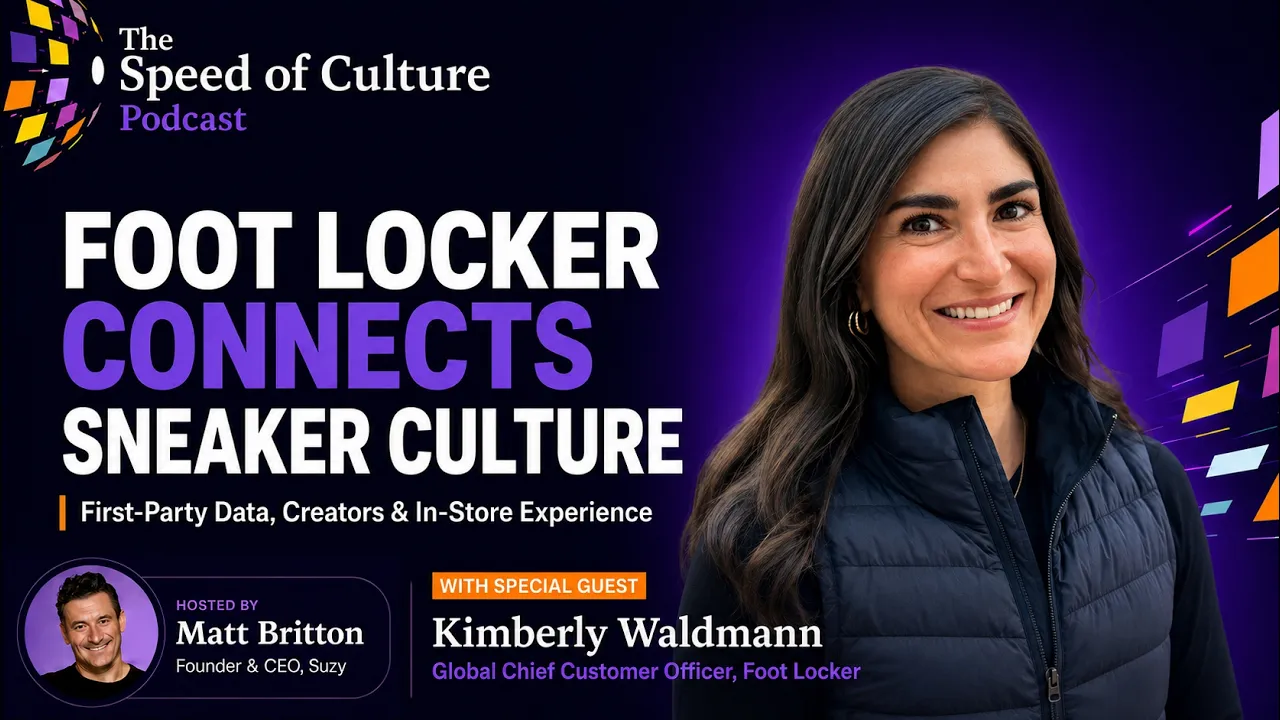
In December 2024, Matt Britton, founder and CEO of Suzy, the AI-powered consumer intelligence platform, sat down with Kimberly Waldmann, Global Chief Customer Officer at Foot Locker, to explore how the iconic sneaker retailer is navigating this cultural transformation.
The conversation, featured in Episode 146 of The Speed of Culture Podcast, reveals how Foot Locker is reimagining retail in an era where physical stores were supposedly on their deathbed. Instead of retreating to digital channels, the brand is doubling down on in-store experiences while leveraging first-party data, creator partnerships, and a deep understanding of sneaker culture to build genuine connections with the next generation of customers.
The stakes have never been higher. The global sneaker market is projected to grow from $91.71 billion in 2025 to approximately $153.45 billion by 2034, with women's sneakers representing the fastest-growing segment at a compound annual growth rate of 8.15% through 2032. Gen Z buys sneakers and lives sneaker culture.
They dress from the shoes up, anchor their identity in footwear, and expect retailers to understand that sneakers are a form of self-expression, not just functional footwear.
Foot Locker's approach addresses a critical question facing modern retail: How do brands remain culturally relevant while building sustainable business models powered by data and genuine customer relationships? The answer, according to Waldmann, lies in balancing analytics with authenticity, respecting the voices of creators and tastemakers, and reimagining physical retail as an irreplaceable cultural hub.
Unlocking the Inner Sneakerhead: Expanding Sneaker Culture Beyond Collectors
For decades, sneaker culture belonged to a distinct subculture of basketball enthusiasts, athletes, and dedicated collectors who camped outside stores for exclusive drops and memorized serial numbers. Today, sneaker culture is mainstream, and retailers like Foot Locker are working to expand its reach even further by “unlocking the inner sneakerhead in everyone.”
This democratization of sneaker culture represents one of the most significant retail transformations in recent memory. Women's sneakers have emerged as a particularly dynamic segment, representing the fastest-growing category within the sneaker market.
According to market research, women's sneaker resale market share jumped from 1.6% in 2014 to 42.7% by 2022, a staggering increase that signals fundamental shifts in who considers themselves part of sneaker culture and how they engage with it.
The evolution reflects broader cultural trends. Sneakers have become the intersection of sports, music, fashion, and pop culture. Young consumers, particularly Gen Z, are dressing “from the shoes up,” meaning they start with a statement shoe and build an entire outfit around it.
This represents a fundamental shift from the historical retail narrative where footwear was secondary to apparel.
Waldmann emphasizes that women's participation in sneaker culture extends beyond casual wear. Many women are engaging with sneaker fashion as a primary expression of personal style, participating in resale markets, and building collections with the same dedication as traditional sneakerheads.
For Foot Locker, recognizing and celebrating this expansion requires more than adding women's sizes to existing shelves, it demands reimagining the entire retail experience.
The sneaker market's explosive growth trajectory reflects this expanding audience. With the global sneaker market valued at approximately $92.43 billion in 2024 and projected to reach $153.45 billion by 2034, the opportunity is undeniable.
Within this larger market, women's sneakers are growing faster than any other segment, with market projections expecting growth from $30.78 billion in 2025 to $57.23 billion by 2035.
For retailers, the challenge and opportunity are identical: How do you authentically welcome new audiences into sneaker culture without diluting the community values that made sneaker culture powerful in the first place?
Foot Locker's answer involves deepening cultural understanding, respecting existing communities, and creating inclusive spaces where everyone from longtime collectors to curious newcomers can discover their connection to sneaker culture.
The Power of First-Party Data: From Marketing Gold to Customer Intelligence
In today's digital environment, data has become the lifeblood of effective retail. However, not all data is created equal. As privacy regulations tighten and third-party cookies disappear, first-party data, information that customers voluntarily share with brands, has become increasingly precious.
Waldmann describes first-party data as “marketing gold,” and Foot Locker's revamped FLX Rewards program demonstrates precisely why. Rather than deploying generic marketing campaigns to broad audiences, Foot Locker uses first-party data to create hyper-personalized experiences tailored to individual customer interests and behaviors.
The distinction matters significantly. Third-party data relies on tracking users across the web, raising privacy concerns and becoming less reliable as platforms restrict cross-site tracking.
First-party data comes directly from customers who opt in, creating a trust-based relationship where customers understand what information is being collected and what value they receive in return.
Foot Locker's FLX Rewards program incentivizes customers to share their preferences and behavior data. A basketball enthusiast receives personalized communications about new basketball releases, player collaborations, and performance innovations.
A style-focused customer gets curated recommendations about limited-edition drops, designer collaborations, and fashion-forward releases. The same shoe might be promoted entirely differently depending on the customer segment.
The business impact of this approach is substantial. According to joint research by Google and the Boston Consulting Group, marketing activities leveraging first-party data delivered a 2.9x increase in revenue and a 1.5x decrease in marketing costs compared to campaigns that didn't utilize such data.
For retailers specifically, implementing loyalty programs that enable first-party data collection and scaling personalized offers typically improves revenue and profit by 3–5%.
Foot Locker's results validate this research. In Q4 2024, 50% of the brand's sales came from loyalty program members, representing a dramatic increase from just 20% one year prior.
This transformation didn't happen overnight. It required building a membership program that customers actively wanted to join, not through forced opt-ins but through genuine value delivery.
The FLX Rewards program, now boasting over 32 million members, provides Foot Locker with an unprecedented window into customer preferences, shopping behaviors, and cultural interests.
This data enables the brand to understand what merchandise resonates with which audiences, when to launch new products, and how to communicate in ways that feel authentic rather than exploitative.
However, Waldmann emphasizes that data analytics alone cannot drive success. She advocates for combining data-driven insights with intuition and cultural judgment, what she describes as “blending measurable insights with creative judgment.”
“Blending measurable insights with creative judgment.”
This balance ensures that personalization enhances rather than undermines the customer experience.
The rise of first-party data strategies reflects a broader retail evolution. The future belongs to brands that can develop genuine relationships with customers, understand what customers actually want (rather than assume it), and deliver experiences that feel personally relevant rather than randomly targeted.
Reimagining Retail: Why Physical Stores Remain Essential to Sneaker Culture
Industry analysts predicted that e-commerce would render physical retail obsolete. Yet, despite decades of forecasts about the death of the brick-and-mortar store, Foot Locker is doubling down on physical retail.
The brand is experiencing success precisely because it understands something critical about sneaker culture: some experiences cannot be replicated online.
The Foot Locker Reimagined concept represents a fundamental rethinking of what a sneaker retail store can be. Rather than treating stores as warehouses where transactions happen, Foot Locker is designing them as cultural hubs and experiential environments.
These reimagined stores feature several key innovations. Trend zones showcase cultural moments and emerging styles, helping customers discover new aesthetics and understand how different sneakers fit into broader fashion narratives.
Specialized sizing experiences go beyond simply offering multiple widths and lengths. They provide the expertise and fitting technology that digital channels cannot replicate. Most importantly, knowledgeable staff serve as cultural guides rather than transaction facilitators.
This approach recognizes a fundamental truth about Gen Z shopping behavior: 81% of Gen Z shoppers prefer shopping in person to online, a higher percentage than any other generation.
This isn't because they reject digital: Gen Z is profoundly digital. Rather, it's because they understand that some purchasing decisions, particularly around cultural products like sneakers, benefit from in-person evaluation and expert guidance.
When a customer is choosing between three versions of a limited-edition sneaker drop, they want to hold them in their hands, assess the materials and construction quality, and understand the design choices.
They want to discuss the cultural significance of the release with someone who understands sneaker history and can contextualize the design within broader cultural movements. They want to be part of a community, not just a transaction.
The physical store also serves as a staging ground for cultural moments. Product launches, collaborations, and exclusive drops become events when they're anchored in physical space.
Waldmann's perspective on retail reflects this understanding:
“Physical stores aren't dead because digital still can't replicate the human experience, the cultural moment, and the ability to try things on and get expert guidance.”
This reframing moves retail from a commodity function (transaction processing) to a cultural function (community creation and cultural interpretation).
Reimagined stores also serve a critical secondary purpose: they generate valuable data about customer behavior. Physical retail becomes a research laboratory for understanding what resonates culturally.
Creator Partnerships and Tastemakers: From Brand Control to Cultural Collaboration
The relationship between brands and culture has fundamentally shifted. Historically, brands viewed themselves as the creators and controllers of their cultural narrative.
Today, this top-down model has inverted.
Waldmann articulates this shift clearly:
“Tastemakers and culture bearers are going to interpret your brand codes and your narratives in ways that you never anticipated, and that's actually what's going to impact your customers.”
In other words, brands no longer control their cultural meaning. That authority has transferred to creators, influencers, and community members who interpret brand signals through the lens of their own cultural understanding.
Foot Locker's partnership with Anthony Edwards exemplifies this approach. Rather than simply paying Edwards to endorse a shoe, Foot Locker worked with him to co-create the AE1 basketball shoe, a product that reflected Edwards' vision, playing style, and cultural perspective.
This approach resonates with Gen Z consumers specifically because it aligns with how they evaluate authenticity. According to market research, 97% of Gen Z shoppers identify social media as their primary source of purchase inspiration.
However, they're increasingly sophisticated in distinguishing between authentic creator partnerships and transparently commercial endorsements.
The creator economy has become central to retail success, particularly in categories like sneakers where cultural relevance matters as much as functional product quality.
Moreover, the economics of creator partnerships have become increasingly sophisticated. Rather than one-off endorsement deals, successful partnerships now involve revenue sharing, long-term collaborations, and genuine co-creation.
Effective creator strategy requires mapping which creators align with which customer segments and ensuring diversity across partnerships.
Balancing Data and Intuition: Why Numbers Alone Cannot Drive Culture
One of the most insightful moments in Waldmann's conversation with Matt Britton involves her emphasis on balancing data analytics with human intuition.
While first-party data provides invaluable insights into customer behavior and preferences, Waldmann cautions against allowing metrics to completely overshadow creative judgment and cultural understanding.
She references Walt Whitman's philosophy, suggesting that successful strategy requires embracing complexity and contradiction.
“Analytics tell you what happened, but only intuition informed by deep cultural understanding tells you why it matters and what to do about it.”
This balance is particularly critical in the sneaker industry, where cultural moments often defy conventional analytics.
The most dangerous situation for a retail brand occurs when data becomes a justification for abandoning cultural authenticity.
Waldmann's perspective advocates for data as an input to decision-making, not the sole determining factor. Analytics should inform intuition rather than replace it.
The balance also acknowledges that retail operates in real-time culture. The most successful brands combine historical data analysis with cultural intuition that allows them to anticipate where culture is heading rather than simply react to where it has been.
Key Takeaways
- Women's Sneaker Culture Is Redefining the Industry: The women's sneaker market is growing at 8.15% annually, with women's resale share increasing from 1.6% in 2014 to 42.7% by 2022. Retailers that fail to authentically welcome women into sneaker culture will miss the fastest-growing customer segment.
- First-Party Data Creates Authentic Personalization: Foot Locker's FLX Rewards program grew to 32 million members and drove 50% of Q4 2024 sales from loyalty members. First-party data enables personalization that feels relevant rather than intrusive because customers voluntarily share preferences.
- Physical Retail Remains Irreplaceable for Cultural Products: Despite e-commerce growth, 81% of Gen Z prefer in-person shopping. Reimagined stores that combine expert guidance, trend discovery, and cultural moments cannot be replicated online.
- Creators Drive Cultural Relevance More Than Brand Control: Brands that view creators as cultural partners rather than promotional spokespersons generate greater authenticity and community resonance, particularly among Gen Z audiences.
- Data and Intuition Must Work Together: The most successful retail strategies balance analytics insights with cultural judgment. Data informs decisions, but cultural understanding ensures those decisions align with authentic brand values and community expectations.
Frequently Asked Questions
How is Foot Locker differentiating itself in a competitive sneaker retail landscape?
Foot Locker is differentiating through three interconnected strategies: leveraging first-party data for personalized marketing, creating immersive in-store experiences that provide cultural guidance and community, and partnering authentically with creators who shape sneaker culture.
Rather than competing primarily on price or selection, Foot Locker is competing on cultural relevance and community building.
What role do women play in modern sneaker culture?
Women have become central to sneaker culture, not peripheral. Women's sneakers represent the fastest-growing market segment with 8.15% annual growth rates.
Many women anchor their entire fashion identity in sneaker choices, participating in resale markets, limited-edition drops, and style collaborations.
Why is first-party data so important for retail success?
First-party data is critical because it enables personalization without relying on invasive tracking practices. Customers voluntarily share preferences in exchange for relevant experiences.
Additionally, marketing activities leveraging first-party data generate 2.9x higher revenue and 1.5x lower costs compared to campaigns without such data.
How can retailers authentically partner with creators?
Authentic creator partnerships move beyond transactional endorsements to co-creation and long-term collaboration. Brands should identify creators whose values align with their own, give creators creative input into products and campaigns, and structure partnerships that benefit creators based on long-term success rather than short-term promotion metrics.
Looking Ahead
The future of sneaker retail belongs to brands that can navigate the intersection of data-driven personalization and authentic cultural engagement.
Foot Locker's approach, combining sophisticated first-party data strategy with respect for sneaker culture's communities, reimagined physical retail experiences, and authentic creator partnerships, provides a compelling blueprint for retail success in the AI-powered, culture-first economy.
For leaders navigating these same challenges, several resources can deepen understanding:
- Suzy offers the consumer intelligence tools and research methodologies that enable brands to understand culture at scale, combining quantitative and qualitative insights to drive strategy.
- The Speed of Culture Podcast features conversations with leaders from major brands exploring how businesses stay culturally relevant in rapidly changing markets.
- Generation AI: The Book by Matt Britton provides comprehensive analysis of how artificial intelligence is reshaping consumer behavior, workplace dynamics, and business strategy.
- AI Keynote Speaker services help organizations understand the intersection of emerging technology, consumer behavior, and business strategy.
- Speaker HQ connects business leaders with expert speakers who can illuminate emerging trends and equip organizations with strategies for navigating rapid change.
Meta Elements
Meta Title: The Future of Sneaker Culture: Foot Locker's Data-Driven Retail Innovation | Speed of Culture EP146
Meta Description: Discover how Foot Locker is leveraging first-party data, creator partnerships, and reimagined retail experiences to lead the future of sneaker culture. Insights from Global CCO Kimberly Waldmann.
Focus Keywords: sneaker culture retail strategy, first-party data personalization, Foot Locker innovation, Gen Z retail experience, women's sneaker market, creator partnerships, loyalty program data
Estimated Reading Time: 8-10 minutes
Content Type: Long-form Educational/Industry Insights
Target Audience: Retail executives, marketing leaders, business strategists, Gen Z consumer researchers, AI and personalization professionals
Episode Reference: The Speed of Culture Podcast Episode 146
Guest: Kimberly Waldmann, Global Chief Customer Officer, Foot Locker
Host: Matt Britton, Founder and CEO, Suzy
Air Date: December 10, 2024
Duration: 31 minutes

%20(400%20x%20100%20px)%20(300%20x%2050%20px)%20(150%20x%2050%20px).avif)