The $5 Billion Blueprint: How Creator-Led Brand Growth Is Reshaping the Future of Influencer Marketing
Opening
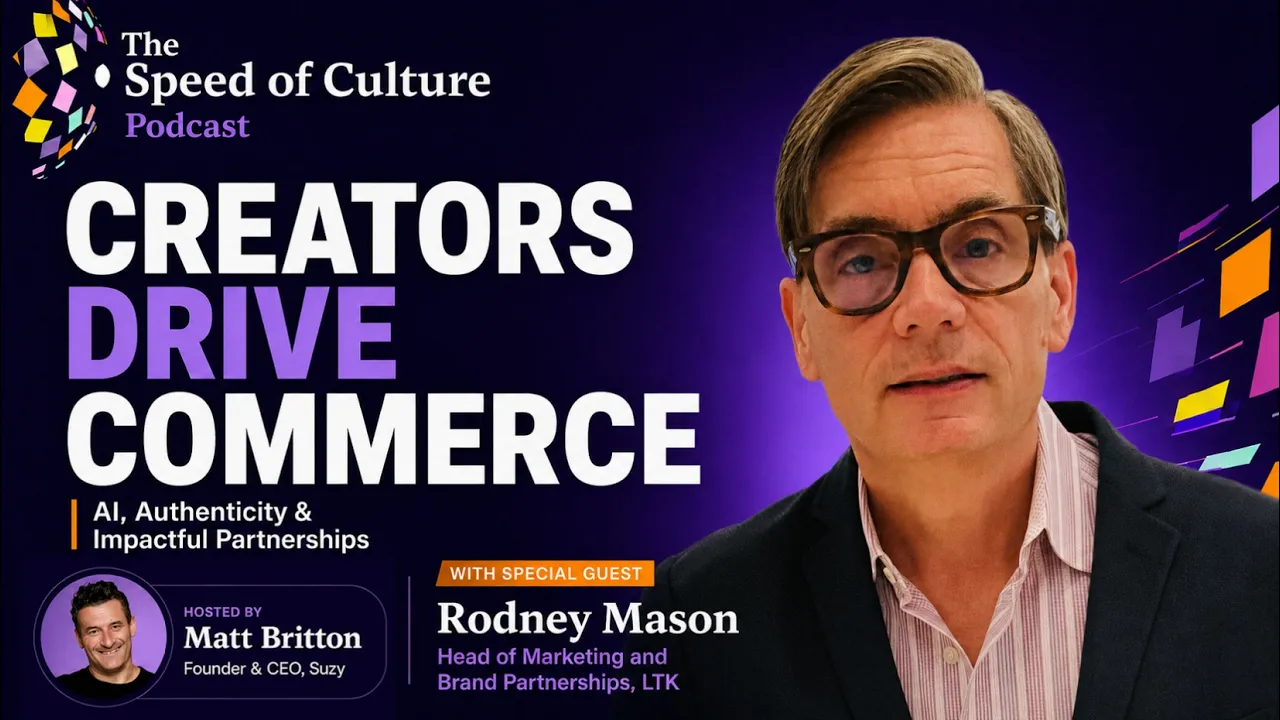
In January 2025, the creator economy reached a pivotal inflection point. As more brands recognize that authenticity and genuine connections matter more than follower counts, the influencer marketing landscape has undergone a fundamental transformation. The Speed of Culture Podcast, a collaboration between Adweek and Suzy featuring host Matt Britton, founder and CEO of Suzy, the AI-powered consumer intelligence platform, sat down with Rodney Mason, Head of Marketing and Brand Partnerships at LTK, to explore this evolution.
In Episode 153, titled "The $5 Billion Blueprint: Rodney Mason Shares LTK's Vision for Creator-Led Brand Growth in 2025," Mason unpacks how creators have evolved from affiliate marketers into full-funnel growth partners capable of driving over $5 billion in annual retail sales. The conversation reveals that the creator economy has transcended its early reputation as a niche marketing channel. Today, it represents one of the most sophisticated and data-driven ecosystems in modern marketing, powered by AI tools that enhance efficiency while preserving the authenticity consumers crave.
This episode is essential listening for brand executives, marketing leaders, and anyone seeking to understand where consumer engagement is headed in 2025 and beyond. With 84% of LTK's 40 million monthly shoppers trusting brands recommended by creators, a 64% lift compared to the general population, the numbers tell a compelling story: creator-led marketing is no longer an experimental channel but a strategic imperative.
The insights Mason shares reflect a broader industry shift. According to LTK's 2025 Creator Marketing Trends Report, 73% of Gen Z and 57% of Millennials rely on creators for purchase decisions. Simultaneously, 65% of the general population, 78% of Millennials, 91% of Gen Z, and an impressive 94% of LTK shoppers look to creators for the latest trends. These are indicators of how creators have become trusted advisors in consumer decision-making, fundamentally changing how brands must approach marketing in a creator-first world.
The Evolution of the Creator Economy: From Affiliate Marketing to Full-Funnel Growth
The creator economy has undergone a dramatic transformation in the past five years, and understanding this evolution is critical for brands seeking to compete in 2025. When LTK launched in 2010, the platform pioneered the concept of affiliate marketing for influencers, allowing creators to earn commissions on products they recommended. This model worked, but it was limited. It positioned creators as promotional channels rather than strategic marketing partners.
The COVID-19 pandemic accelerated the creator economy's maturation in unexpected ways. With consumers confined to their homes and seeking authentic guidance, creators became lifestyle entertainers, blending entertainment with commerce and helping brands build trust in a digital-first world. Audiences turned to creators not just for product recommendations but for genuine connection and inspiration.
This shift established creators as trusted advisors rather than mere promotional vehicles. Today, the role of creators has evolved far beyond simple affiliate relationships. According to insights shared during the Speed of Culture episode, affiliate marketing now drives less than half of LTK's revenue.
Instead, creators operate as full-funnel marketers, participating in brand awareness campaigns, consideration strategies, and conversion initiatives. Tools like LTK Boost exemplify this evolution, enabling brands to supercharge creators' organic content with paid media, delivering hyper-targeted campaigns that expand reach and drive measurable ROI.
This transition represents a fundamental change in how brands should think about creator partnerships. Rather than treating creators as influencers-for-hire who produce one-off content, forward-thinking brands are building long-term relationships with creators who can serve as strategic partners across every stage of the customer journey.
A notable example comes from a Starbucks Frappuccino campaign at Walmart, where three creators drove 145 million impressions, 5 million products purchased, a seven-point increase in ad recall, 8.9% sales lift, and an impressive $5.58 in return on ad spend (ROAS).
The economics of creator partnerships have shifted dramatically. In 2024, brands increased their investment in influencer partnerships by 49%, and content creators now command 25% of social marketing budgets. This reallocation of resources reflects a simple reality: creators deliver higher ROI, stronger engagement, and greater authenticity than traditional digital advertising approaches.
As traditional digital ad budgets face saturation and declining performance, brands are discovering that creators represent a more efficient and effective path to meaningful consumer connections.
Rodney Mason and LTK: Shaping the Creator Ecosystem at Scale
Understanding Rodney Mason's role at LTK provides important context for the insights he shares in Episode 153. With over a decade of experience driving innovation in the creator economy, Mason has been instrumental in positioning LTK as the world's first and largest creator-powered shopping platform. Under his leadership as Head of Marketing and Brand Partnerships, LTK has grown into a hub for over 40 million monthly shoppers and more than 300,000 global creators spanning multiple industries.
LTK's scale is staggering. Premium lifestyle creators in 150+ countries now drive more than $5 billion in annual retail sales through the platform. Today, 40 million monthly consumers turn to LTK creators in the LTK shopping platform to find inspiration and instantly shop the styles recommended by their favorite creators.
LTK facilitates over 55,000 brand collaborations annually, making it the central nervous system connecting creators, brands, and consumers in the modern creator economy.
Mason's perspective is shaped by direct observation of how the creator ecosystem evolves. He introduced what he calls the "LTK Law," a framework predicting that a new dominant social media platform emerges every three years. While TikTok currently leads, platforms like YouTube Shorts, Pinterest, and X are gaining traction as consumers gravitate toward community-driven spaces.
This insight is crucial for brands seeking to maintain relevance, platform diversification is no longer optional but essential.
"Our focus with brands now is to help them grow their audiences because that's what they care about. They're trying to grow their audiences, and we're doing that in every imaginable way through creators."
This philosophy reflects a sophisticated understanding that authentic audience growth through creator partnerships creates more sustainable, valuable consumer relationships than synthetic engagement tactics.
LTK's recent announcements underscore this commitment to evolution. The platform announced its first Creator Upfronts event in New York City to showcase the future of creator-led marketing, introduced a video-first consumer app experience, and released its 2025 Creator Marketing Trends Report demonstrating the undeniable power of creators in shaping consumer trust and trends.
These initiatives position LTK not merely as a transaction platform but as a strategic partner in brand growth.
The Role of AI in Preserving Authenticity While Driving Efficiency
One of the most compelling themes in Episode 153 is the discussion around artificial intelligence's role in the creator economy. Counterintuitively, AI doesn't represent a threat to authenticity, when deployed thoughtfully, it enhances creators' ability to maintain genuine connections while operating at greater scale and efficiency.
Artificial intelligence is transforming the creator economy by streamlining processes and enhancing scalability without compromising authenticity. AI-powered tools help match creators with the right brands based on audience alignment and values, not just follower counts. AI optimizes content for different platforms, helping creators understand how to present the same authentic message across YouTube, TikTok, Instagram, and emerging platforms.
These tools automate routine tasks like drafting posts, analyzing audience preferences, and identifying optimal posting times, freeing creators to focus on what they do best: building genuine connections with their audiences.
For brands, AI provides unprecedented precision in campaign execution. Machine learning models can identify which creators and content formats drive the highest engagement and conversion rates for specific audiences. This enables brands to allocate budgets more efficiently, moving away from spray-and-pray influencer marketing toward data-driven creator partnerships that consistently deliver results.
However, the AI-authenticity paradox remains real. With 86% of creators already using generative AI to power their content production, the remaining 14% are expected to join during 2026. The critical distinction is transparency.
Creators who use AI as a tool while maintaining genuine voice and values find that audiences appreciate the efficiency gains. Conversely, creators who use AI to manufacture fake authenticity face audience backlash. This insight is crucial: AI isn't about replacing human connection but amplifying it.
The trust data supports this nuanced view. Among LTK's consumer base, 84% trust brands recommended by creators, a significant lift. But this trust is fragile. When 64% of consumers distrust influencers who don't disclose their relationship with brands, it becomes clear that authenticity includes transparency about partnerships, sponsorships, and tool usage.
Brands and creators who embrace this transparency find that audiences reward them with loyalty and higher engagement.
Creator-Led Brand Growth: The Full-Funnel Marketing Revolution
Traditional marketing funnels separated brand awareness, consideration, and conversion into distinct channels and campaigns. Creator-led marketing has fundamentally disrupted this model. Creators now operate across the entire funnel, and their authentic endorsements simultaneously build awareness, drive consideration, and generate conversions.
The metrics supporting this shift are compelling. Creators have become the driving force behind consumer trends across demographics. According to LTK's research, 65% of the general population, 78% of Millennials, 91% of Gen Z, and 94% of LTK shoppers look to creators for the latest trends.
This is active decision-making driven by trust in creators' curation and recommendations rather than passive content consumption.
The full-funnel model works because creators function as lifestyle curators rather than simple salespeople. When a creator recommends a product, they're implicitly recommending an entire aesthetic, lifestyle, and set of values. This holistic endorsement is far more powerful than traditional advertising, which typically isolates product benefits without contextualizing them within a broader lifestyle narrative.
Tools like LTK Boost exemplify how the full-funnel model operates in practice. The platform allows brands to take creators' organic content, the authentic recommendations that gained initial traction and engagement, and amplify it with paid media investment. This approach respects both the creator's authentic voice and the brand's need for reach and measurability.
The hyper-targeted campaigns deliver precision while maintaining authenticity, expanding reach beyond organic audiences and driving measurable ROI.
Content reuse amplifies this effect further. According to industry data, 58% of enterprise brands reuse creator content across their websites, 55% repurpose it for paid social or digital advertising, and 53% use it for organic social. This multiplier effect means that a single authentic creator recommendation can generate exponential returns as it flows through every customer touchpoint.
Building Sustainable Creator Partnerships in 2025
The shift from one-off influencer campaigns to long-term creator partnerships represents one of the most significant changes in marketing strategy for 2025. This evolution reflects a fundamental recognition: authentic relationships require time and consistency to develop.
Brands in the vanguard of creator marketing have shifted their mindset from "influencers-for-hire" to "business partners." Instead of commissioning creators for single campaigns, leading brands are building ongoing partnerships where creators understand brand values deeply and can authentically represent those values across multiple campaigns, platforms, and content formats.
This approach requires trust and communication from both parties. Creators need creative freedom to maintain authenticity while working within brand guidelines. Brands need access to performance data and insights showing how creator partnerships drive business results.
When both parties approach the relationship with transparency, the outcomes improve dramatically.
The data supports this long-term perspective. While influencer marketing budgets grew 170% year-over-year in recent years, this growth came with a crucial caveat: brands were reallocating budgets from traditional digital advertising where ROI had declined. This reallocation suggests that brands are making deliberate, strategic choices about where to invest marketing resources.
Those choices increasingly favor creators who can demonstrate long-term value rather than one-off campaigns.
Looking ahead, industry observers predict that in 2026, influencers will take on leadership roles at leading brands as Creative Directors to drive more brand awareness and better connect with audiences. This evolution suggests that the most sophisticated brands will move beyond treating creators as external partners and toward embedding them in strategic marketing roles where they can influence brand direction and messaging.
Key Takeaways
- Authenticity Beats Targeting: In 2025, authentic creator recommendations drive higher engagement and conversion than algorithmic targeting alone. Brands that prioritize genuine partnerships over follower counts see superior results.
- Creators Are Full-Funnel Partners: The era of creators-as-affiliate-marketers has ended. Today's most effective creator partnerships span awareness, consideration, and conversion, with tools like LTK Boost amplifying organic content through paid media investment.
- AI Enhances Rather Than Replaces Authenticity: 86% of creators already use generative AI, and smart deployment of AI tools helps creators work more efficiently while maintaining genuine connections with audiences. Transparent use of AI actually builds trust.
- Consumer Trust in Creators Continues to Climb: With 84% of LTK shoppers trusting brands recommended by creators and 94% of that audience looking to creators for trend inspiration, creator influence now rivals traditional media in shaping consumer behavior.
- Long-Term Partnerships Drive Superior Results: Brands are shifting from transactional influencer relationships to strategic, long-term partnerships where creators serve as trusted advisors across multiple campaigns and platforms.
Frequently Asked Questions
How Has the Creator Economy Changed Since the Pandemic?
The COVID-19 pandemic transformed creators from entertainment figures into trusted lifestyle advisors. With consumers seeking authentic guidance during lockdowns, creators became sources of both entertainment and commerce guidance. This established the trust foundation that enables today's sophisticated creator marketing strategies.
What Is the "LTK Law," and Why Does It Matter for Brands?
Rodney Mason introduced the "LTK Law," predicting that a dominant social media platform emerges every three years. This framework reminds brands that platform loyalty is temporary and audience attention is constantly shifting. Successful brands build creator partnerships with creators active across multiple platforms rather than depending on single-platform success.
How Do Brands Measure the ROI of Creator Partnerships?
Modern creator marketing platforms provide granular performance data tracking impressions, engagement, conversions, and revenue attribution. Brands increasingly use tools like LTK Boost to connect organic creator content with paid media amplification, enabling precise measurement of campaign performance across the full funnel.
Why Is Transparency About Brand Relationships Critical in Creator Marketing?
Research shows that 64% of consumers distrust influencers who don't disclose brand relationships. This transparency is both ethical and strategically essential. Audiences reward authentic disclosure and punish deceptive practices, making transparent partnerships more effective long-term.
Looking Ahead
The creator economy in 2025 represents a maturation of both the platform infrastructure and brand understanding of how to work effectively with creators. Rodney Mason's insights in Episode 153 of the Speed of Culture Podcast provide a roadmap for brands seeking to participate in this evolution thoughtfully.
The convergence of authentic creator voices, AI-powered efficiency tools, full-funnel marketing strategies, and consumer trust in creator recommendations creates unprecedented opportunities for brands willing to make genuine commitments to creator partnerships. The $5 billion in annual retail sales flowing through LTK demonstrates the sheer scale of this opportunity, but the real story is more nuanced.
That $5 billion represents millions of consumer relationships built on authentic trust between creators and audiences.
For deeper insights into the creator economy, consumer behavior, and AI's role in marketing strategy, explore these resources:
- Suzy. AI-powered consumer intelligence platform providing the data insights driving modern marketing decisions
- The Speed of Culture Podcast. Featuring conversations with marketing leaders, brand executives, and creators shaping the future of consumer engagement
- Generation AI: The Book. Matt Britton's exploration of how AI is transforming generational consumer behavior
- AI Keynote Speaker Services. For organizations seeking insights into AI's impact on consumer behavior and marketing strategy
- Speaker HQ. Comprehensive resources on speaker strategy and thought leadership

%20(400%20x%20100%20px)%20(300%20x%2050%20px)%20(150%20x%2050%20px).avif)