Opening
The hospitality industry stands at a critical inflection point. As post-pandemic travelers increasingly demand meaningful experiences that blend leisure with well-being, hotels face unprecedented pressure to innovate faster than ever before. The traveler of 2024 is not simply seeking a place to sleep. They expect seamless digital interactions, deeply personalized services, and authentic connections to well-being experiences that matter to them.
In this landscape of accelerating consumer expectations, Hyatt Hotels Corporation is charting a bold new path that merges cutting-edge technology with human-centered service design.
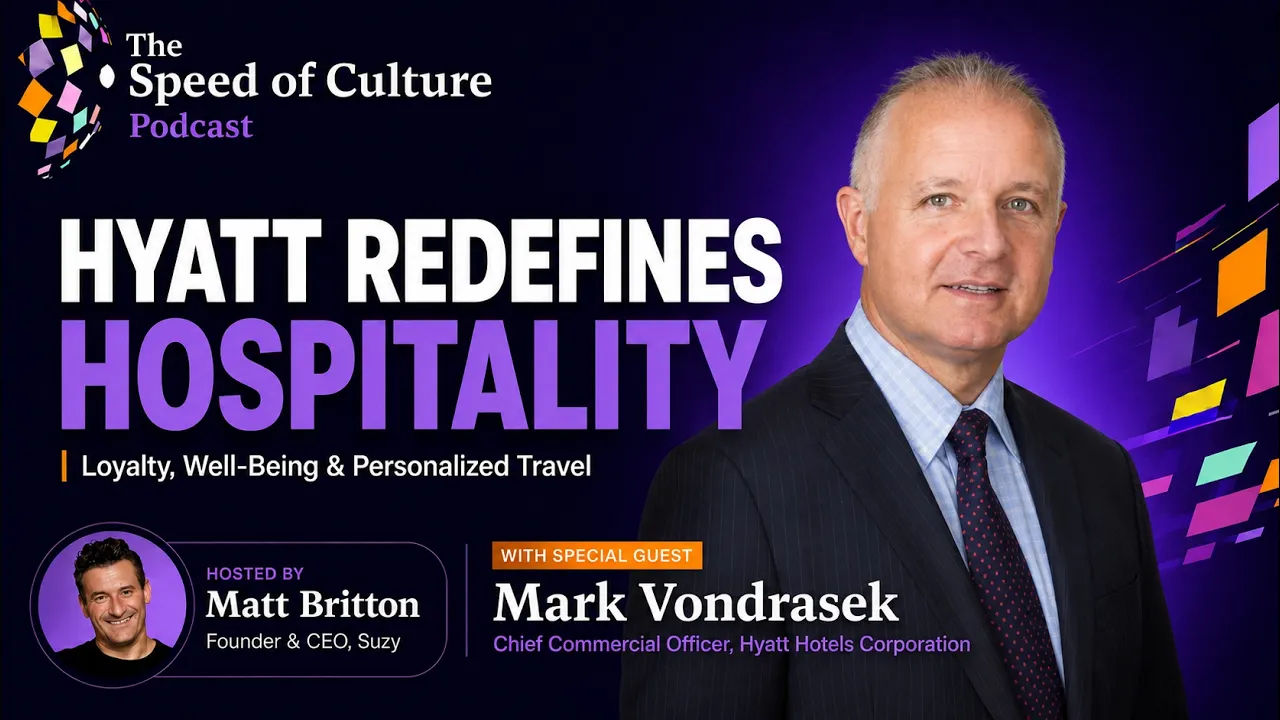
In a recent episode of The Speed of Culture Podcast, Matt Britton, founder and CEO of Suzy, the AI-powered consumer intelligence platform, sat down with Mark Vondrasek, Chief Commercial Officer of Hyatt Hotels Corporation, to discuss how Hyatt is redefining hospitality through innovation, well-being, and customer-centric personalization.
With over 20 years of experience in the hospitality industry, Vondrasek has been instrumental in integrating forward-thinking strategies that address the evolving needs of millennial and Gen Z travelers. The conversation reveals how one of the world's leading hospitality brands is using AI, data analytics, and intentional service design to create guest experiences that feel less like transactions and more like genuine moments of care.
This episode, titled "Suite Innovations: Mark Vondrasek on Hyatt Hotels' Path to Personalized Hospitality," aired on December 17, 2024, and provides essential insights for hospitality executives, marketing leaders, and anyone interested in understanding how enterprise brands are adapting to the demands of modern consumers.
Those who move at the speed of culture win. Those who don't, risk irrelevance.
Wellness as the New Competitive Differentiator
The post-pandemic traveler has fundamentally changed their relationship with hospitality. No longer content with thread count and marble bathrooms, today's guests are prioritizing wellness as a core component of their travel experience.
According to industry data, wellness tourism now represents a $651 billion market opportunity, with projections showing annual growth of 16.6% through 2027. More than half of American travelers are now actively prioritizing wellness-focused holidays designed to enhance their lifespan and overall well-being.
For Hyatt, this shift has become a cornerstone of their strategic vision. Vondrasek emphasizes that Hyatt is intentionally evolving the range of experiences it offers to meet this growing demand. Rather than positioning wellness as a luxury add-on, Hyatt is embedding well-being into the core guest experience.
This approach recognizes that travelers increasingly view their hotel stays as opportunities to advance their personal health goals, whether through restorative sleep environments, fitness programming, nutritional offerings, or mental health-focused amenities.
The business case for this strategy is compelling. Hotels offering comprehensive wellness programs report 15% higher average daily rates (ADR), and guests on wellness-focused stays spend 50–100% more than those on traditional accommodations. Additionally, 80% of guests are more likely to return to hotels that offer personalized wellness services, including tailored fitness plans and spa treatments.
This data demonstrates that investing in wellness is not merely about brand differentiation, it directly impacts revenue and customer lifetime value.
Hyatt's approach extends beyond amenities. The brand is fundamentally rethinking how wellness permeates every touchpoint of the guest journey. From pre-arrival communications that address wellness preferences to in-room technologies that support sleep quality and recovery, Hyatt is demonstrating that wellness is not a destination but a design principle that should govern the entire hospitality experience.
The Guest of Honor Program: Reimagining Loyalty in the Digital Age
Loyalty programs in hospitality have historically operated on a straightforward premise: accumulate points, redeem rewards, unlock status. Hyatt's Guest of Honor program shatters this conventional wisdom by expanding the circle of beneficiaries beyond individual frequent travelers.
In this innovation, Hyatt acknowledges a critical shift in consumer values, particularly among younger demographics. Millennial and Gen Z travelers increasingly seek to share experiences with loved ones, family members, friends, and partners.
The Guest of Honor program reimagines loyalty by extending elite benefits and privileges not just to loyal members but to their broader networks. This approach reflects a deeper understanding of how modern consumers define travel: as shared moments rather than solitary accumulations of status points.
From a strategic standpoint, the Guest of Honor program serves multiple purposes. First, it increases the viral potential of brand advocacy by making elite benefits shareable, thereby transforming individual loyalty into network-driven growth. Second, it acknowledges that the true value of a luxury experience is amplified when shared with others. Third, it creates a compounding effect where network members who enjoy elevated experiences during loyalty program perks are more likely to become customers themselves.
Hyatt's mission is to "be a trusted partner" and "be smart with how you're selling that value."
By extending loyalty benefits to guests' honor lists, whether family or friends, Hyatt is demonstrating that they understand what their customers truly value: not just luxury accommodations, but the ability to create meaningful shared memories.
The Guest of Honor program also represents a sophisticated data opportunity. By understanding who guests bring into their loyalty circle, Hyatt gains insights into relationship dynamics, shared interests, and travel patterns that can further inform personalization strategies. This creates a virtuous cycle where each program interaction yields richer data for creating even more compelling future experiences.
Millennials, Gen Z, and the Digital-First Hospitality Imperative
The hospitality industry's traditional customer base (affluent, mature business travelers and luxury leisure consumers) has been disrupted by a new demographic reality: millennials and Gen Z now dominate both leisure and business travel.
According to recent data, younger travelers have fundamentally different expectations around digital convenience, personalization, and authenticity compared to previous generations. These younger travelers don't simply prefer digital experiences; they expect them as baseline standards.
A study cited by Oracle Hospitality and Skift Research found that 71% of guests are more likely to choose hotels that offer self-service technology, including contactless check-in and digital room keys. This is not a niche preference, it represents the new majority expectation.
For Hyatt, this demographic reality has necessitated a comprehensive reimagining of the digital ecosystem. The brand has invested significantly in revamping the World of Hyatt mobile app, recognizing that the app is often the primary touchpoint for younger travelers.
The updated app delivers what younger consumers demand: hyper-relevant offers, seamless booking experiences, and lightning-fast transaction speeds. Rather than presenting a static menu of options, the app uses data and personalization logic to surface the experiences most likely to resonate with individual users.
Vondrasek's comments reflect a clear-eyed understanding of this generational shift. Rather than lamentation about "how things used to be done," Hyatt is meeting travelers where they are, in their phones, in their preferred channels, with their preferred modes of interaction.
This adaptive approach is existential. Brands that fail to meet digital-first expectations risk becoming irrelevant to the generations that will drive tourism for the next two decades.
The hospitality industry is experiencing what researchers call "digital transformation": the integration of digital technologies such as cloud-based systems and AI tools that enhance both operational performance and guest experience. For Hyatt, this transformation is about reimagining the guest journey from first awareness through post-stay advocacy, far beyond IT infrastructure work.
AI and Empathy: Creating Authentic Connections at Scale
Perhaps the most profound insight from Vondrasek's conversation with Matt Britton concerns the role of artificial intelligence in hospitality. There is widespread concern that AI will dehumanize customer experiences. That algorithms will replace the personal touch that makes hospitality meaningful.
Hyatt is leveraging AI not to eliminate human connection but to enable it at scale. The brand processes millions of data points, from World of Hyatt loyalty program enrollments, guest preferences, booking history, feedback, and in-stay behavior, to develop sophisticated understanding of individual guests.
This data foundation then enables Hyatt's teams to deliver personalized services that would be impossible to orchestrate manually.
One concrete example illustrates this principle powerfully. Hyatt uses AI systems to identify guests who prefer certain amenities, room configurations, or wellness services. Pre-arrival text communications then offer personalized touches, "We've prepared the quiet room you prefer" or "We've arranged the morning yoga class you mentioned last visit."
These moments feel personal because they are informed by data but delivered with genuine care. The AI doesn't replace empathy; it amplifies the human capacity to demonstrate care at scale.
Hotels using AI to analyze guest data are providing personalized recommendations and services that significantly increase guest satisfaction. Smart systems can analyze booking patterns, preferences, and behavioral history to automatically suggest treatments, room configurations, and experiences tailored to individual needs.
Integrated wellness apps now enable guests to effortlessly book spa treatments, reserve fitness classes, and create personalized wellness itineraries, all powered by recommendation engines that understand their preferences.
Hyatt's investment in AI-driven customer service is equally instructive. The brand has implemented conversational AI interfaces in contact centers to handle millions of inquiries annually. These systems are trained to understand context, detect sentiment, and route complex issues to human agents while resolving straightforward requests efficiently.
The result is not dehumanization but optimization, freeing human agent time for situations where genuine judgment and empathy are most valuable.
The deeper principle Vondrasek emphasizes is clear: technology should enhance rather than diminish humanity in service. When deployed thoughtfully, AI becomes a tool for understanding customers more deeply and responding to their needs with greater precision and care.
The Strategic Imperative: Focusing on Who You'll Become, Not Just Who You Are
In his conversation with Matt Britton, Vondrasek emphasizes a philosophy that extends beyond hospitality strategy:
"Focus a lot more on who you're going to be."
This forward-looking orientation reveals Hyatt's fundamental approach to competitive advantage in a rapidly changing market.
Many hospitality brands approach strategy as optimization of existing assets and approaches. Hyatt's approach is fundamentally different: it's about anticipating where the market is heading and positioning the organization to lead that shift rather than react to it.
This mindset explains why Hyatt is investing in wellness when it's still emerging, digital capabilities before competitors have fully caught up, and AI applications that are not yet universally adopted across the industry.
It also explains Vondrasek's emphasis on becoming a trusted partner and operating with intentionality around value communication. In a commoditized industry where many players offer similar room inventory at similar price points, competitive advantage accrues to brands that develop deep trust with customers and consistently deliver on promises around understanding and meeting their needs.
The strategic implication for the broader hospitality industry, and indeed for any enterprise brand facing rapid market evolution, is clear: the brands that thrive in uncertain times are those that invest in understanding future customer needs before those needs become universal, build capabilities in anticipation of market shifts, and maintain flexibility to adjust course as new evidence emerges.
For Hyatt, this means continuing investment in personalization infrastructure, wellness programming, digital platforms, and AI capabilities even as industry adoption rates remain below saturation. It means viewing innovation as a continuous journey rather than a destination, and maintaining a clear-eyed commitment to the guest experience even as operational pressures and complexity increase.
Key Takeaways
- Wellness Tourism Represents Massive Market Opportunity: With wellness tourism valued at $651 billion and growing at 16.6% annually, hotels investing in comprehensive wellness programs report 15% higher ADRs and see guests spending 50–100% more than traditional stays.
- Digital-First Expectations are Now Table Stakes: 71% of guests prefer hotels offering self-service technology, and the expectation for seamless digital experiences (mobile check-in, digital room keys, personalized app interfaces) is no longer differentiating but baseline mandatory.
- Loyalty Programs Must Evolve Beyond Points: Hyatt's Guest of Honor program demonstrates that younger travelers value shareable experiences over individual status accumulation, requiring loyalty strategies that enable shared benefits and network effects.
- AI Amplifies Rather Than Replaces Human Connection: When deployed thoughtfully with ethical guardrails, AI enables personalization at scale, allowing brands to demonstrate genuine care through data-informed, empathy-driven service design that would be impossible manually.
- Anticipatory Strategy Beats Reactive Optimization: The brands winning in hospitality are those investing in capabilities before market adoption is universal, maintaining forward focus on who they'll become rather than optimizing who they already are.
Frequently Asked Questions
How is AI transforming the guest experience in hospitality?
AI is transforming hospitality by enabling personalized service delivery at scale. Hotels now use AI systems to analyze guest data (preferences, booking history, behavior patterns) to deliver tailored recommendations, optimize room assignments, and automate customer service inquiries.
Importantly, this technology amplifies rather than replaces human empathy. When used ethically, AI allows hotel teams to focus their finite human capacity on situations requiring genuine judgment and care while automating routine tasks. The result is faster service, higher guest satisfaction, and more authentic personal connections during interactions that matter most.
What role does wellness play in modern travel decisions?
Wellness has evolved from luxury amenity to core travel decision factor. Post-pandemic travelers increasingly evaluate hotels based on wellness offerings, sleep quality infrastructure, fitness programming, and mental health support.
The data is compelling: 80% of guests are more likely to return to hotels with personalized wellness services, hotels offering comprehensive wellness programs achieve 15% higher ADRs, and guests spend 50–100% more on wellness-focused stays. For hoteliers, this represents both an opportunity to differentiate and a requirement to remain competitive with increasingly wellness-conscious travelers.
How are hotels meeting the digital expectations of younger travelers?
Younger travelers, millennials and Gen Z, expect digital-first experiences including mobile check-in, digital room keys, personalized recommendations through hotel apps, and seamless booking interfaces.
Hotels are responding by investing heavily in mobile platforms, contactless services, and personalization engines that deliver hyper-relevant offers and experiences. The brands winning with younger demographics recognize that digital channels are amplifications of human service rather than alternatives to it: they enable faster, more convenient baseline experiences while freeing human staff to focus on creating memorable moments.
What is the business case for investing in personalization infrastructure?
The business case is substantial. Personalized experiences drive higher satisfaction, increased return visits, and premium pricing power. Hotels offering personalized services achieve measurably higher customer lifetime value, higher ADRs, and more efficient operations through data-driven resource allocation.
Additionally, personalization creates network effects through word-of-mouth and social media amplification. For a brand like Hyatt, these investments are not discretionary luxury improvements but essential competitive infrastructure.
Looking Ahead
The conversation between Matt Britton and Mark Vondrasek at Hyatt reveals a hospitality industry in profound transition. The brands thriving in this environment are those that understand a fundamental truth: consumers are moving at the speed of culture, and organizations must match that pace or risk becoming irrelevant.
For executives in hospitality and beyond, the episode offers critical lessons: invest in understanding future customer needs before they become universal; deploy technology thoughtfully to amplify rather than diminish human connection; organize around guest-centric value creation rather than traditional operational constraints; and maintain strategic clarity about the experience you're trying to create while remaining flexible about how to deliver it.
For more insights on how brands are adapting to consumer demands and cultural shifts, explore these resources:
Meta Elements
Page Title: Suite Innovations: How Hyatt Hotels is Redefining Hospitality Through AI and Personalization | Speed of Culture Podcast Ep. 148
Meta Description: Learn how Hyatt's Chief Commercial Officer Mark Vondrasek is transforming guest experiences through AI, personalization, wellness innovation, and digital-first strategies. Speed of Culture Podcast Episode 148 insights.
Keywords: Hyatt Hotels personalization, hospitality innovation, hotel AI, guest experience, wellness tourism, digital transformation hospitality, Mark Vondrasek, luxury hotel technology, customer experience strategy, hotel industry trends
{
  "@context": "https://schema.org",
  "@type": "BlogPosting",
  "headline": "Suite Innovations: How Hyatt Hotels is Redefining Hospitality Through AI, Personalization, and Wellness",
  "description": "Insights from Speed of Culture Podcast Episode 148 with Hyatt CCO Mark Vondrasek on personalized hospitality, AI innovation, wellness, and digital strategy.",
  "datePublished": "2024-12-17",
  "dateModified": "2025-02-27",
  "author": {
    "@type": "Person",
    "name": "Matt Britton",
    "url": "https://mattbritton.com/"
  },
  "publisher": {
    "@type": "Organization",
    "name": "Speed of Culture Podcast",
    "url": "https://speedofculture.co/"
  },
  "mainEntity": {
    "@type": "Podcast",
    "name": "Suite Innovations: Mark Vondrasek on Hyatt Hotels' Path to Personalized Hospitality",
    "url": "https://speedofculture.co/episode/suite-innovations-mark-vondrasek-hyatt-hotels",
    "datePublished": "2024-12-17",
    "description": "Mark Vondrasek, Chief Commercial Officer of Hyatt Hotels Corporation, discusses how Hyatt is redefining hospitality through innovation, well-being, and personalization.",
    "interactionStatistic": {
      "@type": "InteractionCounter",
      "interactionType": "https://schema.org/ListenAction",
      "userInteractionCount": "1000"
    }
  }
}
Recommended Internal/External Links:
%20(400%20x%20100%20px)%20(300%20x%2050%20px)%20(150%20x%2050%20px).avif)