Why the Shift to CTV is Real: How Smart TV Data is Transforming Advertising
In the rapidly evolving media landscape, Connected TV (CTV) has transitioned from an emerging channel to a strategic imperative for advertisers and publishers alike. The acceleration from traditional linear television to streaming platforms fundamentally changed how brands reach consumers, and smart TV data has become the competitive advantage separating industry leaders from laggards.
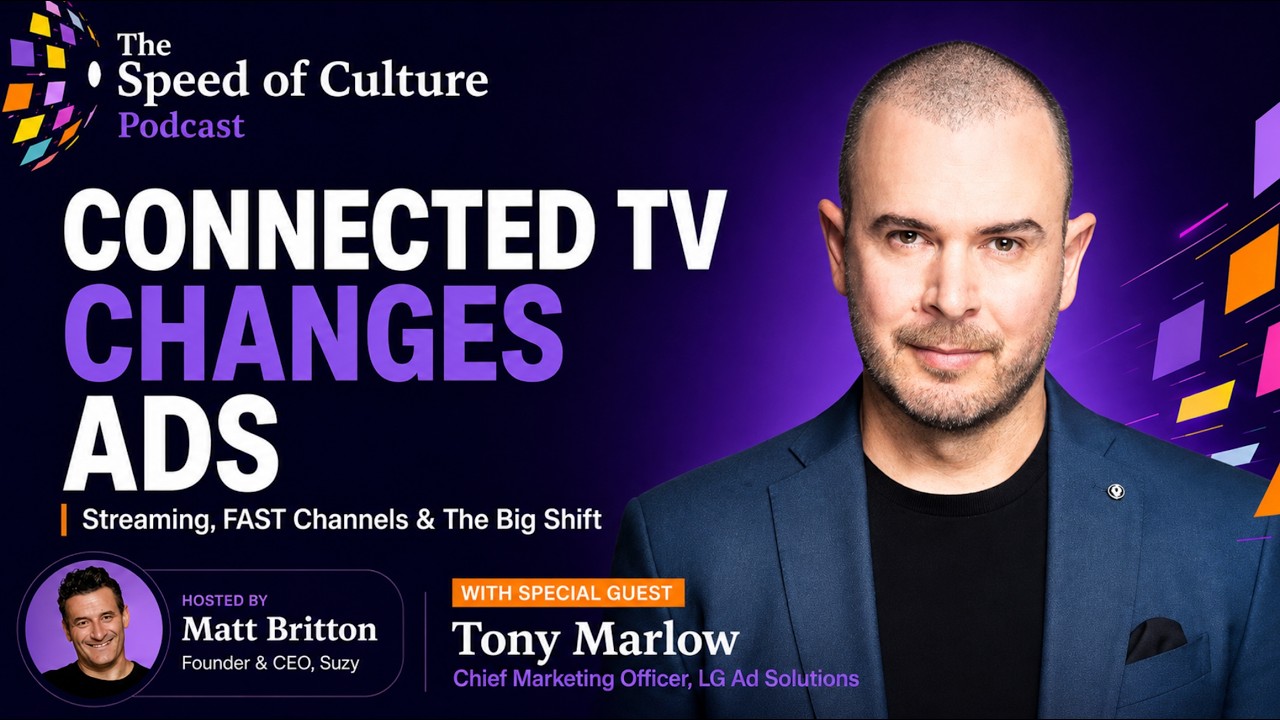
Matt Britton, founder and CEO of Suzy, the AI-powered consumer intelligence platform, recently hosted Tony Marlow, Chief Marketing Officer at LG Ad Solutions, on the Speed of Culture podcast to explore the seismic shifts reshaping television advertising. This episode, released on February 16, 2023, provides essential insights for C-suite executives, marketing leaders, and agency professionals seeking to understand how smart TV data is enabling unprecedented precision in audience targeting and campaign measurement.
The conversation reveals why the movement to CTV represents far more than a technological transition, it represents a fundamental restructuring of the television ecosystem itself, driven by data-enabled capabilities that outpace traditional broadcasting by orders of magnitude.
Understanding the Two Phases of “The Big Shift”
Tony Marlow frames the transformation of television advertising through a strategic lens he calls “The Big Shift”, a phenomenon characterized by two distinct but interconnected phases that are remaking the advertising ecosystem.
The first phase involved the technological transition from traditional linear television to connected TV platforms, a shift that accelerated dramatically during the pandemic as consumer behavior fundamentally changed overnight. Consumers began subscribing to streaming services like Netflix, Disney+, Hulu, and Paramount+ at unprecedented rates, causing traditional broadcast and cable television viewership to decline precipitously.
The infrastructure supporting this transition witnessed the decline of hardware dongles (HDMI streaming devices) as smart TVs became ubiquitous, enabling consumers to access personalized content directly through their television sets without intermediary devices.
This first phase introduced a critical shift in how content reaches consumers: the movement from broadcast delivery to direct-to-glass experiences. Rather than receiving content through cable signal distribution or set-top boxes, viewers now stream content directly to their television sets through built-in applications and operating systems.
This architectural change might seem purely technical, but it fundamentally redistributed power in the television ecosystem. Streaming platforms and content providers gained direct relationships with viewers, while traditional cable networks lost control of the distribution layer.
For advertisers, this transition created a new reality: the ability to reach consumers on the devices where they spend the most time watching video content, with unprecedented data visibility into their viewing behaviors.
The second phase of The Big Shift involves an equally dramatic transformation in business models. As subscription-based video services matured and market saturation became apparent, streaming platforms and distributors shifted focus toward advertising-supported models.
Major players including Netflix, Disney+, and Paramount+ launched ad-supported tiers, fundamentally changing the economics of CTV. Rather than relying exclusively on subscription revenue, these platforms now generate incremental advertising revenue while maintaining subscription tiers.
This shift from pure subscription models to hybrid advertising and subscription approaches creates new opportunities for advertisers while forcing marketers to rethink their strategic approaches to the platform ecosystem.
Leveraging Smart TV Data and ACR Technology for Precision Targeting
The technological foundation enabling LG Ad Solutions and other market leaders to capitalize on the CTV transition is Automatic Content Recognition (ACR) technology integrated into modern smart televisions.
ACR functions as a deterministic measurement layer that operates at the edge of the television itself, capturing frame-by-frame identification of content displayed on the screen in real-time. Unlike probabilistic, panel-based measurement approaches that rely on statistical extrapolation from limited sample sizes, ACR data provides deterministic, first-party insights into actual viewing behavior without sampling uncertainty.
LG's ecosystem encompasses 33 million opted-in smart televisions across the United States, representing substantial household coverage across demographic segments and geographic regions. This scale of ACR-enabled inventory provides advertisers with unparalleled precision in understanding not only what consumers watch, but also when they watch it, for how long, and in what context.
The data infrastructure captures program viewership patterns, brand advertising exposure, competitive ad dynamics, and gaming activity, creating a comprehensive 360-degree view of television consumption.
The advantages of ACR-based targeting extend beyond measurement accuracy. Because LG Ad Solutions leverages deterministic data collection rather than probabilistic modeling, the platform eliminates the statistical uncertainties inherent in panel-based approaches.
This distinction matters significantly for advertisers seeking confidence in their targeting precision and measurement accuracy. An advertiser can identify consumers watching specific content categories, program genres, competing brands, or complementary products, then deliver precisely targeted creative messaging at the moment when audience receptivity is highest.
Integration with major data collaboration platforms and partners amplifies these capabilities. LG's partnership with Databricks, for example, enables the integration of ACR data with advanced analytics infrastructures, allowing advertisers to enrich first-party customer data with LG's television viewership signals.
This capability transforms television from a broadcast-only channel into a data-driven precision marketing layer that feeds into integrated, cross-device campaign strategies. Advertisers can now identify consumers on television, recognize them across digital platforms, and orchestrate coordinated messaging that drives measurable business outcomes.
The Competitive Advantage of Advanced Creative and Cross-Device Integration
While data precision and targeting capabilities represent significant competitive advantages for CTV-first advertisers, the medium's creative possibilities extend far beyond traditional broadcast advertising formats.
Connected TV advertising supports interactive, shoppable units that integrate seamlessly into the user interface, transforming the television screen from a passive viewing environment into an interactive commerce destination. QR codes and other bridge technologies unify the television experience with mobile devices, enabling consumers to engage with offers, access additional information, and complete transactions without leaving their living rooms.
Multi-channel campaign integration represents another critical lever for performance optimization. Research demonstrates that campaigns integrating CTV video, home screen advertising placements, and mobile video deliver substantially superior outcomes compared to single-channel approaches.
Specifically, integrated campaigns achieve 4.7x higher brand awareness, 8.7x stronger ad recall, and 11.2x greater consideration than single-channel video efforts alone. These performance multipliers reveal that synergy across channels amplifies message effectiveness, with CTV serving as the foundation that establishes brand presence before reinforcing messages through mobile and home screen touchpoints.
Home screen advertising represents a particularly compelling emerging opportunity within the CTV ecosystem. The LG home screen experience, the interface consumers navigate when their smart televisions are powered on, offers concentrated attention and high engagement rates.
Unlike traditional cable television where viewers might be distracted or multi-screening, the CTV home screen captures intentional user attention at the moment they're deciding what to watch next. This psychological moment represents premium inventory for advertisers seeking to reach highly engaged audiences.
Recent data indicates that home screen advertising has experienced 60% growth in placements, with brand attention metrics demonstrating the effectiveness of this positioning strategy.
The convergence of these creative and distribution advantages creates opportunities that linear television cannot match. Traditional broadcast advertising relies on fixed, 30-second creative units delivered to broad audiences based on program demographics rather than individual viewer characteristics or behaviors.
CTV enables sophisticated formats, shoppable experiences, precise audience targeting, and performance measurement that transcend the capabilities of linear broadcasting. For brands seeking to drive awareness, engagement, and conversion, CTV represents the modern television advertising platform.
Market Dynamics and the Case for Immediate Action
The business case for CTV-first advertising strategies has strengthened dramatically over the past 18 months, driven by converging market forces and shifting consumer preferences.
Connected TV advertising spending in the United States reached $28.79 billion in 2024, representing continued aggressive growth from the $25.90 billion invested globally in 2023. Projections suggest that CTV ad spending will exceed $40 billion by 2027 and potentially reach $46.89 billion by 2029, demonstrating the channel's trajectory as a primary driver of growth within the broader television advertising ecosystem.
More significantly, digital video advertising (including CTV) surpassed linear television for the first time in 2024, capturing nearly 60% of all television and video advertising budgets by 2025. This crossover represents a historic inflection point where streaming-based television has become the primary medium for television advertising rather than a supplementary channel.
The momentum continues accelerating, with CTV ad spending projected to surge approximately 22% in 2024 and beyond, substantially outpacing the stagnation or decline observed in linear television.
For individual advertisers and agencies, these market dynamics create both opportunity and urgency. First-mover advantages in data-enabled CTV campaigns have begun to narrow as more advertisers adopt the platform, but sophisticated execution remains a differentiator.
Agencies and brands that develop expertise in leveraging ACR data, executing multi-channel integration strategies, and optimizing creative for CTV formats gain competitive advantages in reaching increasingly mobile and streaming-first consumer audiences.
Additionally, demographic patterns favor accelerated adoption. Younger audiences, including Gen Z and younger millennials, have effectively abandoned linear television in favor of streaming platforms and CTV experiences.
However, the penetration of streaming adoption extends across all demographic segments, with older audiences increasingly adopting smart TVs and streaming services. The convergence of demographic adoption patterns means that by 2025-2026, CTV will represent the primary television medium across virtually all consumer segments, making proficiency in CTV-specific strategies an essential competency for marketing leaders.
Building CTV Expertise and Strategic Capabilities
As organizations prioritize CTV-first strategies, several capabilities become essential for competitive performance. First, data literacy represents a fundamental requirement.
Marketing teams must develop fluency in ACR data, understanding what it measures, how it can be applied to audience targeting, and how to interpret measurement results. This requires investment in training, tools, and personnel capable of working across data platforms and analytical infrastructures.
Organizations lacking data capabilities should prioritize recruiting or partnering with professionals who understand television measurement, audience data platforms, and digital audience targeting.
Second, creative excellence for CTV formats demands specialized capabilities distinct from broadcast television production. While traditional TV commercials remain valuable within CTV environments, the medium's interactive and shoppable capabilities enable creative executions that traditional broadcast advertising cannot achieve.
Brands should invest in developing CTV-native creative competencies, including interactive design, motion graphics for CTV interfaces, and shoppable advertising formats that drive commerce directly from television experiences.
Third, infrastructure and technology investments ensure that organizations can effectively manage, measure, and optimize CTV campaigns at scale. This includes implementing demand-side platforms (DSPs) capable of leveraging ACR data and first-party customer data for precise targeting, establishing measurement frameworks that accurately attribute outcomes to CTV activities, and integrating CTV data into broader marketing analytics and attribution systems.
Organizations lacking these capabilities face challenges in demonstrating CTV's contribution to business outcomes, which can inhibit budget allocation and strategic commitment.
Finally, organizational alignment between media teams, creative teams, data teams, and finance represents a prerequisite for CTV success. The sophistication of data-driven CTV campaigns requires collaboration across traditionally siloed functions.
Media teams must communicate targeting objectives and audience insights to creative teams, while data teams ensure measurement accuracy and optimization rigor. Finance teams must understand the business case for CTV investment and approve budget allocations based on performance evidence rather than historical allocations.
Key Takeaways for Business Leaders
- The CTV transition represents a structural shift in media consumption and advertising: Digital video advertising has surpassed linear television for the first time, with projections suggesting CTV ad spending will reach $46.89 billion by 2029. The transition from linear to CTV reflects fundamental changes in consumer behavior that will not reverse, requiring immediate strategic action from advertisers seeking to reach modern audiences effectively.
- ACR technology enables deterministic, precision-based audience targeting: LG Ad Solutions leverages Automatic Content Recognition data from 33 million opted-in smart televisions to eliminate statistical uncertainty from measurement and targeting, creating competitive advantages for advertisers who adopt data-driven CTV strategies rather than relying on traditional broadcast approaches.
- Multi-channel integration amplifies CTV effectiveness: Campaigns combining CTV video, home screen advertising, and mobile video delivery achieve 4.7x higher awareness, 8.7x stronger recall, and 11.2x greater consideration than single-channel efforts, demonstrating that sophisticated cross-device orchestration represents the optimal approach to contemporary television advertising.
- Home screen advertising represents emerging premium inventory: Home screen placements have experienced 60% growth and capture concentrated consumer attention at high-intent moments when audiences are actively deciding what to watch next, creating valuable advertising opportunities that traditional broadcast cannot replicate.
- Building CTV expertise requires investment across multiple functions: Organizations seeking CTV competence must invest in data literacy, CTV-native creative capabilities, technology infrastructure, and cross-functional alignment between media, creative, data, and finance teams. First-mover advantages in sophisticated CTV execution remain available to organizations willing to commit resources to capability development.
Frequently Asked Questions
What is the fundamental difference between CTV and linear television, and why does it matter for advertisers?
Connected TV (CTV) refers to streaming-based television delivered through internet connectivity to smart televisions and connected devices, enabling precise targeting, measurement, and interactive creative executions. Linear television, by contrast, relies on broadcast or cable signal distribution, delivering the same content to all viewers within a geographic region simultaneously.
For advertisers, the distinction matters profoundly: CTV enables audience-specific targeting based on deterministic ACR data, while linear television relies on demographic targeting at the program level. CTV also supports interactive, shoppable advertising formats and provides granular performance measurement at the individual impression level, capabilities that linear television cannot match.
How does ACR (Automatic Content Recognition) data improve advertising outcomes compared to traditional television measurement approaches?
Automatic Content Recognition operates at the television itself, capturing actual viewing behavior without sampling or statistical extrapolation. Traditional television measurement relies on panel-based approaches where small samples of households represent larger populations, introducing statistical uncertainty into targeting and measurement.
ACR data from millions of opted-in smart televisions provides deterministic insights into actual viewership patterns, enabling advertisers to identify consumers watching specific programs, genres, or content categories with precision previously impossible in broadcast television. This accuracy allows for significantly more effective audience targeting and higher confidence in measurement accuracy.
What are the practical implications of moving advertising budgets from linear television to CTV, and how should organizations manage the transition?
Moving budget allocation from linear to CTV requires strategic planning across media buying, creative production, measurement infrastructure, and organizational reporting. Organizations should begin by building internal expertise in CTV-specific capabilities, including familiarity with demand-side platforms (DSPs) that support ACR data integration, understanding CTV creative formats and best practices, and developing measurement frameworks that accurately track CTV contributions to business objectives.
Transitioning should occur gradually, beginning with test campaigns that establish baseline performance data, then scaling investments based on demonstrated results. This approach mitigates risk while building organizational competence in the new platform.
How does LG Ad Solutions' ecosystem and data infrastructure provide competitive advantages compared to other CTV platforms?
LG Ad Solutions operates a comprehensive ecosystem encompassing 33 million opted-in smart televisions across the United States, creating substantial scale for audience targeting and measurement. The platform's deterministic ACR data layer operates at the television level, eliminating sampling uncertainty inherent in competitive approaches.
Integration with partners including Databricks, Magnite, and local content recognition providers enables LG to offer comprehensive 360-degree views of television consumption patterns while maintaining privacy compliance through user opt-in requirements. For advertisers, this ecosystem translates into unmatched precision in targeting, measurement accuracy, and access to comprehensive television viewership data that informs cross-device marketing strategies.
Looking Ahead
The shift to Connected TV represents far more than a technological transition or a media channel evolution. It reflects fundamental changes in how consumers access entertainment, how brands reach audiences, and how the television advertising industry measures effectiveness and delivers value.
Tony Marlow's insights on the Speed of Culture podcast underscore that organizations embracing CTV-first strategies, grounded in sophisticated use of smart TV data, creative innovation, and multi-channel integration, will define competitive advantages across the advertising ecosystem.
For marketing leaders seeking to understand modern television advertising and build strategic capabilities for the era of CTV dominance, the convergence of consumer behavior, technology platforms, and market dynamics creates both immediate opportunities and urgent imperatives. The window for establishing expertise and competitive advantage in data-driven CTV advertising remains open, but competitive pressures and market consolidation will narrow these advantages for late-moving organizations.
Leaders interested in deepening their understanding of consumer intelligence, AI-driven marketing strategies, and the broader evolution of media consumption should explore resources from Suzy, the AI-powered consumer intelligence platform that powers modern marketing decision-making.
Additionally, Matt Britton's thought leadership on technology, consumer behavior, and business transformation, including his book Generation AI and his work as an AI keynote speaker, provides essential frameworks for understanding how artificial intelligence and data-driven strategies reshape business performance across industries.
Organizations seeking to develop comprehensive expertise in speaker-led learning and strategy development should explore Speaker HQ, which offers curated resources and expert perspectives on technology, consumer intelligence, and business transformation.
The convergence of CTV adoption, smart TV data analytics, and AI-driven audience intelligence represents a fundamental inflection point in advertising evolution, one that will determine competitive positioning for organizations across the marketing ecosystem for years to come.
%20(400%20x%20100%20px)%20(300%20x%2050%20px)%20(150%20x%2050%20px).avif)






.jpeg)