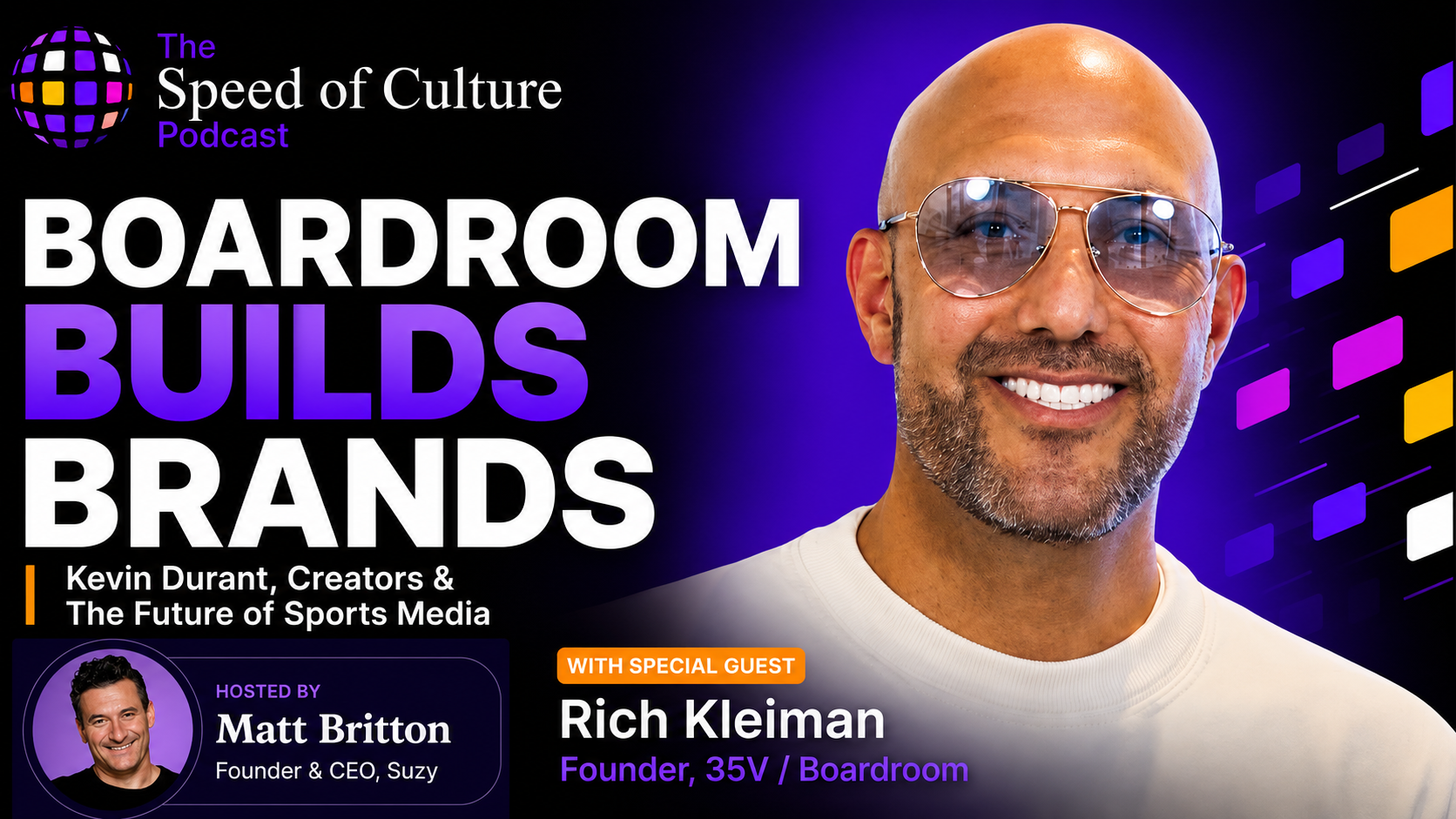
Building an Enterprise in the Creator Economy: Lessons from Rich Kleiman
The creator economy has evolved from a buzzword into a multi-billion-dollar economic force reshaping how media, sports, and entertainment intersect with brand building. Yet the most valuable lesson emerging from this transformation is about building durable enterprises around communities, content, and culture rather than about individual creators.
Matt Britton, founder and CEO of Suzy, the AI-powered consumer intelligence platform, has long observed that the most significant business opportunities emerge at the intersection of cultural shifts and entrepreneurial vision. On The Speed of Culture podcast, Britton sat down with Rich Kleiman, co-founder of 35V and Boardroom and longtime business partner of NBA superstar Kevin Durant, to explore how patience, authenticity, and strategic thinking transform individual talent management into enterprise-scale businesses.
Kleiman's journey (from music supervisor and artist manager to co-founder of a diversified media, sports, and investment company alongside one of basketball's greatest players) illustrates a critical insight for business leaders: the creator economy is about brands, communities, and the infrastructure that connects them, more than about individuals.
For executives navigating a landscape where creator influence increasingly rivals corporate marketing power, Kleiman's story offers a practical framework for building lasting value in an economy driven by authenticity and community engagement.
Why "Overnight Success" Always Takes Time
One of the most revealing themes in Kleiman's conversation with Britton is the myth of overnight success. In a business culture that celebrates rapid scaling and viral moments, Kleiman's career arc tells a different story, one defined by patience, persistence, and strategic positioning over nearly two decades.
Kleiman started his career in the late 1990s at Radical Media, working as a music supervisor on independent films and original programming. He partnered on OneLevel.com, a hip-hop community commerce website, before meeting British DJ Mark Ronson and becoming his manager.
Through the Allido Records partnership with Ronson, Kleiman learned the music management business from the ground up, managing artists like Wale, Rhymefest, and Saigon while building relationships across the entertainment industry.
His move to Roc Nation in 2008 placed him alongside Jay-Z, where he served as Vice President and managed a roster of artists that included Meek Mill and Solange. That same year, at a Jay-Z concert at Madison Square Garden, he was introduced to a 19-year-old Kevin Durant who had just won the NBA Rookie of the Year Award.
It would take four more years before Kleiman officially became Durant's agent and manager in 2012. The lesson for business leaders is profound: building authentic relationships and developing genuine expertise cannot be compressed into accelerated timelines.
Kleiman's ability to build 35V and Boardroom with Durant rested on a foundation of trust, shared vision, and complementary skills that were forged over years, not weeks. In an era where speed is celebrated, Kleiman's trajectory demonstrates that the most valuable enterprises are built on foundations that take time to establish.
From Talent Management to Enterprise Building
The pivotal moment in Kleiman's career came in March 2020, when he recognized that his business model, centered primarily around managing Durant's career, could fail. This crisis of sustainability drove a fundamental strategic shift from individual talent management to enterprise building.
Kleiman and Durant co-founded two entities that reflect this evolution: 35V (Thirty Five Ventures), Durant's family office and personal deals business, and Boardroom, a sports, media, and entertainment network. Together, these entities represent a diversified enterprise spanning media production, events, strategic partnerships, and investments.
Boardroom's focus on covering the business of sports and entertainment, showcasing how athletes, executives, musicians, and creators move the business world forward, creates a media platform that generates value independent of any single individual's career trajectory.
The productions reflect this enterprise ambition. Boardroom has produced SWAGGER, a scripted series with Imagine Entertainment and Apple TV+. Two Distant Strangers, an Academy Award-winning short film on Netflix, emerged from the 35V ecosystem.
NYC Point Gods, an Emmy-nominated documentary on Showtime, further established the enterprise's creative credibility. For business leaders watching the creator economy, this evolution from individual to enterprise represents the maturation path that separates sustainable businesses from personality-dependent ventures.
As Britton has observed through his work with Fortune 500 companies, the brands that build infrastructure around cultural movements, rather than attaching to individual moments, create compounding value that persists beyond any single trend cycle.
The Creator Economy as a Brand-Building Platform
Kleiman articulated a vision of the creator economy that challenges conventional thinking. Rather than viewing creators as individual influencers who monetize audience attention, he described the creator economy as fundamentally about building brands with communities that creators can galvanize through exclusive experiences, assets, and shared identity.
This distinction matters enormously for business leaders. When the creator economy is understood as a brand-building platform rather than an influencer marketing channel, entirely different strategic possibilities emerge.
Brands can partner with creator-led enterprises as equals rather than treating creators as distribution channels for corporate messaging. The infrastructure Kleiman built around Durant demonstrates this principle in action.
Rather than simply licensing Durant's name and likeness to brands for endorsement deals, 35V and Boardroom created original intellectual property, media content, and business ventures that leverage Durant's cultural position to build standalone brands.
The Coinbase strategic partnership, announced in 2022, exemplifies this approach, it positions Durant and Boardroom as active participants in the cryptocurrency ecosystem rather than passive celebrity endorsers.
For marketers and brand builders, this model suggests a fundamental rethinking of creator partnerships. The most valuable creator relationships are not transactional endorsements but co-creation opportunities where brands and creator enterprises build shared value.
This approach requires patience, genuine alignment, and willingness to share creative control, qualities that mirror the relationship-building philosophy Kleiman has practiced throughout his career.
Web3, Digital Assets, and the Future of Community Engagement
During the conversation with Britton, Kleiman identified the evolution of technology, particularly Web3 and blockchain-based systems, as a critical accelerator for the creator economy. His perspective was grounded in the fundamental characteristics of these technologies: openness, accountability, and the ability to create direct relationships between creators and their communities without intermediary platforms.
The implications for business are significant. Web3 technologies enable creators and brands to offer exclusive experiences, digital assets, and community membership that bridge physical and digital engagement.
NFTs, which Kleiman identified as among the fastest-growing trends in the digital space, represent not just collectible assets but access tokens, community identifiers, and relationship contracts between creators and their audiences.
While the NFT market has experienced significant volatility since this conversation, the underlying principle remains valid: digital assets that represent genuine community membership and access to exclusive experiences retain value because they serve a functional purpose beyond speculation.
Boardroom's content coverage of Web3, blockchain, and digital asset trends, featuring conversations with companies like Yuga Labs and creators like Steve Aoki, reflects a strategic bet that the intersection of sports, entertainment, and emerging technology will define the next generation of media and commerce.
As Britton explores in his book Generation AI, the generations growing up with digital-native technologies will have fundamentally different expectations for how they interact with brands, creators, and communities. Understanding these expectations today is essential preparation for the enterprise opportunities of tomorrow.
Building Value Through Strategic Patience
Perhaps the most resonant insight from Kleiman's conversation with Britton is his philosophy of strategic patience. In an entrepreneurial culture that prizes speed and disruption, Kleiman advocates for a deliberately measured approach to value creation.
"Is there real value in what we're building?"
His guiding question serves as both a strategic filter and a long-term orientation device. This philosophy manifests in how 35V and Boardroom approach partnerships, content, and business development.
Rather than pursuing every opportunity that Durant's celebrity attracts, Kleiman evaluates each initiative against a standard of genuine value creation. Does this partnership build the enterprise's capabilities? Does this content strengthen the brand's authority? Does this investment create compounding returns rather than one-time revenue?
The Gotham FC investment, a stake in a professional women's soccer team in New Jersey and New York, illustrates this selective approach. Rather than investing in the most visible or immediately lucrative sports property, the investment reflects a long-term bet on the growth of women's professional sports and the community-building potential of local team ownership.
For business leaders, Kleiman's approach offers a counterpoint to the growth-at-all-costs mentality that has defined much of the startup and creator economy. The enterprises that endure are those built on foundations of genuine value, authentic relationships, and strategic patience.
The window for establishing competitive advantage in community-driven commerce may be narrowing, as Britton frequently notes in his keynotes to enterprise leaders, but the response should be strategic investment in durable capabilities, not reactive pursuit of every trending opportunity.
Key Takeaways for Business Leaders
- Invest in building enterprise infrastructure around creator partnerships rather than treating creators as transactional endorsement channels for existing brand messages.
- Recognize that the most valuable creator economy businesses are built over years of authentic relationship development, shared vision, and complementary skill building.
- Evaluate Web3 and digital asset opportunities through the lens of genuine community engagement and functional utility rather than speculative asset appreciation.
- Apply strategic patience to business development by filtering every opportunity through the question of whether it creates genuine, compounding value for the enterprise.
- Diversify creator-brand partnerships across media, content, events, and investments to build resilient businesses that are not dependent on any single revenue stream or individual.
Frequently Asked Questions
What is the creator economy and why should business leaders pay attention?
The creator economy encompasses the businesses, platforms, and economic activity generated by independent content creators and the enterprises built around them. Business leaders should pay attention because creator-led brands increasingly influence consumer purchasing decisions, cultural conversations, and market trends. The creator economy is not limited to social media influencers, it includes media companies, investment vehicles, and brand partnerships that generate billions in annual revenue.
How do you build a sustainable business in the creator economy?
Building a sustainable creator economy business requires evolving beyond individual personality dependence toward enterprise infrastructure. This means creating original intellectual property, diversifying revenue across media, events, partnerships, and investments, and building brand equity that transcends any single creator's career arc. Rich Kleiman's development of 35V and Boardroom alongside Kevin Durant illustrates this enterprise-building approach.
What role do Web3 and digital assets play in the creator economy?
Web3 technologies enable direct relationships between creators and their communities without platform intermediaries. Digital assets like NFTs can function as community access tokens, exclusive experience passes, and identity markers that deepen engagement between creator brands and their audiences. The long-term value of these technologies lies in their ability to create transparent, accountable community infrastructure rather than speculative trading opportunities.
How can traditional brands partner effectively with creator enterprises?
Traditional brands should approach creator partnerships as co-creation opportunities rather than endorsement transactions. This means aligning on shared values, investing in long-term relationships, allowing creative collaboration, and measuring success through brand-building metrics rather than short-term impression counts. The most effective partnerships create shared intellectual property and community value that benefits both the brand and the creator enterprise.
Looking Ahead
Rich Kleiman's journey from music supervisor to co-founder of a diversified media and sports enterprise alongside Kevin Durant illustrates the trajectory of the creator economy itself, from individual talent monetization to enterprise-scale value creation.
For business leaders seeking to navigate this evolving landscape, the principles of strategic patience, authentic relationship building, and genuine community engagement provide a durable framework.
Listen to the full conversation on The Speed of Culture podcast, where Matt Britton continues to bring the most important voices in business, media, and culture to share their insights on the forces reshaping consumer engagement.
To explore how these trends impact your organization, connect with Matt Britton through his speaking platform or get in touch directly.

%20(400%20x%20100%20px)%20(300%20x%2050%20px)%20(150%20x%2050%20px).avif)