How Smart Brevity Is Redefining Business Communication in the Age of Information Overload
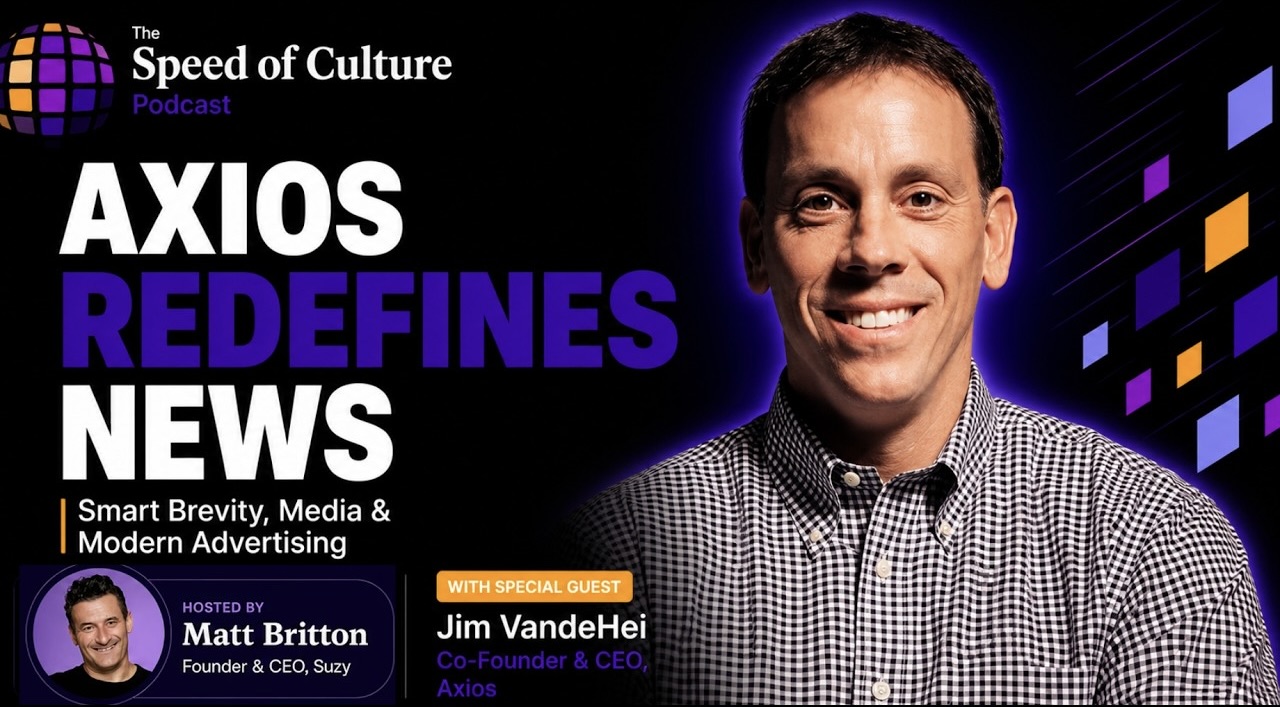
In October 2022, just weeks after Axios closed an acquisition by Cox Enterprises for $525 million, Jim VandeHei sat down with Matt Britton on the Speed of Culture podcast to discuss one of the most compelling communication philosophies reshaping how modern organizations operate: Smart Brevity. As the co-founder and CEO of Axios, VandeHei has spent the last six years pioneering a fundamentally different approach to news, marketing, and enterprise communications, one that delivers maximum impact with minimum words.
Matt Britton, founder and CEO of Suzy, the AI-powered consumer intelligence platform, explored with VandeHei how Smart Brevity emerged as both an editorial philosophy and a business strategy that has disrupted legacy media while building a sustainable, scalable model for the digital age. This conversation reveals why understanding and implementing Smart Brevity principles is becoming a competitive necessity for organizations that want to capture attention and drive action in an environment where information overload is the default state.
VandeHei's journey from rolling out Politico in 2007 to building Axios into a multi-hundred-million-dollar media and software company offers critical lessons for executives, marketers, and communicators. The speed of culture is accelerating, and the ability to communicate efficiently while disrupting entrenched industries has become the defining challenge of the moment. This episode cuts to the heart of that challenge, presenting a masterclass in how clarity, brevity, and strategic focus can transform entire industries.
The podcast conversation demonstrates why effective communication has evolved from a peripheral skill to the core engine of organizational success. In a world where attention is scarce and competition for it is fierce, the organizations that win are those with the clearest messages and the most efficient delivery mechanisms, rather than those with the most information.
Smart Brevity: The Formula That Changed News and Business Communication
At its core, Smart Brevity represents a radical simplification of how information is packaged and delivered. Developed by VandeHei alongside co-authors Mike Allen and Roy Schwartz, and published as a book in 2022, Smart Brevity provides a specific formula that has proven remarkably effective across dozens of industries: Top Line → Why It Matters → The Details → What's Next.
This four-part structure sounds deceptively simple, but its power lies in its discipline. By committing to this framework, Axios demonstrated that communications could be made approximately 40 percent shorter while actually retaining all the essential information. In practical terms, this means a message that typically requires 500 words can be communicated effectively in 300.
The result is distilled information that respects the reader's time while maximizing comprehension and retention. VandeHei emphasizes that Smart Brevity is "fast, clipped, cut to the bone," in a way that eliminates the noise that typically surrounds important information without sacrificing meaning.
In traditional news writing and corporate communication, there's often layers of context, background, qualifier, and narrative framing before the reader reaches the actual news or takeaway. Smart Brevity inverts this: you start with what matters most, then layer in supporting detail only as needed.
The business implications are profound. Every organization that sends emails, publishes content, or communicates with stakeholders is essentially competing for mental real estate. Smart Brevity acknowledges this reality and addresses it head-on.
The formula has been tested and refined across Axios' networks of over one million newsletter subscribers across 24 major metropolitan markets. It is proven at scale.
For business leaders and communicators, the Smart Brevity framework offers a template that can be applied to everything from internal communications to customer messaging, from board presentations to marketing campaigns. The underlying insight is that constraints force clarity.
By limiting the space available for a message, you force yourself to identify what actually matters and eliminate everything else. This discipline is rare in organizational communication, which tends to privilege comprehensiveness over clarity.
From Politico to Axios: Building a Sustainable Model for Digital Media
VandeHei's career trajectory offers a masterclass in recognizing when an industry is ripe for disruption. His previous roles at Roll Call, the Wall Street Journal, Washington Post, and his co-founding of Politico in 2007 gave him deep expertise in political journalism and media economics.
But his move to co-found Axios in 2016 represented a more fundamental shift: not just creating another news outlet, but reimagining the entire operating model for digital media.
The Axios model diverges from traditional media in several critical ways. First, there's the newsletter-first approach. Rather than building a website that readers visit, Axios built a distribution system that comes directly to readers' inboxes.
Second, there's the geographic expansion strategy: Axios didn't try to be everything to everyone nationally. Instead, it built lean, two-person teams in 24 major metropolitan markets, each producing email newsletters tailored to local news and business communities. This hyper-local approach to national news infrastructure was novel, and it proved sustainable.
Third, and perhaps most importantly, there's the revenue model. Rather than betting entirely on subscriptions, the model many digital media companies have pursued, Axios adopted a 50-50 split between advertising and subscriptions.
VandeHei openly embraces advertising as a fundamental part of media sustainability, arguing that "advertising supports free media and journalism." In his view, this position simply acknowledges economic reality.
However, Axios' approach to advertising differs markedly from legacy media: the company prioritizes contextual, non-intrusive advertisements that feel integrated rather than intrusive.
The financial performance of this model is striking. Local newsletters are projected to generate $4-5 million in annual revenue per market. With operations in 24 metro markets, the arithmetic becomes compelling.
The Axios model has proven that digital media doesn't have to choose between serving readers and building a financially sustainable business. Both are possible when you start with the reader's experience as your north star, then architect the business model around that.
This approach to building a sustainable media business while maintaining editorial integrity stands in sharp contrast to many of the struggles in digital journalism. VandeHei's willingness to invest in local teams, to value the subscription revenue stream, and to embrace advertising as a legitimate revenue source demonstrates that thoughtful business model design can be just as important as editorial quality in determining a media company's success.
Being a Great Communicator Is Now the Whole Game
"Being a great communicator, a great marketer, a great advertiser is the whole game right now."
This assertion from VandeHei during his conversation with Matt Britton warrants unpacking, because it contains a truth that many organizations are still struggling to internalize.
For decades, the assumption in many industries was that a great product speaks for itself. Build something valuable, and customers will find you. While this was never entirely true, it was plausible in an era of relative scarcity, when there were fewer options and information traveled more slowly.
But in 2024, that assumption has inverted. There is no shortage of options in virtually any industry. Information travels instantaneously. Attention is the scarce resource.
This shift has profound implications. A mediocre product with excellent communication and marketing will outperform an excellent product with poor communication every single time. This doesn't mean communication matters more than product quality, both are necessary.
But it does mean that exceptional communication has become table stakes for any organization that wants to compete at the highest level.
VandeHei's observation applies beyond media. It applies to enterprise software companies, to consumer brands, to B2B services, to nonprofits, to educational institutions.
The organizations that understand their customer's journey, that can articulate value proposition clearly and concisely, that can adapt their messaging for different audiences and channels. These organizations will win their markets. Those that don't will struggle, regardless of how good their underlying product or service is.
This insight also connects directly to why Axios HQ, the company's enterprise software division, emerged as a significant business opportunity. Axios realized that the Smart Brevity methodology that made their editorial product successful could be commercialized for enterprise use.
Organizations across industries want to communicate more effectively with their teams, customers, and stakeholders. Smart Brevity provided a proven framework for doing exactly that.
Disruption, Scale, and the Evolution of Legacy Industries
The Axios story is ultimately a story about disruption done thoughtfully. VandeHei didn't set out to destroy the news industry or prove that traditional media was stupid. He identified a genuine problem. That people were drowning in information and struggling to understand what actually mattered, and he built a business model to solve it.
This approach to disruption is worth examining because it's more successful and more sustainable than the move-fast-and-break-things approach that dominated Silicon Valley thinking for years.
Thoughtful disruption requires deep expertise in the industry you're trying to disrupt. VandeHei brought decades of experience in journalism, political communications, and media economics. This expertise allowed him to identify which elements of legacy media were broken and which were actually valuable.
He didn't throw out everything that came before; he kept what worked and reimagined what didn't.
The acquisition by Cox Enterprises for $525 million validates this approach. Legacy media companies recognized value in what Axios built, and they were willing to pay premium prices to acquire it.
This isn't the typical Silicon Valley exit where a startup is acquired for talent and technology; it's an acquisition of a profitable, growing business that has built something genuinely different.
For business leaders across industries, the Axios story offers a template. When you're thinking about disruption, whether you're trying to disrupt your own industry or a new one, start with deep expertise, solve a genuine problem, build a sustainable business model, and think long-term about scale.
The companies that win are those that build foundations that allow them to grow consistently over years and decades, rather than those that grow the fastest initially.
The Future of Communications: Smart Brevity Beyond Media
The ultimate significance of VandeHei's work extends far beyond journalism. Smart Brevity represents a framework for communication that will become increasingly important as information environments continue to accelerate.
Whether you're leading a team, marketing a product, communicating with investors, or running an entire organization, the principles that made Axios successful apply directly to your context.
Consider the internal communications landscape at most organizations. How many emails does an average employee receive daily? How many of those are actually efficient in their communication? What percentage of time is wasted parsing poorly structured information?
Smart Brevity addresses these inefficiencies directly. By adopting the framework (Top Line, Why It Matters, Details, What's Next) organizations can dramatically improve internal communication.
Similarly, in customer marketing and brand communication, Smart Brevity principles can transform how companies engage their audiences. Rather than lengthy marketing copy that asks readers to extract the value proposition themselves, Smart Brevity-influenced messaging leads with the most important information and builds from there.
This approach typically improves engagement, conversion, and customer satisfaction simultaneously.
The data-driven nature of Smart Brevity also aligns perfectly with how modern organizations should be thinking about communication. You can measure whether a message was understood, whether it drove action, whether it achieved its intended goal.
Smart Brevity, having emerged from journalism and news, inherently understands that you must measure impact. In an age of AI-powered analytics and business intelligence platforms like Suzy, this alignment between communication methodology and measurement capability creates opportunities for continuous improvement.
Key Takeaways for Business Leaders
- Smart Brevity is a framework, not a gimmick. The four-part structure (Top Line → Why It Matters → The Details → What's Next) can reduce message length by 40% while maintaining or improving comprehension and action. This is applicable across industries and use cases, from internal communications to customer marketing.
- Distribution and business model matter as much as content. Axios didn't just create better journalism; it built a distribution system (newsletters) and revenue model (50-50 advertising/subscriptions) that proved sustainable at scale. Your product alone won't determine success in the information economy.
- Effective communication is now a core business competency. VandeHei's assertion that being a great communicator, marketer, and advertiser is the whole game right now reflects a fundamental shift in how competitive advantage is built. Organizations must prioritize communication excellence as a strategic capability.
- Thoughtful disruption outperforms move-fast-and-break-things. Deep industry expertise combined with genuine problem-solving and sustainable business model design creates more durable disruption than speed alone.
- Measure everything. From message clarity to conversion rates to revenue per market, Smart Brevity principles are grounded in measurement and iteration. Organizations should apply the same rigor to their communication strategies.
Frequently Asked Questions
What exactly is Smart Brevity, and how does it differ from just being concise?
Smart Brevity is a specific formula developed by Jim VandeHei, Mike Allen, and Roy Schwartz that structures communication into four parts: the top line (the most important information), why it matters (context and significance), the details (supporting information), and what's next (implications and actions).
It differs from general conciseness because it provides a specific structure that forces clarity. Rather than simply trying to write less, Smart Brevity provides a discipline: you must understand the hierarchy of information and present it in that order.
This framework can reduce message length by approximately 40% while actually improving comprehension and retention.
Can Smart Brevity be applied to internal business communications beyond journalism?
Absolutely. While Smart Brevity emerged from journalism and news, the underlying principle, that people make better decisions with clearly presented information in the right order, applies universally.
Organizations can use Smart Brevity to improve emails, meeting agendas, project updates, and strategic communications. The framework is particularly valuable in high-complexity environments where professionals receive massive information flows and struggle to extract what matters most.
Any organization wanting to improve internal communication efficiency should experiment with Smart Brevity structures.
How did Axios build a sustainable media business while other digital news outlets struggled?
Axios succeeded through several specific choices. First, it adopted a newsletter-first distribution model rather than relying on website traffic.
Second, it embraced a local market strategy with lean two-person teams in 24 major metros, rather than trying to be everything to everyone nationally.
Third, it built a balanced revenue model with 50% advertising and 50% subscriptions, rather than betting entirely on one revenue stream.
Fourth, it maintained editorial discipline around Smart Brevity, which created a differentiated product that readers valued.
The combination of these elements (distribution, geographic focus, balanced revenue, and editorial discipline) created sustainable unit economics.
Why would a traditional media company like Cox Enterprises pay $525 million to acquire Axios?
Legacy media companies recognized in Axios a business model and methodology that proved more sustainable and scalable than their traditional operations. Cox Enterprises was acquiring not just a revenue stream, but a proven playbook for digital media success, access to over one million newsletter subscribers, and Smart Brevity intellectual property and expertise.
The acquisition validated that Axios had solved genuine problems in media that traditional players hadn't. For Cox, acquiring Axios provided a way to rapidly modernize its media operations and compete in the digital era.
Looking Ahead
The Speed of Culture podcast episode with Jim VandeHei offers a masterclass in how organizations can build sustainable competitive advantages through superior communication. For leaders interested in deepening their understanding of how communication, culture, and business strategy intersect, the episode is essential listening.
For organizations looking to apply these principles, whether you're building a media company, marketing a consumer brand, leading an enterprise, or innovating in any competitive space, the lessons from VandeHei's career and Axios' success are directly applicable.
The ability to communicate clearly, efficiently, and with impact has become a defining capability. Organizations that master this skill will outcompete those that don't.
Matt Britton, as founder and CEO of Suzy, the AI-powered consumer intelligence platform, works extensively with companies on understanding and communicating with their audiences more effectively.
For organizations interested in exploring how data-driven insights and strategic communication can drive business outcomes, Britton's work, and his AI keynote speaker services, offers valuable frameworks. Learn more about his speaking platform at Speaker HQ.
Organizations can also deepen their understanding of how artificial intelligence is reshaping culture and communication through Matt Britton's book Generation AI, which explores the implications of AI across business, society, and culture.
The principles of Smart Brevity and the frameworks discussed in this podcast episode align perfectly with the broader transformation that AI is enabling in how organizations understand and communicate with their audiences.

%20(400%20x%20100%20px)%20(300%20x%2050%20px)%20(150%20x%2050%20px).avif)