October 18, 2022
The Future of Marketing in Web3 & the Metaverse with Jennifer Stranzl, CMO at CoinDesk

Jennifer Stranzl
CMO
This is some text inside of a div block.
This is some text inside of a div block.
LISTEN ANYWHERE YOU FIND YOUR PODCASTS
%20(400%20x%20100%20px)%20(300%20x%2050%20px)%20(150%20x%2050%20px).avif)

In the rapidly evolving landscape of digital marketing, few topics generate as much debate, and opportunity, as Web3 and the metaverse. While mainstream adoption remains in its infancy, forward-thinking brands are already experimenting with blockchain-based marketing strategies, NFT initiatives, and immersive virtual experiences.
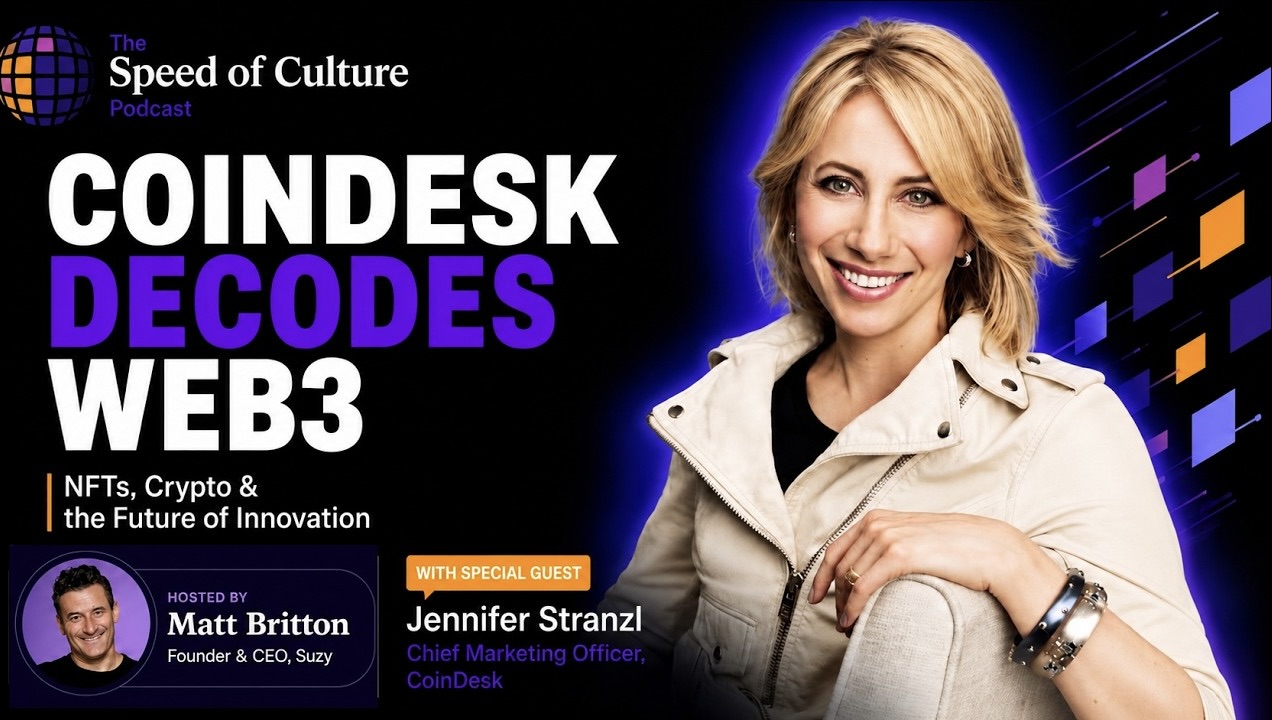
On Episode 18 of the Speed of Culture podcast, Matt Britton, founder and CEO of Suzy, the AI-powered consumer intelligence platform, sat down with Jennifer Stranzl, CMO at CoinDesk, to explore how Web3 technologies are reshaping the future of marketing and brand engagement.
Jennifer Stranzl brings a unique perspective to this conversation, combining deep expertise in both traditional corporate marketing and cutting-edge digital strategy. With an MBA from Harvard Business School and undergraduate studies in brain and cognitive science at MIT, Stranzl has built an exceptional career spanning investment banking at Goldman Sachs, consumer marketing leadership at P&G and L'Oreal, and strategic innovation roles at the Wall Street Journal Online and Sears Canada.
At CoinDesk (the world's most influential platform for crypto and blockchain media, events, and data) she leads marketing strategy during a transformative period for the industry.
The timing of this conversation is particularly significant. October 2022, when this episode aired, coincided with “crypto winter” a period of market contraction that tested the resilience of blockchain projects and highlighted the challenges of mainstream adoption.
Yet despite market headwinds, over $60 billion had been invested in crypto and blockchain technologies in the preceding two years, signaling sustained institutional and venture capital interest. The metaverse, once dismissed as speculative hype, was attracting serious investment from luxury brands like Dolce & Gabbana, Gucci, Louis Vuitton, Tiffany, and Adidas, all launching NFT and metaverse initiatives. McKinsey research projected virtual product sales would reach $54 billion, revealing enormous market potential for brands willing to experiment.
This article explores the key insights from Stranzl's discussion with Britton, offering business leaders actionable strategies for navigating Web3 marketing, understanding consumer adoption barriers, and preparing their organizations for a metaverse-integrated future. Whether your organization is a Fortune 500 company exploring blockchain marketing or a growth-stage startup building in Web3, these insights provide a roadmap for understanding where consumer behavior and technology are converging.
Traditional marketing operates on a broadcast model. Brands create messaging, push it through channels, and measure success through impressions and conversions.
Web3 fundamentally inverts this relationship. Instead of brands speaking at consumers, Web3 marketing centers on building engaged communities where members have actual ownership stakes in the platform or project's success.
Jennifer Stranzl emphasized that the most successful Web3 marketing campaigns prioritize community awareness and engagement above all else. This represents a seismic shift from the paid-media-dominated playbooks that dominated marketing for decades.
In Web3 ecosystems, authentic community members become brand ambassadors, content creators, and stakeholders, all motivated by tokenization and shared economic incentives.
The mechanics of this shift deserve deeper examination. In traditional marketing, a consumer is a consumer. They purchase a product or service, receive value, and the transaction concludes.
In Web3, tokenization transforms consumers into participants in a decentralized economy. By distributing tokens to early community members, DAOs (Decentralized Autonomous Organizations) and blockchain projects align incentives between the brand and its audience. When the platform succeeds, token holders benefit directly.
This alignment creates psychological and financial buy-in that traditional customer loyalty programs struggle to replicate.
CoinDesk's approach to marketing itself exemplifies this community-first philosophy. As the industry's most trusted media platform, CoinDesk hosts Consensus, the crypto industry's premier event, which drew 20,500 attendees in 2022 despite market turbulence.
This gathering functions not primarily as a transactional revenue event but as a nexus point for community building, thought leadership, and relationship cultivation. The success of Consensus demonstrates that in Web3, assembling your community physically reinforces digital bonds and creates network effects that far exceed traditional conference models.
For business leaders unfamiliar with Web3, this community-centric approach may seem foreign. However, the principles align with broader shifts toward community-driven consumer brands.
Platforms like Discord, Telegram, and emerging Web3-native communities become virtual gathering spaces where members exchange information, provide peer support, and develop collective identity around shared values or interests. Smart marketing in Web3 leverages these spaces to foster genuine engagement rather than deploy interruption-based advertising.
Non-fungible tokens (NFTs) represent one of the most visible, and controversial, applications of blockchain technology to marketing and brand engagement. At their core, NFTs are cryptographic assets that prove ownership and authenticity of digital items on the blockchain.
However, in the context of marketing strategy, NFTs serve a more nuanced purpose: they enable direct creator monetization and create new revenue streams for brands while simultaneously offering consumers tangible ownership of digital assets.
The luxury sector has led NFT adoption, with prestigious brands recognizing that their existing customer base values exclusivity and status signals. Dolce & Gabbana generated millions in secondary-market sales for its limited NFT collection.
Gucci, Louis Vuitton, Tiffany, and Adidas all developed metaverse-integrated NFT strategies that allowed loyal customers to purchase digital assets and virtual experiences. These initiatives accomplish multiple marketing objectives simultaneously: they generate direct revenue, create talking points that drive earned media coverage, signal innovation and forward-thinking positioning, and offer early-adopter customers new forms of exclusivity.
However, NFT marketing requires careful consideration of execution and audience targeting. As consumers develop greater sophistication around blockchain technology, poorly conceived NFT initiatives risk appearing opportunistic or inauthentic.
The most successful brands view NFTs not as a quick monetization tactic but as a strategic component of a broader community-building and customer relationship strategy.
Creator monetization extends beyond established brands to independent creators, artists, musicians, writers, and content creators of all types. Blockchain technology enables these creators to tokenize their work, sell directly to their audiences, and retain greater economic value compared to traditional intermediaries.
For marketing strategists, this reshaping of creator economics has profound implications. Influencer marketing and creator partnerships, already critical to modern brand strategy, will increasingly occur within tokenized ecosystems where creators have genuine ownership of their audience relationships and can monetize directly.
From a business perspective, companies that develop strong relationships with creators in Web3 communities position themselves to reach engaged, often wealthy, early-adopter audiences with high trust in creator recommendations. The challenge lies in building authentic partnerships rather than transactional sponsorships.
Despite substantial investment and media attention, Web3 and cryptocurrency remain niche phenomena. Research cited during Stranzl's discussion revealed critical adoption barriers.
Among potential cryptocurrency consumers, 37% cited price volatility as the primary concern preventing adoption. For non-users, 30% cited complexity as a fundamental barrier.
These statistics underscore a central challenge: the technology underlying Web3 is complex, and the regulatory environment remains uncertain.
Price volatility particularly affects institutional adoption and consumer confidence. When cryptocurrency prices fluctuate dramatically in short timeframes, it undercuts narratives of stability and value storage that are necessary for mainstream adoption.
During crypto winter, when prices decline significantly, consumer sentiment deteriorates, and media coverage turns skeptical. Marketing in this environment requires exceptional sophistication, messaging must acknowledge market realities while maintaining conviction about long-term technological value.
Complexity represents an equally significant barrier. For most consumers, cryptocurrency wallets, private keys, gas fees, and smart contracts remain opaque and intimidating.
Users requiring technical literacy are a self-selected group, and mass-market adoption requires dramatic simplification of the user experience. Marketing alone cannot overcome poor user experience design; product teams must prioritize accessibility alongside technologists and designers working to reduce friction.
Jennifer Stranzl's focus at CoinDesk involves increasing mass adoption and awareness, targeting both B2B audiences in traditional finance and B2C consumers.
This dual focus reflects a strategic reality: mainstream adoption requires simultaneous movement across institutional and consumer segments. TradFi (traditional finance) institutions entering the cryptocurrency space bring capital, legitimacy, and distribution channels that accelerate ecosystem growth.
At the same time, B2C marketing that educates everyday consumers about blockchain benefits and use cases builds the consumer base necessary for sustainable mainstream adoption.
The metaverse, a hypothetical future iteration of the internet featuring persistent virtual worlds, immersive experiences, and economic systems, represents a longer-term opportunity than current NFT markets.
Yet some leading brands are already establishing strategic positions in virtual worlds and metaverse platforms. Gucci's Roblox experience, Adidas's NFT initiative, and Tiffany's collaboration with NFT platform partner exemplify approaches that combine direct commerce, brand experience, and community engagement.
For legacy brand marketers evaluating Web3 investment, several strategic principles emerge.
As Jennifer Stranzl navigated her career from traditional corporate marketing through Wall Street Journal Online's digital transformation to CoinDesk's blockchain focus, she developed deep familiarity with organizational change and capability building.
Moving from her roles at P&G and L'Oreal, where consumer goods marketing relied on retail distribution, advertising, and brand building, to digital-native environments required learning entirely new competitive dynamics, tools, and success metrics.
For organizational leaders considering Web3 engagement, this model offers valuable lessons.
Most legacy organizations lack in-house blockchain expertise, making external partnerships or hiring essential. However, sustainable competitive advantage requires developing genuine internal capabilities rather than outsourcing Web3 strategy entirely.
Progressive organizations are creating Web3 task forces, launching innovation labs, and allocating budget toward talent development in these emerging areas.
CoinDesk's Consensus conference serves as an annual learning opportunity for marketers and brand leaders seeking to understand industry trends, build relationships with Web3 experts, and discover emerging opportunities. Participation at such convenings accelerates organizational learning and builds networks that support ongoing strategy development.
The metaverse refers to interconnected virtual worlds where users interact through avatars, make purchases, build communities, and engage in immersive experiences. Marketers should care because early evidence suggests substantial consumer willingness to spend on virtual products and experiences.
McKinsey research projected $54 billion in virtual product sales, indicating material market opportunity. Additionally, brands establishing early presence in metaverse platforms build awareness and customer relationships in spaces where future digital-native generations will spend increasing time.
NFTs serve multiple purposes beyond speculative assets. They enable direct creator monetization, provide digital ownership and authentication, and create exclusive community membership mechanisms.
While some NFT projects are speculative or poorly conceived, the underlying technology has legitimate applications for luxury brands, creators, and community-building initiatives. Smart marketing deploying NFTs focuses on utility, community benefit, and customer alignment rather than purely speculative value appreciation.
Begin with education and small pilots. Allocate budget toward team training and Web3 education.
Partner with specialized agencies or consultants to run limited experiments, perhaps a small NFT collection, a Discord community, or metaverse presence in platforms like Roblox. Measure outcomes, gather learnings, and iterate. This approach builds organizational capability and market understanding while limiting financial risk during a rapidly evolving period.
Web3 and AI represent complementary technological shifts reshaping customer engagement. AI-powered consumer intelligence platforms like Suzy enable marketers to understand audience behavior, preferences, and sentiment across both traditional and Web3 channels.
As Web3 adoption grows, AI tools will become essential for analyzing blockchain data, identifying community trends, and personalizing experiences at scale across decentralized ecosystems.
Jennifer Stranzl's insights offer valuable guidance for business leaders navigating one of marketing's most significant transformations. While Web3 adoption remains nascent and market dynamics turbulent, the underlying technology enables fundamentally new relationships between brands and communities.
Forward-thinking organizations are experimenting, learning, and positioning themselves for a future where tokenization, NFTs, and metaverse engagement become standard elements of customer strategy.
For deeper exploration of how AI and emerging technologies reshape consumer behavior and marketing strategy, explore Matt Britton's latest research and frameworks at Suzy, where consumer intelligence drives smarter decision-making.
Additional insights into technology-driven transformation can be found in Generation AI: The Book, which explores how artificial intelligence reshapes industries and consumer relationships.
Those seeking to develop expertise in speaking about emerging technologies and future business trends may be interested in Matt Britton's availability as an AI keynote speaker for conferences and corporate events.
For ongoing exploration of how culture, technology, and business intersect, listen to the full Speed of Culture podcast, where industry leaders share insights shaping tomorrow's marketing landscape.
Organizations serious about building Web3 capabilities should explore Speaker HQ for resources on building organizational expertise and learning from industry thought leaders.





.jpeg)