July 30, 2024
Curious Minds, Bold Moves: Suzanne Kounkel’s Guide to Market Leadership

Suzanne Kounkel
Chief Marketing Officer
This is some text inside of a div block.
This is some text inside of a div block.
LISTEN ANYWHERE YOU FIND YOUR PODCASTS
%20(400%20x%20100%20px)%20(300%20x%2050%20px)%20(150%20x%2050%20px).avif)

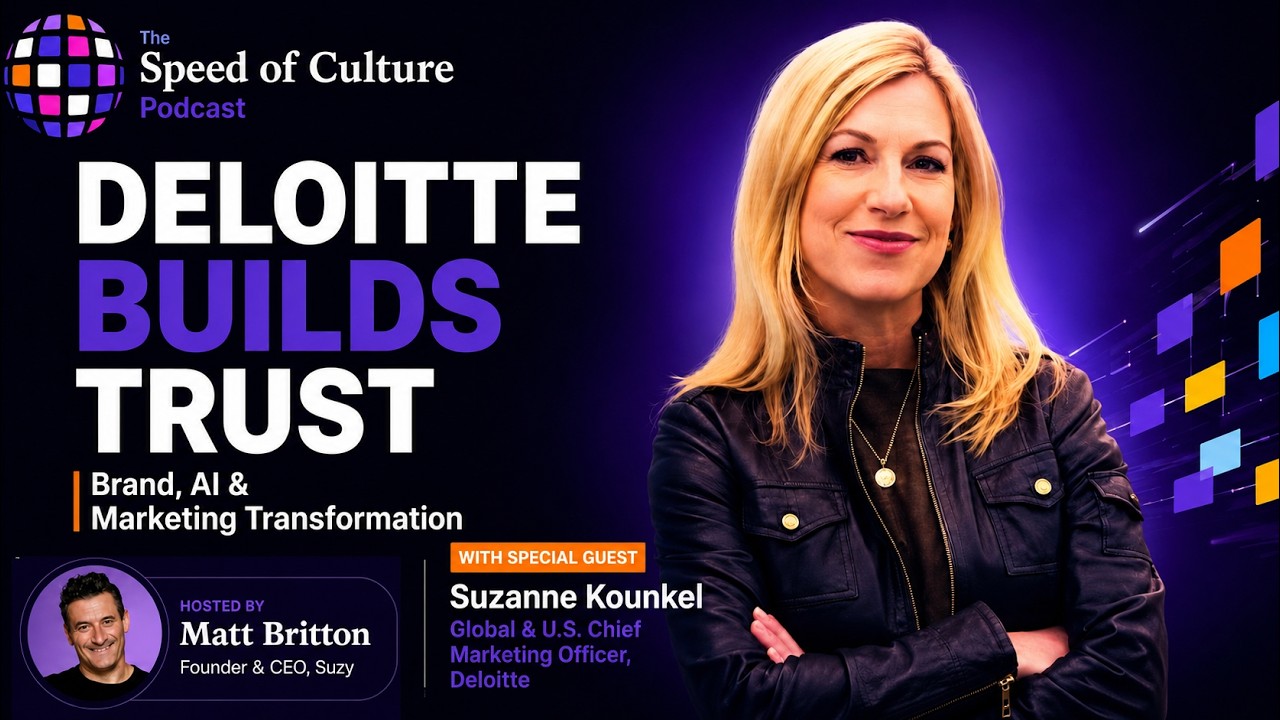
In the rapidly evolving landscape of business-to-business marketing and professional services, few leaders have demonstrated the agility and strategic vision required to navigate transformation at scale. Suzanne Kounkel, Global Chief Marketing Officer at Deloitte, brings over three decades of marketing, sales, and customer experience expertise to bear on the pressing challenges facing enterprise organizations today.
On Episode 123 of The Speed of Culture Podcast, hosted by Matt Britton, founder and CEO of Suzy, the AI-powered consumer intelligence platform, Kounkel shares profound insights into the qualities that define effective marketing leadership and the strategies that enable organizations to thrive amid disruption.
This episode, titled "Curious Minds, Bold Moves: Suzanne Kounkel's Guide to Market Leadership," was released on July 30, 2024, and provides a masterclass in how curiosity, adaptability, and strategic clarity drive growth in the professional services sector. Through her conversation with Britton, Kounkel illuminates the fundamental shift occurring in B2B marketing, where employees serve as brand ambassadors, where every touchpoint must reinforce customer value, and where continuous learning remains non-negotiable for leaders navigating an increasingly complex business environment.
The insights shared in this episode resonate far beyond Deloitte's walls. As organizations across industries grapple with digital transformation, artificial intelligence integration, and talent retention challenges, Kounkel's perspective on market leadership offers a roadmap for CMOs and marketing executives seeking to elevate their impact within the C-suite.
Her emphasis on curiosity as a leadership competency, her advocacy for organizational agility, and her commitment to building brand purpose provide practical guidance for any leader looking to drive sustainable growth while maintaining cultural coherence and customer trust.
For marketing professionals, business leaders, and anyone seeking to understand how top-tier organizations approach brand strategy and market positioning, this episode delivers actionable wisdom grounded in real-world application at one of the world's most influential consulting firms.
Suzanne Kounkel's career trajectory reveals a fundamental truth about modern marketing leadership: the discipline has evolved from a supporting function to a strategic business imperative. With over thirty years in marketing, sales, and customer experience, Kounkel has witnessed and shaped this transformation firsthand.
Her current role as Global Chief Marketing Officer at Deloitte places her at the intersection of brand strategy, organizational alignment, and business growth, responsibilities that demand far more than traditional marketing expertise.
In her conversation with Matt Britton, Kounkel addresses how marketing leadership has become increasingly complex. The CMO today must be part strategist, part organizational catalyst, and part data scientist.
This multidisciplinary requirement reflects broader shifts in how organizations create competitive advantage. Where marketing once operated in relative isolation, developing campaigns and managing communications, the modern CMO must drive alignment across the entire organization, from product development to customer delivery to talent recruitment.
Deloitte's approach exemplifies this evolution. Under Kounkel's stewardship, Deloitte has positioned marketing not as a departmental function but as a strategic capability that permeates the entire organization.
This perspective directly influenced the development of her Next Gen CMO Academy, an initiative designed to develop marketing leaders equipped with the competencies required in the modern business environment. The academy focuses not just on traditional marketing skills but on strategic business acumen, data literacy, creative leadership, and organizational influence, the competencies that separate CMOs who merely execute campaigns from those who shape organizational strategy.
This evolution becomes particularly relevant when examining how Deloitte itself markets its services. As a global consulting powerhouse, Deloitte's brand is not built primarily through advertising or traditional marketing channels but through the consistent delivery of client value, the thought leadership of its professionals, and the strategic expertise embedded in its organizational DNA.
Kounkel's marketing strategy reinforces and amplifies these inherent organizational strengths rather than creating them from scratch, a critical distinction that separates B2B professional services marketing from consumer marketing.
The episode's title, "Curious Minds, Bold Moves", immediately signals Kounkel's core conviction: curiosity serves as the foundation for innovation, strategic clarity, and organizational agility. In an environment characterized by rapid technological change, shifting customer expectations, and emerging competitive threats, curiosity distinguishes leaders who merely react to market changes from those who anticipate and shape them.
Kounkel emphasizes that curiosity represents more than intellectual interest; it constitutes an organizational competency that drives sustainable competitive advantage. When leaders approach their market, their customers, and their industries with genuine curiosity, they remain open to emerging insights, resistant to organizational complacency, and nimble enough to evolve their strategies as conditions shift.
This mindset proves especially valuable for professional services organizations like Deloitte, where understanding client challenges at a deeper level than competitors directly translates into richer service offerings and stronger client relationships.
The practical implications of curiosity-driven leadership manifest across multiple dimensions of Deloitte's marketing strategy. First, it influences how the organization conducts customer research and insight generation.
Rather than relying solely on quantitative data and historical patterns, Deloitte's marketing function emphasizes deep listening, understanding not just what clients need but why they need it, what constraints they face, and what aspirations drive their strategic priorities. This human-centered approach to research generates insights that transcend surface-level trend analysis.
Second, curiosity drives Deloitte's approach to digital transformation and technology adoption. Rather than implementing tools and platforms for their own sake, Kounkel describes a culture of experimentation and learning that evaluates new capabilities through the lens of customer value creation.
This prevents the trap of technological adoption becoming an end in itself, a danger many organizations face when pursuing digital transformation initiatives.
Third, and perhaps most importantly, curiosity shapes how Deloitte's marketing team approaches its role as an internal change agent. Marketing leaders who demonstrate genuine curiosity about how other functions approach their challenges (whether that's operations, delivery, talent, or innovation) develop a more sophisticated understanding of organizational dynamics.
This understanding enables marketing to serve as a translator and bridge-builder across traditional silos, enhancing its influence and impact across the organization.
While curiosity provides the intellectual foundation for effective leadership, adaptability represents the operational capability that translates curious insights into organizational action. Kounkel's conversation with Britton addresses one of the defining challenges of contemporary marketing leadership: maintaining strategic clarity and brand coherence while remaining agile enough to respond to rapid environmental shifts.
The professional services industry exemplifies the forces demanding organizational adaptability. Artificial intelligence, cloud computing, automation, and new service delivery models continuously reshape what consulting firms can offer clients and how they deliver value.
Deloitte's marketing strategy must simultaneously address this flux while maintaining the brand consistency and positioning that build trust with enterprise clients. This represents a delicate balance: organizations cannot pivot so frequently that they lose strategic focus, yet they cannot remain rigid in their positioning when market realities shift beneath them.
Kounkel describes how adaptability manifests in Deloitte's marketing operations. The organization has invested significantly in marketing technology and analytics capabilities that enable rapid insight generation and campaign optimization.
Rather than planning annual campaigns with quarterly reviews, Deloitte's marketing approach incorporates ongoing monitoring, testing, and refinement. This allows the team to respond to emerging trends, client feedback, and competitive moves while operating within an overall strategic framework.
Adaptability also extends to how Deloitte positions its services and capabilities. The firm's messaging has evolved to emphasize AI integration, technology-enabled services delivery, and human-centric problem-solving, reflecting genuine shifts in market demand and organizational capability.
Yet this evolution maintains continuity with Deloitte's established brand positioning around professional excellence, client focus, and strategic insight. The organization adapts its emphasis without abandoning its core brand promise.
For marketing leaders working across all industries, this balance between consistency and adaptability holds critical lessons. Brands that rigidly adhere to outdated positioning become irrelevant; conversely, brands that shift too frequently lose the coherence required to build lasting customer relationships and internal alignment.
Effective adaptability requires clarity about core brand identity, a structured process for monitoring environmental change, and the organizational courage to evolve when conditions warrant.
The conversation between Britton and Kounkel also addresses adaptability at the organizational culture level. Deloitte's talent challenges, like those affecting professional services firms generally, require marketing to play a role in employer brand positioning and talent attraction.
Adaptability in this context means evolving how the organization communicates about career opportunity, work environment, and professional development as generational expectations shift. Kounkel's leadership incorporates this reality directly into her marketing strategy, recognizing that talent is the firm's primary asset and that marketing serves as a critical channel for signaling organizational values and opportunity to potential recruits.
One of the most distinctive elements of Deloitte's marketing strategy is its recognition that in professional services organizations, employees serve as the primary brand. The firm's approach to employee advocacy represents a sophisticated evolution beyond typical employer branding, positioning employees as genuine brand ambassadors who extend the organization's reach and credibility across markets and industries.
This philosophy underlies Deloitte's Ambassador Program, which has evolved dramatically over the past decade. The program has enrolled over 7,200 employees as active brand advocates.
These ambassadors have generated impressive metrics: 720,000 clicks, 385 million social impressions, and 461,000 social shares. These numbers reflect not random social media activity but strategically coordinated messaging that amplifies Deloitte's thought leadership, reinforces brand positioning, and extends market presence through channels and networks that paid media alone cannot reach.
The genius of Deloitte's employee advocacy approach lies in its dual orientation. On one hand, it recognizes organizational self-interest: employees amplifying the brand generates tangible business value through expanded reach, increased credibility, and stronger client relationships.
On the other hand, the program is positioned genuinely as benefiting employees themselves, offering opportunities to build personal brands, establish thought leadership in their functional areas, and expand their professional networks. This mutual benefit orientation creates sustainable engagement rather than relying on top-down mandates.
Kounkel's emphasis on employee advocacy connects directly to her observation that every employee represents the brand to customers and prospects. A consultant conducting a discovery session with a client is embodying the brand promise of analytical rigor, strategic insight, and client-centric problem-solving, well beyond delivering professional services.
When that same employee shares relevant insights on social media, contributes to industry conversations, or participates in Deloitte-sponsored thought leadership initiatives, they extend the brand's credibility and reach.
This approach has profound implications for how Deloitte recruits, onboards, develops, and retains talent. Employee brand ambassadors must be not just competent professionals but genuinely committed advocates for the organization's mission and values.
This requires sustained investment in company culture, professional development, and creating authentic opportunities for employees to contribute to work they find meaningful. The Ambassador Program cannot thrive in organizations with weak internal cultures or where employees feel disconnected from organizational purpose.
For marketing leaders across industries, Deloitte's employee advocacy strategy offers a roadmap for multiplying marketing impact while simultaneously strengthening organizational culture and employee engagement. The most effective employee advocacy programs emerge not from marketing mandates but from genuine organizational commitment to enabling employees to do work they find meaningful and to representing organizations in which they feel genuine pride and connection.
Throughout her conversation with Matt Britton, Kounkel emphasizes a theme that has become increasingly central to her leadership: the importance of purpose-driven brands. In an environment where organizations compete not just on product specifications and service delivery but on demonstrated values and authentic commitment to stakeholder interests, brand purpose represents a fundamental competitive asset.
Deloitte's approach to brand purpose extends beyond corporate social responsibility or philanthropic initiatives, though these play a supporting role. Instead, purpose permeates strategic decision-making about how the firm allocates resources, which clients it serves, how it develops its people, and what role it plays in addressing systemic business and social challenges.
This integration of purpose into core business strategy distinguishes authentic purpose-driven organizations from those deploying purpose primarily as a marketing tactic.
The firm's purpose, "Making an impact that matters", directly influences marketing strategy and communications. Rather than marketing Deloitte's services in isolation, the organization's messaging emphasizes how its expertise addresses clients' most pressing challenges.
Whether a client faces digital transformation pressures, workforce disruption, or complex regulatory environments, Deloitte's marketing positions the firm as a strategic partner capable of helping organizations navigate fundamental transformation successfully.
This purpose-driven positioning appeals to multiple stakeholder constituencies simultaneously. Enterprise clients seek vendors who understand their strategic priorities and can deliver solutions aligned with organizational transformation objectives.
Talent prospects seek employers whose work contributes to meaningful outcomes rather than serving purely financial or narrow functional purposes. Investors and the broader business community increasingly evaluate organizations through the lens of whether they create or destroy value for society writ large.
Purpose-driven marketing also creates internal alignment that enhances organizational effectiveness. When employees understand how their work connects to meaningful outcomes, when they can articulate their organization's purpose authentically to clients and prospects, when they see the organization making strategic decisions in alignment with stated values, engagement increases and turnover decreases.
Marketing's role in communicating and reinforcing purpose becomes a human resources and organizational development function as much as a customer-facing discipline.
Kounkel's leadership emphasizes that purpose-driven brands require authentic commitment rather than superficial positioning. Customers, employees, and investors have developed sophisticated capacities to identify purpose-washing, where organizations claim commitment to principles their actions contradict.
Deloitte's ability to position itself as a purpose-driven organization rests on genuine strategic alignment between the firm's value proposition, how it operates internally, and how it measures success.
Kounkel emphasizes the integration of curiosity, adaptability, and purpose throughout organizational strategy rather than treating marketing as an isolated functional discipline. Her leadership approach positions marketing as a strategic business capability that influences organizational culture, talent development, customer relationships, and competitive positioning simultaneously.
She has been particularly influential in developing the next generation of CMO talent through Deloitte's Next Gen CMO Academy, which emphasizes strategic business acumen beyond traditional marketing expertise. Her perspective on employee advocacy and purpose-driven positioning reflects a sophisticated understanding of how professional services organizations create competitive advantage through thought leadership and talent excellence.
Deloitte's Ambassador Program achieves business impact through multiple mechanisms. First, employee advocacy extends market reach, when thousands of professionals share relevant insights on social media, speak at industry events, and contribute to thought leadership initiatives, they amplify Deloitte's presence across markets and industries.
Second, employee advocacy builds credibility, prospects and clients value insights from practicing professionals more than corporate messaging alone. Third, the program strengthens internal culture by offering employees opportunities to build personal brands and contribute to organizational narrative.
Fourth, employee advocacy data provides insights into what messaging resonates with stakeholder audiences, directly informing content strategy. The program's success metrics, 385 million social impressions and 7,200 enrolled ambassadors, demonstrate scale, but the real business value emerges through client acquisition, talent recruitment, and thought leadership positioning.
Purpose-driven marketing creates competitive advantage across multiple dimensions. When authentic, organizational purpose attracts and retains talent that feels genuinely connected to organizational mission, reducing turnover costs and increasing engagement.
Purpose-driven positioning helps customers understand how vendor solutions align with their strategic priorities, facilitating decision-making and deepening client relationships. Purpose influences resource allocation decisions, identifying which markets, client segments, and service offerings represent highest strategic value.
Most importantly, authentic purpose prevents organizations from pursuing growth at any cost, which often undermines long-term value creation. For marketing specifically, purpose-driven positioning enables distinctive market positioning that transcends commodity competition based primarily on price, features, or service delivery efficiency.
Effective balance requires clarity about core brand identity, strategic positioning, and non-negotiable organizational values combined with structured processes for monitoring environmental change and testing emerging opportunities. Organizations can maintain strategic coherence while evolving service positioning, marketing messaging, or operational practices.
Regular scenario planning, competitive intelligence, and customer insight generation create early warning systems for market shifts that warrant strategic evolution. Successful adaptation often involves subtle repositioning rather than wholesale strategic change, emphasizing different aspects of existing brand identity or service capabilities as customer needs and market conditions shift.
Kounkel's approach at Deloitte exemplifies this balance through consistent messaging about strategic insight and problem-solving capability while evolving specific service positioning to address emerging opportunities in AI, digital transformation, and technology-enabled service delivery.
Suzanne Kounkel's insights in Episode 123 of The Speed of Culture Podcast offer invaluable guidance for marketing leaders navigating an increasingly complex and dynamic business environment. Her emphasis on curiosity as a leadership competency, her commitment to organizational adaptability, her strategy of employee advocacy at scale, and her conviction that purpose-driven organizations outcompete those driven purely by financial metrics provide a comprehensive framework for thinking about contemporary marketing leadership.
For deeper exploration of these themes and additional insights into how leading organizations approach marketing strategy and culture, consider exploring these resources: