February 1, 2024
Closing the Gender Gap with Shelley Zalis, CEO of The Female Quotient

Shelley Zalis
CEO
This is some text inside of a div block.
This is some text inside of a div block.
LISTEN ANYWHERE YOU FIND YOUR PODCASTS
%20(400%20x%20100%20px)%20(300%20x%2050%20px)%20(150%20x%2050%20px).avif)

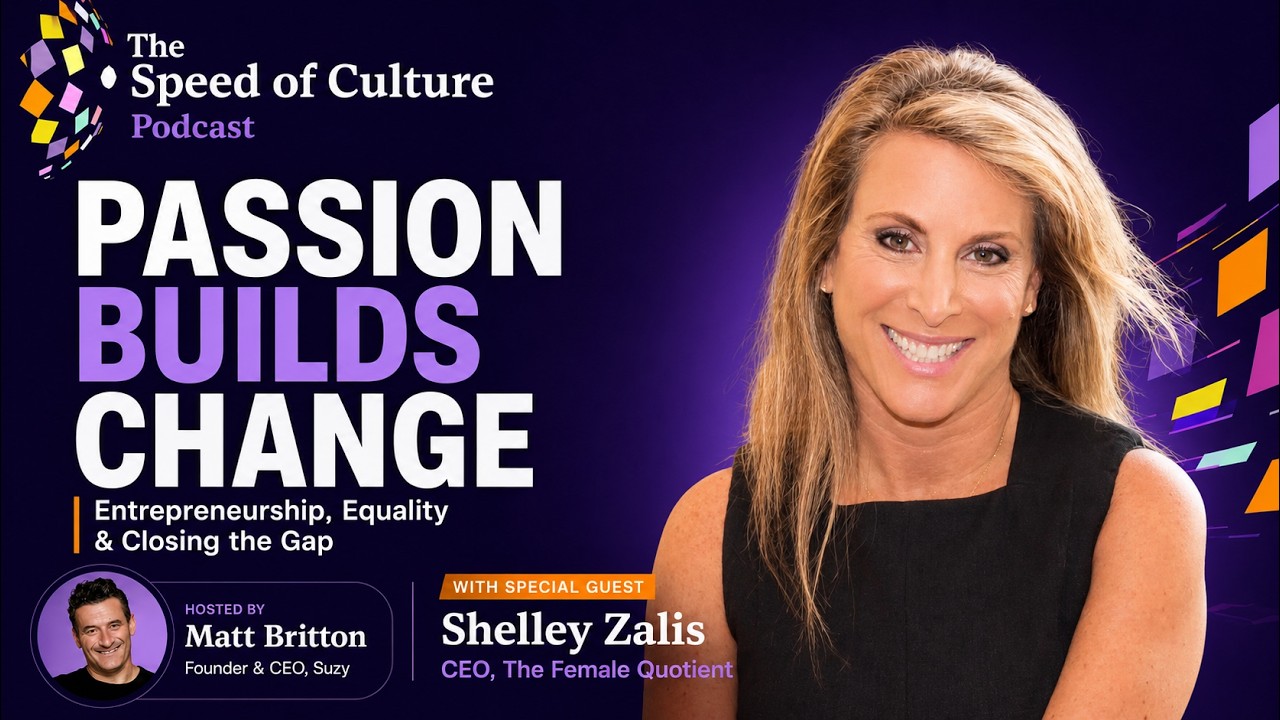
In an era where workplace diversity has become more than a buzzword, it's a business imperative, few leaders have made the impact that Shelley Zalis has achieved in advancing gender equality. As CEO of The Female Quotient, Zalis has built a global movement dedicated to closing the gender gap in business.
On a recent episode of The Speed of Culture Podcast, Matt Britton, founder and CEO of Suzy, the AI-powered consumer intelligence platform, sat down with Shelley to explore her groundbreaking journey from pioneering online research to revolutionizing workplace gender dynamics.
The conversation reveals the power of conviction, resilience, and intentional leadership in transforming organizational cultures. Shelley's story is one of relentless innovation, from founding OTX, the research company that fundamentally changed how companies gather consumer insights, to creating the Equality Lounge, which has become the signature platform for gender equality conversations at major global business conferences.
What makes Shelley's approach different is her unflinching focus on actionable solutions. Rather than simply acknowledging gender disparities, The Female Quotient works directly with organizations to implement data-driven strategies that foster genuine, measurable change.
Her philosophy is simple yet profound: leaders can control the narrative around gender equality, and they have the data to reverse legacy mindset gaps that have persisted for decades.
This episode provides essential lessons for C-suite executives, HR leaders, and entrepreneurs who recognize that diverse teams perform better, think better, innovate faster, and drive sustainable business growth.
In conversation with Britton, Shelley emphasizes that closing the gender gap is a strategic business decision that directly impacts the bottom line, as well as a moral imperative. For leaders seeking to build truly inclusive organizations, her insights offer both inspiration and concrete frameworks for action.
Shelley Zalis began her career in traditional market research, a field dominated by outdated methodologies and even more outdated thinking. While her peers accepted the status quo, Shelley envisioned something revolutionary: moving research from offline to online.
The vision was bold, but the reception was almost universally dismissive. In the early 2000s, when Shelley approached her employers at a traditional research firm with the concept, they rejected it outright.
"They told me it was the wrong time."
Rather than abandon her vision, she recognized a critical moment of opportunity. At a panel featuring Larry Mock, then Chief Research Officer at Procter & Gamble, Shelley approached him to discuss her concept.
However, when she informed her boss about the meeting, he made a decision that crystallized everything she needed to know: he sent three male colleagues in her place, characterizing the meeting as a "boys' club" affair.
That moment became a turning point. Shelley realized that her vision would never materialize if she didn't take control of it herself.
She took her concept to Nielsen, launching what would eventually become OTX, a company that completely disrupted the research industry. What started as a contrarian idea became the blueprint for modern consumer intelligence.
Shelley's experience in building OTX demonstrates a crucial insight about innovation: it requires the innovator to embody multiple roles simultaneously. In her Speed of Culture podcast episode, she describes assuming the positions of the "first," the "second," and the "third" in any innovation journey.
The first is the innovator who makes mistakes while creating something entirely new. The second is the copycat who imitates without understanding the underlying mechanisms. The third is the sweeper who refines and builds upon the existing ecosystem.
By continually disrupting herself and refusing to become complacent, Shelley transformed not just her company, but an entire industry.
The OTX acquisition by Ipsos OTX marked a watershed moment, validating her vision and positioning her as a thought leader in market research innovation. But for Shelley, this success was only the foundation for her next mission: addressing the systemic gender inequalities she had witnessed and experienced firsthand throughout her career.
After building a successful research company, Shelley had achieved what many entrepreneurs dream of, financial security, industry recognition, and the respect of her peers. But success in business didn't mean success in creating a truly equitable workplace culture.
As she reflected on her career journey, Shelley realized that despite her accomplishments, the fundamental structures that made women feel isolated, undervalued, and excluded in business settings remained largely unchanged.
The genesis of The Female Quotient came from a deeply personal realization: the industry had constructed an exclusive network for men, the proverbial "boys' club" and women were systematically shut out.
Determined to create the opposite, a space where women not only belonged but thrived, Shelley launched what would become the Equality Lounge. The concept was elegant in its simplicity: invite women to "walk the floor" together at major industry conferences, experiencing the "power of the pack."
What started with 50 women at CES evolved into a global movement that now reaches millions of professionals across industries.
The Equality Lounge is a carefully curated space where women executives, entrepreneurs, and emerging leaders can connect, collaborate, and build the kind of networks that have historically been available only to men.
By intentionally creating these spaces at major conferences like Davos, Cannes Lions, Advertising Week, and CES, Shelley has effectively inverted the traditional power dynamic.
What's particularly strategic about The Female Quotient's approach is its evolution from grassroots advocacy to global impact. In 2024 alone, the Equality Lounge at Davos attracted over 6,000 participants and generated 350+ speaking sessions focused on critical gender-related topics, from childcare policy to neurodiversity in the workplace.
Throughout her conversation with Matt Britton on The Speed of Culture Podcast, Shelley emphasizes a management principle that fundamentally differentiates successful leaders from those who merely maintain the status quo: hire for passion, train for skill.
When Shelley founded OTX, the field of online research barely existed, so there were no seasoned veterans to hire. She sought individuals with an almost evangelical belief in the vision.
These were people willing to fight the industry's skepticism, willing to learn on the job, and willing to persist through failures that inevitably come with innovation.
This approach reflects a deeper understanding of what drives sustained excellence. Technical skills can be taught, systems can be learned, and processes can be refined. But passion, the intrinsic motivation that keeps someone going when facing rejection and setbacks, is far more difficult to instill after hiring.
As a leader, Shelley has extended this philosophy throughout The Female Quotient. She actively seeks out others who share her passion for gender equality and invests significantly in developing their skills.
The implications for executive leadership are profound. In an increasingly competitive talent market, companies that can attract and retain passionate people will outperform those relying solely on compensation and benefits.
Among the United Nations' 17 Sustainable Development Goals, gender equality stands out as uniquely actionable for individual leaders and organizations.
Shelley's central argument throughout her podcast appearance is deceptively straightforward: leaders must be intentional about gender equality.
This isn't about well-meaning efforts or diversity training programs that check boxes without creating change. It's about systematic, data-driven approaches to identifying and eliminating the structural barriers that prevent women from advancing in organizations.
The Female Quotient works directly with enterprises to conduct thorough analyses of recruitment pipelines, advancement rates, pay equity, representation in leadership, and organizational culture.
Armed with this data, companies can identify specific intervention points where targeted action will have the most impact.
Breaking down these legacy gaps requires both data and leadership courage. Leaders must be willing to ask difficult questions about retention, advancement, meeting culture, caregiving expectations, and the narratives they promote about leadership.
The organization's research collaborations, including work with Deloitte on women in cybersecurity, demonstrate the power of bringing gender equity research into specific industries.
The most visible manifestation of Shelley's vision is the Equality Lounge, but its significance extends beyond networking events to the structural impact it creates.
At Davos, CES, Cannes Lions, and Advertising Week, the Equality Lounge has become the place where women executives network, where brands demonstrate their commitment to equality, and where the most important conversations about gender in business happen.
The reach of this approach has been extraordinary. The Female Quotient's social community has grown to exceed 3 million followers, with the Davos 2024 event alone hosting over 6,000 participants across 90+ sessions.
Beyond the lounge itself, The Female Quotient has expanded into thought leadership, research, advisory services, and strategic partnerships.
The recent launch of RX (in partnership with XR Extreme Reach) represents another innovation: a new industry metric for measuring representation in advertising and creative content.
The Female Quotient takes a comprehensive, data-driven approach to gender equality rather than focusing solely on awareness or training. It combines the Equality Lounge, research, advisory services, thought leadership, and strategic partnerships to create sustainable change.
Begin with an honest assessment of representation, retention, and policies. Start with high-impact, achievable changes such as flexible work policies, transparent promotion criteria, and diverse interview panels. The key is intentionality, demonstrating that gender equality is a strategic priority.
Men in leadership positions control hiring decisions, promotion processes, and organizational culture. When men champion women's advancement and model inclusive behaviors, they accelerate progress significantly.
Organizations should establish metrics such as representation across levels, pay equity analysis, promotion rates, retention rates, and engagement scores disaggregated by gender. What gets measured gets managed.
Shelley Zalis's work with The Female Quotient represents a generational shift in how business addresses gender equity.
The Business Case Becomes Undeniable: As diversity metrics become more transparent, the link between gender-diverse teams and financial performance will become even clearer.
Technology Enables Accountability: AI and data analytics tools will increasingly help organizations identify bias in hiring, promotion, and compensation decisions.
Generation Z Redefines Workplace Expectations: Younger professionals have different expectations about inclusivity and organizational values, reshaping competitive dynamics.
Intersectionality Gains Focus: Future progress will require addressing how gender intersects with race, ethnicity, sexual orientation, and other identities.
For leaders seeking to build truly inclusive organizations, the lessons from Shelley's journey are clear: conviction matters, data drives decisions, and intentionality transforms culture.
For deeper insights into consumer intelligence and emerging business trends, visit Suzy, the AI-powered platform founded by Matt Britton.
To listen to more episodes exploring the intersection of culture, business, and innovation, check out The Speed of Culture Podcast.
Interested in learning about Matt Britton's research on emerging generations and AI? Discover his book Generation AI.
For speaking engagements and thought leadership on consumer trends and culture, explore Matt Britton's work as an AI keynote speaker or visit Speaker HQ.