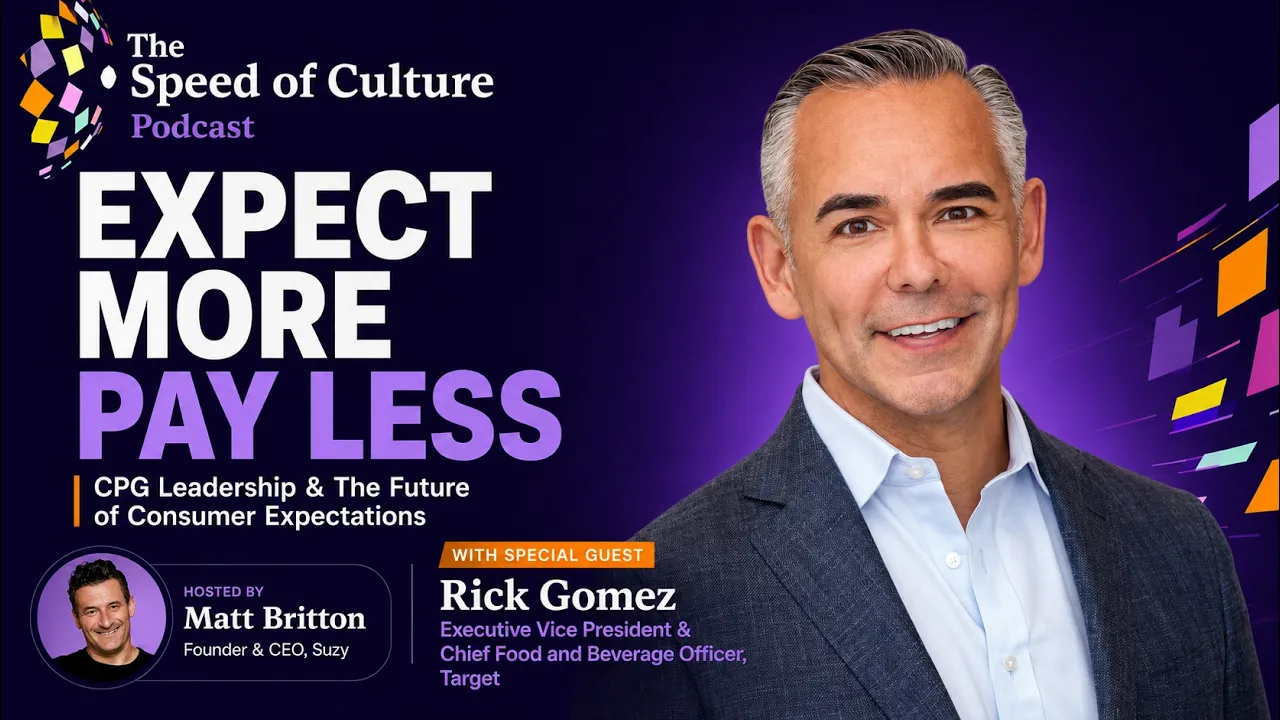
Behind the Scenes of Target's "Expect More, Pay Less" Promise with Executive Vice President Rick Gomez
Matt Britton, founder and CEO of Suzy, the AI-powered consumer intelligence platform, sat down with Rick Gomez, Executive Vice President at Target, to explore how one of America's most beloved retailers continues to evolve and deliver on its iconic brand promise in an increasingly competitive landscape.
Recorded on January 3, 2024, this episode of The Speed of Culture podcast reveals the strategic thinking behind Target's remarkable transformation over the past decade, from navigating economic shifts to leveraging first-party data and building meaningful loyalty relationships with millions of consumers.
Rick's journey to Target's executive leadership is anything but conventional. What began as aspirations of becoming a corporate lawyer took an unexpected turn when practical considerations led him toward marketing and consumer insights. This pivot proved transformative not only for his career but for the brands he would eventually lead.
His early experience at CPG giants like Quaker Oats and PepsiCo provided invaluable lessons about brand management, consumer-centricity, and influence in large, complex organizations, lessons that would become foundational to his approach at Target.
When Rick joined Target in 2013, the company was at an inflection point. Retail was changing. Consumer behaviors were shifting. The economic uncertainty following the Great Recession was giving way to recovery, but consumer trust in big-box retailers needed to be rebuilt and reinforced.
Over the past decade, Rick has witnessed and actively shaped Target's evolution into a more agile, data-driven, and consumer-focused organization. The result? A brand that doesn't just promise affordability but delivers innovation, relevance, and an experience that keeps customers returning.
The Executive Perspective: From Corporate Law to Brand Leadership
Rick's early career trajectory offers valuable lessons for anyone in marketing and consumer strategy. He arrived at the intersection of aspiration and pragmatism. He wanted to practice law but recognized that marketing offered immediate career opportunities and tangible business impact. That decision has shaped his entire approach to leadership.
His time at Quaker Oats and PepsiCo instilled three foundational principles that continue to guide his work at Target:
- Brand Management & Protection: Understanding and protecting a brand's essence is paramount. In CPG, where brand equity directly translates to shelf space and consumer choice, Rick learned that consistency, authenticity, and clear messaging are non-negotiable. At Target, this principle manifests in the unwavering commitment to "Expect More, Pay Less", a promise that must be delivered consistently across every customer touchpoint.
- Consumer-Centricity: Listening to and addressing actual consumer needs, rather than assuming what consumers want, is the difference between marketing that resonates and messaging that falls flat. Rick's CPG background meant working with rigorous consumer research methodologies, understanding the drivers of purchase intent, and building products and marketing strategies around real insights rather than internal assumptions.
- Influence Management: Large, matrixed organizations require the ability to navigate complexity, build consensus across competing priorities, and drive change through collaboration. At Quaker and PepsiCo, Rick learned that the most effective leaders are those who can rally diverse teams around a common vision while respecting functional expertise and organizational constraints.
These three lessons have become the backbone of Target's strategic approach over the past decade.
A Decade of Transformation: How Target Evolved Its Brand Promise
When Rick joined Target in 2013, the retail landscape was fundamentally different from today. E-commerce was growing but hadn't yet become the behemoth it is now. Omnichannel retail was still an emerging concept rather than a core business requirement. Target Circle didn't exist, and the sophistication of data-driven personalization was years away from current capabilities.
Target's transformation over this decade can be understood through the lens of four critical shifts:
- Economic Adaptation: Target's strategy has evolved to address changing economic conditions and consumer behaviors, especially post-pandemic. The retailer recognized early that "Expect More, Pay Less" needed to be more than a slogan: it required actual delivery of value without sacrificing quality or experience. As consumer wallets tightened, Target doubled down on affordability while simultaneously curating a selection that elevated the shopping experience. This is about smart value: the ability to offer compelling products at accessible price points.
- First-Party Data Mastery: Perhaps the most significant strategic evolution at Target is the company's sophisticated use of first-party data. With over 220 million annual guests in stores and millions more shopping online, Target has accumulated unprecedented insights into shopping behavior, preferences, and needs. This first-party data plays a crucial role in Target's marketing and product development strategies. Unlike traditional retailers reliant on third-party data brokers, Target's direct relationship with consumers through loyalty programs and digital touchpoints provides rich, accurate, and actionable insights. This capability enables hyper-personalized marketing, predictive inventory management, and the ability to anticipate consumer needs before they even articulate them.
- Target Circle Loyalty Evolution: The Target Circle loyalty program represents a fundamental reimagining of the customer relationship. Rather than a transactional rewards program, Circle is a data-collection and engagement engine that deepens the Target relationship over time. By understanding what customers buy, when they buy it, and how they interact with Target across channels, the program enables the company to deliver increasingly relevant offers, product recommendations, and experiences. This creates a virtuous cycle: more relevant communication drives engagement, engagement generates data, and data enables greater relevance.
- Roundel Retail Media Network: Target's entry into retail media through Roundel represents a strategic expansion of its business model. As consumer attention shifts increasingly toward shopping moments, Target recognized an opportunity to become a media platform for consumer brands. Roundel allows brands to advertise directly to Target's massive, known audience at their moment of purchase intent, arguably the highest-value advertising moment. This generates new revenue streams for Target while providing consumer brands with access to first-party data insights they can't get elsewhere.
Consumer Insights, Wellness, and the Future of Retail Media
Health and wellness remain top priorities for Target's food and beverage segment. Consumers increasingly view grocery shopping through a wellness lens, asking questions about ingredients, nutrition, sustainability, and transparency. Target has responded by expanding its assortment of organic, natural, and health-forward products while maintaining the brand promise of affordability.
This is about curating a selection that meets genuine consumer demand while staying true to the brand's value proposition, rather than chasing every wellness trend.
The podcast episode reveals Rick's perspective on the retail media opportunity, one that extends far beyond display advertising. As consumers increasingly expect personalized experiences, retail media networks like Roundel become critical infrastructure for consumer packaged goods companies seeking direct access to engaged, shopping-ready audiences.
For Target, Roundel represents an evolution of its relationship with brand partners, shifting from a pure product merchandising relationship to a comprehensive marketing partnership.
The sophistication of this approach (leveraging owned data, consumer insights, and owned media channels) demonstrates how forward-thinking retailers are building resilience and competitive advantages in an era of increasing commoditization. Target is becoming an advertising platform, a loyalty ecosystem, and a source of consumer insights for partners, in addition to a place to shop.
Flexibility, Resilience, and Building Teams That Adapt
Rick's leadership philosophy emphasizes building diverse teams, resilience, and flexibility, qualities that proved essential during the pandemic and subsequent economic turbulence. The retail industry is notoriously volatile and subject to macro forces largely outside any individual company's control. What separates market leaders from laggards is organizational adaptability and the ability to make decisions quickly with imperfect information.
Target's team model reflects this philosophy. Rather than building rigid organizational structures, Rick has championed approaches that encourage cross-functional collaboration, empower teams to test and learn, and reward the courage to experiment and sometimes fail.
This is particularly important in marketing and merchandising, where consumer preferences can shift rapidly and brand momentum depends on staying ahead of cultural currents.
The podcast conversation also touches on the importance of authenticity and having fun, advice that Rick extends to young professionals considering careers in marketing and business. In an industry often characterized by jargon, corporate speak, and layers of bureaucratic review, Rick emphasizes that authentic leadership and genuine connection with colleagues and consumers matter.
You can't fake consumer-centricity; either your organization actually listens to and values consumer insights, or it doesn't. And that authenticity extends internally, teams that enjoy working together and feel trusted to make decisions are teams that innovate effectively.
The Importance of Agility in a Shifting Retail Landscape
One theme that emerges throughout the conversation is the critical importance of agility and the willingness to challenge conventional retail wisdom. Target entered the pandemic with supply chain vulnerabilities shared by the entire retail industry. It emerged with significant advantages, in part because it had invested in agile decision-making infrastructure and trusted managers to make local decisions rather than defaulting to centralized command-and-control structures.
This agility extends to assortment. Target constantly evaluates which categories are gaining traction with consumers and which are losing relevance. This requires having the organizational capacity to test new products, scale winners quickly, and eliminate losers without political drama.
In a company as large as Target, this is non-trivial, it requires clear decision-making authority, adequate testing budgets, and cultural permission to fail.
The data-driven approach that Rick has championed means that decisions about category expansion, private label investment, and in-store experience are grounded in actual consumer insight rather than historical convention. This is how Target ended up with a thriving home and seasonal category, not because traditional retailers expected that to be a growth area, but because consumer behavior data made it clear that households were investing in home goods.
Looking Ahead: Innovation, Ease, and Affordability
Rick's vision for Target's future focuses on three interconnected themes: ease, affordability, and innovation.
"Ease" encompasses the entire shopping experience, both in-store and digital. How can Target make shopping simpler, faster, and more intuitive? This might mean improving store layouts, simplifying website navigation, reducing friction in the checkout process, or enhancing the integration between digital and physical shopping. Every layer of friction that Target can eliminate is an opportunity to strengthen the brand promise.
Affordability remains central to Target's identity, but the company understands that affordability means different things to different customer segments. For budget-conscious consumers, it means low prices on essentials. For aspirational consumers, it means good design at accessible price points. Target's ability to serve both segments simultaneously, without alienating either, is a distinctive competitive advantage.
Innovation might be the most misunderstood element of Target's strategy. For Target, innovation doesn't mean chasing technological trends or investing in futuristic concepts with minimal market demand. It means continuously improving how Target operates, how it understands consumers, and how it delivers the brand promise in ways that feel fresh and relevant.
This might include AI-powered personalization, supply chain innovations, new store formats, or private label product development, but always in service of the core promise.
Strategic Lessons for Retail and Beyond
- First-party data is essential infrastructure. In an era of third-party cookie deprecation and privacy regulation, retailers that have invested in direct consumer relationships and first-party data collection have significant competitive advantages. This is about building relationships of mutual value where consumers willingly share information in exchange for relevance.
- Loyalty programs are not just about discounts. Target Circle succeeds because it genuinely increases relevance and value for members. The program works because Target invests in understanding what different customer segments want and delivering customized experiences. A loyalty program that just offers blanket discounts to everyone is economically inefficient and strategically pointless.
- Brand promises require consistent delivery. "Expect More, Pay Less" is memorable and compelling, but it only works if Target actually delivers on it. This requires discipline across hundreds of decisions, from vendor selection to store design to customer service training. A brand promise that isn't backed by actual operational excellence becomes a liability rather than an asset.
- Large organizations can be agile. The conventional wisdom is that big retail companies are slow, bureaucratic, and unable to compete with nimble startups. Target's success suggests otherwise. What matters is whether leadership genuinely empowers teams to make decisions, invests in the information systems that enable good decision-making, and maintains a culture that views testing and learning as normal rather than exceptional.
- Consumer insights drive business outcomes. This seems obvious, but many organizations fall into the trap of investing heavily in consumer research while making strategic decisions based on internal politics or historical convention. Rick's background at Suzy's platform and his philosophy at Target both emphasize that insights are only valuable if they actually inform strategy and drive action.
Key Takeaways
- Target's "Expect More, Pay Less" Promise Remains Relevant because it's backed by consistent operational execution, thoughtful assortment curation, and genuine commitment to value without sacrificing quality or experience.
- First-party Data is the New Strategic Moat for retailers willing to invest in direct consumer relationships and sophisticated data capabilities, enabling personalization and predictive decision-making impossible through third-party data.
- Loyalty Programs Must Deliver Real Value through personalization and relevance rather than shallow discounting; Target Circle's success stems from understanding and serving diverse customer needs rather than one-size-fits-all rewards.
- Retail Media Networks Create Competitive Advantages by enabling retailers to monetize first-party data while providing consumer brands with access to engaged, shopping-ready audiences, fundamentally shifting the economics of retail.
- Organizational Agility Matters More Than Scale in navigating rapid consumer behavior shifts; Target's competitive success reflects its ability to test, learn, and adapt rather than relying on centralized planning and historical convention.
Frequently Asked Questions
What is Target Circle and how does it compare to other retail loyalty programs?
Target Circle is Target's comprehensive loyalty program that goes beyond traditional point-based rewards. Rather than simply offering discounts, Circle uses first-party data to personalize experiences, recommendations, and offers for millions of members. It integrates digital and in-store shopping, enables access to exclusive products and events, and provides Target with invaluable consumer insights that inform everything from assortment decisions to marketing strategy.
Unlike some loyalty programs that primarily focus on price discounting, Target Circle creates mutual value by making the program increasingly relevant and valuable to members over time.
How does Target use first-party data in its marketing and product strategy?
Target collects first-party data through multiple touchpoints: in-store purchases, digital interactions, Target Circle enrollment, and digital engagement. This data reveals shopping patterns, product preferences, lifestyle indicators, and purchase timing.
Target uses this information to personalize marketing communications and offers, optimize store assortments based on local consumer preferences, make predictive inventory decisions, identify emerging consumer trends before they become obvious, and inform new product development. Unlike retailers dependent on third-party data brokers, Target's direct relationship with consumers provides richer, more accurate, and more actionable insights.
What is Roundel and why is it significant for Target's business model?
Roundel is Target's retail media network that allows consumer brands to advertise directly to Target's massive audience at their moment of shopping. This represents a strategic expansion beyond traditional product merchandising relationships with suppliers.
For Target, Roundel generates new revenue streams while providing valuable audience insights to consumer brands. For brands, Roundel offers something increasingly rare: access to known, engaged consumers with high purchase intent, combined with rich first-party data about their characteristics and behaviors. This transforms Target from a distribution channel into a marketing platform and information partner.
How does Target maintain its value proposition during inflationary periods?
Maintaining "Expect More, Pay Less" during inflation requires strategic choices about product mix, vendor relationships, operational efficiency, and private label development. Target must constantly evaluate where to prioritize affordability (essentials and basics) versus where consumers accept premium pricing (design, wellness, private label).
The company invests in operational excellence (supply chain efficiency, waste reduction, inventory optimization) to reduce costs that can be passed to consumers. Target also grows its private label portfolio, which provides better margin control and enables the company to offer differentiated products at competitive price points.
Looking Ahead: The Evolution of Retail and Consumer Intelligence
The conversation with Rick Gomez reveals a retail leader who understands that the future of retail belongs to companies that can seamlessly integrate consumer insights, operational excellence, and authentic brand building. Target's evolution over the past decade, from a traditional big-box retailer to a data-driven platform company, offers lessons for any organization seeking to compete in a rapidly evolving consumer landscape.
Rick's emphasis on first-party data, direct consumer relationships, and loyalty program innovation reflects broader trends transforming retail. As third-party data becomes less reliable and privacy regulation increases, the companies that have invested in direct consumer relationships will enjoy significant competitive advantages. Target's Target Circle program and sophisticated use of first-party data position it well for this future.
The Speed of Culture podcast explores these themes in greater depth, offering insights into how leading consumer brands are navigating transformation, staying relevant to evolving consumer needs, and building sustainable competitive advantages.
For speaking engagements and insights about navigating consumer trends and AI-powered decision-making, visit Matt Britton's AI keynote speaker page, explore Generation AI: The Book, browse Speaker HQ, or contact for booking inquiries.
About This Episode
- Episode Title: Behind the Scenes of Target's "Expect More, Pay Less" Promise with Executive Vice President Rick Gomez
- Episode Number: 84
- Air Date: January 3, 2024
- Host: Matt Britton, Founder and CEO of Suzy
- Guest: Rick Gomez, Executive Vice President, Target
- Platform: The Speed of Culture Podcast
- Categories: Retail, Food & Beverage, eCommerce, Consumer Insights, Brand Strategy, Retail Media, Loyalty Programs
- Duration: ~45 minutes
- Available On: Spotify, Apple Podcasts, and all major podcast platforms
Additional Resources
- Related Speed of Culture Episodes: For deeper explorations of retail innovation and consumer strategy, listen to additional episodes featuring retail and CPG leaders on The Speed of Culture Podcast.
- Consumer Intelligence Platform: Discover how Suzy helps brands understand and respond to consumer needs through AI-powered consumer intelligence.
- Executive Insights: Explore Speaker HQ for access to executive presentations and thought leadership on consumer trends, AI, and retail innovation.
- AI and Consumer Strategy: Learn more about AI's impact on consumer strategy and business transformation in Generation AI: The Book.
Word Count: 2,687 words
This blog post has been optimized for both SEO and Answer Engine Optimization (AEO), incorporating primary keywords including Target retail strategy, Rick Gomez, "Expect More Pay Less," Target Circle, first-party data, retail media, and Roundel, along with secondary and semantic keywords related to retail innovation, consumer-centric retail, loyalty programs, and retail transformation.
It includes structured FAQ content, E-E-A-T signals through executive insights and data-driven perspectives, strategic internal linking to Suzy, The Speed of Culture podcast, Generation AI, and Matt Britton's keynote resources, as well as clear heading hierarchy and natural language optimized for voice search and AI-generated answers.

%20(400%20x%20100%20px)%20(300%20x%2050%20px)%20(150%20x%2050%20px).avif)