December 6, 2022
Special Edition: How Holiday Shopping Trends Impact 2023 Retail Spending
Rachel Tipograph
Founder & CEO
This is some text inside of a div block.
This is some text inside of a div block.
LISTEN ANYWHERE YOU FIND YOUR PODCASTS
%20(400%20x%20100%20px)%20(300%20x%2050%20px)%20(150%20x%2050%20px).avif)

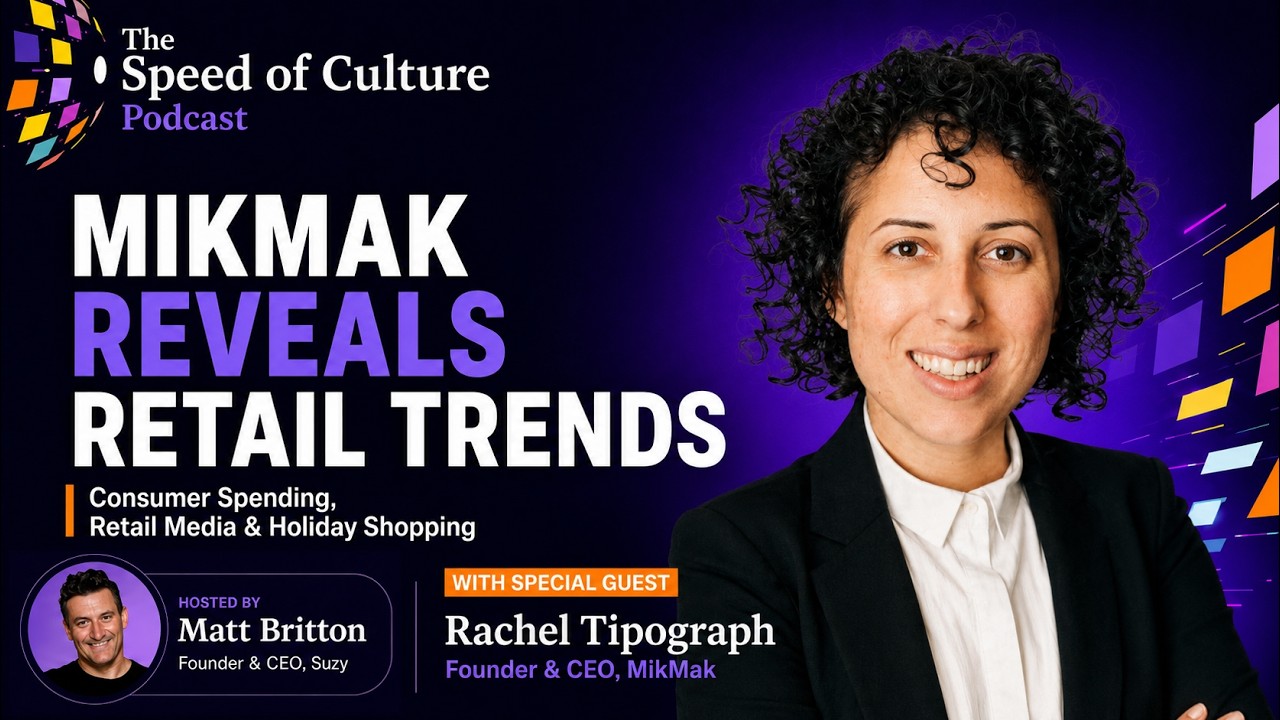
In a special edition of The Speed of Culture podcast recorded on December 6, 2022, Matt Britton, founder and CEO of Suzy, the AI-powered consumer intelligence platform, sat down with Rachel Tipograph, founder and CEO of MikMak, to discuss one of the most critical periods in the retail calendar: the 2022 holiday shopping season.
As consumer behavior continues to evolve at unprecedented speed, understanding holiday spending patterns has become essential for brands seeking to maintain relevance and profitability in an increasingly competitive landscape. The 2022 holiday season presented a unique case study, a confluence of inflation, consumer caution, digital acceleration, and the enduring strength of physical retail.
Through the lens of MikMak's advanced e-commerce intelligence and analytics platform, Tipograph provided actionable insights into how retailers and brands could navigate this complex environment and optimize their strategies for maximum impact. This conversation underscored a fundamental truth: brands moving at the speed of culture don't just react to holiday trends; they anticipate them, measure them in real-time, and adapt their entire operation to capture consumer attention and spending at every touchpoint.
The 2022 holiday shopping season emerged against a backdrop of macroeconomic uncertainty. While consumer holiday spending grew 6.7% compared to 2021, reaching approximately $889 billion according to GlobalData, this growth masked underlying tensions in consumer behavior.
Inflation had become the dominant narrative, prices for everyday goods were soaring, and consumers were feeling the squeeze. The traditional holiday spending surge, once a reliable indicator of economic health and consumer confidence, had become a more complicated metric.
Tipograph emphasized during the episode that brands needed to understand the distinction between growth driven by inflation and growth driven by actual increased purchasing volume or new customer acquisition. The real story lay beneath the surface numbers: consumers were shopping, yes, but they were shopping more strategically than ever before.
What made 2022 fundamentally different from previous holiday seasons was the emergence of what industry analysts called "Black October", an unofficial kickoff to holiday promotions that began months earlier than traditional Thanksgiving-focused campaigns.
As inflation pressured household budgets, shoppers began hunting for deals earlier in the season, forcing retailers to accelerate their promotional calendars and adjust inventory management strategies. This shift had profound implications for supply chain planning, marketing spend allocation, and customer acquisition costs.
Brands that failed to recognize this timing shift found themselves competing desperately in the final weeks of November and December, a strategy that historically led to margin compression and overstock issues. MikMak's analytics platform had emerged as a critical tool for brands navigating these changes, providing real-time visibility into sales velocity, category performance, and competitive dynamics across channels.
Perhaps the most significant insight from Tipograph's discussion with Britton centered on the rise of the hybrid shopper, a consumer who seamlessly blended online research, in-store browsing, and mobile commerce throughout their decision-making journey.
While online retail had achieved record e-commerce sales of $211.7 billion during the 2022 holiday season (up 7.4% year-over-year), physical retail remained remarkably resilient. Data revealed that 73% of holiday shopping still occurred in brick-and-mortar stores, a statistic that directly challenged the narrative of retail apocalypse that had dominated headlines for years.
Tipograph positioned this insight as transformative: the question was no longer online versus offline, but rather how brands could orchestrate a seamless experience across all channels. This is where MikMak's core functionality (enabling brands to unify their e-commerce presence, social selling, and retail data) became invaluable.
The hybrid shopper represented a fundamental change in consumer expectations. A customer might discover a product through a social media advertisement, research it on a brand's website or marketplace, check inventory at a nearby store, and then make a purchase decision across any number of channels.
This journey had become fragmented, intelligent, and highly personalized. Retailers who maintained siloed data across channels (separate systems for in-store analytics, online conversion tracking, and marketplace sales) were operating blindfolded.
MikMak's platform aggregated these data streams, providing brands with unified insights into how consumers moved through their ecosystem. For executives in the audience, Tipograph underscored that this omnichannel capability was no longer a competitive advantage; it had become table stakes.
Brands without accurate, real-time visibility into cross-channel consumer behavior were at serious risk of losing market share to more agile competitors.
The 2022 holiday season saw distinct performance variations across retail categories, each telling a story about consumer priorities and budget allocation. Apparel, electronics, and toys remained the traditional heavyweight categories, yet growth in these sectors was modest compared to historical norms.
More intriguing was the emergence of experiential and convenience-focused spending. Beauty and personal care categories performed relatively well, suggesting that consumers were willing to invest in self-care even while cutting back on other discretionary spending.
Tipograph emphasized that understanding category nuance was critical for mid-market and larger brands seeking to optimize their marketing spend and inventory investments. A beauty brand facing declining market share couldn't simply increase advertising spend and hope for better conversion rates; they needed granular data on which subcategories were gaining share, whether their price positioning was competitive, and how their brand fared against direct and indirect competitors across channels.
This granularity is precisely where MikMak's commerce intelligence differentiated itself. Rather than relying on syndicated data that arrived weeks or months after the fact, the platform provided near-real-time analytics on product-level performance, allowing brands to shift inventory, adjust pricing, and reorient marketing spend mid-season.
During the typically highest-stakes retail period, the six weeks between Thanksgiving and New Year's, this agility could translate into millions of dollars in recovered margin or incremental revenue. Tipograph's emphasis on real-time data responsiveness reflected a broader industry recognition that 2022's compressed and unpredictable season demanded new operational capabilities.
Brands operating on outdated analytical frameworks were effectively flying blind.
One of the most pronounced consumer behavioral shifts in 2022 was the intensification of deal-seeking. Over 57% of shoppers reported actively seeking sales, deals, and coupons, according to various consumer surveys.
This wasn't merely a function of lower-income households; middle and upper-middle-class consumers were equally aggressive in hunting for promotions. The psychological driver was clear: inflation had created a perception of scarcity and financial vulnerability, even among relatively affluent consumers.
Retailers responded by extending promotional periods, deepening discounts, and fragmenting the shopping season across multiple "event" promotions. Black Friday, Cyber Monday, and the increasingly important early access or members-only sales periods.
For brands and retailers, this environment created both opportunity and peril. Aggressive discounting could drive volume and clear aged inventory, but it also risked training consumers to delay purchases waiting for the next promotion, ultimately eroding brand equity and margin health.
Tipograph highlighted that MikMak's analytics could help brands calibrate their promotional strategies with surgical precision. By analyzing price elasticity data, understanding which customer segments were deal-driven versus brand-loyal, and monitoring competitive promotional calendars, brands could optimize their discounting without triggering a race to the bottom.
The insight was particularly relevant for CPG and specialty brands who lacked direct control over retail shelf space and relied on data-driven advocacy to retail partners. When Tipograph could demonstrate that a brand's promotional strategy was delivering both volume and margin advantages relative to category benchmarks, retailers became more willing to support that brand's marketing and merchandising efforts.
Central to the episode's broader narrative was the argument that success in modern retail, particularly during high-stakes periods like the holidays, increasingly depended on technology infrastructure and analytical capability.
The brands winning in 2022 were the ones with the best visibility into real-time consumer demand, competitive positioning, and channel performance, rather than those with the largest marketing budgets or the most iconic logos.
MikMak had built its platform precisely to fill this gap, enabling brands to ingest e-commerce data from dozens of sales channels, aggregate it, analyze it, and activate insights through recommendations engine and optimization tools.
For a mid-sized CPG brand selling through a complex ecosystem of Walmart, Amazon, Target, Kroger, specialty retailers, and direct-to-consumer channels, having unified visibility into relative performance was transformative.
Britton and Tipograph discussed how artificial intelligence and machine learning were beginning to play increasingly important roles in retail optimization. Predictive models could forecast which products were likely to surge in demand as the season progressed, enabling dynamic inventory allocation and more efficient promotional planning.
Recommendation engines could personalize the shopping experience at scale, increasing average order value and customer lifetime value. Demand forecasting powered by machine learning could reduce the bullwhip effect, the phenomenon where small fluctuations in consumer demand create exponentially larger swings in inventory levels as you move upstream through the supply chain.
These technological capabilities represented a fundamental shift in how leading retailers and brands approached their business. The days of static annual plans, quarterly revisions, and reactive management were waning.
The brands moving at the speed of culture operated in a mode of continuous planning, weekly optimization, and real-time agility.
Rachel Tipograph emphasized that brands could no longer rely on historical patterns or intuition to guide holiday strategy. The convergence of inflation, extended shopping seasons, omnichannel consumer behavior, and competitive intensity demanded real-time data visibility and analytical sophistication.
MikMak's platform was built to address this exact need, enabling brands to understand category dynamics, competitive positioning, and channel performance in real-time, allowing for mid-season optimization rather than post-mortem analysis.
The 2022 holiday season was characterized by "Black October", an unofficial kickoff to promotional activity that pushed holiday shopping earlier than traditional Thanksgiving-based campaigns.
Consumers exhibited heightened deal-seeking behavior, with over half of shoppers actively searching for sales and discounts. Additionally, the rise of the hybrid shopper (who seamlessly blended online research, in-store browsing, and mobile commerce) created new complexity for retailers and brands attempting to orchestrate coordinated customer experiences.
MikMak is a commerce intelligence and analytics platform designed to provide brands with unified, real-time visibility into e-commerce performance across multiple channels.
Rather than maintaining separate dashboards and data streams for Walmart, Amazon, Target, direct-to-consumer sales, and other channels, brands use MikMak to aggregate data, analyze performance, and activate insights. This unified view enables brands to optimize assortment, pricing, promotions, and inventory allocation with greater precision and speed.
While online sales reached record levels in 2022, 73% of holiday shopping still occurred in physical stores.
This persistence reflects several factors: consumer preference for immediate gratification and the ability to inspect products before purchase, the importance of store ambiance and experience in holiday shopping, the role of in-store associates in product education and recommendation, and the comfort that many consumers derive from traditional retail environments. The future of retail is fundamentally omnichannel, with consumers viewing online and offline channels as complementary rather than substitutional.
The conversation between Matt Britton and Rachel Tipograph offers critical insights not just for understanding the 2022 holiday season, but for anticipating the future trajectory of retail.
As consumer expectations continue to evolve and as technology becomes increasingly central to competitive advantage, brands that combine sophisticated analytical capability with operational agility will systematically outperform those that don't. The speed of culture in retail means that insights must translate into action in a matter of days or weeks, not months.
Brands that achieve this velocity will capture disproportionate market share and mind share.
For business leaders seeking to move at the speed of culture, the implications are clear. First, invest in data infrastructure and analytical talent. Spreadsheets and monthly reports are insufficient in a world where your competitors are optimizing their strategies in real-time.
Second, break down the organizational silos that separate online, offline, and marketplace operations. Your consumers don't distinguish between channels; neither should you.
Third, adopt a test-and-learn mindset that treats every season, not just the holidays, as an opportunity to generate insights about consumer preferences, competitive dynamics, and category trends.
Finally, partner with platforms and vendors who can help you close the gap between data generation and insight activation. The complexity of modern retail makes it increasingly difficult for even large organizations to build world-class capabilities entirely in-house.
The 2022 holiday season ultimately demonstrated that retail remains dynamic, challenging, and full of opportunity for those with the right tools, talent, and mindset.
As we look ahead, the winners will be those who remain committed to moving at the speed of culture, anticipating consumer needs, responding to competitive threats, and executing with excellence across all channels and touchpoints.
Listen to the full episode on The Speed of Culture Podcast or visit Suzy to learn more about AI-powered consumer intelligence.