March 15, 2024
Burger King’s Million Dollar Whopper Idea with CMO, Pat O’Toole
Pat O'Toole
CMO
This is some text inside of a div block.
This is some text inside of a div block.
LISTEN ANYWHERE YOU FIND YOUR PODCASTS
%20(400%20x%20100%20px)%20(300%20x%2050%20px)%20(150%20x%2050%20px).avif)

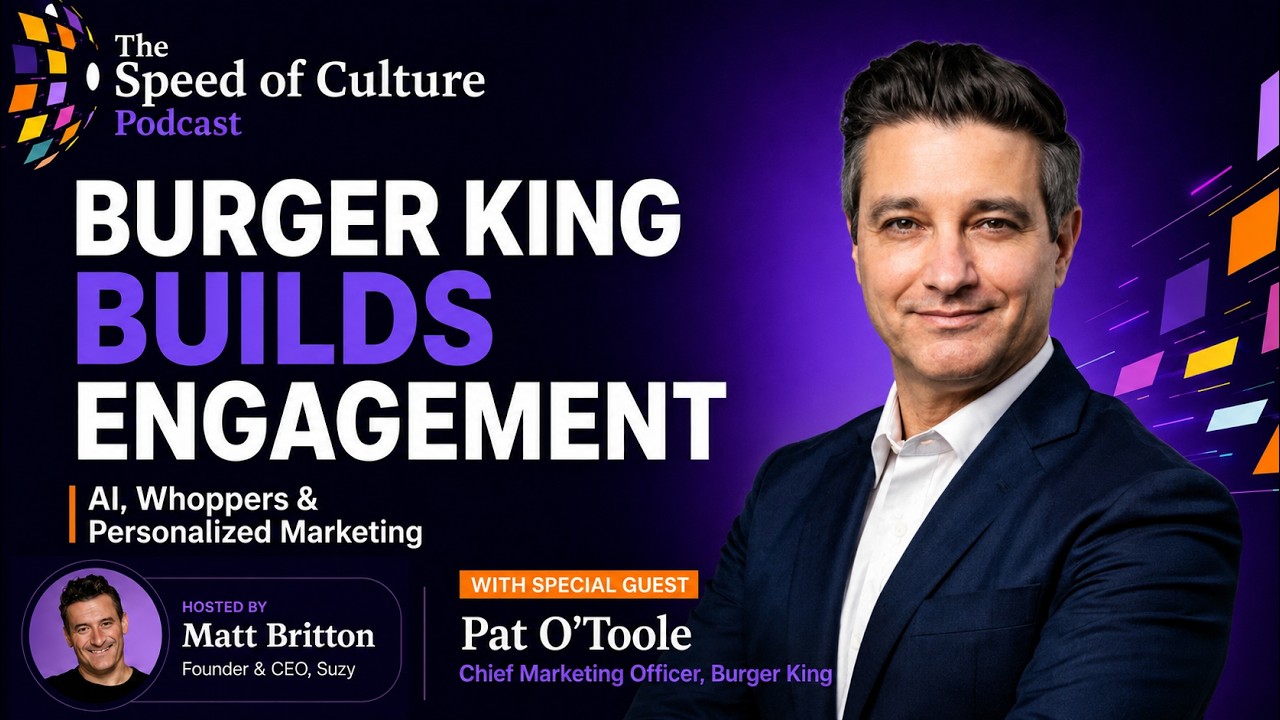
In February 2024, Burger King fundamentally reimagined how quick-service restaurants engage customers through technology and creativity. The Million Dollar Whopper contest represents a watershed moment in fast-food marketing, combining generative AI, consumer co-creation, and bold brand confidence into one integrated campaign that generated over 1 million contest entries and drove record-setting in-store sales.
To understand the strategy and vision behind this innovative initiative, Matt Britton, founder and CEO of Suzy, the AI-powered consumer intelligence platform, sat down with Pat O'Toole, Chief Marketing Officer at Burger King, on Episode 97 of The Speed of Culture Podcast. During their in-depth conversation, O'Toole breaks down how Burger King leveraged generative AI to democratize product creation, built anticipation through three finalist reveals, and executed what may be the most ambitious consumer engagement campaign in quick-service restaurant history.
The Million Dollar Whopper contest emerges against a backdrop of significant marketing challenges facing the QSR industry. Fast-food chains typically follow predictable campaign cycles: limited-time offers (LTOs), celebrity partnerships, and occasional contests that capture consumer attention for weeks before fading.
Burger King's approach was fundamentally different. By inviting customers to design their own Whopper using an AI-powered platform, the company shifted from passive consumers to active co-creators. Customers could input text descriptions of their dream Whopper (whether that meant adding gummy bears, sriracha, or even ice cream) and the platform would generate high-quality images and videos. This single innovation transformed the contest from a typical sweepstakes into a viral content machine that extended the campaign's reach far beyond traditional advertising channels.
The business results speak for themselves. The campaign achieved 14 million visits to the BK App, generated 3 million Whopper creations using the AI platform, produced 1.3 million AI-generated video ads, and drove record-setting sales performance in November 2024.
But beyond the numbers, the Million Dollar Whopper contest offers invaluable lessons about how CMOs can harness emerging technologies, empower consumer creativity, and build brand loyalty in an era where authenticity and personalization have become table stakes. The contest was built on an understanding that modern consumers want to create, express themselves, and be recognized for their ideas rather than be lectured by brands.
When Pat O'Toole joined Burger King in 2023 from Mountain Dew at PepsiCo, he inherited a brand facing a familiar challenge: how to stand out in a crowded QSR marketplace dominated by entrenched competitors and shifting consumer preferences. The Whopper, despite being an iconic menu item with decades of brand equity, had become routine for many customers.
O'Toole recognized an opportunity to flip the script entirely by turning customers into menu architects.
The Million Dollar Whopper campaign leveraged generative AI in a way that few QSR brands had attempted at this scale. Rather than relying on a panel of chefs or marketing executives to develop limited-time offerings, Burger King opened the process to millions of consumers.
The contest invited customers to describe their ideal Whopper, using the AI interface to generate photorealistic images and videos of their creations. This was a strategic shift that addressed fundamental questions about product development, customer engagement, and brand relevance.
Generative AI enabled Burger King to process an unprecedented volume of creative consumer input efficiently. Traditional product development cycles in QSR typically involve months of research, test kitchens, and market testing. The Whopper customization platform compressed this timeline dramatically.
More importantly, it created a feedback loop where consumers felt invested in the brand because they had contributed directly to product innovation. When someone uses the AI tool to imagine a Maple Bourbon BBQ Whopper with crispy onions and jalapeños, and then learns their creation could appear on menus nationwide, the emotional connection to the brand transforms from passive consumption to active participation.
The platform's success also stemmed from smart technological implementation. The generative AI models created realistic visualizations that customers could immediately share on social media. A person spending five minutes customizing their dream Whopper might spend another twenty minutes sharing the AI-generated video with friends, tagging Burger King, and encouraging others to participate.
This organic, user-generated amplification represents marketing efficiency that traditional paid advertising struggles to match. The 1.3 million AI-generated video ads mentioned in campaign results weren't created by Burger King's internal creative team. They were generated by customers and shared across social platforms, turning individual contest entries into distributed marketing assets.
O'Toole's perspective on the Million Dollar Whopper reflects a deeper understanding of contemporary consumer psychology. The campaign wasn't trying to convince people that Burger King makes the best burgers (a claim competitors make constantly). Instead, it positioned Burger King as a brand confident enough to let customers define quality and uniqueness on their own terms.
This aligns with the "Have It Your Way" heritage that Burger King has owned since the 1970s, but it operationalizes that promise in a contemporary way. For Gen Z and millennial consumers who have grown up with customization at every level of their digital experience, this approach feels natural rather than gimmicky.
The Million Dollar Whopper campaign structure reveals sophisticated understanding of engagement psychology and content marketing velocity. Burger King didn't simply announce "submit your Whopper idea and maybe win a prize." Instead, they engineered a campaign architecture with distinct phases that maintained momentum across quarters and created multiple moments for media coverage and consumer participation.
Over 1 million consumers entered the contest, submitting creative variations on the Whopper ranging from adventurous combinations to deliberately outrageous flavors.
Rather than immediately crowning a winner, Burger King elevated three finalists whose creations reflected different consumer tastes and regional preferences:
This finalist selection demonstrated strategic diversity. Each creation represented different flavor profiles, geographic origins, and consumer segments.
By elevating three options rather than simply announcing a winner, Burger King created new opportunities for engagement: voting campaigns, social media debates about which variant was most appealing, and media coverage analyzing the finalists as representatives of American creativity.
The financial structure, $1 million for first place, $200,000 for second place, and $100,000 for third place, positioned the contest at a scale that commanded attention. A million-dollar prize generates news coverage far beyond typical QSR promotional campaigns.
It signals that Burger King viewed this initiative as genuinely important rather than a small-scale promotion. The prize magnitude also alleviated concerns that the contest was merely a sophisticated data-harvesting operation.
By committing significant capital to actual consumer winners, Burger King demonstrated authentic commitment to the premise that customer creativity deserved recognition.
O'Toole's ability to architect and execute this multi-phase campaign reflects how modern CMOs need to think across traditional, social, and experiential media simultaneously. The finalist reveals became content moments on their own, garnering coverage from marketing trade publications, food media, and social platforms.
Each phase of the campaign extended its lifespan and gave audiences new reasons to engage with Burger King's narrative.
While the Million Dollar Whopper's surface appeal centered on consumer creativity and an ambitious prize, the campaign's deeper strategic value lay in building Burger King's Royal Perks loyalty program membership. This represents a crucial distinction between short-term promotional gimmicks and sustained brand growth initiatives.
QSR loyalty programs have become non-negotiable components of competitive strategy in the industry. Programs like McDonald's app and Wendy's rewards system represent ongoing touchpoints where customers interact with brands between visits.
Burger King recognized that the Million Dollar Whopper campaign could serve as a powerful acquisition tool for Royal Perks membership. Customers engaging with the AI creation platform were incentivized to join the loyalty program, creating customer data, transactional history, and behavioral insights that inform future marketing efforts.
The loyalty program integration also changes campaign economics. Traditional advertising campaigns generate awareness but often fail to capture sustained customer relationships.
Loyalty program memberships create owned channels (email lists, app pushes, and preference data) that enable Burger King to communicate directly with customers without relying on paid media or organic social reach. A customer who joins Royal Perks to enter the Million Dollar Whopper contest becomes a member potentially for years, receiving personalized offers, early access to new products, and exclusive promotions.
Pat O'Toole's marketing background at PepsiCo, where he led Mountain Dew's marketing efforts, likely informed this approach. Mountain Dew has successfully built deep fan communities through participatory campaigns and user-generated content strategies.
Transferring these principles to Burger King meant recognizing that the brand's future growth depended less on celebrity endorsements or expensive 30-second TV spots and more on creating platforms where customers became active brand evangelists.
The campaign data validates this strategy. The 14 million BK App visits and millions of Whopper creations represent extraordinary engagement metrics.
These are active users spending time within Burger King's owned digital ecosystem, rather than passive viewers of a commercial. Each interaction generates data about consumer preferences, creative inclinations, and behavioral patterns.
That information becomes invaluable for future product development, personalized marketing, and loyalty program optimization.
Moreover, the campaign achieved what every modern marketer covets: authentic customer advocacy. When someone spends time creating a personalized Whopper and shares it on Instagram or TikTok, they're voluntarily promoting Burger King to their social networks, unprompted by any paid advertisement.
This earned media value would be extraordinarily expensive to purchase through traditional advertising channels.
The Million Dollar Whopper campaign occurs at an inflection point in how artificial intelligence reshapes marketing and consumer engagement across industries. For fast-food chains specifically, this campaign demonstrates how AI can address longstanding challenges in the QSR competitive landscape.
First, the campaign illustrates how generative AI reduces the friction between consumer imagination and brand execution. Historically, the gap between what customers wanted and what restaurants could realistically offer was significant.
The AI visualization platform bridges that gap by letting customers see photorealistic versions of their ideas instantly, creating satisfaction even if their concept doesn't become a permanent menu item.
Second, the campaign demonstrates how AI can democratize creative collaboration. Burger King didn't position itself as the arbiter of taste or expertise in burger construction.
Instead, the brand became a facilitator, providing a platform where consumer creativity could flourish. This represents a fundamental psychological shift from "here's what we recommend" to "here's what you can create."
For younger consumers particularly, this collaborative approach feels more authentic than traditional top-down brand communication.
Third, the Million Dollar Whopper campaign provides a blueprint for how CMOs can integrate AI into customer acquisition funnels. Rather than viewing AI as merely a cost-reduction tool, the campaign positions AI as a customer engagement lever.
The technology creates experiences that customers actively want to participate in, generating interest and loyalty as byproducts.
The campaign also reflects broader industry trends toward personalization and customization. Chipotle pioneered the concept of customizable fast-casual restaurants, proving that consumers would pay premium prices for personalized preparation.
Burger King's approach applies similar principles through digital and AI-driven channels. Rather than standing in line to customize a physical burger, customers customize digitally and then can choose whether to order the real version.
Looking at the 1.3 million AI-generated video ads created during the campaign, there's an important lesson about content distribution and social commerce. Traditional brand-created content faces challenges gaining organic reach on social platforms saturated with competing messages.
By enabling customers to generate brand-aligned content through the AI tool, Burger King created millions of unique, highly targeted pieces of content that customers themselves distributed.
This represents a significant evolution in how brands can think about content strategy and social media marketing.
When discussing campaign success, industry commentators typically focus on immediate KPIs: sales lifts, app downloads, and social mentions. The Million Dollar Whopper certainly delivered on these fronts, the 14 million app visits and record-setting November 2024 sales figures demonstrate substantial commercial impact.
However, the campaign's longer-term significance may extend beyond quantifiable short-term metrics.
Pat O'Toole's presence at Burger King during this campaign period represents a crucial factor in its success. As a CMO with significant marketing pedigree and experience at a major beverage brand, O'Toole brought strategic sophistication to campaign development and execution.
The campaign didn't emerge by accident; it reflected deliberate thinking about consumer psychology, technology integration, brand positioning, and loyalty program dynamics.
The campaign also positions Burger King as an innovator in the highly competitive QSR space at a moment when that positioning matters enormously. As larger brands like McDonald's and Wendy's invest heavily in AI-powered customer experiences, Burger King's willingness to experiment with generative AI in customer-facing applications demonstrates organizational agility and commitment to emerging technology integration.
Furthermore, the campaign created substantial goodwill and positive brand associations with technological innovation and consumer empowerment. Customers came away from the Million Dollar Whopper campaign not feeling surveilled or manipulated, but rather feeling heard and creative.
That emotional association with the brand becomes increasingly valuable as privacy concerns and AI skepticism grow more pronounced among consumers.
The campaign also generated valuable data about consumer preferences, creative inclinations, and behavior patterns. The three finalist selections suggest what flavor combinations resonate most strongly with Burger King's customer base.
That insight informs future product development, limited-time offers, and even permanent menu innovations.
Traditional fast-food contests typically ask consumers to guess, predict, or simply enter a sweepstakes for existing products. Burger King's Million Dollar Whopper inverted this model by asking customers to become product designers.
The AI-powered customization platform enabled customers to create photorealistic visualizations of their dream Whoppers, transforming the contest from passive participation into active creative collaboration.
The campaign recognized that modern consumers don't want to simply consume products; they want to help shape them. This approach generated higher engagement, more shareable content, and stronger emotional connections to the brand than traditional promotional mechanisms.
Generative AI served as the technological backbone enabling the campaign's core innovation: instant visualization of customer creativity.
The AI platform generated photorealistic images and videos of custom Whoppers within seconds, and these visualizations were immediately shareable on social media.
The technology also enabled Burger King to process millions of creative submissions efficiently, a task that would be impossible using traditional product development or focus group methodologies.
Customers could see their ideas come to life visually, creating satisfaction and emotional investment regardless of whether their specific creation ultimately became a menu item.
Burger King's decision to elevate three finalist creations rather than immediately announcing a single winner revealed sophisticated understanding of engagement psychology.
The finalist reveals created distinct content moments: media coverage analyzing each finalist, social media debates about flavor preferences, voting campaigns, and continued customer interaction.
This phased approach extended the campaign's lifespan and provided audiences with multiple reasons to engage with Burger King's narrative.
The geographic and flavor diversity of the finalists also signaled that diverse customer preferences mattered to the brand, broadening appeal across different consumer segments.
The Million Dollar Whopper functioned as a sophisticated customer acquisition tool for Burger King's Royal Perks loyalty program.
Customers engaging with the AI creation platform were incentivized to join the loyalty program, providing Burger King with owned-channel access and valuable customer data including preferences, demographic information, and transaction history.
These loyalty program memberships create ongoing touchpoints where Burger King can communicate directly with customers, personalize offers, and gather behavioral insights that inform future marketing.
The campaign converted millions of one-time contest participants into sustained, data-rich customer relationships, the ultimate objective of modern loyalty program strategy.
The Million Dollar Whopper campaign demonstrates how contemporary CMOs can harness emerging technologies, empower consumer creativity, and build sustainable competitive advantages in highly competitive industries.
As generative AI continues evolving and consumer expectations around brand experiences accelerate, campaigns that successfully integrate technology with authentic consumer participation will increasingly define category leadership.
For organizations seeking to understand how consumer preferences are shifting, how emerging technologies reshape brand engagement, and how to build competitive advantages in rapidly evolving markets, the insights are invaluable. Suzy, Matt Britton's AI-powered consumer intelligence platform, provides real-time market research capabilities that enable organizations to make faster, more data-driven decisions about strategy, product development, and marketing execution, exactly the capabilities that informed Burger King's innovative approach.
To explore more perspectives on how emerging technologies reshape brand strategy, consumer engagement, and competitive positioning, The Speed of Culture Podcast features leading CMOs, marketing innovators, and brand strategy experts discussing the most pressing challenges and opportunities in contemporary marketing.
For perspectives on how generative AI and emerging technologies reshape not just marketing but broader business strategy, Matt Britton's book Generation AI provides comprehensive frameworks for understanding AI's implications across industries and consumer segments.
Additionally, for organizations seeking thought leadership on these topics, Matt Britton serves as an AI keynote speaker helping organizations understand emerging technology trends and their strategic implications.
Those interested in hosting or collaborating with world-class marketing and technology speakers can connect through Speaker HQ, which represents leading voices on marketing, consumer trends, AI, and organizational transformation.