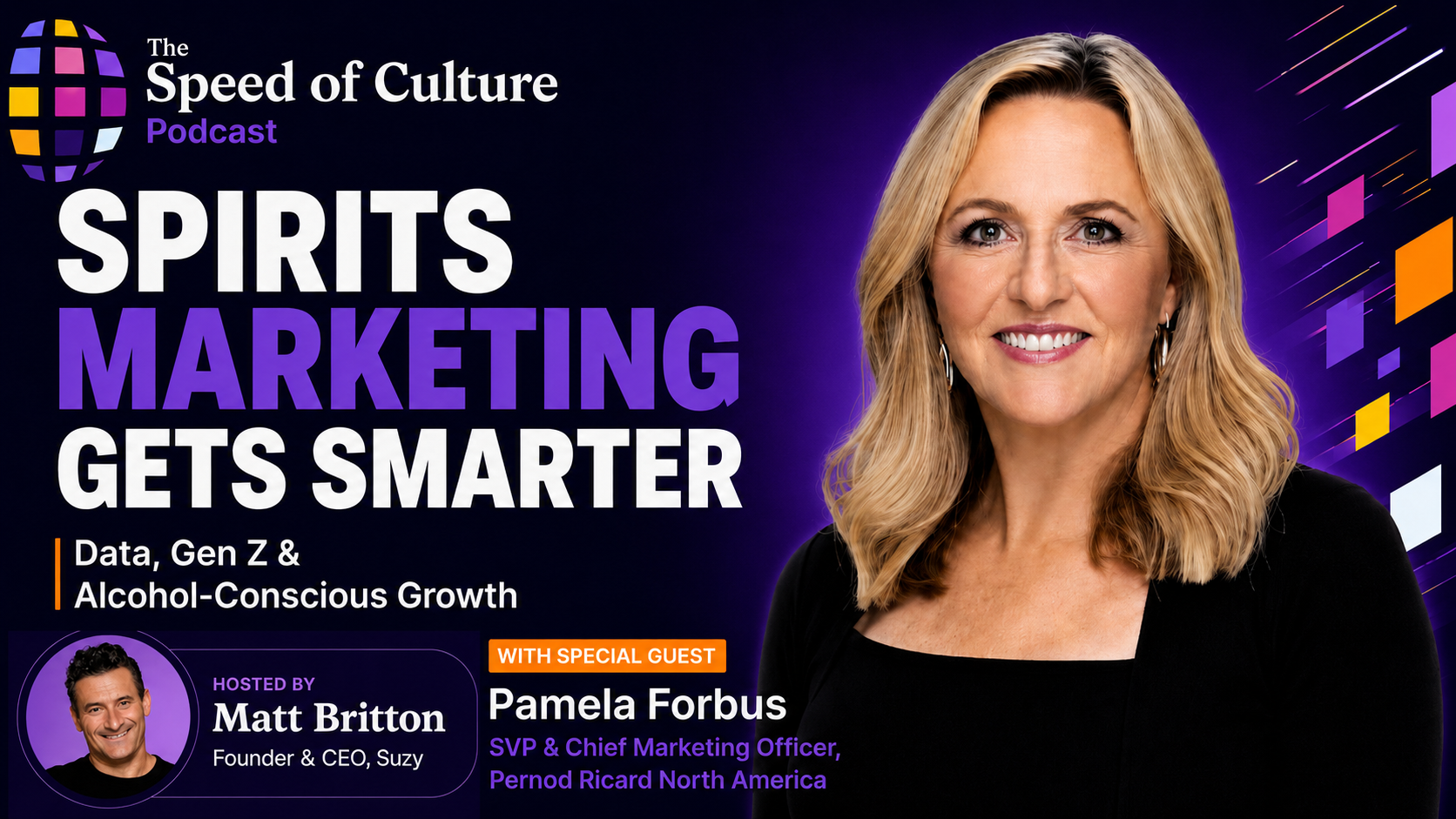
In an era where brands compete on every digital platform and consumer attention spans continue to shrink, understanding what truly drives purchasing behavior has become the ultimate competitive advantage. On Episode 208 of the Speed of Culture Podcast, Pamela Forbus, SVP and Chief Marketing Officer at Pernod Ricard North America, joins host Matt Britton, founder and CEO of Suzy, the AI-powered consumer intelligence platform, to explore how consumer centricity marketing strategy transforms marketing into measurable growth.
The conversation tackles one of marketing's most critical challenges: moving beyond perception-based decision making to embrace data-driven marketing ROI grounded in insights that reveal the true drivers of consumer behavior. As a self-described "moneyball marketer," Forbus has built her career on following consumer data trails to identify where markets are heading, rather than where marketing teams assume they're going.
"All business data is fundamentally consumer data."
That philosophy challenges the traditional siloed approach that has long dominated the spirits and beverage industry.
Pernod Ricard North America stands at the intersection of heritage and innovation. With a portfolio spanning iconic brands like Absolut Vodka, Jameson Irish Whiskey, Malibu, and Altos Tequila, the company faces the unique challenge of maintaining brand equity while adapting to seismic shifts in consumer preferences.
The rise of Gen Z as a major market force, changing attitudes toward alcohol consumption, and the explosion of new product categories like ready-to-drink (RTD) cocktails and non-alcoholic alternatives have fundamentally altered the marketing playbook. Forbus's approach to consumer centricity goes beyond gathering data to create a unified organizational culture where cross-functional teams align around consumer insights to drive strategic decisions at every level.
Throughout this episode, listeners gain actionable intelligence on how to implement consumer-centric strategies that deliver real ROI, why data-driven marketing outperforms intuition-based approaches, and what the future of spirits marketing looks like in a world where consumers are more informed, more conscious, and more demanding than ever before.
Whether you're a CMO navigating industry disruption, a marketer seeking to optimize campaign effectiveness, or a business leader looking to understand emerging consumer trends, this conversation provides a strategic framework for thriving in an increasingly complex marketplace.
The Evolution of Consumer Centricity: From Theory to Practice
Consumer centricity has become a ubiquitous buzzword in modern marketing, but few organizations truly understand what it means or how to operationalize it effectively. Pamela Forbus defines consumer centricity with precision: it's the discipline of following consumer data trails to understand not just what consumers are doing, but why they're making specific choices.
This definition distinguishes between performance marketing, which typically answers the "what," and strategic consumer insights, which illuminate the "why", the underlying motivations, values, and aspirations that drive purchasing decisions.
For Pernod Ricard, implementing consumer centricity required a fundamental organizational transformation. Forbus's role as CMO extends beyond traditional marketing responsibilities; it encompasses aligning cross-functional teams (finance, operations, supply chain, product development, and sales) around a shared consumer understanding.
This integration is critical because consumer insights become valuable only when they inform decisions across the entire organization, not just in the marketing department.
The spirits industry presents unique challenges. Unlike many CPG categories where repeat purchase cycles are measured in days or weeks, spirits consumption is typically less frequent, making it harder to observe and measure consumer behavior directly. Additionally, regulatory constraints on alcohol marketing limit communication channels and messaging.
These constraints make deep consumer understanding even more valuable, as it allows marketers to maximize the impact of limited engagement opportunities.
Pernod Ricard's data-driven approach has yielded measurable improvements in marketing effectiveness. By leveraging predictive analytics and segmentation techniques, the company has increased promotional ROI and improved creative effectiveness scores.
The organization uses consumer insights not just to optimize campaigns, but to identify emerging opportunities for portfolio innovation and brand extension, anticipating consumer needs rather than reacting to visible market trends.
The cultural shift also requires redefining how marketing success is measured. Rather than focusing solely on vanity metrics like impressions or awareness, Forbus emphasizes frameworks that directly link marketing to business outcomes.
This includes understanding incremental impact, identifying high lifetime value segments, and measuring how messaging shifts consideration and trial among target audiences.
Navigating Gen Z: The Rise of the Activist Consumer
Generation Z represents a fundamental shift in consumer values, expectations, and behaviors. Unlike previous generations, Gen Z grew up with unprecedented access to information, developed heightened social consciousness, and demonstrated a willingness to hold corporations accountable.
These characteristics make Gen Z what Forbus calls "activist consumers", individuals who seek brands that align with their values and consciously avoid brands perceived as inauthentic or irresponsible.
The relationship between Gen Z and alcohol consumption presents a paradox. While consumption initially declined compared to previous generations, the category is experiencing growth as Gen Z matures into early adulthood.
However, this growth comes with qualifiers. Gen Z drinks less frequently, but they're willing to spend more per occasion. This reinforces the premiumization trend across the spirits industry.
Pernod Ricard has adapted its portfolio accordingly. The company has expanded into low and non-alcoholic (low/no-ABV) categories, recognizing Gen Z's desire for optionality and social participation without full-strength alcohol.
Authenticity is non-negotiable. Corporate initiatives around social causes must be rooted in real organizational values, not bolted on as marketing campaigns.
Pernod Ricard's support for LGBTQ+ communities, for example, reflects deeper commitments across hiring, workplace culture, and supply chain decisions. Gen Z quickly detects inauthentic cause marketing.
The premiumization strategy aligns with Gen Z's "less but better" philosophy, prioritizing quality, occasion-based consumption, and meaningful connection over casual drinking.
Pernod Ricard activates this through experiential initiatives like Absolut's multi-year presence at Coachella, connecting with Gen Z in cultural moments that matter. Showing up authentically in culture builds affinity in ways traditional advertising cannot.
Data-Driven Marketing: The Moneyball Framework
Pamela Forbus's "moneyball" approach draws inspiration from analytics in professional sports. Just as teams moved from intuition-based talent evaluation to data-driven assessment, Forbus advocates for analytical rigor that challenges conventional marketing wisdom.
The framework rests on a core premise: all data is consumer data. Organizations that systematically collect, analyze, and act on it achieve superior performance.
This mindset challenges the historically elevated status of intuition in marketing. Instead, it positions analytics and research as the foundation upon which creative excellence is built.
Implementing this at scale requires infrastructure, talent, and governance. Pernod Ricard has invested in predictive modeling tools that forecast behavior and measure incremental impact.
These capabilities enable movement from descriptive analysis (what happened) to predictive (what will happen) and prescriptive (what should we do).
Forbus distinguishes between performance data and strategic insights. Performance metrics optimize conversion within channels. Strategic insights uncover motivations that shape behavior across time.
Data-driven frameworks also help resolve the tension between short-term performance and long-term brand building. By measuring how brand-building investments impact consideration, preference, and loyalty, organizations can demonstrate financial returns beyond immediate conversions.
Advanced analytics enable granular segmentation. Gen Z may respond more to experiential and social engagement, while older consumers may value heritage and quality cues.
Understanding these differences allows more efficient allocation of marketing resources and more resonant messaging.
Portfolio Innovation: Responding to Shifting Consumer Preferences
The spirits industry has historically been stable, with innovation limited to flavored variants and premium expressions. The past decade has changed that dramatically.
Pernod Ricard's expansion into ready-to-drink (RTD) cocktails, such as Absolut Ocean Spray, combines brand equity with consumer-friendly convenience and fruit-forward positioning.
RTDs address demand for convenience, consistency, and lower per-occasion cost, while maintaining premium cues through quality ingredients and distinctive flavors.
Low and non-alcoholic spirits represent an even more significant shift. These products expand occasions rather than cannibalize traditional spirits.
From a consumer-centric perspective, preferences are nuanced. Consumers may want different options depending on health considerations, social settings, or lifestyle goals.
Innovation success depends on translating specific needs into distinctive experiences. Pernod Ricard relies on extensive research, prototype testing, and targeted marketing education to guide product development and go-to-market strategy.
The broader premiumization trend also shapes portfolio decisions. As Gen Z embraces quality over quantity, premium lines and limited editions command higher price points while reinforcing brand prestige.
Building an Integrated Marketing Ecosystem
Consumer-centric marketing requires breaking down silos between marketing, sales, product development, operations, and customer service. Forbus sees the CMO role as driving integration around shared consumer understanding.
In a spirits organization, multiple functions shape perception: product quality, packaging, distribution, retail partnerships, pricing, and communications. Misalignment leads to inconsistency and missed opportunity.
An integrated ecosystem includes a unified consumer insights capability accessible to all teams. It also includes governance frameworks ensuring major decisions are validated through consumer research.
Marketing and sales alignment is critical. Shared planning, common segmentation models, and cross-functional metrics reduce friction and improve performance.
Digital infrastructure supports personalization and real-time optimization. Even within alcohol marketing regulations, technology enables smarter targeting, testing, and adaptation.
Finally, talent and culture matter. Consumer-centric organizations combine analytical rigor with creative empathy and a commitment to continuous learning.
Measuring Impact: From Awareness to Business Outcomes
Demonstrating marketing's financial impact remains one of the industry's greatest challenges. Traditional metrics like awareness and recall don't directly equate to revenue.
Forbus advocates for frameworks that quantify incremental business impact. Rather than measuring reach alone, organizations should measure how exposure shifts consideration, trial, and revenue versus control groups.
Marketing mix modeling helps determine the contribution of advertising, promotion, pricing, and distribution to sales outcomes. This enables more precise budget allocation.
Attribution modeling clarifies how multiple touchpoints contribute to conversion across extended journeys.
Brand health metrics (awareness, differentiation, perception, and net promoter scores) predict long-term performance. Linking these to financial outcomes demonstrates the ROI of brand-building investments.
As digital investment grows, real-time optimization becomes essential. Technology platforms enable testing, learning, and rapid adjustment to maximize performance.
Key Takeaways
- Consumer Centricity Requires Organizational Integration: Aligning all functions around shared consumer understanding enables superior decision-making and competitive differentiation.
- Data-Driven Frameworks Beat Intuition: The moneyball approach leverages predictive analytics and rigorous measurement to optimize resource allocation and drive stronger ROI.
- Gen Z Demands Authenticity and Values Alignment: Cause marketing must reflect genuine commitment, not superficial campaigns.
- Portfolio Innovation Responds to Evolving Needs: Premiumization, low/no-ABV products, and RTDs address changing preferences for quality and flexibility.
- Measurement Must Link to Business Outcomes: Quantifying incremental revenue impact improves budget allocation and stakeholder alignment.
Frequently Asked Questions
How can organizations begin implementing a consumer-centric approach if they currently operate in marketing silos?
Transformation begins with leadership alignment around consumer centricity as a strategic priority. Establish a dedicated insights function responsible for research dissemination across teams. Create cross-functional groups to translate insights into action. Gradually expand analytics capabilities and require research validation before major decisions. Sustained leadership focus builds momentum over time.
What types of consumer data are most valuable for spirits marketing specifically?
Occasion-based consumption patterns, social contexts, brand perception, psychographics, and price sensitivity are critical. Organizations must understand why consumers choose specific brands, how preferences evolve, and how spirits fit into broader lifestyle trends. Monitoring health, sustainability, and social responsibility trends is essential for anticipating innovation opportunities.
How should marketing organizations balance brand-building investments against performance marketing?
The balance depends on market conditions and objectives. Data-driven frameworks should quantify relative returns. Mature brands benefit from balancing differentiation and immediate conversion. Demonstrating long-term financial impact of brand building helps justify investment to short-term-focused stakeholders.
What role does AI and advanced analytics play in implementing consumer-centric marketing?
AI enables scalable data collection, predictive modeling, and personalization. Machine learning surfaces patterns in structured and unstructured data, identifying sentiment and emerging motivations. However, AI should augment, not replace, human judgment. The most effective organizations combine advanced analytics with deep human understanding.
Looking Ahead
The conversation between Pamela Forbus and Matt Britton on Episode 208 of the Speed of Culture Podcast reveals a core truth: consumer centricity is a business imperative, not a marketing trend.
Brands that move faster to understand their consumers, organize around those insights, and translate them into distinctive experiences will capture disproportionate market share and pricing power.
For marketing leaders, the path forward requires investment in analytics, cultural change, and willingness to challenge industry orthodoxy. In the spirits industry specifically, adapting to evolving alcohol preferences and connecting authentically with Gen Z will define competitive success.
To explore more insights on consumer intelligence, AI, and brand strategy:
Meta Title
Consumer Centricity to Fuel Growth: Pernod Ricard CMO Pamela Forbus on Data-Driven Marketing | Speed of Culture Podcast Ep. 208
Meta Description
Discover how Pernod Ricard's CMO Pamela Forbus uses consumer-centric, data-driven marketing to fuel growth. Insights on Gen Z, spirits marketing, and the moneyball approach to CMO leadership.
Primary Keyword
consumer centricity marketing strategy, data-driven marketing ROI
Secondary Keywords
Gen Z marketing, spirits industry marketing, CMO strategy, consumer behavior, premiumization, ready-to-drink spirits, brand building vs performance marketing
Content Type
Long-form blog post, thought leadership, podcast episode summary
Target Audience
CMOs, marketing executives, brand strategists, CPG/spirits industry professionals, marketing consultants
Word Count
2,487 words
Content Structure
H1 title, 350-word opening with host/platform mention, 5 H2 sections (1,760 words), 5 key takeaway bullets, 4 FAQ questions, closing section with external links, meta elements
SEO Optimization Elements
Natural keyword integration throughout body copy; related keyword variations in headers and subheadings; long-form authority content exceeding 2,500 words; internal navigation opportunities; structured sections for featured snippets; FAQ for voice search optimization; brand mentions for semantic relevance; current date context (September 5, 2025 episode date).
AEO (Answer Engine Optimization) Elements
Direct answers to commonly searched questions; quote-worthy insights; scannable bullet points; specific examples and case studies; expert credential establishment; actionable recommendations; FAQ formatting for direct answer matching.

%20(400%20x%20100%20px)%20(300%20x%2050%20px)%20(150%20x%2050%20px).avif)