October 7, 2025
Hype check: How Complex stays youth-first and culturally relevant

Moksha Fitzgibbons
President
This is some text inside of a div block.
This is some text inside of a div block.
LISTEN ANYWHERE YOU FIND YOUR PODCASTS
%20(400%20x%20100%20px)%20(300%20x%2050%20px)%20(150%20x%2050%20px).avif)

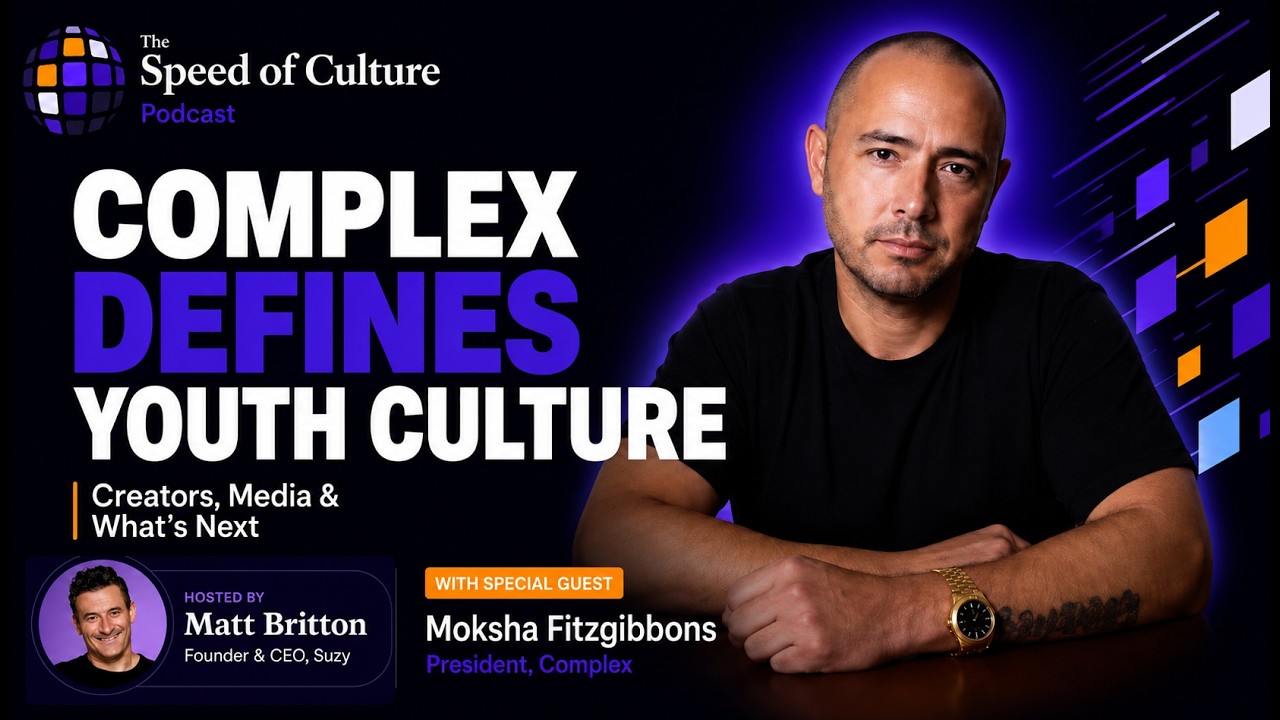
In today's rapidly shifting media landscape, few brands have managed to maintain cultural relevance across multiple decades while remaining the definitive voice for younger audiences. Yet Complex has accomplished exactly that, from its origins as a scrappy magazine in the early 2000s to its current position as a global powerhouse in youth culture, music lifestyle, and digital commerce.
In this episode of The Speed of Culture Podcast, Matt Britton, founder and CEO of Suzy, the AI-powered consumer intelligence platform, sat down with Moksha Fitzgibbons, President of Complex, to unpack the strategic decisions that have kept the brand perpetually in tune with what young audiences actually care about. Fitzgibbons brings over two decades of experience building Complex into a $100 million media empire, and his insights reveal a masterclass in brand evolution, creator partnerships, and the intersection of content, commerce, and real-world experiences.
The conversation touches on the critical moments that shaped Complex's trajectory: navigating the seismic print-to-digital pivot during the 2008 financial crash, building cultural tentpole events like ComplexCon that draw record-breaking audiences, and leveraging emerging technologies while maintaining the authenticity that resonates with Gen Z and millennial consumers.
What emerges from their discussion is a framework for how modern media brands can avoid the trap of trying to chase trends and instead position themselves as trendsetters, by deeply understanding their audience, betting on creator talent, and building ecosystems that extend far beyond traditional publishing.
As consumer behavior becomes increasingly fragmented across platforms and channels, the strategies Complex has employed, depth over reach, betting on technology and creators, and integrating physical experiences with digital content, offer a blueprint for executives in media, marketing, and brand strategy looking to future-proof their organizations in an AI-first world.
When the 2008 financial crash hit, Complex faced an existential moment. Like many print publications, the brand was vulnerable to the economic downturn and the accelerating digital migration that was fundamentally reshaping the media industry.
But rather than cling to the legacy print model, Fitzgibbons and the Complex team made a bold strategic decision: fully embrace digital.
This pivot was about reimagining what a media brand could be in a digital-first world, well beyond putting print content online. Complex invested in building a proprietary digital platform, experimenting with new formats, and most critically, recognizing that the internet offered unprecedented opportunities to connect directly with creators and audiences at scale.
The decision to go all-in on digital proved transformative. By the early 2010s, Complex had established itself as the go-to destination for content about sneaker culture, hip-hop, fashion, and streetwear, verticals where young audiences were increasingly congregating online.
The brand didn't just cover these subcultures; Complex became embedded within them, earning credibility through authentic storytelling and deep community connections.
What's particularly instructive about Complex's approach is that the brand didn't dilute its identity in pursuit of growth. Instead, it doubled down on the specific cultural verticals and audiences it understood best. This principle of depth over reach became foundational to Complex's long-term success and remains central to how the brand operates today.
One of the most revealing aspects of Fitzgibbons' discussion with Britton is the emphasis Complex places on creator partnerships and talent development. Rather than relying solely on company-produced content, Complex has built an ecosystem where creators, artists, athletes, and influencers are central to the brand narrative.
This strategy has produced some of the most culturally defining series in contemporary media. Shows like Hot Ones, where celebrities eat increasingly spicy chicken wings while answering interview questions, and Sneaker Shopping, which combines lifestyle content with commerce, didn't emerge from a corporate brainstorming session. They evolved from deep understanding of what creators and audiences wanted to engage with.
Research consistently shows that 61% of Gen Z and millennials trust influencers' recommendations, and Gen Z audiences feel more connected to brands that understand their passions. Complex's creator-centric model taps directly into this dynamic.
By partnering with creators who are authentic voices within specific subcultures, rather than hiring generic celebrity ambassadors, Complex maintains credibility and relevance within multiple overlapping communities.
The creator partnership approach also extends to economic opportunity. Complex doesn't simply feature creators; it builds business models where creators can monetize their talents and audiences. This includes exclusive product releases, live shopping experiences, and revenue-sharing arrangements that align the interests of the brand and its creative talent.
Furthermore, Fitzgibbons' background at NTWRK, North America's premier livestream shopping platform, informed how Complex has evolved its creator economy strategy. The integration of live shopping, cultural drops, and exclusive merchandise at events and on digital platforms creates multiple revenue streams while keeping the brand fresh and commerce-adjacent without sacrificing editorial integrity.
In an era when digital platforms dominate media consumption, Complex made a counterintuitive bet on physical, in-person experiences. ComplexCon, which debuted in 2014 and has since evolved into the premiere youth culture festival and commerce event, represents one of the most successful convergences of content, commerce, and community in modern media.
The 2025 edition of ComplexCon shattered records, drawing 70,000 attendees to the Las Vegas Convention Center across two days (October 25-26). The event brought together over 400 leading brands across fashion, art, food, and innovation, alongside electrifying performances from artists like Young Thug and music industry legends through partnerships like Verzuz.
What makes ComplexCon strategically significant is how it operationalizes the brand's core value proposition. Rather than being a traditional trade show or music festival, ComplexCon is an immersive ecosystem where content, community, and commerce converge.
Attendees don't just consume brand messaging; they participate in culture-making moments. Limited-edition product releases, exclusive collaborations (like Daniel Arsham's 2025 artistic direction), panel discussions with industry luminaries, and performances all combine to create an experience that reinforces Complex's position as the epicenter of youth culture.
The success of ComplexCon also demonstrates an important principle: physical experiences can coexist with and amplify digital presence. The festival generates massive social media engagement, exclusive content opportunities, and user-generated content that extends its reach far beyond the Las Vegas Convention Center.
When Verzuz livestreamed its Cash Money Records vs. No Limit Records battle at ComplexCon 2025, it generated over 8 million viewers on Apple Music, a global audience that never physically attended the event but experienced the cultural moment through Complex's digital ecosystem.
ComplexCon's international expansion, with editions in Hong Kong and beyond, signals that physical experiences, when grounded in authentic cultural relevance and executed at scale, remain powerful tools for building generational brand loyalty in a fragmented media landscape.
As Britton and Fitzgibbons discuss throughout their conversation, technology is both an opportunity and a risk for modern media brands. The introduction of artificial intelligence into content creation, audience analytics, and commerce operations presents unprecedented possibilities but also existential challenges.
Complex's approach is pragmatic: embrace technology as a tool for better understanding audiences and optimizing operations, but maintain human creativity and editorial judgment at the center of the brand experience.
This is particularly important as AI-generated content becomes increasingly sophisticated and cheaper to produce. Media brands that compete purely on the basis of volume or commodity content will be disintermediated by AI. Those that compete on authenticity, depth, and human insight will thrive.
The launch of Complex Shop, a shoppable digital hub expected to drive over $100 million in commerce sales, demonstrates how technology can be leveraged to create new revenue streams and deepen engagement with audiences.
By integrating shopping experiences directly into content, Complex has created a flywheel where editorial authority translates directly into commerce, and commerce insights inform editorial strategy.
Fitzgibbons' earlier role at NTWRK, combined with his current focus on scaling Complex into a Gen Z commerce leader through live shopping and cultural drops, reflects an understanding that the future of media is increasingly monetized through commerce integration rather than display advertising alone.
The convergence of content and commerce is increasingly central to sustainable media business models.
However, Fitzgibbons is also clear that technology cannot be allowed to compromise authenticity. The brands and creators that Gen Z trusts are those that demonstrate genuine interest in the culture they're serving, not those using AI-generated personas or insincere attempts to co-opt cultural moments. Technology must serve the mission of deeper connection, not replace it.
Perhaps the most counterintuitive insight from Fitzgibbons' conversation with Britton is the explicit prioritization of depth over reach. In an attention economy where metrics like impressions and followers often dominate strategic thinking, Complex has consistently made decisions that prioritize audience quality, cultural relevance, and long-term brand equity over vanity metrics.
This manifests in multiple ways. Complex's editorial voice remains distinctive, it doesn't water down content to achieve broader mass appeal. The brand owns specific cultural verticals (sneaker culture, hip-hop, fashion, gaming, anime) and has deep expertise that competitors struggle to replicate.
The creator partnerships reflect this principle as well. Rather than scattering resources across hundreds of influencers, Complex partners deeply with creators who authentically embody the culture the brand serves. The result is higher engagement rates, better content, and more authentic storytelling than brands pursuing vanity metrics.
The live event strategy follows the same logic. ComplexCon could have been expanded into dozens of smaller events across multiple cities. Instead, Complex has created fewer, larger, more immersive experiences that build cultural momentum and generate massive earned media coverage.
The 2025 event's 70,000 attendees and cultural significance generated far more brand value than a dozen smaller regional conferences would have.
This depth-over-reach philosophy also extends to how Complex thinks about audience development. Rather than pursuing every demographic, the brand has maintained clarity about its core audience (youth culture enthusiasts, Gen Z, millennials interested in fashion, music, and lifestyle) and has deepened relationships within that audience over time.
This results in an audience that is younger, more engaged, and more valuable to advertisers and commerce partners than older, less engaged audiences that broad-reach strategies might deliver.
As Fitzgibbons and Britton discuss, the media and marketing landscape will continue to evolve rapidly. AI will reshape content production, audience analytics, and consumer expectations. New platforms will emerge. Cultural moments will accelerate in frequency and intensity.
Yet the fundamental principles that have enabled Complex to maintain relevance across two decades remain as important as ever.
Authenticity, deep audience understanding, creator partnerships, physical experiences, and depth over reach are not tactics that will become obsolete as technology advances. Instead, they become more valuable precisely because they're harder to replicate at scale and more resistant to commoditization than volume-based strategies.
For executives in media, marketing, and brand strategy, the Complex model offers several critical takeaways:
The Speed of Culture Podcast episode featuring Moksha Fitzgibbons reveals that staying culturally relevant is about building something authentic enough to evolve with the culture it serves, more than predicting the future or moving fastest.
Complex succeeded by making bold strategic pivots when necessary (embracing digital during the 2008 crash) while maintaining clarity about its core identity and audience. The brand prioritizes depth over reach, builds genuine relationships with creators and communities, and integrates physical experiences with digital content. Rather than chasing every trend, Complex positions itself as an authority within specific cultural verticals, which builds long-term credibility that's harder to commoditize.
Creator partnerships are central to Complex's strategy rather than peripheral. The brand develops proprietary series (Hot Ones, Sneaker Shopping, GOAT Talk) in collaboration with talented creators, builds economic opportunities for creators to monetize their audiences, and structures partnerships as aligned incentives rather than transactional relationships. Since 61% of Gen Z and millennials trust influencer recommendations, authentic creator partnerships deliver higher engagement and brand trust than traditional advertising.
Physical events create cultural moments that generate global impact when integrated with digital distribution. The 2025 ComplexCon drew 70,000 attendees and generated 8 million livestream viewers globally. These experiences create user-generated content, exclusive story moments, and community bonding that amplifies digital reach while justifying premium commerce pricing. Physical and digital are complementary rather than competing channels in Complex's strategy.
Complex embraces technology (AI analytics, live shopping platforms, content optimization) as a tool for deeper audience understanding and operational efficiency, but maintains human creativity, editorial judgment, and authenticity at the center of its brand experience. As volume-based, AI-generated content becomes commoditized, brands competing on authenticity and depth, Complex's core positioning, will become more valuable rather than less.
The conversation between Matt Britton and Moksha Fitzgibbons offers executives, marketers, and media professionals a roadmap for building and maintaining cultural relevance in an AI-driven, fragmented media landscape.
Whether your organization operates in media, consumer brands, or marketing services, the principles underlying Complex's success (authenticity, depth, creator partnerships, and technology serving human connection) apply directly to your business.
To explore more conversations about AI, consumer behavior, and the future of culture, visit The Speed of Culture Podcast. For insights into Gen Z and AI-driven consumer intelligence, explore Suzy. To dive deeper into how AI is reshaping consumer behavior and business strategy, read Generation AI by Matt Britton.
For keynote presentations on these topics, visit AI Keynote Speaker or Speaker HQ.