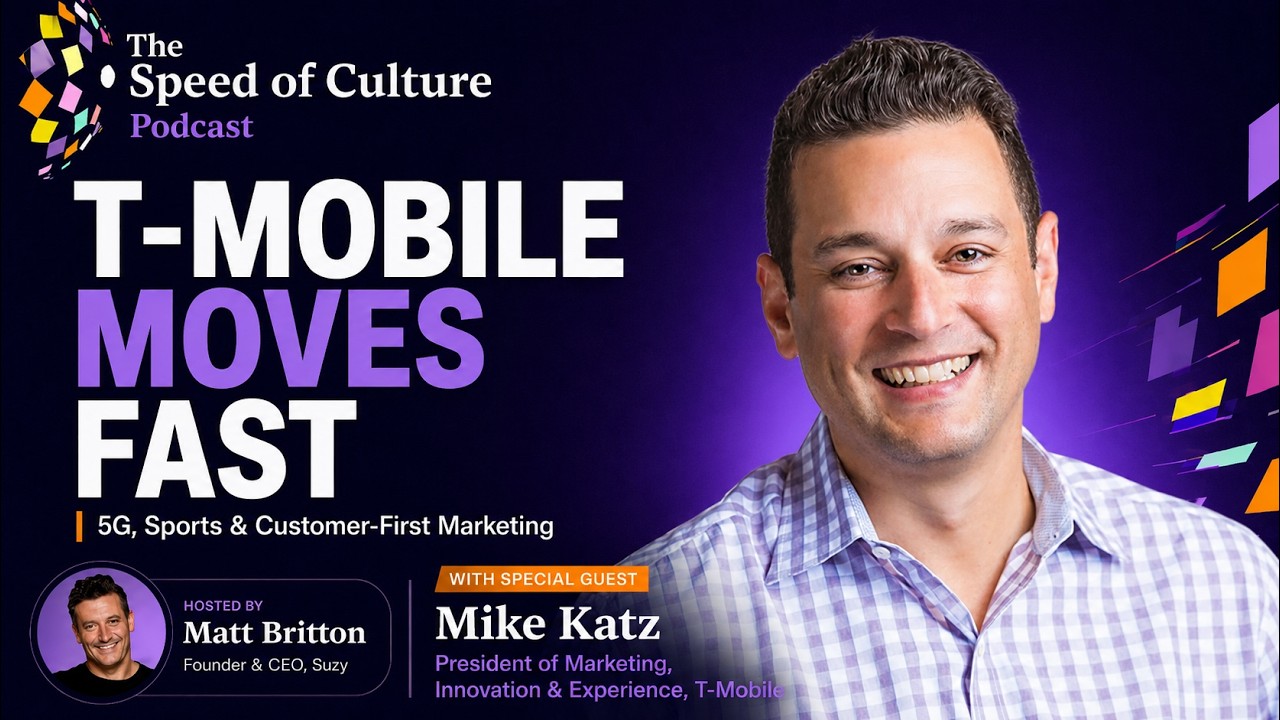
Mike Katz, President of Marketing, Innovation and Experience at T-Mobile, recently joined Matt Britton, founder and CEO of Suzy, the AI-powered consumer intelligence platform, on episode 33 of the Speed of Culture podcast. This conversation delved into one of the most transformative technologies reshaping the telecommunications landscape: 5G.
Released on February 7, 2023, the episode explores how T-Mobile is leveraging 5G technology not just as a network advancement, but as a catalyst for reimagining the entire consumer experience. With over 113 million customers, representing nearly one-third of Americans: T-Mobile stands as a leader in the U.S. telecom market, and Katz's insights reveal the strategic thinking driving the company's approach to next-generation connectivity.
The conversation spans critical ground for business leaders and marketing professionals seeking to understand how disruptive technologies can be weaponized for competitive advantage. Katz brings 25 years of institutional knowledge from T-Mobile, having started his career on the front line and progressed through corporate strategy before transitioning to marketing around 2010.
He assumed the Chief Marketing Officer role in April 2022, before transitioning to his current position in January 2023, where he oversees all marketing, digital, product, supply chain, and wholesale operations. This breadth of responsibility underscores the interconnected nature of modern telecommunications strategy, where technology, customer experience, and business operations form an integrated ecosystem.
Throughout the episode, Katz articulates how T-Mobile's unwavering focus on putting customers first has become its primary differentiator in an increasingly commoditized industry. The podcast serves as a masterclass in how legacy carriers can reinvent themselves by embracing a challenger mentality, regardless of their market position or customer base size.
The Un-Carrier Philosophy: How Customer-Centricity Drives Market Leadership
T-Mobile's path to becoming the most valuable telecom company in the world begins with a fundamental commitment that permeates every level of the organization: putting customers first. This philosophy goes far beyond marketing positioning, it represents a genuine operational and cultural commitment.
When T-Mobile makes hiring decisions, they prioritize candidates who demonstrate customer empathy. When they design programs, they start with customer pain points. When they allocate resources, they consistently ask: what delivers the greatest value to the people who use our service?
This customer-centric culture has become T-Mobile's most defensible competitive moat in an industry historically plagued by commoditization and customer dissatisfaction. While competitors focus on incremental network improvements or pricing optimization, T-Mobile consistently asks deeper questions about what consumers actually need and how the company can deliver surprising value.
This mindset led to the elimination of long-term contracts, a move the industry said would destroy profitability but which instead attracted millions of customers tired of predatory telecom practices. It led to unlimited data plans when competitors were still selling tiered models. It led to free international roaming when competitors charged premium fees for basic global connectivity.
The Un-carrier strategy represents the operationalization of customer-centricity at scale. Since launching the Un-carrier movement, T-Mobile has implemented dozens of industry-shaking initiatives designed to eliminate customer pain points and redefine consumer expectations.
Free Wi-Fi on commercial flights for all customers. Free streaming from popular entertainment services. Free hotspot data. These represent a fundamental reimagining of what customers can expect from their wireless carrier.
With over 110 million customers, T-Mobile could easily rest on its success and optimize for margin expansion like competitors. Instead, the company continues to maintain its underdog mentality, constantly looking for ways to challenge industry norms and raise customer expectations.
Katz articulates that maintaining this challenger spirit despite being the second-largest wireless carrier in the country requires constant cultural reinforcement and strategic decision-making that sometimes prioritizes customer value over short-term profitability.
Building Killer Networks: 5G as Both Technology and Business Opportunity
The technical capabilities of 5G, faster speeds, lower latency, greater capacity, represent the table stakes for competing in the modern telecommunications market. But in Katz's discussion, 5G emerges as something more significant: a foundational technology that enables entirely new business models, customer experiences, and market opportunities.
When the team analyzed 5G's practical implications, they identified that download speeds of up to 10x greater than 4G would enable broadband-quality internet delivery through wireless networks. This insight led to T-Mobile 5G Home Internet, transforming the company's infrastructure into a legitimate alternative to traditional wired broadband.
With 5G Home Internet now available to more than 40 million homes nationwide, the addressable market for T-Mobile extends far beyond smartphone users into the entire ecosystem of households seeking reliable, high-speed internet connectivity.
In many parts of the country, particularly rural areas and underserved communities, consumers have been trapped in a choice between expensive, unreliable broadband or no broadband option at all. T-Mobile's 5G Home Internet offering speeds of over 100 megabits delivers genuinely competitive performance without requiring expensive fiber deployment.
For approximately 21 million Americans who still lack access to broadband internet, services like T-Mobile 5G Home Internet represent genuine relief and expanded economic opportunity.
From a strategic perspective, Katz emphasizes that this opportunity only materializes because of T-Mobile's foundational commitment to network quality. The company's 5G network covers 326 million people with more geographic coverage than AT&T and Verizon combined, an essential prerequisite for innovative applications like home internet service.
Looking forward, Katz discusses revolutionary applications that will emerge as 5G becomes ubiquitous. Virtual reality, augmented reality, metaverse platforms, and immersive entertainment experiences all require the low-latency, high-bandwidth connectivity that only 5G networks can provide at scale.
Growth in Unexpected Places: Local Marketing and B2B Expansion
While T-Mobile's consumer brand presence dominates popular consciousness, Katz reveals a significant strategic initiative to expand T-Mobile's addressable market through localized marketing efforts and sophisticated B2B engagement.
The local marketing initiative reflects recognition that national messaging cannot fully address the specific needs and cultural contexts of diverse American communities. T-Mobile shifts toward hyperlocal community outreach, adapting messaging to resonate with specific regions while maintaining consistent brand personality.
This approach directly addresses a critical challenge in modern marketing: breaking through the noise of mass-market advertising. When T-Mobile invests in understanding and engaging with specific communities, the company creates opportunities for deeper relationships and more authentic connection.
The B2B expansion represents an equally significant strategic pivot. Enterprises need reliable networks, dedicated account management, customized solutions, and communication with decision-makers who understand their specific business challenges.
This dual growth strategy, deepening penetration in local markets while expanding into B2B, positions T-Mobile for sustained growth independent of consumer market dynamics.
Strategic Partnerships as Experience Multipliers
When T-Mobile needed to upgrade network infrastructure to support Formula 1 racing, the company faced a choice: invest in capability and remain invisible, or invest in capability and leverage the partnership for brand amplification.
T-Mobile chose the latter, sponsoring Formula 1 as a way to connect with passionate fans while simultaneously testing and demonstrating network performance in an extreme-stress environment.
This partnership exemplifies sophisticated marketing thinking: authentic capability-building wrapped in compelling brand experiences. By connecting infrastructure upgrades to exciting brand moments, T-Mobile transformed what could have been an invisible investment into a powerful narrative about innovation and network leadership.
Following the success of Formula 1, T-Mobile expanded partnerships to include Major League Baseball, music festivals, and other properties aligned with its brand positioning.
The Challenger That Became the Leader
Despite being the second-largest wireless carrier in the United States with over 110 million customers, T-Mobile continues operating with the mentality of a challenger brand.
Katz attributes this sustained challenger mentality to deliberate cultural architecture. Leadership reinforces that the company's competitive position remains fragile and that complacency poses an existential threat.
Recent Un-carrier moves, including "Phone Freedom", which allows customers to escape device contracts, demonstrate this mindset in action. Rather than relying on contractual lock-in, T-Mobile builds loyalty through superior value and customer experience.
As T-Mobile became the most valuable telecom company in the world, surpassing AT&T's market capitalization for the first time, the company doubled down on the Un-carrier philosophy and customer-centric values that generated its success.
Key Takeaways for Business Leaders
- Customer-centricity transcends marketing positioning: Companies that authentically organize themselves around customer value, from hiring to resource allocation, build emotional loyalty and sustainable competitive advantage.
- Disruptive technology enables new business models: T-Mobile recognized that 5G enabled entirely new offerings like home internet service, not just faster mobile speeds.
- Strategic partnerships should align with authentic business requirements: The Formula 1 partnership amplified real operational investments.
- Market leadership requires continuous innovation: Sustained advantage depends on maintaining a challenger mentality even at scale.
- Growth in adjacent markets hedges against saturation: Expansion into local markets, B2B, and home internet diversifies long-term opportunity.
Frequently Asked Questions
What is T-Mobile's Un-carrier strategy and why has it been so successful?
T-Mobile's Un-carrier strategy represents a commitment to systematically eliminate pain points in telecommunications through bold, industry-shaking moves. Examples include eliminating contracts, offering unlimited data, and providing free international roaming. Its success stems from authentic customer understanding and consistent execution rather than superficial marketing.
How does 5G Home Internet expand T-Mobile's addressable market?
T-Mobile's 5G Home Internet delivers broadband speeds over 100 megabits through wireless networks without requiring expensive infrastructure buildout. With availability to more than 40 million homes, it transforms T-Mobile into a legitimate broadband competitor while addressing the needs of 21 million Americans who lack adequate access.
Why has T-Mobile maintained a challenger mentality despite becoming the market leader?
T-Mobile has avoided complacency through deliberate cultural reinforcement that prioritizes innovation and customer experience over short-term margin optimization. Leadership emphasizes that differentiation, not market position, drives long-term success.
What role does consumer intelligence play in T-Mobile's marketing strategy?
T-Mobile's localized marketing and B2B expansion require sophisticated understanding of consumer and business preferences. Platforms like Suzy enable hyper-targeted marketing strategies at scale, delivering personalized messaging while maintaining operational efficiency.
Looking Ahead: The Convergence of Technology, Experience, and Strategy
The conversation between Matt Britton and Mike Katz offers insights into how mature companies can leverage next-generation technology as a catalyst for reimagining customer experience and competitive strategy.
The rise of 5G connectivity, combined with emerging applications in virtual reality and immersive computing, will continue generating new market opportunities. Companies that recognize these technologies as enabling platforms rather than ends in themselves will capture disproportionate value.
For more insights into the future of consumer behavior, marketing innovation, and technology disruption, explore additional episodes of the podcast. Learn more about AI-powered insights through Matt Britton's work as an AI keynote speaker and explore his book Generation AI.
To connect with expert speakers on emerging consumer trends and technology strategy, visit Speaker HQ or contact for booking inquiries.

%20(400%20x%20100%20px)%20(300%20x%2050%20px)%20(150%20x%2050%20px).avif)