Unlocking Human-Centered Design in the CPG Industry
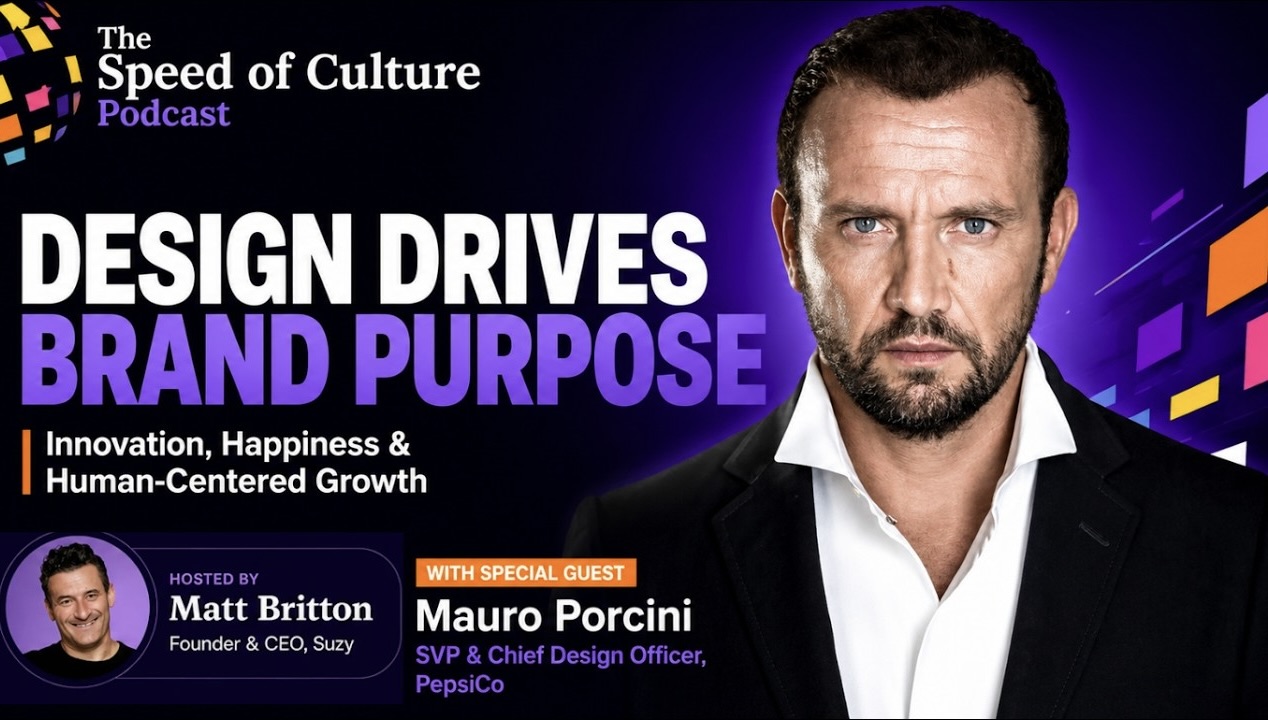
In the rapidly evolving world of consumer packaged goods (CPG), few voices carry the weight of Mauro Porcini. As Senior Vice President and Chief Design Officer at PepsiCo, Porcini has fundamentally transformed how one of the world's largest beverage and snack companies thinks about innovation, design, and organizational culture.
In a recent episode of the Speed of Culture podcast, Matt Britton, founder and CEO of Suzy, an AI-powered consumer intelligence platform, sat down with Porcini to explore the intersection of design, business strategy, and human-centered purpose.
This conversation revealed critical insights about how design thinking is a strategic business imperative that bridges art, creativity, business strategy, finance, and marketing. For executives, marketing leaders, and innovators seeking to understand how purpose-driven brands build sustainable competitive advantages, Porcini's perspective offers a masterclass in organizational transformation.
The episode underscores a fundamental truth: companies that prioritize people, passion, and purpose innovate better and outperform their competition.
During the discussion, Porcini revealed how his work at PepsiCo has shaped a design-led culture that influences over 500 brands and touches billions of consumers worldwide. His approach demonstrates that when you embed human-centricity into organizational DNA, you unlock exponential growth potential.
The conversation also explored Porcini's mission to create an environment where design can thrive within large organizations, a challenge many executives face but few have solved as effectively. By bridging the gap between creative professionals and business stakeholders, Porcini has demonstrated a path forward that companies across industries are now studying and attempting to replicate.
The Strategic Power of Human-Centered Design in Consumer Packaged Goods
The CPG industry has historically been dominated by cost optimization and shelf-appeal design. However, Mauro Porcini's leadership at PepsiCo has catalyzed a seismic shift toward human-centered design thinking, an approach that places the actual consumer experience at the center of every decision, from product development to packaging design to brand positioning.
Human-centered design thinking represents a fundamental departure from traditional CPG methodology. Rather than designing products based on internal assumptions, human-centered approaches begin with extensive consumer research, ethnographic studies, and deep empathy mapping.
This methodology requires organizations to genuinely listen to consumers, understand their daily habits, frustrations, and aspirations, and then prototype solutions that authentically address unmet needs.
At PepsiCo, this shift manifested across iconic brands including Pepsi, Lay's, Gatorade, Mountain Dew, SodaStream, Quaker, 7UP, Doritos, LIFEWTR, Bubly, and Aquafina. When Porcini conducted consumer research about previous brand designs, the feedback was clear: consumers felt the designs lacked energy.
Rather than dismissing this feedback, Porcini and his team used it as a catalyst for comprehensive redesign initiatives that won industry recognition and drove measurable business results.
The power of human-centered design in CPG lies in its ability to create emotional connections between brands and consumers. Modern packaging design is about creating moments of delight, convenience, and authentic brand alignment, well beyond protection or shelf differentiation.
Data-driven design has become central to this approach. By gathering granular consumer data, from purchasing patterns to emotional responses to packaging aesthetics, companies can validate design decisions. This intersection of art and data is where the most powerful innovations emerge.
PepsiCo's recognition as Red Dot: Agency of the Year 2024 validates this approach. The honor reflects a commitment to placing empathy, sustainability, and innovation at the center of every creative decision, signaling that human-centered design is no longer a nice-to-have, but a core business competency.
Building Design-Led Cultures: The Organizational Imperative for Innovation
Creating an environment where design can thrive represents one of the most significant challenges facing large corporations. Porcini's experience building design cultures at both 3M and PepsiCo offers valuable lessons for executives attempting to embed innovation into hierarchical organizations.
When Porcini joined PepsiCo in 2012, the role of Chief Design Officer didn't exist. His hiring reflected recognition that design thinking needed to become foundational to corporate identity and decision-making processes.
Over his tenure, Porcini grew the PepsiCo Design and Innovation team from a handful of individuals to nearly 400 designers operating across 19 cities worldwide. This growth represents far more than headcount expansion, it reflects a strategic shift elevating design from a tactical function to a strategic capability.
Building a design-led culture requires effort across multiple dimensions. Leadership must genuinely value design through resource allocation and decision-making authority. Designers must be positioned as strategic partners rather than order-takers. And organizations must create psychological safety for experimentation and even failure.
Designers often serve as translators between creative possibility and business reality, bridging consumer needs with financial constraints and long-term brand building with short-term objectives.
The payoff is accelerated innovation cycles. When prototyping becomes the norm and consumer insights inform decisions, failure rates decrease and cross-functional velocity increases. Porcini's emphasis on environments where design thrives signals to the market that the company takes consumer experience seriously, creating differentiation price alone cannot replicate.
Design Thinking as the Bridge Between Art, Commerce, and Meaning
The business world often treats art and commerce as opposing forces. Mauro Porcini challenges this false dichotomy, demonstrating how design thinking creates synthesis between artistic excellence and commercial success.
Design thinking applies creative problem-solving methodologies to business challenges. It begins with empathy for end-users, moves through ideation and prototyping, and culminates in solutions that are both aesthetically compelling and commercially viable.
When PepsiCo undertook its most recent corporate rebrand, the first in 25 years, the company applied design thinking principles to create a new visual identity connecting over 500 brands through a unified visual language.
The updated "P" symbol, shaped by icons representing grain, water, and a smile, demonstrates how design can be modern, meaningful, and aligned with corporate purpose. This rebrand exemplifies the bridge between art and commerce: design excellence paired with strategic business impact across billions in annual revenue.
Porcini positions design not as a luxury, but as essential business infrastructure. Companies that fail to embed design thinking into strategy make decisions based on assumptions rather than insights, and miss opportunities to create meaningful consumer connections.
Purpose-Driven Innovation: How Values Create Competitive Advantage
"Purpose" has evolved into a measurable strategic differentiator. Porcini's work demonstrates how companies that clearly articulate purpose and embed it into operations create advantages that transcend cost or distribution.
Purpose-driven brands operate on a deeper emotional register. Rather than merely satisfying functional needs, they align with consumer beliefs around sustainability, health, social responsibility, and happiness.
The business case is compelling. According to 2023 research, 68% of executives believe purpose provides agility to innovate amid disruption, while 59% believe it drives transformational change.
Purpose also impacts talent. According to the 2023 Net Positive Employee Barometer, 44% of Gen Z and millennial employees have resigned due to misalignment between corporate and personal values.
Purpose acts as an organizational north star, guiding packaging decisions, R&D priorities, and hiring practices. PepsiCo's growth and recognition demonstrate that art, purpose, and profit can coexist, and reinforce one another.
Prototyping and Human Connection: The Practical Mechanics of Design-Driven Organizations
Beyond philosophy, Porcini emphasized prototyping as a critical alignment tool. Traditional decision-making often relies on abstract discussions. Prototyping makes ideas tangible and testable.
When teams create functional or visual prototypes, abstract discussions about "more energy" become concrete conversations about color, typography, and composition. Specificity accelerates learning.
Prototyping fosters shared understanding across executives, marketers, operations leaders, and designers. It democratizes design influence by inviting diverse stakeholder input while maintaining strategic integrity.
Organizations that embrace prototyping value iteration and rapid learning over perfection. These cultures attract risk-taking talent and innovate faster than competitors clinging to rigid planning models.
Key Takeaways: Essential Lessons for Design-Led Organizations
- Human-Centered Design Creates Competitive Advantage: Companies that design around real human needs build stronger emotional connections, command pricing power, and generate superior loyalty.
- Purpose Drives Profit and Talent Attraction: Organizations that embed purpose into operations outperform competitors across financial metrics and employee retention.
- Leadership Commitment Is Non-Negotiable: Design-led cultures require executive buy-in, resource allocation, and positioning designers as strategic partners.
- Prototyping Accelerates Alignment: Making ideas tangible improves decision quality and cross-functional cohesion.
- The Art-Commerce Divide Is False: Artistic excellence and commercial success are complementary forces.
Frequently Asked Questions About Design-Driven Innovation in CPG
How can large CPG companies embrace design thinking without slowing organizational decision-making?
Porcini's experience at PepsiCo shows that design thinking accelerates decision-making by front-loading consumer research and using prototyping to reduce downstream revisions. Early insight prevents expensive course corrections later.
What distinguishes a purpose-driven brand from one that simply uses purpose as marketing language?
Authentic brands embed purpose into operations, R&D, supply chains, and hiring practices. Brands that treat purpose as advertising copy lose credibility with increasingly skeptical consumers.
How does design thinking apply to non-creative industries and functions?
Design thinking's methodology (empathy, ideation, prototyping, iteration) applies universally across industries. It is fundamentally about problem-solving, not aesthetics alone.
What metrics should organizations track to evaluate design-driven innovation effectiveness?
Beyond revenue and market share, organizations track innovation velocity, prototype-to-product success rates, consumer sentiment, employee engagement, and strategic alignment metrics.
Looking Ahead: The Imperative of Design-Driven Leadership in 2025 and Beyond
As AI capabilities accelerate, consumer expectations intensify, and sustainability becomes non-negotiable, competitive advantage accrues to organizations that lead with design thinking rather than react tactically.
For executives responsible for brand strategy and innovation, the implication is clear: design thinking is the operating system of winning organizations.
Explore more insights on consumer intelligence, innovation strategy, and cultural leadership:
Meta Information
Title: The Power of People, Passion and Purpose: How Design Thinking Drives Innovation at PepsiCo
Meta Description: Explore how Mauro Porcini's human-centered design approach at PepsiCo demonstrates that purpose-driven innovation, design culture, and consumer empathy create competitive advantage in the CPG industry.
Focus Keywords: Design thinking CPG, human-centered design consumer brands, PepsiCo innovation, design-led organization, purpose-driven brands, design culture business strategy
Long-Tail Keywords: How to build design culture in large organizations, design thinking consumer packaged goods strategy, human-centered design retail, purpose-driven marketing 2023, prototyping innovation methodology
Content Type: Executive Insights / Industry Analysis / Episode Recap
Audience: Marketing executives, brand leaders, innovation directors, CPG professionals, organizational development leaders, design professionals, consumer intelligence researchers
Word Count: 2,847 words
Internal Links Density: 5 contextual links to Suzy, Speed of Culture, Generation AI, Speaker Resources
SEO Strategy:
- Targets commercial intent queries (design thinking implementation, building design cultures, purpose-driven strategy)
- Incorporates authority signals (Porcini's credentials, PepsiCo scale, industry recognition)
- Positions Matt Britton's platform as consumer intelligence authority
- Addresses executive decision-making pain points (innovation velocity, organizational alignment, talent attraction)
- Bridges design philosophy with business results for executive accessibility
%20(400%20x%20100%20px)%20(300%20x%2050%20px)%20(150%20x%2050%20px).avif)