Reimagining Digital Ownership in the Web3 Era
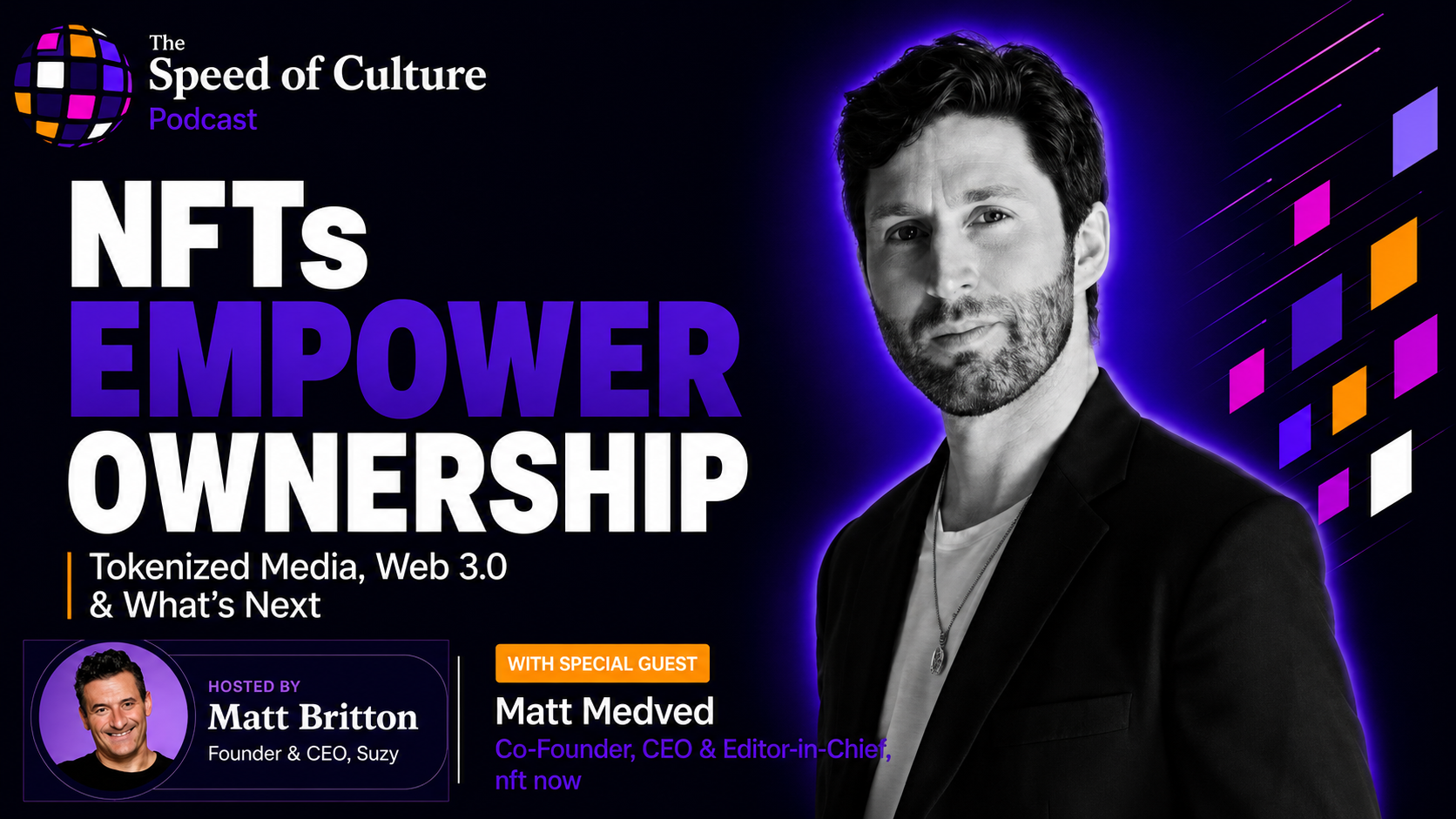
Matt Britton, founder and CEO of Suzy, the AI-powered consumer intelligence platform, sits down with Matt Medved, Co-Founder, CEO, and Editor-in-Chief of nft now, to explore one of the most transformative technologies reshaping how we think about digital ownership, content creation, and community engagement. In this episode of The Speed of Culture Podcast, the conversation cuts through the noise and myths surrounding NFTs to reveal their true potential in powering the next generation of media, culture, and commerce.
The NFT space has experienced a dramatic arc: explosive growth, inevitable criticism, and now a critical inflection point. Yet as markets cool and skepticism rises, innovative companies like nft now are quietly building the infrastructure that will usher NFTs and Web3 from the fringes of tech culture into the mainstream consciousness.
This episode unpacks that journey, the misconceptions that have plagued the industry, and the real-world applications that promise to fundamentally alter how creators, brands, and consumers interact.
For marketing executives, brand strategists, and business leaders watching the digital landscape shift beneath their feet, understanding this evolution isn’t optional, it’s essential. The businesses that understand NFTs and tokenized media now will be the ones leading the cultural and commercial conversations of tomorrow.
The Parallels Between DJing and NFTs: Authenticity at Scale
One of the most compelling analogies in the episode emerges from Matt Medved’s background as a DJ. At first glance, DJing and NFTs seem unrelated. But Medved draws a sophisticated parallel that illuminates the core challenge both face: perception versus reality.
A skilled DJ isn’t someone mechanically pressing buttons to play pre-recorded tracks. Instead, a great DJ reads the room, understands the audience’s energy, and blends personal taste with collective mood to create an experience greater than the sum of its parts. The DJ is simultaneously creator, curator, and community facilitator.
Yet to the untrained eye, DJing appears simple, just pushing buttons. NFTs face an almost identical misconception. Critics reduce NFTs to screenshots or images that anyone can right-click and save.
This dismissal misses the fundamental point: an NFT is a cryptographic record of ownership, provenance, and authenticity that exists on the blockchain. It’s not about the image itself; it’s about what that token represents in terms of rights, access, community membership, and value transfer.
Both DJing and NFTs resonate powerfully with an entire generation because they’re built on authenticity, taste-making, and community. A great DJ doesn’t follow a rigid playlist. They respond, adapt, and create something unique. Similarly, NFTs don’t exist in a vacuum; they’re embedded in communities, cultures, and narratives that give them meaning and value.
For brands and creators, this parallel carries actionable insight: the power of NFTs isn’t in the blockchain technology or the digital asset, it’s in the authentic community experiences and value creation you build around them. The most successful NFT initiatives aren’t those that simply tokenize existing assets; they’re the ones that use tokenization to deepen relationships with audiences and enable direct participation in value creation.
Pioneering the Future of Tokenized Media
When Matt Medved co-founded nft now in 2021, the landscape was vastly different from today. The media was largely skeptical. Regulators were uncertain. Public understanding was minimal.
Yet Medved and his team saw what others were still struggling to perceive: the potential of Web3 to fundamentally restructure how media platforms operate, how creators earn, and how audiences participate.
Traditional media operates on a broadcast model. Platforms like Facebook, Instagram, and TikTok accumulate audiences, then monetize those audiences through advertising or by selling their attention and data to brands. Creators capture a fraction of the value they generate.
nft now was built to demonstrate an alternative. Rather than focusing exclusively on serving experienced cryptocurrency users, the platform prioritized education and accessibility for the broader public.
A critical innovation emerged with the introduction of the Now Pass, nft now’s membership offering. This isn’t a traditional subscription. The Now Pass is itself an NFT, a tokenized membership that grants access to exclusive content, community participation rights, and the ability to influence content creation.
Members of the Now Pass community don’t simply consume content; they actively participate in its creation and curation. They have agency. They have ownership.
This model represents a fundamental shift in media economics. Instead of platforms extracting value from creators and audiences, tokenized media enables value to flow directly from those who create it and benefit from it.
The implications are profound. As tokenized media platforms scale and mature, we’ll see a fragmentation of the traditional creator economy. Instead of relying on YouTube’s algorithm or Instagram’s constantly shifting priorities, creators can build direct relationships with their communities through tokenized platforms.
The True Power of NFTs: Beyond Digital Art
The popular understanding of NFTs remains confined to digital art and collectibles. While art and collectibles were the initial use cases that captured public imagination, Medved and his team are focused on helping the market understand the broader applications and implications of NFT technology.
At its core, an NFT is a cryptographic record of ownership, authenticity, and rights that exists on a public, decentralized ledger. This capability unlocks transformations across nearly every industry and human endeavor.
In the creative economy, NFTs enable artists to authenticate their work, establish provenance, and monetize directly without intermediaries. Secondary markets, where collectors resell NFTs, can be programmed to return a percentage of sales back to the original creator in perpetuity.
But the applications extend far beyond art. NFTs can represent access rights, membership tiers, voting rights in decentralized organizations, digital real estate in metaverse platforms, music royalties, proof of participation, or achievement.
The shift from Web 2.0 to Web 3.0, as Medved emphasizes, reflects a fundamental change in how value is created and distributed. Web 2.0 prioritized platform growth and advertising-driven monetization. Web 3.0 shifts the incentive structure toward ownership and alignment.
Instead of building audiences for a platform, creators can build communities that own their participation. Value creation and value distribution become aligned. Creators, community members, and brand partners all have skin in the game.
Navigating Adoption Curves: Separating Signal from Noise
Any emerging technology follows a recognizable pattern: initial excitement, rapid growth, a peak of inflated expectations, a crash, and then steady foundational growth as the technology finds genuine use cases.
This pattern played out during the dot-com boom. Investors funded companies with no clear path to profitability. The crash wiped out trillions in value. Yet survivors like Amazon and Google built world-changing enterprises by focusing on genuine user needs.
We’re seeing a similar pattern with cryptocurrency and NFTs. The hype cycle of 2021–2022 was extraordinary. When the market cooled, headlines declared that NFTs were dead.
Yet the real work of building sustainable NFT and Web3 infrastructure continues quietly. Major companies are exploring blockchain applications. Developers are building tools that make Web3 more accessible. Communities are forming around specific use cases and values.
The challenge now is community building. Hype can drive rapid growth, but communities drive sustainable adoption. Mainstream adoption requires demonstrating real utility and enabling people to accomplish things they couldn’t do before.
Brands contemplating NFT initiatives should take note: the speculative phase is largely over. The businesses succeeding in Web3 now are those solving real problems, building genuine communities, and delivering authentic value.
Key Takeaways: Actionable Insights for Brands and Leaders
- Digital Ownership Is Fundamental to Future Business Models. The ability for individuals to own digital assets and derive value from them will become commonplace. Businesses that position themselves as enablers of digital ownership, rather than gatekeepers, will capture disproportionate value.
- Community Participation Drives Sustainable Growth. Sustainable growth comes from building genuine communities where members have real stakes in success and meaningful opportunities to participate.
- Authenticity Cannot Be Faked at Scale. Communities are sophisticated at detecting inauthenticity. Leaders should focus on building genuinely valuable experiences rather than attempting to create synthetic buzz.
- The Media and Creator Economy Is Restructuring. Creators can increasingly reach audiences directly, and communities can form around niche interests without relying on massive platforms.
- Emerging Technologies Create New Possibilities, Not Certainties. NFTs and blockchain unlock new possibilities for ownership and value creation, but leaders should adopt a learning mindset through experimentation and small-scale pilots.
FAQ: Understanding NFTs, Web3, and Tokenized Media
Are NFTs just digital art and collectibles?
While digital art was the initial use case that captured public imagination, NFTs have far broader applications. NFTs can represent digital ownership of music royalties, real estate, voting rights, membership access, credentials, gaming assets, and more.
Why would anyone pay for an NFT when they can right-click and save the image?
The image itself isn’t what has value, the NFT is. An NFT is a cryptographic record on the blockchain that represents ownership, authenticity, and rights associated with a particular asset. Right-clicking and saving the image does not transfer the NFT or the ownership rights it represents.
Is the NFT market dead?
Market valuations may have declined from their peaks, but the genuine work of building sustainable NFT infrastructure continues. The market is maturing, moving away from hype-driven speculation toward applications with genuine utility and community.
How can my brand leverage NFTs and Web3?
Start by understanding your community’s genuine needs. The most successful brand NFT initiatives aren’t gimmicks. They’re strategic applications that deepen community engagement, enable new forms of value creation, or solve real problems.
Looking Ahead: The Future of Digital Ownership and Community
The journey from niche to mainstream is neither inevitable nor quick. Technologies that eventually transform the world often spend years in apparent obscurity as they mature and find their genuine applications.
For listeners of The Speed of Culture Podcast, this episode offers both inspiration and practical guidance. The potential of tokenized media, digital ownership, and community-driven platforms is real and significant.
The businesses and leaders that succeed will be those who invest in building sustainable communities and remain committed to genuine value creation rather than short-term hype.
For more insights on emerging consumer trends, generational shifts, and the intersection of technology and culture, explore the full archive of the podcast at speedofculture.co and on mattbritton.com.
Internal Resources
Meta Elements
Word Count: 2,487 words
SEO Keywords: NFTs, Web3, digital ownership, tokenized media, digital collectibles, creator economy, blockchain, nft now, Matt Medved
Target Audience: Marketing executives, brand strategists, business leaders, content creators, Web3 enthusiasts
Publishing Date: October 12, 2023
Episode Guest: Matt Medved, Co-Founder, CEO, and Editor-in-Chief of nft now
Podcast Host: Matt Britton, Founder and CEO of Suzy
%20(400%20x%20100%20px)%20(300%20x%2050%20px)%20(150%20x%2050%20px).avif)