The challenge of scaling a beloved global brand while respecting the unique preferences of local markets has never been more complex, or more critical. As consumer expectations evolve at breakneck speed, brands must navigate multifaceted media environments, emerging technologies, and fiercely competitive digital spaces.
The organizations that succeed are those that combine data-driven insights with authentic creativity and cultural understanding.
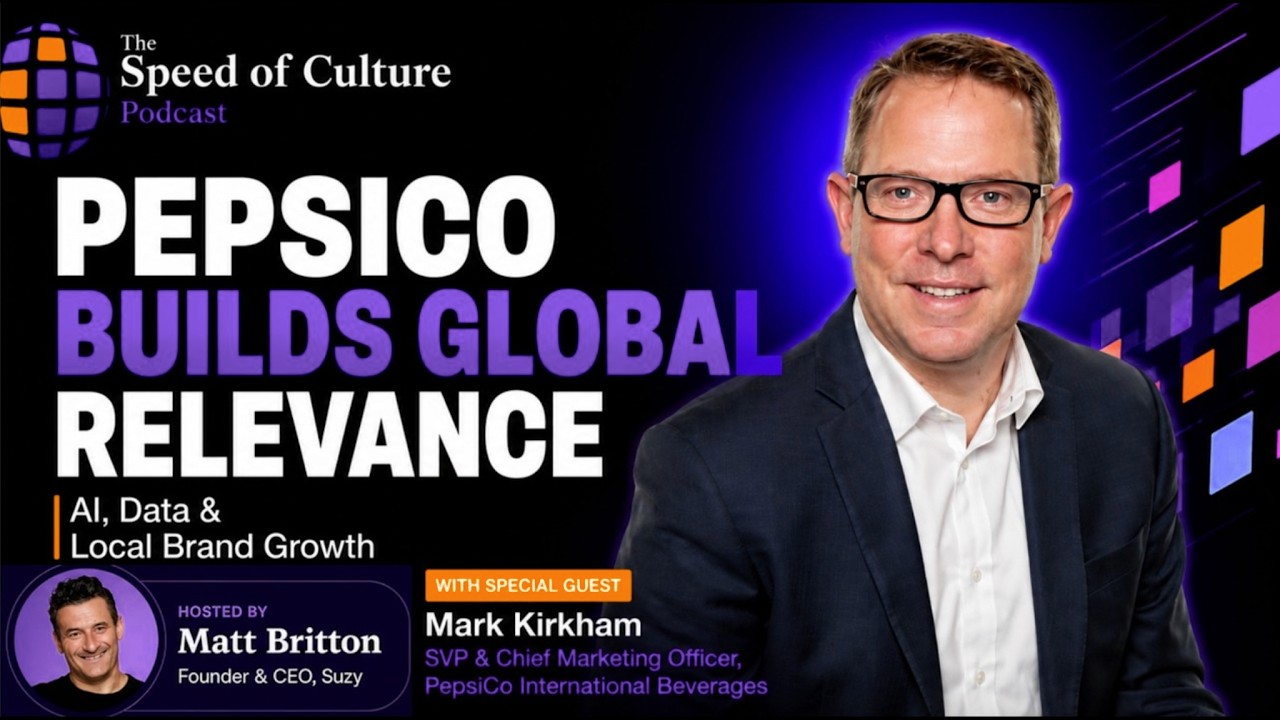
In Episode 130 of The Speed of Culture Podcast, Matt Britton, founder and CEO of Suzy, an AI-powered consumer intelligence platform, sits down with Mark Kirkham, SVP & Chief Marketing Officer at PepsiCo International Beverages, to explore how one of the world's largest beverage companies harnesses artificial intelligence to enhance consumer engagement while maintaining brand consistency across more than 200 countries and territories.
This conversation reveals the sophisticated strategies, technological innovations, and human insights that enable PepsiCo to move at the speed of culture, adapting to local trends while preserving the global brand values that have made Pepsi, Gatorade, Tropicana, and other flagship brands household names worldwide.
The Global Marketing Challenge: Consistency Meets Context
PepsiCo's portfolio spans more than 200 countries, operating in dramatically different cultural, regulatory, and competitive landscapes. What resonates with consumers in Tokyo may fall flat in Toronto. A successful campaign in London requires complete reimagining for markets across Latin America, Asia, and Africa.
Yet beneath these local adaptations must lie a coherent global brand strategy that preserves the essence of what makes a PepsiCo brand distinctive and trusted.
According to Kirkham, the company approaches this duality with clear-eyed pragmatism.
"The day I stop learning is the day I stop being a marketer."
This philosophy reflects continuous curiosity about how consumer preferences shift across regions and demographic segments.
PepsiCo's approach to global-local marketing is underpinned by deep market research and consumer understanding. Rather than imposing a one-size-fits-all marketing playbook, the company invests heavily in understanding regional nuances, from taste preferences and dietary trends to media consumption habits and influencer preferences.
This commitment to localization has proven particularly evident in how PepsiCo introduced zero-sugar beverage offerings in Europe, where health and wellness consciousness runs high.
The complexity increases when considering the mechanics of execution. PepsiCo must coordinate marketing efforts across hundreds of brands and sub-brands, dozens of sales channels, and virtually every digital and traditional media platform.
Centralizing all decision-making would slow innovation and disconnect campaigns from local realities. Decentralizing too much would create inconsistency and squander the economies of scale that global brands enjoy.
Technology, particularly artificial intelligence and advanced data analytics, has become essential to solving this fundamental tension.
Data as Strategy: Building Consumer Intelligence at Scale
Modern marketing is fundamentally a data problem. Successful brands must understand not just who their consumers are, but what motivates them, when they make purchasing decisions, which messages resonate, and how their preferences are shifting in real time.
PepsiCo integrates multiple data sources to build comprehensive consumer profiles. The company combines first-party data, information collected directly from consumers through interactions with brands, websites, and apps, with third-party data acquired from research partners and analytics providers.
The result is a rich, multidimensional picture of consumer preferences and behaviors.
Kirkham describes this approach:
"It's as much about the tools as it is the capabilities to use them. Too many companies outsource capabilities, and what you need to do is in-source capabilities and then use the tools that allow you to do new and different things."
This emphasis on building internal capabilities, rather than simply purchasing off-the-shelf solutions, represents a strategic shift in how sophisticated marketers think about technology.
Tools alone don't create competitive advantage. The human expertise, domain knowledge, and creative vision required to interpret data and translate it into effective marketing campaigns are where true differentiation emerges.
The scale at which PepsiCo executes this data strategy is extraordinary. With billions of potential consumers across global markets, traditional market research methods (surveys, focus groups, ethnographic studies) provide snapshots rather than comprehensive, real-time understanding.
Artificial intelligence and machine learning enable the company to process vast volumes of consumer data, identify patterns, and generate actionable insights at a velocity and precision that would be impossible through manual analysis alone.
Artificial Intelligence: From Mass Marketing to Personalized Connection
For decades, marketing operated within the constraints of mass media. A brand produced one television commercial that played to millions of viewers. A magazine advertisement reached whoever flipped to that page. Media reach was the primary currency of marketing effectiveness.
Digital channels and social media disrupted this model, enabling brands to target specific audience segments and measure individual-level responses. Yet most marketing still operated within a framework of message standardization.
Artificial intelligence is enabling PepsiCo to move beyond even this level of sophistication toward genuine one-to-one personalization at a massive scale.
One striking example is Gatorade's AI-powered avatar, which provides athletes with personalized hydration and product recommendations based on their individual workout routines, fitness levels, and physiological needs.
Rather than a generic "Gatorade keeps you hydrated" message, the AI-driven system delivers guidance that feels individually relevant.
This capability extends across PepsiCo's portfolio. The company is deploying AI to:
- Generate Hyper-Personalized Content: AI enables brands to generate variations of marketing messages that speak to specific audience segments. Lay's executed this strategy in the "Lay's Messi Messages" campaign, using AI to map the facial features of Lionel Messi and generate over 4 million unique, personalized video messages in 10 different languages. Each variation featured Messi speaking directly to an individual consumer, referencing local events, celebrations, or personal details.
- Optimize Regional Campaigns: AI analyzes consumer data across regions to identify which messaging frameworks, creative approaches, and product benefits are most likely to resonate in specific markets. This allows PepsiCo to test campaign elements, measure performance, and scale winners rapidly.
- Create Immersive Brand Experiences: AI enables PepsiCo to build interactive experiences that allow consumers to engage with brands in new ways, from AI-driven recommendation engines to virtual influencers and augmented reality experiences.
- Enhance Influencer Selection and Collaboration: AI helps identify which influencers are most authentic, reach the target audience, and have genuine engagement rather than inflated follower counts from bot networks.
The philosophical shift here is profound. Rather than asking "How do we reach more people with our message?" PepsiCo is asking, "How do we deliver the most relevant, valuable message to each individual consumer?"
Mastering Social Media and Influencer Strategy at Global Scale
A decade ago, small, agile brands dominated social media and influencer marketing. Large, traditional consumer goods companies struggled to adapt to the informal, creative, algorithm-driven nature of platforms like Instagram, TikTok, and YouTube.
PepsiCo has reversed this dynamic. The company now leverages its substantial resources, data capabilities, and brand portfolio to compete effectively with smaller brands in the social and influencer space.
This shift reflects several strategic insights:
- Platform Sophistication: Social media platforms have matured into sophisticated advertising and engagement ecosystems. PepsiCo's scale and data access allow the company to optimize performance across platforms with precision.
- Data-Driven Influencer Strategy: Rather than selecting influencers based on follower counts or subjective fit, PepsiCo uses data to identify influencers whose audiences match target demographics and whose engagement rates are authentic.
- Content Creation at Scale: PepsiCo invests in content production capabilities that allow rapid creation and iteration of social content, testing different creative approaches and scaling winners across markets.
- Localized Adaptation: Campaign frameworks developed in one market can be adapted for audiences in Mumbai, Mexico City, or Moscow within weeks rather than months, preserving brand identity while respecting cultural nuance.
The result is that PepsiCo has become a formidable force in social media and influencer marketing, where scale combined with data sophistication and creative agility creates sustainable competitive advantage.
Technology Balanced with Human Creativity
A critical insight from Kirkham's discussion is that technology and AI, while powerful, are not substitutes for human creativity, cultural understanding, and genuine consumer insight.
Throughout the conversation, Kirkham emphasizes that data and tools enable marketing but do not replace the need for human judgment.
An algorithm can identify which message framework performs best with a given audience segment, but a human creative strategist must understand why it resonates and how to evolve it as cultural contexts shift.
This balance is visible in how PepsiCo approaches AI implementation. The company does not deploy AI to automate marketing decisions wholesale. Instead, AI augments human decision-making, providing insights and options that humans then evaluate and refine.
By building internal teams of data scientists, AI specialists, marketing technologists, and strategists, PepsiCo ensures that technology serves the company's creative vision rather than constraining it.
The Innovation Imperative: Staying Ahead of Consumer Preferences
PepsiCo's commitment to innovation extends beyond marketing existing products to developing new offerings that anticipate and shape consumer preferences.
Kirkham points to several examples: the acquisition of Poppi, a prebiotic soda brand; the launch of Pepsi Prebiotic Cola; and ongoing investments in innovation across major beverage categories.
These moves reflect a core insight: brands that rest on legacy success inevitably lose relevance.
AI and consumer intelligence help mitigate innovation risk. By analyzing consumer conversations, social media discussions, and emerging trends, PepsiCo can identify which product categories and flavor profiles are gaining traction before they become mainstream.
The company can test product concepts with target consumers using platforms like Suzy before committing to large-scale production and marketing, reducing both risk and time to market.
The Speed of Culture: Moving Markets at the Pace of Change
The title The Speed of Culture encapsulates a fundamental challenge facing modern brands. Culture moves fast. Memes emerge and fade. Social movements shift consumer expectations.
Brands that require months to conceive and launch campaigns will always lag behind cultural moments.
PepsiCo invests in real-time data and trend monitoring, maintains flexible creative teams, and empowers regional leaders to make decisions quickly. AI accelerates this further by automating routine tasks and surfacing buried insights.
None of this replaces the need for skilled strategists and creative professionals. But by automating the mechanical aspects of marketing, AI enables human talent to move faster and stay culturally aligned.
Key Takeaways: Translating PepsiCo's Approach
- Invest in Building Internal Capabilities Alongside External Tools: Competitive advantage comes from expertise developed internally, not just tools purchased.
- Embrace Data Integration for Comprehensive Consumer Understanding: Combining first-party, third-party, and partner data creates actionable insight.
- Use AI to Enable Personalization and Relevance at Scale: The opportunity is reaching each person with their most relevant message, rather than simply reaching more people.
- Balance Global Brand Consistency with Local Market Adaptation: Maintain global identity while respecting regional preferences through disciplined frameworks and data.
- Sustain a Culture of Continuous Learning and Curiosity: Organizations that prize experimentation and adaptation remain relevant in rapidly changing markets.
FAQ: Global Taste, Local Twist Marketing Strategy
What Makes PepsiCo's Approach to Global-Local Marketing Different?
PepsiCo combines substantial scale with data sophistication and organizational agility. Rather than defaulting to centralized control or fragmented local execution, the company builds systems that enable both global coordination and local relevance.
AI and data analytics help determine which elements can be standardized globally and which require localization.
How Does PepsiCo Use AI Without Sacrificing Authenticity?
PepsiCo uses AI to augment, not replace, human creativity. AI generates variations; human strategists refine them.
The Lay's Messi Messages campaign used AI for personalization at scale, but human creatives wrote the core messaging and ensured cultural appropriateness.
How Can Smaller Brands Adopt Similar Strategies?
Smaller brands can apply the same principles: build deep consumer understanding, integrate data sources, iterate quickly, and balance consistency with adaptation.
AI-powered platforms like Suzy have democratized access to sophisticated research capabilities once available only to large corporations.
What Role Will AI Play in Marketing Over the Next 5 Years?
AI will deepen across three areas: personalization, optimization, and automation.
Personalization will extend across the entire customer journey. Optimization will become more real-time and precise. Automation will handle routine execution, freeing human talent for strategy and creativity.
Looking Ahead
Interested in learning more about how brands can leverage AI and consumer intelligence to stay ahead of cultural trends?
- Suzy. The AI-powered consumer intelligence platform founded by Matt Britton.
- The Speed of Culture Podcast. Hear from CMOs and innovators navigating rapid cultural change.
- Generation AI. Matt Britton's latest book examining how artificial intelligence is reshaping childhood, culture, and the future of work.
- AI Keynote Speaker. Explore keynote topics on AI, consumer trends, and strategic marketing.
- Speaker HQ. Discover more insights and resources from Matt Britton.
This article is based on Episode 130 of The Speed of Culture Podcast, published September 17, 2024. The Speed of Culture is hosted by Matt Britton, founder and CEO of Suzy, and features conversations with marketing leaders and cultural strategists discussing how brands maintain relevance in dynamic markets.
%20(400%20x%20100%20px)%20(300%20x%2050%20px)%20(150%20x%2050%20px).avif)