Date Published: July 4, 2023
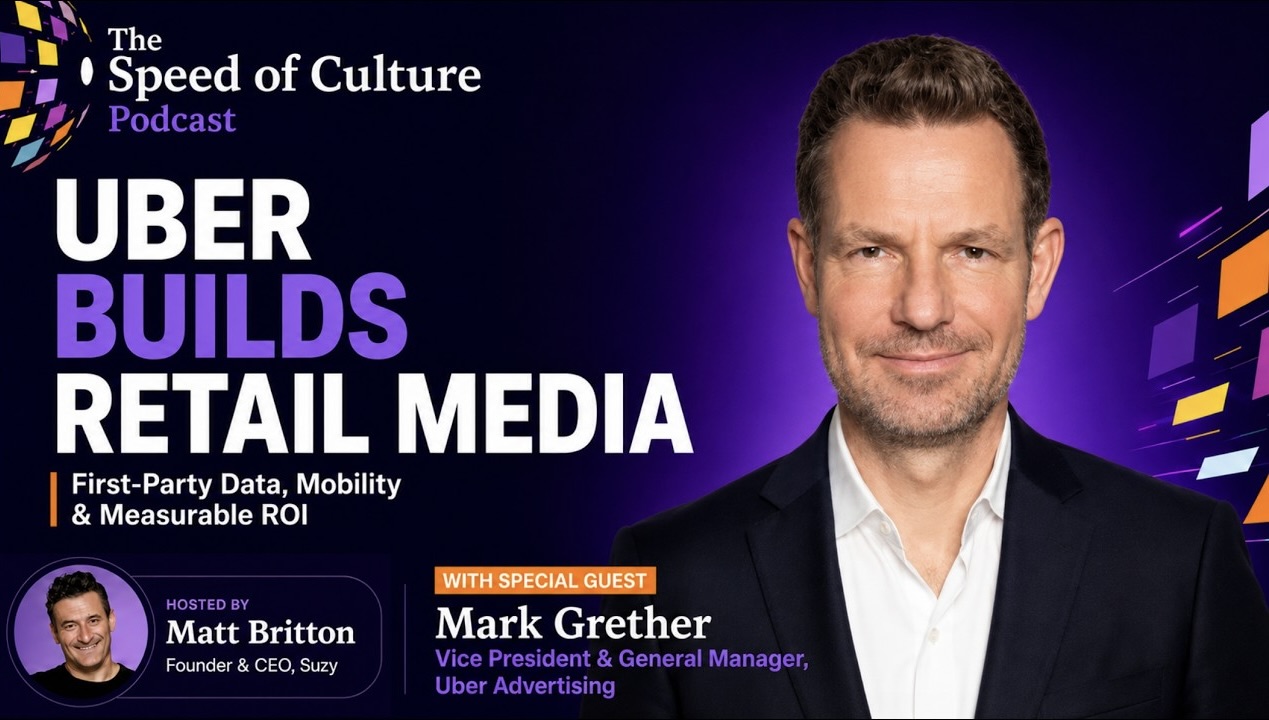
Episode: 57 - Catching a Ride with Uber: The Brand's Evolution into the Advertising Space
Guest: Mark Grether, Vice President & General Manager at Uber Advertising
Host: Matt Britton, Founder and CEO of Suzy
Introduction: Beyond Ride-Sharing to Advertising Innovation
When most people think of Uber, they envision sleek ride-sharing vehicles and convenient delivery at their doorstep. But the company's evolution extends far beyond transportation. Uber has quietly built one of the most sophisticated retail media networks in the world.
In a conversation on the Speed of Culture Podcast, Matt Britton sits down with Mark Grether, Vice President and General Manager at Uber Advertising, to explore how the company transformed its massive consumer touchpoints into a thriving advertising business.
Uber's journey into advertising represents a fundamental shift in how brands understand consumer engagement. With millions of daily interactions across its delivery and mobility platforms, Uber possesses a rare commodity: first-party data at unprecedented scale.
This episode reveals how Grether and his team are leveraging that advantage to revolutionize the advertising landscape, offering brands opportunities to reach consumers at critical decision moments. As the chief strategist behind Uber Advertising, Grether brings decades of experience in audience-centric marketing, having previously led major initiatives at companies like Amazon and founded groundbreaking ventures like Xaxis.
His insights shed light on why the future of advertising lies not in traditional media placements, but in understanding and reaching audiences wherever they are, and Uber's mobility and delivery platforms provide the perfect stage for this revolution.
The Audience-First Approach: How Uber Redefined Advertising Strategy
Understanding the Shift from Web Real Estate to Audience Intelligence
The advertising industry has long operated on a fundamental assumption: buy access to premium web pages and hope your audience shows up. Mark Grether spent much of his career challenging this outdated model.
Early in his career at Xaxis, the organization he co-founded, Grether recognized that successful advertising requires a paradigm shift, moving from buying content spaces to directly targeting and understanding audiences.
This revolutionary concept drove Grether to build Xaxis as the first technology-powered media network centered on audience data rather than inventory. Instead of asking "Where should we advertise?" the platform posed a more intelligent question: "Who is our audience, and where are they?"
This audience-centric philosophy became the foundation for modern programmatic advertising and paved the way for how Uber would eventually approach its own advertising business.
When Grether joined Uber to launch Uber Advertising, he carried this same philosophy: leverage first-party data to create direct, meaningful connections between brands and consumers.
The difference now? Uber's user base and transaction data provided an unprecedented advantage. Every ride request, restaurant order, and grocery delivery became a data point revealing consumer intent, preferences, and purchase behavior.
The Role of First-Party Data in Building Consumer Trust
In an era where third-party cookies are disappearing and privacy regulations tighten, first-party data, information consumers willingly share through their interactions, has become the most valuable asset in advertising.
Uber possesses this data in abundance. Users provide it voluntarily whenever they request a ride, place an order, or browse available services.
This creates a unique opportunity: brands can reach consumers at moments when purchase intent is highest, armed with real behavioral data rather than assumptions.
Unlike traditional advertising that interrupts consumers with generic messages, Uber Advertising can deliver personalized offers to people actively engaged in commerce. A restaurant can reach users browsing delivery options. A consumer goods brand can target shoppers who frequently purchase similar products.
This precision drives measurable returns on investment, a metric that increasingly matters to savvy marketing executives tired of opaque advertising spending.
Uber Advertising's Two-Pillar Strategy: Delivery and Mobility
The Delivery Advantage: Advertising at the Moment of Purchase
Uber Eats transformed food delivery from a local service into a national industry. More importantly, it created a direct line to consumer purchasing behavior.
When someone opens Uber Eats to order lunch, they're in a state of maximum commercial receptivity. They've already committed to spending money, and they're actively browsing options.
This moment of decision is where Uber Advertising thrives. On the delivery side, brands gain access to first-party transaction data that allows them to understand not just who their customers are, but when they buy, what they buy, and how frequently they return.
Restaurants can advertise their latest specials to previous customers. Consumer packaged goods brands can promote products to shoppers with demonstrated affinity for similar items.
The result? Measurable ROI that traditional banner ads and billboards simply cannot match.
The delivery platform generates multiple advertising surfaces: sponsored product placements, branded collections, and promoted merchant partners. Each touchpoint is an opportunity to influence the consumer journey, and each placement generates valuable performance data that advertisers can use to refine their strategies.
The Mobility Revolution: Advertising on the Road
While delivery has created exciting in-app advertising opportunities, Uber's mobility platform opens an entirely different frontier: the physical spaces where consumers spend time in their cars.
The company operates three distinct advertising surfaces in its mobility business:
- The Mobility App: Similar to the delivery side, the Uber app itself provides sponsored listings, premium placements, and targeted messaging to users booking rides.
- In-Car Tablet Business: Uber partnered with entertainment and advertising companies to place screens inside vehicles, creating a captive audience during trips. These tablets display contextually relevant content, local advertising, and promotional offers.
- Cartop Ads: The most visible innovation, advertisements displayed on the exterior of Uber vehicles. As these vehicles move throughout cities, they generate brand impressions at scale, combining traditional out-of-home advertising with the added benefit of targeting specific geographies and neighborhoods.
What makes these advertising surfaces particularly valuable is their captive nature. A passenger waiting for their Uber to arrive, or sitting in a vehicle during their commute, represents a highly concentrated attention opportunity.
This audience cannot scroll past, mute, or ignore the content in the way they might with digital ads. For brands seeking high-impact placements, the mobility platform offers something increasingly rare in advertising: genuine consumer attention.
Talent Development and Organizational Excellence: Building the Team Behind the Innovation
The Philosophy of Empowerment Over Micromanagement
Behind every successful company is a team of talented individuals given the autonomy to make impactful decisions.
In a candid segment of the podcast, Mark Grether discusses how he approaches talent development and retention, principles he's refined across his career at organizations ranging from emerging startups to tech giants.
Grether's philosophy centers on empowerment. He believes that effective leaders share their vision and passion with their team, then step back to allow individuals to make decisions and take responsibility for outcomes.
This approach is counterintuitive to how many organizations operate, instead of top-down decision-making, Grether fosters an environment where team members own their work.
The key balance Grether strikes is crucial: team members have autonomy to make individual decisions, but leadership maintains responsibility for collective outcomes. This creates accountability without micromanagement, trust without recklessness.
In an industry as fast-moving as advertising technology, this approach proves essential. Teams that must await approval for every decision move too slowly. Teams given complete autonomy risk inconsistent strategy.
Grether's model splits the difference, enabling rapid innovation while maintaining strategic coherence.
Why Talent Retention Matters in Digital Advertising
The advertising technology sector faces a constant challenge: talent poaching. The most talented engineers, product managers, and strategists are constantly courted by competitors.
Grether's commitment to building a culture of ownership and autonomy directly addresses this challenge. Talented professionals want to work where their ideas matter, where they can make decisions, and where they see the impact of their work.
By fostering this environment at Uber Advertising, Grether has built a team capable of competing with the best technology companies in the world.
Measuring Success: ROI, Attribution, and Advertiser Accountability
The Shift from Impressions to Outcomes
Traditional advertising metrics are notoriously difficult to track. Did that billboard drive sales? Which TV commercial actually influenced the customer?
These questions remain largely unanswerable, which is why many advertisers still struggle to justify spending. Uber Advertising operates in a different paradigm.
Because Uber controls both the advertising platform and the transaction layer, the company can directly attribute purchases to advertising exposure.
When a user sees a sponsored restaurant on the Uber Eats app and immediately places an order, Uber Advertising captures that data. When a passenger sees an in-car advertisement and later makes a purchase, the company can measure that correlation.
This direct attribution capability transforms advertising from a best-guess activity into a precision marketing tool.
For advertisers, this shift is transformative. Instead of asking "How many people saw this ad?" they can ask "How many people purchased as a direct result of this ad?" and get accurate answers.
This accountability drives higher advertising spending from brands confident they'll see returns, creating a virtuous cycle where effective advertising generates revenue growth, enabling further investment.
The Dual Challenge: Scale and Personalization
Measuring ROI at massive scale presents unique challenges. Uber processes millions of transactions daily across hundreds of cities worldwide.
Building infrastructure capable of tracking, attributing, and reporting on advertising effectiveness across this complexity requires sophisticated data engineering and analytics capabilities.
Grether and his team have invested heavily in these systems, understanding that attribution accuracy directly impacts advertiser satisfaction and platform growth.
Moreover, personalization at scale demands continual refinement. What advertisements resonate with users in New York may fail in Austin.
Seasonal patterns, local preferences, and demographic shifts all require constant monitoring and adjustment. Uber Advertising's infrastructure must support thousands of simultaneous campaigns, each optimizing in real-time based on performance data.
Looking Ahead: The Future of Retail Media Networks in Transportation
Expanding Beyond Current Surfaces
The advertising opportunities Grether outlined on the podcast represent just the beginning of what Uber Advertising can build.
As the company expands into new markets and services, additional advertising surfaces will emerge. Food delivery's growth into grocery, alcohol, and other verticals creates new advertiser categories.
Expansion into new transportation services opens different demographic reaches.
The underlying principle remains consistent: Uber's unique position at the intersection of commerce and mobility grants it unparalleled advertising potential.
Few companies can claim access to the same breadth of consumer touchpoints. Amazon built a powerful advertising business by sitting at the center of e-commerce transactions.
Uber Advertising occupies an equally valuable position in the mobility and delivery commerce space.
Competing with Advertising Giants
Uber's entry into advertising might seem like one company among thousands. In reality, it represents competition with the largest digital advertising platforms: Google, Meta, and Amazon.
Each of these companies built massive ad businesses by understanding consumer intent and delivering targeted messages. Uber's first-party data and consumer touchpoints position it as a legitimate competitor in this tier.
The advantage Uber holds is specificity. Google reaches audiences broadly but without knowing if they're in a purchasing mindset.
Uber reaches audiences actively engaged in commerce. This specificity drives higher value for advertisers and stronger ROI for brands, the fundamental advantage that will drive Uber Advertising's continued growth.
For marketing executives evaluating advertising platforms, Uber Advertising represents a compelling alternative to traditional digital channels. Rather than hoping to reach audiences, brands can advertise directly to consumers in moments of commercial intent.
Key Takeaways: Essential Insights from the Episode
- Audience Intelligence Over Media Inventory: The most successful advertising strategies focus on understanding and reaching audiences, not on buying premium placements. Uber Advertising's foundation in audience-centric thinking, refined through Grether's work at Xaxis, represents the evolution of how smart companies approach advertising.
- First-Party Data is the Currency of Modern Advertising: In a post-cookie world, information that consumers willingly share through transactions becomes invaluable. Uber's massive first-party dataset provides a competitive advantage that rivals the reach of traditional advertising giants.
- Mobility and Delivery as Advertising Channels: Beyond in-app placements, Uber's physical advertising surfaces (in-car tablets, app experiences, and cartop ads) create high-impact opportunities for brands willing to innovate beyond traditional digital channels.
- Empowerment Drives Innovation and Retention: Organizations that trust talented team members to make decisions, while maintaining strategic accountability, move faster and retain better talent. This principle, applied by Grether at Uber Advertising, creates competitive advantages in the fast-moving advertising industry.
- Measurable ROI Transforms Advertising: Direct attribution between advertising exposure and purchases shifts advertising from a cost center into an investment with clear returns. This accountability attracts larger budgets and drives growth.
- Scale with Personalization: Modern advertising platforms must serve millions of campaigns simultaneously while personalizing based on local preferences and real-time performance data. This combination of scale and sophistication creates barriers to entry that protect market leaders.
- Commerce-Adjacent Advertising Outperforms Interruption-Based Models: Consumers already in a purchasing mindset respond more effectively to relevant offers than audiences interrupted during other activities. This principle, embedded in Uber's platform design, explains why retail media networks grow faster than traditional display advertising.
Frequently Asked Questions
What is Uber Advertising exactly, and how does it differ from traditional digital advertising?
Uber Advertising is the company's retail media network that leverages first-party consumer data collected through Uber Eats, Uber mobility, and other services to deliver targeted advertising to users.
Unlike traditional digital advertising (like Google Ads or social media ads) that broadly targets audiences, Uber Advertising reaches consumers at moments of commercial intent, when they're actively making purchase decisions. This precision drives significantly higher ROI for advertisers.
How does Uber use first-party data to improve advertising effectiveness?
When users engage with Uber Eats to order food or use Uber for mobility, they voluntarily provide data about their preferences, locations, purchase frequency, and behaviors.
This first-party data allows Uber to understand individual user interests and preferences without relying on invasive tracking.
Advertisers can then target these users with relevant products and services at moments when they're most likely to make purchases, resulting in better campaign performance and measurable returns on investment.
Can small and mid-sized businesses benefit from Uber Advertising, or is it primarily for large brands?
Both small and large businesses can benefit from Uber Advertising.
Small restaurants and local merchants use the platform to reach nearby customers actively browsing delivery options. Larger brands leverage Uber's audience data and scale to build awareness and drive sales nationally.
The platform supports various campaign types and budgets, making it accessible to advertisers of different sizes, though sophisticated optimization typically requires marketing expertise or agency support.
What makes Uber's in-car advertising different from traditional outdoor advertising like billboards?
In-car advertising (cartop ads and in-vehicle tablets) combines the broad reach of outdoor advertising with targeted geography and measurable performance data.
A cartop ad reaches potentially thousands of people as vehicles move through cities, while data on who saw the ad allows attribution to subsequent purchases.
In-vehicle tablets create highly concentrated attention environments where passengers actively engage with content, rather than passively noticing billboards while driving.
Looking Ahead
Uber Advertising represents a significant evolution in how companies monetize consumer relationships and how brands reach audiences.
Mark Grether's leadership has transformed a ride-sharing and delivery company into a sophisticated media platform capable of competing with digital advertising giants.
The principles underlying this transformation (audience intelligence, first-party data strategy, and commerce-adjacent advertising) will likely define competitive advantage in advertising for years to come.
For marketing executives, agencies, and brands seeking to understand the future of advertising, this episode offers valuable insights.
The platforms that will dominate advertising in the next decade will be those that understand their audiences deeply, respect consumer privacy through first-party data strategies, and deliver value by reaching consumers at moments of commercial intent.
For more insights from industry leaders shaping the future of marketing and consumer intelligence, explore the full Speed of Culture Podcast series.
To learn more about consumer intelligence and data-driven marketing strategy, visit Suzy.
Related Resources
- Explore More from Matt Britton: Visit mattbritton.com to discover additional insights on AI, consumer behavior, and modern marketing strategy
- Generation AI: The Book: Dive deeper into how artificial intelligence is reshaping business strategy with Matt Britton's Generation AI book
- AI Keynote Speaker Services: For insights on AI's role in marketing and business strategy, explore Matt Britton's AI keynote speaking services
- Speaker HQ: Connect with thought leaders across industries at Speaker HQ
- Speed of Culture Podcast: For more episodes exploring how brands navigate culture, consumer behavior, and competitive landscapes, listen to the Speed of Culture Podcast
SEO Title: How Uber Built an Advertising Powerhouse: Mark Grether on Retail Media Networks
Meta Description: Discover how Uber transformed ride-sharing into a sophisticated advertising platform with VP Mark Grether. Explore first-party data strategy, retail media networks, and advertising ROI in Episode 57 of The Speed of Culture Podcast.
Keywords: Uber Advertising, retail media networks, first-party data, advertising ROI, Mark Grether, Speed of Culture Podcast, programmatic advertising, consumer intelligence
Content Type: Podcast Episode Summary/Interview Analysis
Target Audience: Marketing executives, agency leaders, advertising professionals, business strategists, advertising technology professionals
Word Count: Approximately 2,850 words
Reading Level: Advanced (Executive/Professional)
Episode Date: July 4, 2023
Podcast: The Speed of Culture Podcast (in partnership with Adweek)
Published on: mattbritton.com

%20(400%20x%20100%20px)%20(300%20x%2050%20px)%20(150%20x%2050%20px).avif)