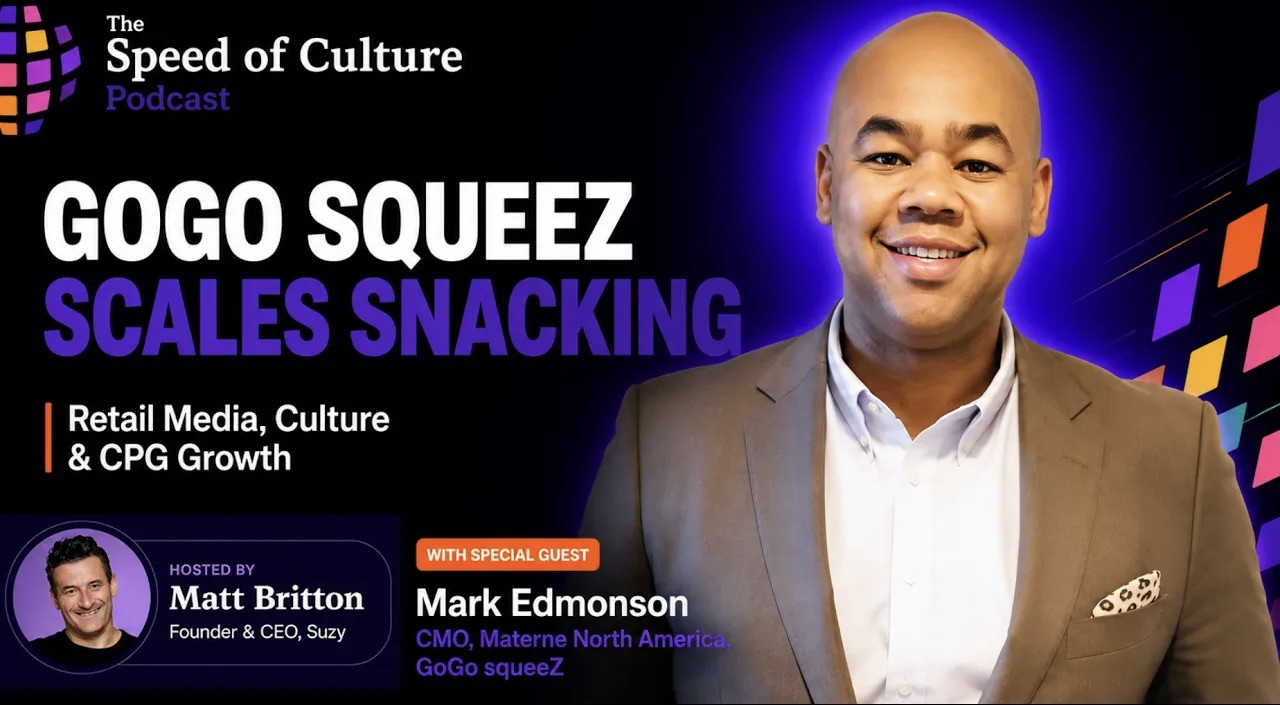
In the consumer packaged goods industry, scaling a brand requires far more than compelling products and clever advertising. It demands a nuanced understanding of evolving consumer behavior, emerging distribution channels, and the speed of market response that separates category leaders from overlooked shelf dwellers.
Matt Britton, founder and CEO of Suzy, the AI-powered consumer intelligence platform, recently sat down with Mark Edmonson, Chief Marketing Officer at Materne North America (GoGo squeeZ), to explore the strategies that enable CPG brands to grow in an increasingly complex and rapidly shifting marketplace. This conversation, recorded in November 2022, captures a critical inflection point for consumer brands navigating post-pandemic recovery, inflationary pressures, and the fundamental restructuring of how consumers discover and purchase food products.
Mark Edmonson brings nearly two decades of marketing experience across iconic brands including Procter & Gamble, Campbell Soup Company (where he managed the legendary Goldfish Crackers line), and Henkel Corporation. His appointment as CMO of GoGo squeeZ marked a significant moment for the Materne North America subsidiary, positioning the popular applesauce and yogurt brand for accelerated growth in a market where younger demographics increasingly drive category expansion.
The discussion between Britton and Edmonson reveals how leading CPG marketers are rethinking traditional playbooks, leveraging direct-to-consumer innovation, optimizing retail partnerships, and building authentic connections with Gen Z and millennial consumers who demand transparency, sustainability, and products that fit their active, on-the-go lifestyles.
For marketing leaders, brand strategists, and innovation executives in the consumer goods space, the insights shared in this episode offer actionable frameworks for thinking about CPG scaling in an era defined by uncertainty, technological disruption, and consumer empowerment.
The Rise of Retail Media: A Game-Changing Distribution Evolution
One of the most transformative developments in the CPG landscape over the past several years has been the explosive growth of retail media. Mark Edmonson identifies retail innovation as a critical lever for brand growth, noting that retailers are continuously evolving their capabilities and introducing cutting-edge technologies that fundamentally change how brands reach and engage consumers.
Retail media platforms, owned and operated by major retailers like Walmart, Amazon, Target, and Instacart, have evolved from simple shelf placement tactics into sophisticated advertising ecosystems that combine first-party data, advanced targeting capabilities, and real-time performance measurement.
For GoGo squeeZ and similar mid-sized CPG brands, retail media represents both opportunity and competitive necessity. Unlike traditional paid media channels where brands compete for attention in fragmented digital environments, retail media positions products at the moment of purchase decision.
These platforms leverage proprietary shopper data and behavior patterns, allowing brands to target specific demographics, purchase occasions, and even previous category buyers. The sophistication now includes over-the-top (OTT) technology, allowing brands to reach consumers on streaming platforms, and advanced search capabilities that capture high-intent shoppers actively seeking products in their category.
What makes retail media particularly attractive for growing CPG brands is the measurement advantage. Brands can directly connect advertising investment to incremental sales through closed-loop systems operated by retailers.
This eliminates much of the attribution ambiguity that plagues traditional media spending, enabling faster optimization cycles and more confident budget allocation. Edmonson's recognition of this shift indicates that successful CPG marketers are no longer betting on traditional mass-market television or broad-reach digital campaigns alone; instead, they're building integrated media strategies where retail media increasingly forms the core of customer acquisition and retention spending.
Direct-to-Consumer Innovation: Speed to Market as Competitive Advantage
Perhaps the most revealing strategic insight from Edmonson concerns GoGo squeeZ's approach to product development and market testing through direct-to-consumer (DTC) channels. In the traditional CPG playbook, new product development involves lengthy research phases, extended production lead times, and the risk that a product might not resonate with consumers by the time it reaches retail shelves.
The company has disrupted this model by using DTC channels, including their own e-commerce platform and Amazon, as rapid testing grounds for new offerings.
This approach delivers multiple strategic advantages. First, it collapses the innovation cycle dramatically. GoGo squeeZ can develop an idea and bring a product to market in as little as eight months, a timeline that would be impossible following traditional retail distribution pathways.
This speed advantage is particularly valuable in a market where consumer preferences are shifting rapidly, seasonal trends evolve, and competitors move quickly to capitalize on emerging opportunities.
Second, the DTC model provides direct access to consumer feedback and data. Rather than relying on point-of-sale data filtered through retail intermediaries, GoGo squeeZ receives immediate, granular insights about which products resonate, which variants consumers prefer, and which price points optimize conversion.
This real-time intelligence allows the brand to make mid-course corrections to formulations, messaging, or positioning before making the significant capital investment required to scale into mass retail.
Third, DTC channels serve as valuable testing grounds for messaging, packaging, and marketing strategies. By running experiments at lower scale and cost through owned channels, GoGo squeeZ can validate hypotheses before rolling out national campaigns or major retail launches.
This experimental approach reduces risk and ensures that when the brand commits to significant retail partnerships or national advertising campaigns, the strategic foundation is grounded in actual consumer data rather than industry assumptions.
The competitive advantage extends beyond speed and insight. For a challenger brand like GoGo squeeZ, the ability to move faster than established category leaders, who often carry legacy systems, organizational complexity, and incumbent brand portfolios that complicate rapid pivoting, represents a meaningful edge.
Edmonson's emphasis on the DTC channel suggests that forward-thinking CPG marketers should view their owned platforms not as lower-margin sales channels but as strategic innovation laboratories where the next generation of category leadership is being shaped.
Product Diversification and Demographic Segmentation: Going Beyond Single-Category Thinking
GoGo squeeZ's product portfolio extension strategy reveals another essential dimension of CPG scaling. What began as an applesauce brand has expanded to encompass yogurt, pudding, and other formats, each targeting specific consumption occasions and demographic segments.
This diversification strategy is not random; rather, it reflects sophisticated thinking about how to maximize market penetration by addressing the distinct needs of different consumer clusters.
The brand recognized that “kids' snack” was too narrow a positioning for sustainable growth. Instead, Edmonson's team approached product expansion through a demographic lens, developing products and messaging specifically for older children, for parents seeking nutritious options for active kids, and for younger consumers increasingly drawn to the brand's values and convenience positioning.
This segmentation approach allows GoGo squeeZ to occupy multiple shelf spaces and compete in adjacent categories, effectively multiplying the number of purchasing occasions and consumer touchpoints.
The diversity of flavors and product formulations within the portfolio serves another strategic purpose: it addresses the reality that consumer preferences are highly fragmented. Rather than betting that a single flagship product will appeal universally, the brand acknowledges that different consumers seek different taste profiles, nutritional compositions, and package formats.
A parent in the Northeast might prefer a particular flavor profile, while a consumer in the Southwest gravitates toward different tastes. Older kids seeking a more sophisticated snacking experience require different positioning than younger children or health-conscious adults.
This approach also has retail implications. The expanded portfolio increases shelf presence and reduces the risk that a shopper will visit the category and find no appealing option.
Retailers appreciate the variety because it allows them to offer broader selection in the premium snacking section, and the multiple SKUs create multiple purchase opportunities within a single brand footprint. From a marketing perspective, the expanded product portfolio creates more content opportunities, allows for more targeted digital and retail media campaigns, and provides multiple entry points for consumers discovering the brand for the first time.
Consumer Engagement in a Noisy Marketplace: Authenticity Over Interruption
A central challenge that Edmonson articulates is one that resonates across the CPG industry: how do brands cut through the overwhelming noise of modern marketing to establish genuine consumer engagement?
The average consumer is exposed to thousands of marketing messages daily. Traditional interruption-based advertising (commercials that interrupt content, banner ads that appear unbidden) faces declining effectiveness as consumers develop sophisticated avoidance behaviors and increasingly consume media through ad-supported streaming platforms, social channels, and other environments where brands must compete for attention.
Edmonson's insight emphasizes storytelling as the antidote. Rather than simply promoting product features or relying on price-based incentives, the most successful CPG brands are articulating a compelling narrative about why consumers need and want their products.
For GoGo squeeZ, this means positioning the brand not merely as a convenient snack but as a partner in supporting active, healthy lifestyles for families navigating modern schedules and wellness priorities.
This storytelling approach requires understanding the specific values and aspirations of target consumers. What drives a parent's purchase decision? Is it convenience, nutritional quality, ingredient transparency, environmental sustainability, or social values?
For older kids and young adults, what makes a snack choice feel authentic rather than marketed? GoGo squeeZ's success suggests that the brand has developed distinct narratives for distinct audience segments, each authentic to that segment's values and needs, rather than attempting a one-size-fits-all approach.
The engagement challenge also intersects with channel selection. In 2022 and beyond, CPG brands cannot assume that mass-market television or traditional grocery store promotions will suffice.
Instead, brands must engage consumers where they naturally congregate: on social platforms, within niche communities, through influencer partnerships that feel authentic rather than transactional, and via owned channels where the brand controls the narrative. Edmonson's emphasis on consumer engagement reflects the reality that modern CPG marketing is fundamentally about building relationships, not just driving transactions.
Emerging Channels and Strategic Flexibility: Staying Ahead of Distribution Evolution
The CPG landscape in 2022 was characterized by extraordinary channel diversification and evolving consumer shopping patterns. Beyond traditional retail, Amazon had become the second-largest grocery player in many categories.
Direct-to-consumer platforms allowed brands to control margins and brand experience, subscription services promised recurring revenue, and emerging channels continued to fragment the once-consolidated retail structure.
For GoGo squeeZ and other scaling CPG brands, this channel fragmentation requires organizational flexibility and willingness to experiment with emerging platforms. What worked as a distribution strategy in 2015 or even 2020 may not work in 2024.
The brands that succeed are those with sufficient organizational agility to test new channels, measure performance quickly, reallocate resources based on results, and scale winners without becoming wedded to legacy distribution partnerships.
This strategic flexibility also extends to pricing and promotional strategies. Different channels operate with different economics and consumer expectations.
The brand must ensure consistent quality, messaging, and brand experience across channels while also remaining responsive to channel-specific opportunities and competitive dynamics. A price-sensitive audience on Amazon might respond to bundle offers or subscription pricing, while premium-focused retailers might require different promotional mechanics and brand positioning.
Key Takeaways for Business Leaders
- Retail media is no longer optional. Leading CPG brands are building retail media into the core of their customer acquisition and retention strategies, leveraging the measurement advantages and first-party data access that these platforms provide. Brands that neglect retail media are ceding competitive advantage to competitors who understand that the moment of purchase has become the moment of maximum marketing impact.
- Direct-to-consumer channels serve as strategic innovation labs, not margin plays. Brands that use owned channels for rapid testing, feedback collection, and speed-to-market advantage are outpacing competitors reliant solely on traditional retail distribution. The eight-month product-to-shelf timeline that GoGo squeeZ has achieved represents a genuine competitive advantage in a market where consumer preferences evolve rapidly.
- Product portfolio expansion must be driven by demographic segmentation, not random innovation. Successful scaling requires disciplined thinking about which consumer segments represent growth opportunities, what specific needs those segments have, and how product and messaging can address those needs distinctly. Brands that fragment their portfolio without clear targeting logic dilute both retail presence and marketing effectiveness.
- Consumer engagement increasingly depends on authentic storytelling that connects to audience values. In a marketplace saturated with marketing messages, brands that articulate compelling narratives about why consumers need their products, aligned with the specific values and aspirations of target audiences, build more resilient customer relationships than brands relying on interruption-based advertising or price promotions alone.
- Organizational agility and channel flexibility are now competitive imperatives. The CPG brands that succeed are those with the infrastructure, leadership mindset, and decision-making speed to experiment with emerging channels, measure results quickly, and reallocate resources to winning strategies. Legacy distribution partnerships and traditional channel strategies cannot be allowed to constrain adaptation to a rapidly evolving retail landscape.
Frequently Asked Questions
How can mid-sized CPG brands compete with category giants on retail media spending?
While large brands certainly have greater financial resources to allocate to retail media, mid-sized brands can compete effectively by focusing on higher-ROI targeting strategies rather than attempting to match spend volume-for-volume.
This means identifying specific demographic segments, purchase occasions, or geographic markets where the brand has higher relevance and concentrating media spend in those areas. Additionally, mid-sized brands often benefit from more nimble optimization cycles (the ability to test, measure, and reallocate budget in weeks rather than months) which can offset lower total spending with superior efficiency metrics and faster adaptation to what actually drives sales.
What are the key challenges in using direct-to-consumer channels as product testing platforms?
DTC testing provides valuable insights, but brands must recognize that DTC consumer behavior may not perfectly predict mass-market response. DTC customers are self-selected consumers who have actively chosen to purchase from the brand's owned channel. They represent early adopters and brand enthusiasts, not necessarily the broader market.
Additionally, brands must invest in sufficient volume to generate statistical significance from testing, and they must have the analytical sophistication to distinguish between noise and signal in the data. Finally, DTC testing requires authentic integration with retail strategies; a product validated in DTC may face different retail economics, shelf placement challenges, or competitive dynamics that require adjustments before national rollout.
How should CPG brands approach packaging and sustainability in the context of rapid product expansion?
Sustainability has become a non-negotiable expectation for many consumer segments, particularly younger demographics. However, packaging innovation, including sustainable alternatives, often involves longer lead times and higher upfront costs than traditional formats.
Brands should approach this by identifying which packaging improvements will most meaningfully resonate with target consumers, prioritizing those innovations, and communicating the sustainability story as part of the broader brand narrative. In some cases, brands may need to educate consumers about trade-offs, explaining, for instance, that a particular sustainable packaging option may have a slightly different appearance or feel than traditional formats.
Transparency about the reasoning behind packaging choices builds authenticity and consumer trust.
What metrics should brands prioritize when evaluating performance across diverse channels?
Rather than optimizing individual channel metrics in isolation, successful CPG brands develop unified performance dashboards that connect channel activity to meaningful business outcomes: incremental volume sales, brand awareness, consideration, purchase intent, and lifetime customer value.
This requires moving beyond traditional media metrics like impressions or click-through rates to understand the actual consumer journey across channels and the relative contribution of each channel to the ultimate business objective.
Brands should also invest in attribution modeling that can handle complex consumer paths to purchase, recognizing that a consumer might discover a brand on social media, research on Amazon, purchase at retail, and then share feedback on brand-owned channels, each touchpoint matters to the overall journey.
Looking Ahead
The conversation between Matt Britton and Mark Edmonson captures a pivotal moment in CPG evolution. Brands that succeed in scaling (whether through geographic expansion, demographic expansion, or adjacent category growth) will be those that embrace new distribution models, remain organizationally nimble in the face of channel disruption, and ground their strategies in deep consumer understanding rather than industry tradition.
For marketing leaders, innovation executives, and brand strategists in the consumer goods space, the implications are clear: the playbooks that worked for decades require fundamental rethinking. Retail media, direct-to-consumer innovation, demographic segmentation, authentic storytelling, and organizational flexibility have become baseline requirements for brands aspiring to lead their categories.
To explore more perspectives on consumer behavior, marketing strategy, and navigating rapid business evolution, visit the Speed of Culture Podcast for additional episodes featuring industry leaders. For deeper consumer insights powered by AI-driven research, learn more about Suzy, the consumer intelligence platform trusted by leading brands to drive innovation and stay ahead of rapidly shifting consumer preferences.
Matt Britton also explores the intersection of artificial intelligence and business strategy in his book Generation AI: Why Generation Alpha & The Age of AI Will Change Everything, which delves into how AI technologies are reshaping consumer behavior and business operations. For those seeking to understand the future of consumer behavior and AI's role in marketing, explore Matt's insights as an AI keynote speaker and resources available through Speaker HQ.
Discover how Suzy's AI-powered consumer intelligence platform helps brands understand evolving consumer behavior and scale with confidence.
%20(400%20x%20100%20px)%20(300%20x%2050%20px)%20(150%20x%2050%20px).avif)