Opening
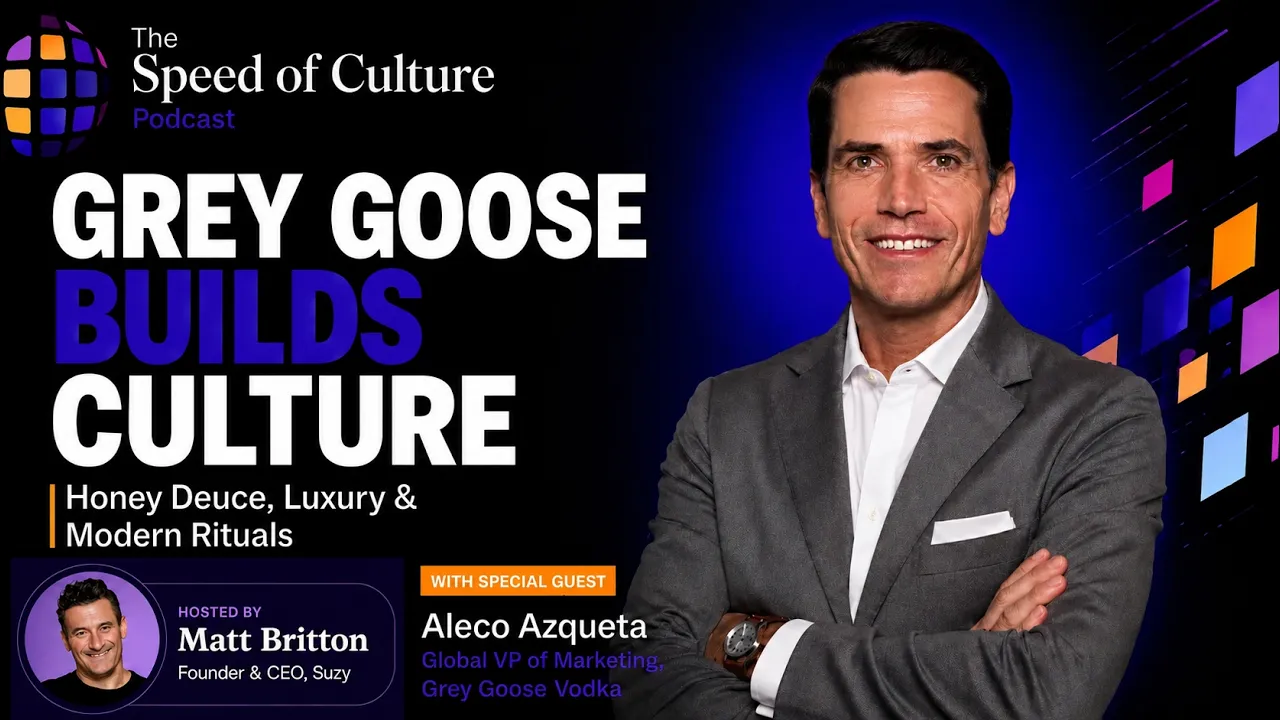
The US Open is a cultural moment that redefines how brands activate at scale. In Episode 209 of The Speed of Culture Podcast, host Matt Britton, founder and CEO of Suzy, the AI-powered consumer intelligence platform, sits down with Aleco Azqueta, Global VP of Marketing at Grey Goose, to dissect how a French luxury vodka brand transformed a 19-year sponsorship into a seasonal phenomenon that generates billions in earned media value.
What makes this conversation essential for modern marketers is simple: Grey Goose treats the US Open as its Super Bowl rather than an advertising opportunity. It is a 365-day strategic investment that culminates in September activation.
Aleco walks through the counterintuitive decisions that shaped this success: why choosing the right athlete partner matters more than signing the world's top-ranked star, how a single cocktail (the Honey Deuce) became an unmissable cultural ritual, and why experiential marketing beats passive impressions every single time.
In an era where consumer attention is fragmented and brand loyalty is conditional, the Grey Goose playbook offers a masterclass in cultural marketing. The brand didn't build dominance through celebrity mega-endorsements or massive broadcast budgets.
Instead, they focused on consistency, relevance, and creating moments where consumers actively opt in to brand experiences. They prioritized brand fit over fame. They invested in experiences that generate their own momentum. And they've built a marketing machine that anticipates consumer behavior rather than chasing it.
This episode cuts to the heart of what it takes to win culturally in 2025: understanding that modern luxury is about belonging to something exclusive rather than flashiness. It's about creating traditions. It's about making consumers feel seen and valued.
For any brand seeking to maximize cultural impact without relying on traditional advertising's diminishing returns, the Grey Goose US Open playbook is required reading.
The 18-Year Overnight Success: Building Cultural Currency Through Consistency
When the Honey Deuce debuted in 2007, nobody expected it would become synonymous with the US Open. The cocktail wasn't born from market research or Madison Avenue brilliance.
It emerged from a practical challenge: Grey Goose needed a drink that could be made quickly during high-traffic US Open events, taste refreshing on hot days, and align with the brand's luxury positioning. A simple vodka-based cocktail with Ginger Ale and a touch of sweetness checked every box.
But the real magic was in the commitment, more than the formula.
According to Aleco Azqueta, what people perceive as an "overnight success" was actually the result of 18 consecutive years of strategic sponsorship consistency. While competitors chased trending athletes and rotating activation concepts, Grey Goose stayed the course.
They showed up. They invested. They refined. Year after year, the brand treated the US Open not as a one-off marketing opportunity but as a core pillar of their brand identity.
This consistency created a compounding effect. By year five, fans had begun to associate the Honey Deuce with the US Open.
By year ten, media outlets automatically featured the cocktail as part of US Open coverage. By year eighteen, the Honey Deuce had transcended product placement and become a genuine consumer ritual, something fans actively sought out, photographed, and shared on social media without any prompting from the brand.
The lesson for modern marketers is profound: cultural currency is built through relentless, intelligent consistency. No one-off celebrity endorsement or viral campaign can substitute for it.
It requires treating a single activation or sponsorship not as a quarterly campaign but as a multi-year commitment where the brand continuously shows up, evolves tactically, and listens to how consumers engage with the experience.
Grey Goose's internal process reflects this philosophy. The brand treats September as the culmination of 12 months of strategic planning.
Marketing, activation, and partnership teams coordinate across functions to ensure every consumer touchpoint, from in-stadium service to social media amplification to post-tournament follow-up, operates as part of a unified system.
After each US Open, the team immediately debriefs, documenting what worked, what fell flat, and what needs to evolve for next year. This commitment to continuous improvement means the activation gets stronger, smarter, and more culturally relevant with each passing year.
Brand Fit Over Fame: Why Aligning Values Matters More Than Star Power
In traditional sports marketing, the playbook is predictable: sign the highest-ranked athlete, leverage their star power, and assume their fan base will translate to brand affinity.
But Grey Goose rejected this formula in favor of something far more sophisticated: selecting athletes whose personal brand and energy genuinely embody the brand's core values.
Instead of pursuing the world's top-ranked tennis stars, Grey Goose partnered with Frances Tiafoe, a player known not for dominance in rankings but for his infectious energy, authentic joy, and distinctive style that aligns perfectly with joie de vivre (the joy of living), the emotional core of the Grey Goose brand.
Tiafoe's personality, his fashion-forward presence, and his approach to tennis reflect the brand's commitment to celebrating life's elevated moments with style and authenticity.
This decision reveals a fundamental truth about modern marketing: consumers have become sophisticated validators of brand partnerships. They can instantly detect when a celebrity endorsement feels forced or inauthentic.
The partnership between brand and athlete must feel genuine, not transactional. When it does, the athlete's fan base becomes an amplifier for the brand message. When it doesn't, audiences dismiss the partnership as corporate manipulation.
Aleco Azqueta's emphasis on brand fit over fame speaks to a broader shift in how luxury brands approach cultural marketing. Luxury is no longer defined solely by exclusive access or price point.
Modern consumers, particularly Gen Z and younger millennials, define luxury as authenticity, intentionality, and belonging. They want to associate with brands that reflect their values and celebrate what they care about.
A partnership between Grey Goose and Frances Tiafoe works because both the brand and the athlete prioritize joy, style, and elevating everyday moments into something special.
The Grey Goose approach also mitigates risk. Top-ranked athletes may command attention, but they also attract controversy and scrutiny.
By choosing partners like Tiafoe, who exemplify the brand's values without the baggage of superstar drama, Grey Goose builds partnerships with longevity. Tiafoe can credibly appear at every US Open, embody the brand in authentic ways, and serve as a genuine advocate rather than a paid endorser reading cue cards.
For brands seeking to build cultural authority, the message is clear: invest in finding athletes, creators, or cultural figures whose personal brand and values naturally align with yours. The partnership will feel authentic, resonate with consumers, and deliver far greater ROI than signing a famous name that doesn't fit.
The Experiential Activation Playbook: How Pop-Ups and Opt-In Moments Drive Cultural Dominance
While the Honey Deuce serves as the conceptual anchor for Grey Goose's US Open strategy, the real innovation lies in how the brand translates this into experiential activations that consumers actively seek out.
The brand understands a critical principle: passive impressions no longer drive cultural impact. Consumers ignore ads, scroll past sponsored content, and dismiss traditional media.
But when a brand creates an experience that consumers opt into, a moment they choose to participate in, the impact multiplies exponentially.
The "Last Serve Bar" at Grand Central Terminal exemplifies this philosophy. Grey Goose opened a three-day pop-up bar running August 27–29, strategically positioned to intercept the 700,000 daily commuters flowing through Grand Central.
The timing was deliberate: the pop-up operated in the days immediately following the US Open, capturing fans on their journey home from Arthur Ashe Stadium.
The location was strategic: over 60 percent of US Open attendees rely on mass transit to reach the venue, making Grand Central a natural congregation point where the brand could deliver a final moment of celebration.
The genius of this activation wasn't the location or timing alone, though both were tactically smart. The genius was that the pop-up operated as an extension of the tournament experience, not a separate advertising moment.
Fans didn't feel like they were being marketed to. They felt like they were participating in the ritual.
They were grabbing one last Honey Deuce before heading home. They were extending the cultural moment. They were creating content that didn't feel like brand content because it felt like genuine celebration.
This experiential approach delivered measurable returns. Pop-up activations generated organic social media amplification, word-of-mouth buzz, and consumer goodwill that traditional advertising couldn't replicate.
Attendees photographed their Honey Deuce, posted to Instagram, and shared the experience with their networks. The brand appeared in thousands of user-generated content posts, all without paying for sponsored content or media placements.
Grey Goose's experiential strategy extends beyond the tournament itself. During COVID, when fans couldn't attend the US Open in person, the brand innovated by delivering Honey Deuce cocktails directly to consumers' homes.
This pivot revealed a critical insight: the value of the experience isn't tied to the physical location. The value is tied to participating in the ritual and feeling connected to the cultural moment.
As the brand expanded this home delivery service to New York, Miami, and Chicago, it transformed what began as a tournament activation into a year-round experiential program that keeps consumers engaged long after September ends.
For marketers considering experiential strategies, the lesson is unmistakable: invest in experiences where your target audience actively wants to participate.
Make the experience about them, not about your brand. Create shareable moments that generate organic content and word-of-mouth amplification. And build flexibility into your activations so you can evolve them based on consumer behavior and market conditions.
Beyond Millennials: How Grey Goose Speaks to Gen Z Without Chasing Trends
A critical challenge facing luxury brands is generational relevance. Millennials built the craft cocktail culture that elevated spirits from functional beverages to cultural expressions.
But Gen Z drinks differently. They consume less alcohol overall and demand brands that align with their values around sustainability, responsibility, and intentionality.
Grey Goose's response to this shift reveals sophisticated generational marketing. Rather than chasing Gen Z through trendy influencer partnerships or TikTok dances, the brand repositioned cocktails as vehicles for elevated, responsible celebration.
The message shifted from "drink more" to "drink better." Instead of focusing on alcohol consumption, Grey Goose emphasizes the ritual, the occasion, and the moment being celebrated.
This positioning resonates with Gen Z precisely because it respects their intelligence and their values. Young consumers are rejecting the binge-drinking culture associated with previous generations, rather than alcohol itself.
They're seeking ways to celebrate that feel intentional and elevated. The Honey Deuce at the US Open represents exactly this: a moment to savor, share, and celebrate with others.
It is about participating in a cultural tradition with style.
The data supports this approach. Nearly three-quarters of Fortune 1000 companies increased experiential marketing budgets in 2025, driven by the recognition that physical activations generate significantly higher brand favorability than digital display or CTV advertising.
For Gen Z specifically, experiential activations create authentic moments that feel less like marketing and more like participation in culture.
Grey Goose's strategy also reflects a broader understanding of how Gen Z consumes information. This generation values peer recommendations and organic discovery over branded messaging.
By investing in experiences that generate authentic word-of-mouth and user-generated content, Grey Goose reaches Gen Z through their preferred channels: Instagram Stories from friends, TikTok videos from trusted creators, and recommendations from people they actually know.
The Year-Round Marketing Machine: From Activation to Strategy to Execution
What elevates Grey Goose's US Open strategy from successful activation to dominant marketing case study is the operational sophistication underlying the campaign.
The brand approaches the US Open sponsorship with the same rigor that a software company approaches product development: clear objectives, cross-functional alignment, data-driven testing, and continuous iteration.
Internally, September is the visible moment, the culmination of 12 months of strategic planning. Starting in January, marketing teams begin conceptualizing the year's activation themes, identifying partnership opportunities, and planning logistical elements.
Through spring and summer, the brand tests creative concepts, refines messaging, and coordinates with the USTA and other partners. By August, all elements are locked and ready for deployment.
This level of planning ensures that nothing feels improvised or rushed. Every consumer touchpoint, from how drinks are served in-stadium, to the design of the pop-up experience, to the social media cadence, operates as part of a cohesive system that amplifies the brand message and creates memorable moments.
Post-tournament, the work doesn't stop. Immediately after the final match, the marketing team debriefs: What resonated with consumers? Which activations drove the highest engagement? What unexpected trends emerged? How did Gen Z respond differently than older consumers?
This intelligence feeds directly into planning for the following year, creating a cycle of continuous improvement that keeps the activation fresh while maintaining the brand's core positioning.
This commitment to excellence and refinement explains why, 19 years into the partnership, the US Open activation remains culturally relevant and generates billions in earned media value annually.
Most brands activate at an event and move on. Grey Goose activates, learns, and evolves. That discipline is the real secret to sustained cultural dominance.
Key Takeaways
- Cultural Currency Is Built Through Relentless Consistency, Not One-Off Campaigns. Grey Goose's 19-year commitment to the US Open created a compounding effect where the brand became inseparable from the tournament. Brands seeking cultural dominance must commit to multi-year investments in specific sponsorships or activations rather than chasing quarterly trending moments.
- Brand Fit Matters Infinitely More Than Celebrity Fame. By partnering with Frances Tiafoe instead of pursuing top-ranked athletes, Grey Goose ensured authenticity and longevity in their partnerships. Modern consumers detect and reject inauthentic celebrity endorsements. Align with partners whose values genuinely reflect your brand, not just their star power.
- Experiential Activations Outperform Traditional Advertising at Every Metric. The Last Serve Bar at Grand Central generated organic social amplification, word-of-mouth buzz, and consumer goodwill that paid advertising cannot replicate. Invest in experiences where consumers opt in and actively want to participate.
- Generational Marketing Requires Understanding Values, Not Just Demographics. Rather than chasing Gen Z through trendy partnerships, Grey Goose repositioned cocktails as vehicles for intentional, elevated celebration. Understanding what each generation values (responsibility, authenticity, cultural participation) matters infinitely more than surface-level demographic targeting.
- Operational Excellence and Continuous Improvement Drive Long-Term Success. Grey Goose's success stems not just from strategic brilliance but from treating the US Open as a year-round strategic program with cross-functional alignment, data-driven testing, and rigorous post-tournament debriefing. Sustained cultural dominance requires discipline and refinement, not inspiration alone.
Frequently Asked Questions
What makes the Honey Deuce more successful than other branded cocktails at sporting events?
The Honey Deuce succeeded because Grey Goose combined practical design (a drink that could be made quickly and tasted refreshing on hot days) with 18 years of consistent presence at the US Open.
The cocktail wasn't forced on consumers; it emerged organically as fans began associating it with the tournament. By treating the drink as an anchor point for a broader brand experience, rather than a standalone product, Grey Goose created a ritual that consumers actively sought out.
Most branded cocktails fail because they attempt to create cultural relevance through novelty. The Honey Deuce succeeded through consistency and integration into an existing cultural moment.
How should brands evaluate whether experiential marketing will generate ROI?
Experiential ROI extends beyond immediate sales metrics. Brands should measure earned media impressions generated by the activation, social media amplification and user-generated content volume, sentiment analysis from conversations about the experience, long-term brand favorability shifts pre- and post-activation, and attribution modeling that connects activation attendance to future purchase behavior.
Grey Goose treats the US Open as a cultural investment that compounds over years rather than a quarterly campaign measured against immediate sales. Modern measurement frameworks (increasingly called Return on Experience or ROX) evaluate emotional, cultural, and long-term business impact alongside direct conversion metrics.
What's the first step a brand should take if seeking to build cultural dominance in a specific sponsorship category?
Start by identifying a sponsorship or cultural moment where your target audience already congregates and actively participates. Commit to a multi-year presence (minimum three years, ideally five-plus) so you can build consistency and familiarity.
Focus relentlessly on brand fit and authenticity in partnership selection rather than chasing the biggest names. Invest in creating experiential moments where your audience opts in and actively participates.
And establish a rigorous post-activation learning process so each year's activation gets smarter, more refined, and more culturally relevant. The first year builds awareness. Years two through five build cultural relevance. Years six-plus build cultural dominance.
How can smaller brands without massive budgets replicate Grey Goose's strategy?
Scale your commitment to match your budget. Instead of pursuing a major sporting event, identify a more niche cultural moment, event, or community where your target audience congregates.
Commit to being present consistently over multiple years. Invest heavily in brand fit and authentic partnership selection.
Focus more resources on creating memorable experiential moments (which often cost less than paid media) than on expensive traditional advertising. Use social listening and consumer research to understand how your audience responds, then refine and evolve.
The brands that succeed are the ones with the deepest commitment to specific communities and the discipline to improve continuously, whatever their budgets.
Looking Ahead
The Speed of Culture Podcast's deep dive with Aleco Azqueta reveals a marketing paradigm shift that's reshaping how brands build cultural authority.
In an era where traditional advertising effectiveness is declining, where consumer attention is increasingly fragmented, and where younger audiences actively reject inauthentic corporate messaging, the Grey Goose playbook offers a blueprint: invest in consistency, prioritize authenticity, create experiences rather than messages, and commit to continuous improvement.
For brand leaders seeking to maximize cultural impact without relying on paid media's diminishing returns, this episode is essential viewing. The conversation bridges strategy and execution, revealing not just what Grey Goose does but why those choices matter for any brand seeking cultural dominance.
To dive deeper into consumer intelligence, generational insights, and the future of AI-powered marketing strategy, explore the full range of resources available:
- Suzy. The AI-powered consumer intelligence platform helping Fortune 1000 brands harness real-time insights to drive growth
- The Speed of Culture Podcast. Where leading voices in marketing, culture, and consumer behavior share the strategies reshaping how brands connect with audiences
- Generation AI: The Book. Matt Britton's latest work exploring how Generation Alpha and the age of AI will fundamentally change everything
- AI Keynote Speaker. Matt Britton speaking on AI, consumer intelligence, and cultural marketing at industry events
- Speaker HQ. Connect with leading voices in marketing, culture, and strategy for your next event

%20(400%20x%20100%20px)%20(300%20x%2050%20px)%20(150%20x%2050%20px).avif)