Sole Purpose: How UNLESS and Under Armour Are Designing Sustainable Shoes and Sportswear
Opening
The sportswear industry stands at an inflection point. As consumers increasingly demand transparency, sustainability, and purpose-driven brands, companies face mounting pressure to reimagine how they design, manufacture, and distribute athletic products.
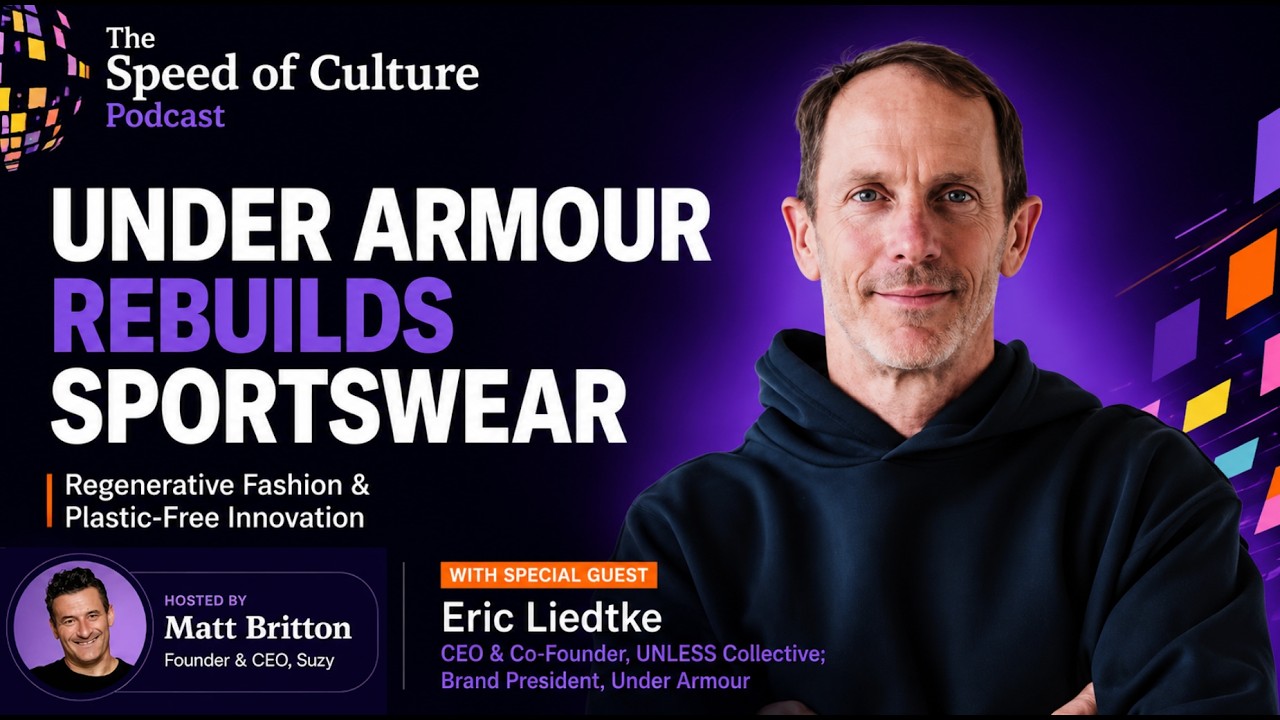
On Episode 217 of the Speed of Culture Podcast, host Matt Britton, founder and CEO of Suzy, the AI-powered consumer intelligence platform, sat down with Eric Liedtke, CEO and Co-Founder of UNLESS, to explore how regenerative innovation is fundamentally reshaping the future of sportswear.
The conversation delves into a mission that many in the industry have long dismissed as impractical: creating premium athletic footwear and apparel from 100% plant-based, plastic-free materials without compromising performance. Liedtke brings three decades of executive experience to this challenge, having spent years as Brand President of Adidas before founding UNLESS Collective in 2021 as the world's first plastic-free apparel brand.
His subsequent partnership with Under Armour in 2024 marks a watershed moment for sustainable fashion, bringing regenerative design principles into the mainstream sportswear market.
This episode dissects the strategic vision, product innovation, and consumer psychology driving the sustainable sportswear revolution. The discussion reveals how legacy corporations are adapting to meet Gen Z and millennial demands for environmental responsibility, how design innovation can actually improve product performance, and what it takes to genuinely transform an entire industry.
For executives, brand strategists, and anyone interested in the intersection of commerce and sustainability, this conversation provides a masterclass in purposeful business leadership and market transformation.
The Rise of Regenerative Fashion: From Concept to Market Reality
The sustainable fashion movement has evolved dramatically over the past decade, transitioning from niche eco-consciousness to mainstream market demand. The global sustainable sportswear market alone reached $15 billion in 2025 and is projected to exhibit a compound annual growth rate of 12% through 2033, according to industry analysts.
This isn't merely a boutique segment, it represents a fundamental shift in how consumers evaluate brands and products.
Eric Liedtke's journey to founding UNLESS Collective reveals the genesis of this transformation. After orchestrating a historic five-year turnaround at Adidas that generated over $8 billion in revenue growth, Liedtke identified a critical gap in the market: no major sportswear brand had achieved true plastic-free production at scale.
Traditional footwear and apparel manufacturing relies almost entirely on petroleum-derived materials (polyester, nylon, synthetic rubber) components that persist in landfills and oceans for centuries.
In 2021, Liedtke launched UNLESS with a radical commitment: zero plastic, zero waste, entirely plant-based. The company didn't position itself as a niche eco-brand but rather as a performance-first alternative that happened to be regenerative.
This distinction proved crucial. Rather than asking consumers to sacrifice functionality for environmental values, UNLESS demonstrated that sustainability and technical excellence could coexist. The first 100% plant-based shoe launched from the company's facilities became a proof-of-concept that shifted industry perceptions overnight.
Under Armour's acquisition of UNLESS in 2024 symbolized a turning point for sustainable sportswear at enterprise scale. The partnership elevated regenerative design from a boutique proposition to a core strategic initiative at one of the world's largest athletic brands.
With Under Armour's manufacturing infrastructure, supply chain expertise, and global distribution network, UNLESS technology could finally reach the mainstream market. This collaboration represents more than a simple acquisition, it demonstrates how incumbent brands recognize that sustainability has evolved from a marketing differentiator to a business necessity.
The market data validates this shift. According to consumer research, 66% of consumers demonstrate willingness to pay premium prices for genuinely sustainable products. Gen Z and millennial consumers increasingly scrutinize supply chains, manufacture methods, and material sourcing.
For brands like Under Armour, investing in regenerative innovation is economically rational. The companies that lead this transition will capture growing market share among younger, more affluent consumers while fortifying themselves against regulatory changes and potential carbon taxes.
Designing for Performance: How Regenerative Materials Compete with Synthetics
A persistent myth in sustainable fashion suggests that environmental responsibility requires accepting compromised performance. Eric Liedtke's work directly challenges this assumption.
The technical innovation embedded in UNLESS's regenerative materials demonstrates that plastic-free design can actually enhance product characteristics.
Plant-based materials offer surprising advantages over traditional synthetics. Bio-fabricated compounds derived from fungal mycelium, mushroom leather, and renewable plant fibers provide superior moisture-wicking properties, breathability, and temperature regulation compared to conventional polyester and nylon.
These materials integrate with the human body's natural thermoregulation systems more effectively, improving comfort during sustained physical activity.
The 2025 Under Armour and UNLESS collaboration introduced three distinct lifestyle sneaker styles, the York Low, Govy Mid-top, and Seaside Slip-on, each engineered with proprietary regenerative materials.
The designs emphasize that plant-based innovation doesn't require aesthetic compromise. These shoes deliver contemporary street style, technical performance features, and completely plastic-free construction simultaneously.
From a design perspective, they're indistinguishable from premium synthetic alternatives, yet they biodegrade safely at end-of-life rather than persisting indefinitely in landfills.
This shift from "sustainable means sacrifice" to "sustainable means innovation" represents a critical psychological rebound in consumer markets. When brands demonstrate that environmental values can coexist with premium quality and contemporary aesthetics, the decision calculus shifts fundamentally.
Consumers evaluate sustainable products against the best available alternatives regardless of environmental impact, with no allowance for a lower baseline.
The regenerative footwear segment exemplifies this principle. The footwear industry, responsible for approximately 65% of sustainable sportswear market revenue in 2024, has become the primary innovation theater for plant-based and recycled materials.
Running shoe manufacturers like Adidas have forged partnerships with companies including Pond, Infinited Fiber, and Spinnova to develop proprietary regenerative composites. These partnerships funnel billions in R&D investment into bio-material science, creating competitive advantages for early movers.
For executives assessing strategic priorities, Liedtke's approach offers a valuable framework: don't position sustainability as a constraint that requires accepting lesser products. Instead, integrate environmental considerations into the design process from inception.
When sustainability shapes product architecture rather than being appended afterward, it generates competitive advantages in performance, durability, and consumer perception.
Building Consumer Demand: The Psychology of Purpose-Driven Brands
Episode 217's discussion explicitly addresses how brands like Under Armour and UNLESS navigate the psychological dimensions of sustainable consumption. This extends beyond product innovation into the realm of consumer behavior, market positioning, and storytelling.
Matt Britton's expertise in consumer intelligence proves particularly relevant here. Through Suzy's AI-powered research capabilities, brands now possess unprecedented visibility into how consumers evaluate sustainability claims, assess authenticity, and develop brand loyalty.
The data reveals critical distinctions between performative sustainability and authentic regenerative commitment.
Consumers increasingly demand transparency regarding material sourcing, manufacturing processes, end-of-life disposal, and supply chain practices. Generic sustainability marketing generates skepticism.
Detailed, verifiable commitments, such as UNLESS's comprehensive material sourcing documentation and biodegradability certifications, build trust and differentiate brands in competitive markets.
The psychology of purpose-driven consumption reveals a generational inflection point. For Gen Z consumers, brand values constitute a primary purchase criterion, equal to or exceeding price and functionality.
A 2025 consumer research report indicates that 73% of Gen Z consumers actively research corporate environmental practices before purchasing.
This demographic shift fundamentally alters brand strategy calculus. Companies that delay sustainable transition risk losing emerging consumer cohorts to competitors who lead on environmental responsibility.
Under Armour's marketing strategy around the UNLESS partnership brilliantly addresses this psychological dynamic. Rather than emphasizing cost premiums (the York Low retails at $149, the Govy Mid-top at $159, the Seaside Slip-on at $119, pricing comparable to conventional premium options), the brand highlights innovation, technical performance, and regenerative commitment as integrated attributes.
This positioning avoids the psychological penalties associated with "eco-friendly alternative" framing, which often implies compromise.
Liedtke's extensive communication strategy, including the Speed of Culture Podcast appearance and similar thought leadership initiatives, reinforces this narrative.
When executives from major brands publicly champion sustainability not as obligation but as opportunity, market perception shifts. Companies observing Under Armour's integration of UNLESS technology face pressure to accelerate their own regenerative initiatives, creating competitive dynamics that benefit the entire industry.
Industry-Wide Transformation: The Path to Mainstream Sustainability
The most significant insight from Episode 217 addresses how individual company innovation catalyzes broader industry transformation. Eric Liedtke's explicit mission involves systematically shifting the entire fashion industry away from petroleum-based materials toward plant-based alternatives.
This ambition extends beyond Under Armour or UNLESS, it represents a reimagining of how the industry itself operates.
This transformation involves multiple dimensions: material science advancement, supply chain restructuring, manufacturing process innovation, and regulatory alignment.
Liedtke's experience with Adidas provided valuable lessons in how large enterprises execute strategic pivots. The Boost footwear platform, Yeezy collaboration, and Parley sustainability line demonstrated that legacy manufacturers could successfully innovate despite organizational inertia.
The Under Armour acquisition of UNLESS represents the next phase, integrating proven sustainable technology into mainstream production at scale.
Market trends validate this trajectory. The sustainable activewear segment is projected to experience the fastest growth through 2032, driven by rising consumer focus on health combined with preference for eco-friendly fabrics.
Footwear brands competing across running, training, and lifestyle categories face increasing expectations to offer plant-based options. This creates competitive pressure: brands that delay sustainable transition risk losing market share to faster-moving competitors.
Regulatory momentum reinforces these market dynamics. The European Union's proposed Extended Producer Responsibility (EPR) regulations would require manufacturers to assume responsibility for end-of-life product disposal, fundamentally altering economics of throwaway culture.
Similar regulations are advancing in other jurisdictions. Brands investing in genuinely biodegradable products position themselves advantageously for regulatory environments where petroleum-based persistent materials face restrictions or taxation.
Liedtke's partnership strategy reflects sophisticated understanding of how to catalyze industry-wide change. By positioning UNLESS not as a niche competitor but as a foundational technology platform that other brands can license and integrate, the company multiplies impact beyond direct market share.
If competitors adopt regenerative materials across supply chains, the entire industry's environmental footprint diminishes, regulatory risk decreases, and consumer perception shifts to normalize sustainable options.
For corporate strategists, Liedtke's approach offers a masterclass in responsible capitalism, how to build profitable businesses that simultaneously advance environmental restoration.
The UNLESS mission explicitly embraces regenerative principles, designing products that improve soil health, sequester carbon, and restore ecosystems upon decomposition. This exceeds traditional sustainability metrics and aims toward positive environmental contribution.
The Consumer Intelligence Factor: Using Data to Understand Market Readiness
Matt Britton's involvement in Episode 217 underscores an often-overlooked dimension of sustainable business transformation: the role of real-time consumer intelligence in strategic decision-making.
Brands navigating the transition to regenerative products face critical unknowns: How many consumers prioritize sustainability? At what price premium? Across which product categories? For which demographic segments?
Suzy's AI-powered research platform addresses these questions at scale, enabling brands to iterate rapidly based on consumer feedback.
The data-driven approach proves essential for companies like Under Armour, which must balance profitability with purpose while competing against entrenched competitors relying on cheaper petroleum-based materials.
Real-time consumer research reveals critical insights for sustainable sportswear strategies. For example, research indicates that consumer willingness to pay sustainability premiums varies significantly by product category, demographic, and geographic region.
Athletic footwear commands higher sustainability premiums than apparel, consumers accept 15-25% price increases for plant-based shoes but resist comparable premiums for basic t-shirts.
Gen Z consumers in urban markets demonstrate stronger sustainability preferences than older consumers in rural areas, requiring differentiated marketing approaches.
These insights enable brands to optimize product portfolio strategy, allocate R&D investment, and target marketing messaging.
Rather than hoping consumers will embrace sustainable options, data-driven brands proactively understand market readiness and tailor go-to-market strategies accordingly.
The Speed of Culture Podcast itself represents a content strategy aligned with this intelligence-gathering approach.
By featuring Eric Liedtke in conversation with Matt Britton, the podcast simultaneously shapes consumer perceptions and gathers real-time responses to regenerative innovation narratives.
Listener engagement metrics, social sharing patterns, and post-episode brand sentiment provide quantitative feedback on how audiences respond to these sustainability messages.
For executives launching sustainable product lines, the lesson is clear: supplement intuition with rigorous consumer intelligence.
The companies that succeed in transitioning to regenerative business models are those that combine visionary leadership with data-driven market understanding. Liedtke's vision for plastic-free athletics provides direction; Britton's expertise in consumer psychology and AI-enabled research provides the navigation system.
Key Takeaways
- Regenerative innovation requires viewing sustainability as a design opportunity, not a constraint. When environmental considerations shape product architecture from inception, they generate competitive advantages in performance, durability, and consumer perception while avoiding the psychological penalties of "eco-friendly alternative" positioning.
- Market demand for sustainable sportswear has transitioned from niche segment to mainstream growth driver. The global sustainable sportswear market reached $15 billion in 2025 and is projected to grow at 12% annually through 2033, with Gen Z and millennial consumers demonstrating willingness to pay premiums for genuine environmental commitment.
- Strategic partnerships between incumbent enterprises and specialized sustainable innovators accelerate industry transformation at scale. Under Armour's acquisition of UNLESS demonstrates how legacy manufacturers can integrate proven regenerative technology into mainstream production, multiplying impact beyond direct market share.
- Consumer intelligence platforms enable brands to optimize sustainable strategies based on real-time market feedback. Understanding demographic variation in sustainability preferences, price sensitivity, and product category dynamics allows companies to tailor go-to-market approaches and allocate R&D investment strategically.
- Authentic sustainability commitment differentiates brands more effectively than performative environmental claims. Transparent material sourcing, comprehensive supply chain documentation, and verifiable biodegradability certifications build consumer trust in ways that generic sustainability marketing cannot, particularly among demanding Gen Z audiences.
Frequently Asked Questions
What makes UNLESS different from other sustainable sportswear brands?
UNLESS distinguishes itself through comprehensive plastic-free design combined with mainstream performance standards and aesthetic appeal. Rather than positioning as a niche eco-alternative, the company engineered plant-based materials that perform comparably to or exceed synthetic alternatives in moisture-wicking, breathability, and durability.
Under Armour's acquisition enabled scaling this technology to global distribution while maintaining regenerative principles. The three-shoe collection (York Low at $149, Govy Mid-top at $159, Seaside Slip-on at $119) demonstrates that plant-based footwear can achieve premium pricing comparable to conventional alternatives without sacrificing style or function.
How do plant-based materials biodegrade, and what happens to shoes after disposal?
Regenerative materials engineered by UNLESS and other sustainable manufacturers are designed to safely return to soil through biological decomposition processes. Plant-based materials derived from fungal mycelium, mushroom leather, and renewable plant fibers break down into organic compounds that enrich soil ecosystems rather than persisting in landfills or oceans.
Unlike synthetic materials that require hundreds of years to decompose (if ever), regenerative compositions typically degrade within 2-3 years under appropriate conditions. Some materials actually sequester carbon or improve soil health upon decomposition, supporting regenerative agriculture principles rather than merely reducing environmental harm.
What is the price premium for sustainable sportswear, and is it justified?
The Under Armour and UNLESS collaboration demonstrates that authentic regenerative footwear can achieve price parity with premium conventional options rather than requiring substantial premiums. The Seaside Slip-on at $119, for example, costs less than many established premium lifestyle sneakers.
Consumer research indicates that willingness to pay sustainability premiums varies by product category and demographic, with footwear commanding higher premiums (15-25%) than apparel. The value proposition extends beyond environmental considerations, regenerative materials often deliver superior performance characteristics that justify premium pricing independent of sustainability benefits.
How does Eric Liedtke's Adidas experience inform his UNLESS strategy?
Liedtke's tenure as Adidas Brand President involved orchestrating historic corporate transformation, delivering over $8 billion in revenue growth while launching the Boost footwear platform, facilitating the Yeezy collaboration, and establishing the Parley sustainability initiative.
This experience demonstrated that legacy manufacturers could execute innovation despite organizational inertia, that performance-first product development could coexist with environmental responsibility, and that strategic partnerships could accelerate market transformation.
These lessons directly inform UNLESS's positioning as a technology platform available to mainstream brands rather than solely a direct competitor, and Under Armour's integration of UNLESS innovation into core product lines demonstrates how to scale sustainable transformation across enterprise manufacturing infrastructure.
Looking Ahead
The conversation between Matt Britton and Eric Liedtke on Episode 217 of the Speed of Culture Podcast illuminates a critical inflection point for the sportswear industry.
As consumer expectations, regulatory pressure, and competitive dynamics converge, brands face mounting pressure to transition from petroleum-based models toward regenerative alternatives.
The companies that execute this transition successfully, integrating genuine environmental commitment into core product innovation, communicating authentically about sustainability, and supporting transformation with rigorous consumer intelligence, will emerge as industry leaders in the next decade.
The UNLESS and Under Armour partnership proves that regenerative design can achieve mainstream success without sacrificing performance, aesthetics, or profitability.
For executives, strategists, and innovation leaders, the fundamental lesson is clear: sustainability has transitioned from a marketing narrative to a core business strategy.
Organizations that treat regenerative innovation as competitive opportunity rather than regulatory burden will capture emerging consumer demand, fortify against regulatory risk, and build brands that resonate with the next generation of informed, purposeful consumers.
Explore more insights on consumer behavior, AI-driven market research, and the future of sustainable business through these resources:

%20(400%20x%20100%20px)%20(300%20x%2050%20px)%20(150%20x%2050%20px).avif)