Opening: Understanding Culture as the Ultimate Marketing Force
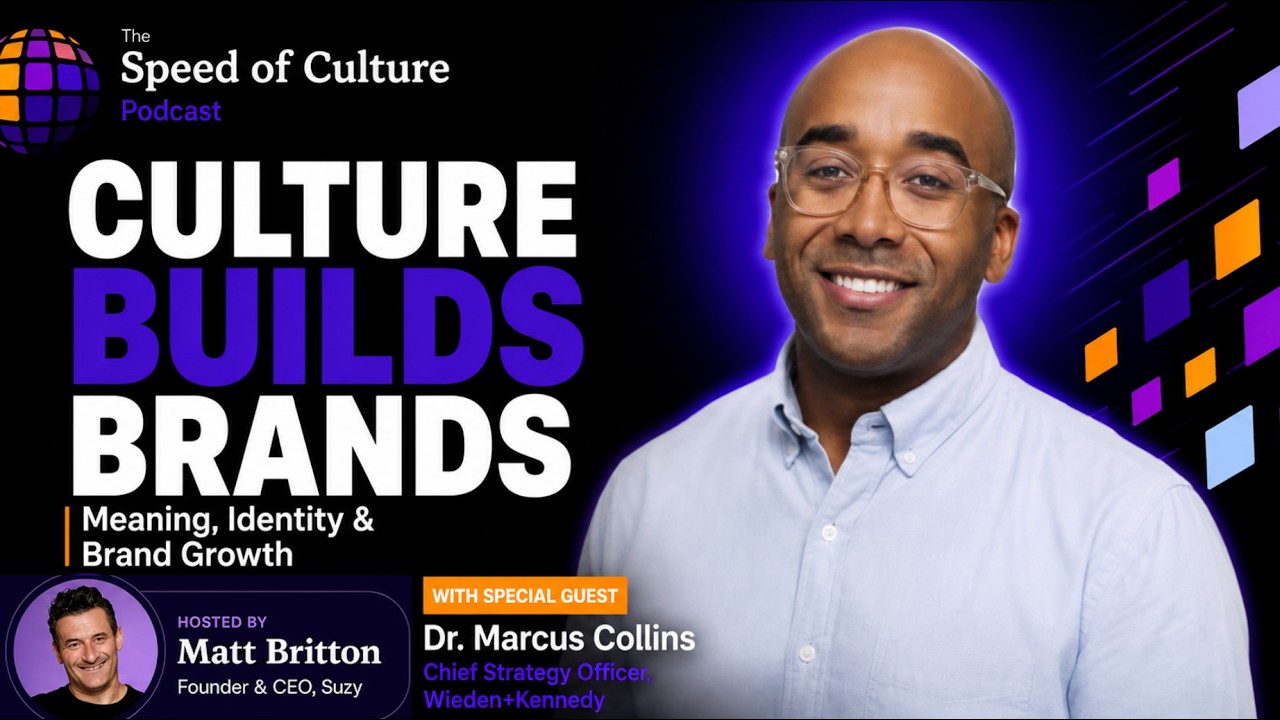
In today's fragmented consumer landscape, brands face an unprecedented challenge: breaking through the noise to connect authentically with audiences. Yet one transformative force remains more powerful than demographics, spending power, or traditional segmentation: culture. This is precisely why Matt Britton, founder and CEO of Suzy, the AI-powered consumer intelligence platform, brought Dr. Marcus Collins onto The Speed of Culture Podcast to explore how culture shapes human behavior and drives brand success.
Dr. Marcus Collins is a Clinical Assistant Professor of Marketing at the University of Michigan's Ross School of Business and the best-selling author of For the Culture: The Power Behind What We Buy, What We Do, and Who We Want to Be. With one foot in academia and another in practice, having served as Chief Strategy Officer at Wieden+Kennedy, one of the world's most influential creative agencies. Collins brings a unique perspective on the intersection of marketing, culture, and consumer psychology.
In this episode, recorded on June 27, 2023, Collins and Britton dive deep into how brands can leverage cultural understanding to create meaningful connections with consumers and build lasting loyalty. For marketers, brand leaders, and cultural strategists seeking to understand the mechanisms of consumer behavior in 2023 and beyond, this conversation offers essential insights backed by research, real-world examples, and actionable strategies that can be implemented across industries.
Understanding the DNA of Culture: Why Belonging Matters More Than Demographics
The Tribal Instinct in Modern Marketing
Dr. Collins begins by establishing a fundamental principle that underpins all of his work: the human need to belong to a tribe is encoded in our DNA. This is a deep psychological driver that predates modern marketing by millennia. People instinctively seek out communities where they can find similarity, shared values, and mutual identity.
When brands understand this primitive human need, they unlock the power to move from commodity selling to cultural leadership. Traditional marketing has relied on demographics (age, gender, income, location) to segment audiences. However, Collins argues that this approach is fundamentally limiting.
Demographics tell us who someone is in structural terms, but they reveal nothing about why someone makes the decisions they do, what they aspire to become, or what values define their sense of identity. Culture, by contrast, operates at a deeper level. It represents a system of values, symbols, and norms that demarcate not just who people are, but how they see the world around them and what tribes they belong to.
A 35-year-old affluent executive and a 35-year-old teacher may share identical demographics but have completely different cultural identities, aspirations, and brand affinities. Understanding this distinction is essential for modern marketing.
The Power of Psychographic Segmentation
Rather than defaulting to demographic segmentation, Collins advocates for psychographic segmentation, understanding consumers through their beliefs, values, interests, and cultural identity. This approach establishes people's self-identity in a way that demographics simply cannot. When brands communicate through a cultural lens, they're speaking directly to the identity aspirations of their audience.
Consider how this plays out: A brand that promotes a culture and values aligned with its audience has a dramatically better chance of differentiation and building emotional loyalty. Demographic peers may be competitors at the surface level, but cultural peers become brand advocates and community members.
Cultural Contagion and Brand Differentiation: From Generic to Iconic
The Liquid Death Case Study: Making Water Aspirational
One of the most compelling examples Collins discusses is Liquid Death, a bottled water brand operating in one of the most commoditized markets imaginable. Water has no meaningful product differentiation. H2O is H2O. Yet Liquid Death has achieved iconic status among environmentally conscious, edgy consumers by packaging the product in aluminum cans and adopting the tagline “Death to Plastics.”
The genius of this positioning is the culture rather than the product. Liquid Death identified a tribe: sustainability-focused, counterculture-oriented consumers who view plastic consumption as antithetical to their identity. By embedding cultural values into every touchpoint (packaging, messaging, brand personality), Liquid Death transformed a generic commodity into a symbol of cultural identity.
Consumers don't just buy water; they buy membership in a sustainability-conscious tribe. This example illustrates Collins' central thesis: Culture is the ultimate differentiator, especially for products competing in commoditized categories.
When a brand articulates a clear cultural identity and values system, it gives consumers permission to choose based on identity alignment rather than functional attributes alone.
Identity as the Anchor of Culture
Throughout the conversation, Collins emphasizes that identity is the anchor that holds culture together. Brands that successfully leverage brand culture are those that help consumers express or aspire to a particular identity. Nike's core belief, “every human is an athlete” has remained constant for decades, yet the brand has evolved its product lines, communications, and cultural moments to stay relevant across generational and market shifts.
This consistency allows Nike to evolve without losing its cultural authority. The brand doesn't chase trends; it invites consumers into a cultural identity that's continuously evolving while remaining rooted in its foundational belief. This is how brands achieve sustained relevance without losing brand integrity.
Cultural Evolution Without Ideological Compromise: Nike's Master Class
How Brands Stay Relevant While Maintaining Core Values
A critical insight from Collins concerns how brands can evolve their cultural identity to remain relevant without fundamentally changing their core ideology. Many brands mistake evolution for revolution, pivoting so dramatically that they alienate their existing cultural community while failing to authentically connect with new audiences.
Nike demonstrates the opposite approach. The brand's core belief (that athleticism is a human quality available to everyone, not just professional athletes) has remained unwavering since its inception. Yet Nike has continuously evolved:
- Its product portfolio has expanded from running shoes to lifestyle apparel, sports equipment, and digital services.
- Its cultural moments have shifted from endorsing individual athletes to championing social movements.
- Its brand communication has evolved from performance-focused messaging to identity and aspirational storytelling.
- Its cultural community has expanded from dedicated runners to weekend athletes to fitness enthusiasts to cultural trendsetters.
Each evolution has been consistent with Nike's foundational belief, yet has allowed the brand to remain culturally relevant and attractive to new consumer segments. This is the model Collins advocates for brands seeking to stay at the forefront of cultural marketing: evolve your expressions while protecting your core ideology.
The Role of Technology in Extending Cultural Connectivity
How Digital Platforms Reshape Human Connection
As the conversation turns to technology's role in shaping culture and consumer behavior, Collins offers a nuanced perspective. Technology, in his view, is fundamentally an extension of human behavior and human connectivity. It doesn't create new human needs; it amplifies, extends, and sustains existing ones.
There's a natural decay in human relationships when physical proximity decreases or regular in-person contact diminishes. Technology (particularly social platforms, messaging apps, and community forums) extends and sustains connectivity across distance and time. This has profound implications for cultural communities and brand tribes.
Before social technology, cultural communities were geographically bounded. You could only fully participate in tribes with people you could physically access. Now, culture is distributed globally.
A teenager in rural Ohio can find and join a cultural community of like-minded peers across the globe, participate in its rituals, adopt its symbols, and build identity through it, all digitally mediated. For brands, this means cultural communities are no longer constrained by geography.
A brand can build a global cultural tribe around shared values, and that tribe can self-organize, create content, and extend the brand's cultural message far beyond traditional marketing channels. This is why community-building and cultural authenticity have become paramount in digital-first marketing.
For the Culture: From Theory to Practice and Personal Insight
The Book Behind the Movement
Dr. Collins' best-selling book, For the Culture: The Power Behind What We Buy, What We Do, and Who We Want to Be, distills years of academic research, strategic consulting experience, and personal reflection into a framework for understanding cultural influence on human behavior. Rather than presenting a dry academic treatise, Collins uses his own mistakes, struggles, and epiphanies as teaching moments throughout the book.
The book argues that true cultural engagement is the most powerful vehicle for influencing behavior. While temporary incentives, discounts, and functional benefits can drive short-term transactions, cultural alignment drives long-term loyalty, advocacy, and community membership.
A consumer who chooses a brand because it represents their cultural identity is fundamentally different from a consumer who chooses it because it's on sale. Collins' hope is that readers, whether they're brand leaders, marketing professionals, entrepreneurs, or simply conscious consumers, can learn from his journey and use cultural frameworks to make better decisions.
For brand leaders, the book provides a strategic toolkit for identifying, articulating, and activating the cultural identity of their brand. For consumers, it offers frameworks for understanding why they make the choices they do and how culture shapes their behavior.
Practical Takeaway for Marketers
The central lesson from Collins' work is this: Move beyond asking “Who is my customer?” and start asking “What cultural identity do my customers aspire to? What tribe do they want to belong to? What values do they use to define themselves?”
When brands answer these questions authentically and embed cultural identity into every element of the brand experience, from product design to packaging to customer service to community activation, they move from being a transaction provider to being a cultural institution.
The AI and Marketing Frontier: How Consumer Intelligence Shapes Cultural Strategy
Connecting Insights to Cultural Understanding
The conversation between Matt Britton and Dr. Collins also touches on how AI-powered consumer intelligence platforms like Suzy enable marketers to understand culture at scale. Traditional market research has struggled to capture cultural identity and psychographic depth because these dimensions aren't easily quantifiable through surveys or focus groups.
However, modern consumer intelligence platforms can analyze real-time consumer behavior, sentiment, language, and community participation across digital channels to identify emerging cultural movements, understand cultural affinities, and track shifts in cultural identity.
This data, combined with qualitative research and ethnographic understanding, enables brands to make more culturally informed decisions. For Suzy, this means providing brands with tools to understand not just what consumers are buying, but why they're buying it, what cultural identity are they expressing? What tribe are they joining? What values are they signaling?
This shift from behavioral insights to cultural insights represents the frontier of competitive advantage in marketing.
Key Takeaways: What Every Marketer Should Know
- Culture Trumps Demographics: While demographic segmentation has historically dominated marketing, cultural identity is a far more powerful driver of consumer behavior. Brands that segment by cultural identity rather than demographics will achieve superior differentiation and loyalty.
- Tribal Belonging is a Primary Human Need: People don't just want to buy products; they want to belong to communities. Brands that position themselves as cultural institutions, not just commodity providers, tap into this fundamental human need and build unshakable loyalty.
- Psychographics Over Demographics: Understanding consumers through their beliefs, values, and cultural identity (psychographics) reveals far more about their decision-making than age, income, or location (demographics). Modern marketing requires psychographic segmentation.
- Differentiation Through Values Alignment: In commoditized categories, brands cannot compete on functional attributes. The path to differentiation is through clear articulation of cultural values and authentic alignment with consumer cultural identity. See: Liquid Death.
- Evolution Requires Ideological Consistency: Brands can and should evolve their products, communications, and market presence. However, this evolution must remain true to core ideological beliefs. Nike's consistency in its “every human is an athlete” philosophy, combined with continuous tactical evolution, is the model.
- Technology Extends, Not Transforms, Human Connection: Digital platforms and technology amplify existing human needs for connection and community. Brands that build authentic cultural communities in digital spaces can achieve unprecedented scale and loyalty.
- Psychographic Data Requires Ongoing Research: Understanding cultural identity requires more than one-time research. Culture shifts rapidly, especially among younger cohorts influenced by social media and digital communities. Brands need continuous, real-time cultural intelligence to stay relevant.
FAQ: Common Questions About Cultural Marketing
How is cultural identity different from brand loyalty?
Brand loyalty traditionally focuses on repeat purchase behavior and satisfaction with product performance. Cultural identity goes deeper. It's about whether the brand reflects and reinforces how the consumer sees themselves and wants to be seen. A consumer can be loyal to a brand out of habit; they become culturally aligned with a brand when it represents their values and identity.
Can smaller brands effectively use cultural marketing, or is this just for big companies?
Cultural marketing is actually more accessible to smaller and emerging brands. Large companies often struggle with cultural authenticity because they're trying to appeal to multiple segments simultaneously. Smaller brands can achieve cultural authenticity by deeply understanding and serving a specific cultural community.
Liquid Death is instructive here, as a newer brand, it had the freedom to build a strong cultural identity around sustainability and counterculture values.
How can B2B brands leverage cultural marketing?
B2B brands often dismiss cultural marketing as applicable only to consumer products. However, B2B purchase decisions are still made by humans with cultural identities and tribal affiliations. A software company targeting creative professionals can build a cultural identity around empowering creative freedom.
An enterprise solution provider can position itself as a partner to mission-driven organizations. The principles are the same; the cultural community is simply more narrowly defined.
What's the relationship between cultural marketing and social responsibility?
Authentic cultural alignment often involves social values. However, there's a critical difference between brands that genuinely embody cultural values and brands that performatively adopt cultural causes. Consumers, especially younger cohorts, are increasingly sophisticated at detecting inauthentic cultural positioning (often called “woke-washing” or “cause-washing”).
Brands must ensure that their cultural positioning is authentic to their actual values and operations.
Looking Ahead: The Future of Culture-Driven Marketing
The conversation with Dr. Marcus Collins highlights a fundamental shift in how brands must approach marketing strategy. The days of treating marketing as a communication problem, finding the right message to reach the right demographic, are waning.
The future belongs to brands that treat marketing as a cultural problem: How do we build an authentic cultural identity? How do we understand and serve the cultural aspirations of our audience? How do we become a cultural institution rather than merely a commodity provider?
For brand leaders, marketers, and strategists seeking to understand consumer behavior in an increasingly complex and culturally fragmented world, Dr. Collins' work and the insights shared in this episode of The Speed of Culture Podcast provide an essential framework.
To dive deeper into these concepts, explore Dr. Collins' best-selling book, For the Culture, discover more about the Suzy consumer intelligence platform, and listen to the full episode on The Speed of Culture Podcast. For additional insights on Gen Z marketing, consumer behavior, and the future of brand strategy, check out Generation AI by Matt Britton and explore resources at Speaker HQ for keynote speakers and thought leadership on emerging consumer trends.

%20(400%20x%20100%20px)%20(300%20x%2050%20px)%20(150%20x%2050%20px).avif)