Why Cultural Relevance is the New Competitive Advantage for Brands in 2024
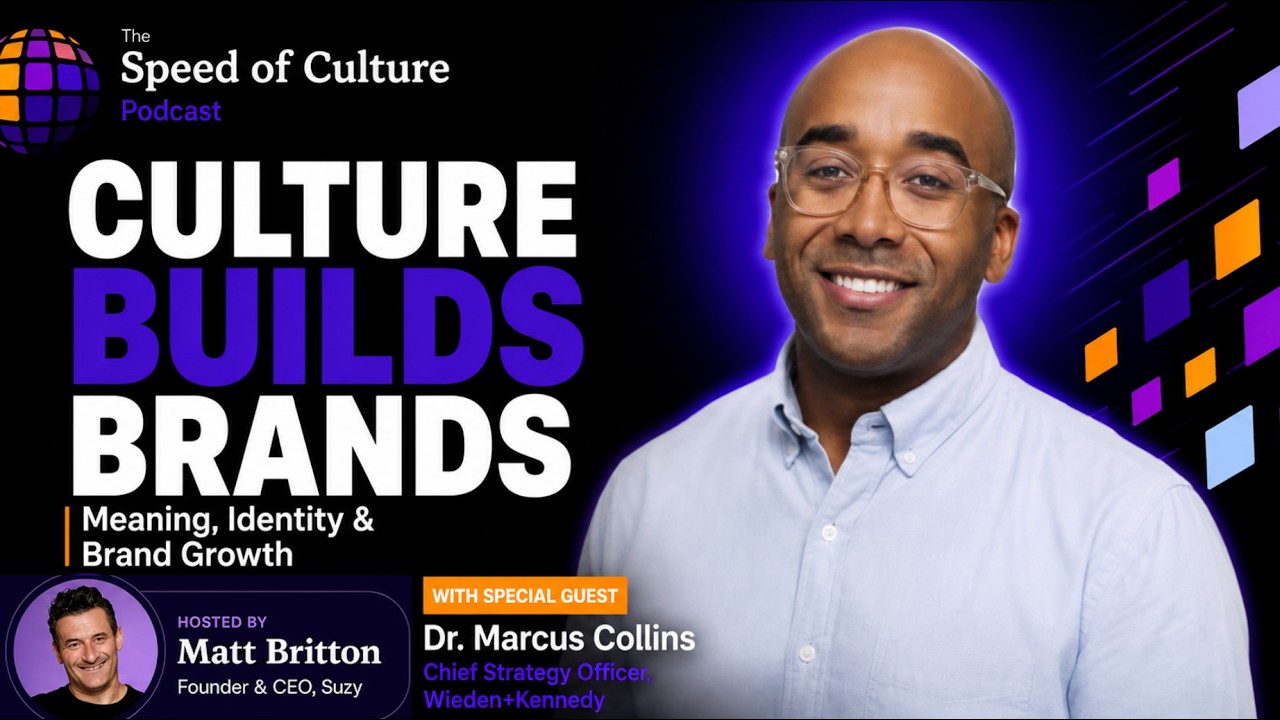
In an era where consumer attention spans shrink daily and algorithmic feeds dictate cultural narratives, brands face an unprecedented challenge: how do you stay culturally relevant without appearing tone-deaf or opportunistic? This question sits at the heart of a compelling conversation between Matt Britton, founder and CEO of Suzy, the AI-powered consumer intelligence platform, and Dr. Marcus Collins, Chief Strategy Officer at Wieden+Kennedy New York, as captured in the latest episode of the Speed of Culture podcast.
The discussion reveals a fundamental truth that separates category leaders from cultural afterthoughts: understanding culture goes well beyond gathering more data points or mining social media sentiment. It means recognizing that culture functions as the operating system that governs how people actually behave, make decisions, and construct their identities in the real world.
Dr. Collins brings decades of expertise to this conversation, including groundbreaking work with brands like Apple, Beyoncé, McDonald's, and Google, alongside his role as a Clinical Assistant Professor at the University of Michigan Ross School of Business and author of the USA Today bestseller For the Culture.
The timing of this conversation couldn't be more critical. As brands navigate an increasingly fragmented media landscape where TikTok sidewalk trends move faster than boardroom strategic plans, the gap between companies that truly understand cultural undercurrents and those that merely chase viral moments has never been wider.
The most damaging mistake brands make today? Confusing intimacy with information. A company might have 10 million first-party data points about consumer behavior, yet lack any genuine understanding of what actually motivates those consumers to show up, believe in something, or advocate for a brand to their peers.
This blog post unpacks the essential insights from Matt Britton's conversation with Dr. Marcus Collins, exploring how brands can move beyond treating culture like a seasonal marketing campaign and instead embed cultural understanding into their DNA. For CMOs, brand strategists, innovation leaders, and anyone responsible for keeping a brand's pulse steady in turbulent cultural moments, this conversation offers a masterclass in moving from cultural tourism to cultural citizenship.
The stakes have never been higher, and the tools to understand culture, through AI-powered consumer intelligence platforms like Suzy, have never been more accessible.
The Operating System Metaphor: Why Data Alone Won't Make Your Brand Culturally Relevant
Dr. Marcus Collins opens the conversation with a deceptively simple yet profoundly important reframing: culture functions as the operating system that governs our world. Just as a computer operating system determines how software runs, how systems communicate, and what functions are possible, culture determines how people actually behave, what they value, and how they construct meaning in their lives.
This metaphor obliterates a common misconception that persists in marketing departments everywhere: the belief that consumer behavior can be adequately understood through data aggregation and analytics dashboards.
A brand might know that 35% of their target demographic purchased Product X last quarter, that engagement rates peaked at 8 PM on weekdays, or that the aesthetic preferences lean toward minimalist design. None of this data, however, captures what culture actually is, the shared beliefs, values, rituals, and ways of communicating that give purchase decisions meaning beyond the transactional.
Consider Apple's evolution as a case study that Collins himself contributed to during his tenure helping build iTunes and Nike sports music initiatives. Apple didn't dominate the digital music space because they had better data about listening patterns than competitors.
They dominated because they understood that iPod ownership became a cultural statement about identity, taste, and belonging to a particular tribe of design-conscious, innovation-oriented consumers. The product was inseparable from the culture it both reflected and reinforced.
The distinction matters enormously in 2024 because brands now have access to unprecedented amounts of data. Marketing technology stacks are more sophisticated than ever. Yet simultaneously, consumer trust in brands continues to decline.
Why? Because data without cultural understanding produces marketing that feels hollow, inauthentic, or, worse, cringingly out of touch. A brand can perfectly target a demographic with personalized ads based on browsing history, purchase patterns, and location data, yet if that messaging doesn't resonate with the actual cultural values and identity signaling that matters to those consumers, the campaign crashes and burns on social media.
Dr. Collins emphasizes that the most successful brands today are those that treat cultural understanding as foundational to strategy, not as an afterthought to data interpretation.
Instead of asking “What does the data tell us people want?”, the question becomes “What does the culture people actually live in tell us about how they construct meaning and identity?”
The Suzy platform, with its real-time consumer intelligence capabilities, enables brands to bridge this gap, using AI and data science to identify cultural patterns and shifts that quantitative metrics alone would miss.
Tribes, Not Segments: Redefining How Brands Think About Their Audiences
One of the most actionable insights from the Speed of Culture episode involves a critical reframing of audience strategy: shifting from thinking about consumers as market segments to understanding them as tribes.
Market segments are demographic and psychographic categorizations created by brands. Tribes are organic communities that exist in the real world (neighborhoods, online communities, subcultures, creative movements) where people use shared cultural codes to communicate identity and belonging.
A woman aged 25-34 with household income of $75,000–$150,000 who shops in the athletic wear category is a market segment. A TikTok user who participates in the hyperactive sneaker culture community, who follows indie design accounts, who posts authentically about her gym journey while also celebrating body diversity, and who discusses sneaker drops with her core friend group. That's a tribe.
Brands that make the mistake of treating tribes as market segments run into a specific problem: their messaging, when it lands, feels like it comes from outside the community.
“When brands treat cultural engagement like a tourist, the meaning attributed to your brand can live without you.”
If a brand participates in a cultural moment the way a tourist visits a foreign country (showing up, taking pictures, checking off experiences, then leaving) the community will move on without the brand. There's no real relationship. There's no genuine investment. There's certainly no tribal loyalty.
This insight has profound implications for brand strategy. It means that authentic cultural engagement requires ongoing participation and genuine belief in the values a tribe represents.
The tribes vs. segments distinction also explains why brands struggle with TikTok compared to traditional media channels. TikTok's architecture is fundamentally tribal. Algorithms drive users toward content that resonates with their communities and cultural identities.
A TikTok tribe can immediately detect when a brand is performing culture versus living it. And they will publicly, virally, and without mercy, call that inauthenticity out.
Understanding your brand's audiences as tribes, not just as data points to be segmented and targeted, requires different research methodologies, different insights infrastructure, and fundamentally different organizational capabilities. Rather than relying on post-hoc analysis of segments, brands can use real-time data to understand the actual tribal communities their products serve, what cultural narratives matter to those tribes, and how to participate authentically in those cultural moments.
The TikTok Effect: How Culture Gets Made Today (And Why Boardrooms Are No Longer in Charge)
Perhaps the most striking insight from Dr. Collins' perspective: TikTok has become the single largest arbiter of what's culturally relevant at any given moment. What's hot is determined on sidewalks, in bedrooms, in garages, and in physical communities, not in corporate strategy sessions or advertising boardrooms.
Historically, major brands, entertainment conglomerates, and media companies had significant gatekeeping power over cultural narratives. Today, a 16-year-old in rural Ohio can create a dance, post it to TikTok, and watch it go viral across millions of people within days, completely bypassing traditional media infrastructure.
By the time a brand's research team identifies a trend, asks for boardroom approval to create a campaign, produces the content, and publishes it, the cultural moment has often already passed or been thoroughly absorbed and re-contextualized by the community that created it.
The implications for brand strategy are staggering. Cultural relevance requires the ability to sense cultural shifts in real time, understand the subtleties of what makes something culturally meaningful versus culturally cringey, and move with speed that most traditional organizations simply can't match.
Dr. Collins' observation that culture isn't cosplay. You don't put it on and take it off is particularly relevant here. Brands that approach TikTok trends as fleeting opportunities to seem "relatable" by using trending sounds or hashtags without understanding the underlying cultural meaning typically face public backlash.
This doesn't mean brands should avoid TikTok. Rather, it means they must invest in genuine cultural understanding and real-time monitoring capabilities. They need to understand not just what's trending, but why.
The brands that will win in this environment are those that treat cultural intelligence as critical infrastructure, similar to how they treat financial intelligence or competitive intelligence. AI-powered consumer intelligence platforms enable brands to process massive amounts of cultural data in real time, identify emerging trends and tribal movements, and understand the actual values and narratives that are driving behavior.
The Intimacy-Information Gap: Why Your Data Doesn't Know Your Customers
Dr. Collins makes a distinction that should be taped above every CMO's desk: there's a vast difference between information and intimacy.
Brands accumulate information obsessively, first-party data, behavioral data, purchase history, browsing patterns, email engagement metrics. Yet this information often produces the opposite of intimacy. In fact, it can create a false sense of knowing customers when, in reality, the brand remains an outsider to the actual culture these customers inhabit.
Intimacy requires understanding what people actually care about, what gives their lives meaning, what communities they belong to, what identity they're constructing, and what values they want their purchases to signal.
A customer might purchase a particular athletic brand not because the technical specifications are superior, but because that brand's cultural positioning (what it signals about identity, values, and belonging) aligns with their tribal affiliation.
The practical consequence of this gap is marketing that misses the mark despite being precisely targeted. The information was perfect. The intimacy was nonexistent.
These are fundamentally different research questions that require different methodologies and different tools.
Building a Culturally Intelligent Organization: The Infrastructure Brands Need Today
The final piece of Dr. Collins' framework addresses an organizational challenge: how do brands actually build the capabilities to stay culturally relevant in an environment where culture is created on TikTok sidewalks, not in boardrooms?
First, brands need to fundamentally reorganize how they source consumer insights. Rather than waiting for quarterly research reports or annual brand tracking studies, they need real-time cultural intelligence. Tools like Suzy leverage AI to process consumer signals, detect emerging trends, and identify cultural shifts at speed and scale.
Second, brands need embedded cultural practitioners within their organizations. This might mean TikTok creators on the marketing team, cultural advisors who represent the actual communities the brand serves, or research roles specifically designed to understand tribal movements and cultural narratives.
Third, brands need decision-making processes that can move at cultural speed. Most traditional marketing organizations require weeks or months from insight to campaign execution. Cultural moments move faster.
Fourth, brands need to think of cultural participation not as a marketing channel but as a fundamental part of brand strategy and organizational culture. Staying culturally relevant requires embedded expertise, real-time intelligence infrastructure, and organizational cultures genuinely committed to serving the communities your brand represents.
Key Takeaways for Business Leaders
- Culture is an operating system, not a marketing message. The most culturally relevant brands understand that culture governs how people actually behave and construct identity. This requires research and strategy that goes far beyond demographic and psychographic data.
- Engage with tribes, not segments. Market segments are constructs created by brands; tribes are real communities where people use shared cultural codes. Authentic cultural relevance requires genuine, ongoing participation in tribal communities, not touristic marketing campaigns.
- Speed and authenticity are inseparable. In the TikTok era, cultural moments move faster than traditional decision-making processes. Brands must build organizational capabilities for real-time cultural intelligence and decision-making without sacrificing authenticity or brand integrity.
- Information is not intimacy. Advanced data analytics and personalization can create a false sense of knowing customers. True cultural understanding requires deep knowledge of the communities customers belong to and the values those communities embody.
- Cultural participation is an organizational imperative. Staying culturally relevant demands embedded cultural practitioners, real-time intelligence infrastructure, and organizational cultures genuinely committed to serving the communities your brand represents.
Frequently Asked Questions
How can brands balance real-time cultural participation with brand consistency?
This is one of the most common challenges in modern marketing. The answer lies in distinguishing between brand identity (which should remain consistent) and cultural expression (which must evolve with cultural moments).
A brand's core values, purpose, and positioning should remain stable. These are the foundation of trust. However, how a brand expresses those values, participates in cultural conversations, and engages with emerging tribes should evolve as culture evolves.
What's the difference between cultural appropriation and authentic cultural participation for brands?
Dr. Collins and other cultural strategists distinguish these through several criteria: depth of knowledge, community benefits, authenticity of belief, and longevity of engagement.
The key is that authentic participation requires the brand to serve communities, not just leverage cultural moments for attention.
How do you measure cultural relevance?
Traditional metrics like engagement rates and impressions don't fully capture cultural relevance. Better measurements include community perception, cultural influence, and longevity of impact.
Advanced consumer intelligence platforms can track these qualitative and quantitative signals in real time, providing a more complete picture of cultural positioning than traditional advertising metrics.
What role should data science and AI play in cultural strategy?
Data science and AI are accelerators and amplifiers of human cultural judgment, not replacements. Tools like Suzy use AI to process massive amounts of consumer signals, identify emerging trends, and surface patterns that human researchers might miss.
However, interpretation and authentic response require human cultural expertise. The most effective organizations combine real-time AI-powered insights with embedded cultural practitioners who can translate data into meaningful strategy.
Looking Ahead: Building Your Cultural Intelligence Strategy
The conversation between Matt Britton and Dr. Marcus Collins reveals that cultural relevance is no longer a nice-to-have marketing advantage. It's a fundamental requirement for brand survival in 2024 and beyond.
The brands that will thrive are those that treat culture not as a campaign theme, but as the operating system their strategy runs on.
- Explore real-time consumer intelligence: Visit Suzy to learn how AI-powered platforms can provide the real-time cultural insights your brand needs to stay relevant.
- Dive deeper into cultural strategy: Listen to the full episode and subscribe to the Speed of Culture podcast for ongoing conversations with cultural leaders and strategists.
- Build your knowledge: Check out Dr. Marcus Collins' bestseller For the Culture for deeper frameworks on how culture drives behavior.
- Explore AI's role in strategy: Matt Britton's book Generation AI explores how artificial intelligence is reshaping marketing and business strategy.
- Learn from keynote insights: For a deeper exploration of AI's impact on consumer understanding and brand strategy, explore Matt Britton's keynote speaking topics or visit Speaker HQ to discuss cultural strategy and AI for your organization.
The cultural moment is now. The tools to understand and participate authentically are available. The question isn't whether your brand can afford to invest in cultural intelligence. The question is whether you can afford not to.

%20(400%20x%20100%20px)%20(300%20x%2050%20px)%20(150%20x%2050%20px).avif)