April 2, 2024
Northwestern Mutual CMO Lynn Teo on Innovating Financial Marketing for the Next Generation

Lynn Teo
CMO
This is some text inside of a div block.
This is some text inside of a div block.
LISTEN ANYWHERE YOU FIND YOUR PODCASTS
%20(400%20x%20100%20px)%20(300%20x%2050%20px)%20(150%20x%2050%20px).avif)

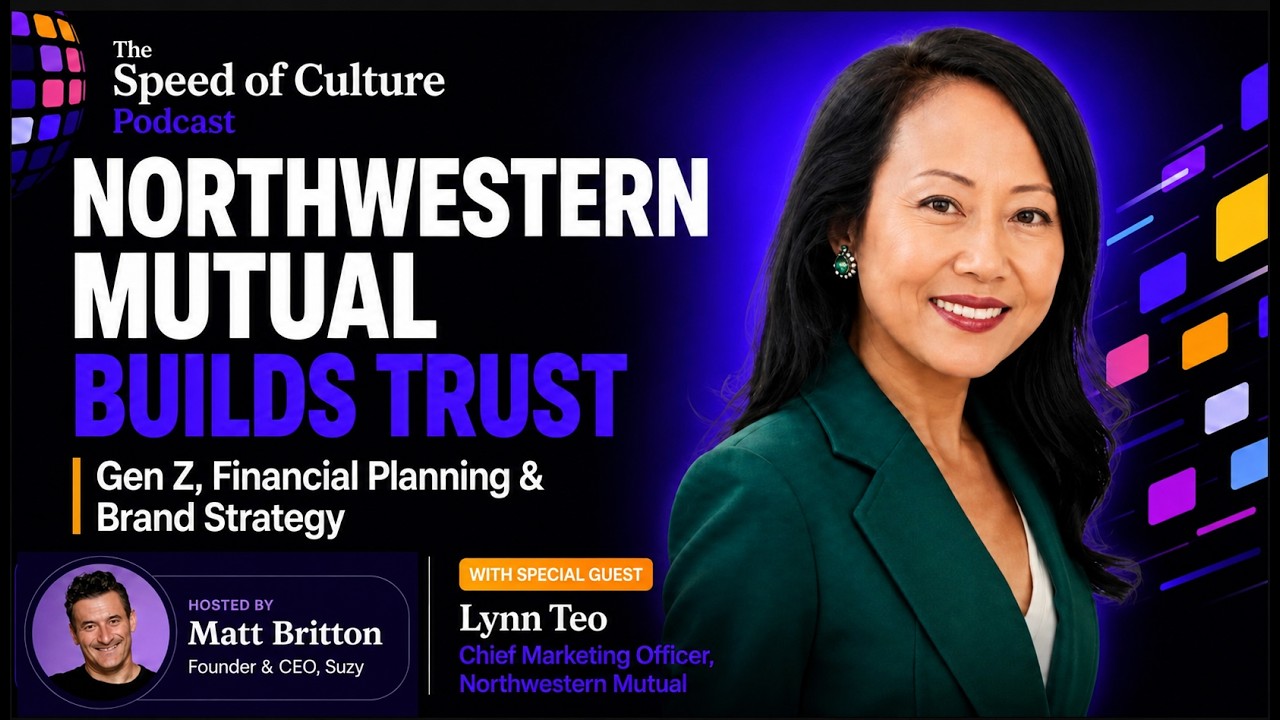
In an era where financial services firms compete not just on products but on purpose, one executive stands out for her visionary approach to reimagining how legacy brands connect with younger consumers. Lynn Teo, Chief Marketing Officer of Northwestern Mutual, recently joined Matt Britton, founder and CEO of Suzy, the AI-powered consumer intelligence platform, on The Speed of Culture Podcast to discuss how traditional financial institutions can remain relevant in an increasingly digital-first world.
Recorded at CES in Las Vegas on April 2, 2024, this compelling episode marks a turning point in the conversation around financial services marketing. Rather than viewing Gen Z's skepticism toward traditional finance as an obstacle, Teo frames it as an opportunity, a chance for established firms to prove their value through authenticity, education, and genuine consumer understanding.
Her perspective challenges the conventional wisdom that legacy brands must choose between honoring their heritage and embracing innovation. Instead, Teo demonstrates that these elements can coexist and reinforce one another when guided by a clear understanding of what younger consumers actually want.
For marketers in the financial services sector, Teo's insights offer a masterclass in strategic transformation. Her journey from technical expert at Bell Labs to senior creative strategist at boutique agencies like AKQA and McCann, and finally to the C-suite at one of America's most trusted financial institutions, has equipped her with a unique perspective on what drives long-term consumer relationships.
This episode explores the evolution of brand strategy in financial services, the critical role of consumer intelligence in marketing success, and the specific tactics Northwestern Mutual employs to reach and engage Gen Z, a demographic that represents trillions in future wealth.
The conversation touches on everything from social media strategy and content personalization to the integration of artificial intelligence in customer experience design. More importantly, it articulates a philosophy of marketing that transcends traditional promotional tactics.
The best marketing occurs when consumers feel genuinely understood, when brands demonstrate they grasp not just what customers want to buy, but who they are and what matters to them across their entire lives.
The rise of Gen Z as an economic force has upended decades of conventional wisdom in financial services marketing. Unlike previous generations, Gen Z consumers possess unprecedented access to financial information, alternative investment platforms, and peer-reviewed commentary on traditional financial institutions.
This democratization of financial knowledge has fundamentally altered how younger consumers evaluate and select financial partners. Teo emphasizes that Gen Z does not respond to traditional hard-sell marketing tactics.
Instead, this demographic gravitates toward brands that demonstrate relevance and helpfulness before attempting to sell anything at all. The implications are profound: financial services firms must shift from product-focused messaging to value-focused engagement that acknowledges the consumer's broader life context.
Gen Z consumers transition through multiple life stages (from college to first jobs, from independent living to partnerships and family formation) and they expect brands to evolve with them, providing consistent guidance and support at each juncture.
This shift from transactional relationships to long-term partnerships requires a fundamental reimagining of how financial institutions position themselves. Rather than promoting specific investment products or insurance policies, leading firms are repositioning themselves as life advisors.
Northwestern Mutual's approach exemplifies this philosophy: instead of marketing products in isolation, the firm emphasizes its holistic financial planning methodology, which integrates risk products and investment vehicles into a coherent strategy aligned with a client's broader life goals.
The engagement preference Teo identifies also reflects broader consumer skepticism toward marketing as a category. Gen Z grew up alongside digital advertising, influencer marketing, and increasingly sophisticated attempts to manipulate consumer behavior.
As a result, they have developed refined filters for detecting and dismissing overtly promotional content. They seek instead to be entertained, educated, or informed, experiences that provide genuine value independent of any immediate commercial transaction.
This reality has transformed the role of CMOs in financial services from promotional visionaries to content strategists and consumer educators.
Lynn Teo's career trajectory offers valuable lessons for marketing executives navigating the transition from agency to client-side roles. Her journey began at Bell Labs, where she developed deep technical expertise before pivoting to creative strategy.
This early grounding in technology would prove invaluable throughout her career, providing a foundation for understanding how digital innovation could enhance consumer relationships.
Her subsequent tenure at prestigious agencies, including AKQA, known for pioneering digital transformation work, and McCann, one of the world's largest advertising networks, exposed Teo to diverse industries and business challenges. This breadth of experience cultivated what Teo describes as a fearless approach to transformation and innovation.
Agency environments demand rapid problem-solving, creative agility, and the ability to drive change under pressure. These capabilities translate directly to the complex challenges of stewarding a legacy brand's digital evolution.
However, Teo notes a critical difference between agency and client-side roles: accountability and stakes. In the agency world, losing an account is a setback, but it does not end a career trajectory.
On the client side, particularly in a role as visible as CMO, the consequences of strategic miscalculations are far more personal and profound. This heightened accountability has forced Teo to develop a different mindset, one grounded in results, measurable outcomes, and the long-term health of an organization.
Where agencies thrive on innovation and conceptual boldness, client-side leadership requires the additional dimension of disciplined execution and budget stewardship.
This transition also brings Teo into direct contact with operational realities that remain invisible at many agencies. Northwestern Mutual's business model, rooted in relationships with financial advisors in the field, means that marketing strategy must be coordinated with sales enablement, compliance, and distribution channel considerations.
The CMO's role extends beyond creative excellence to encompassing business partner relationships, organizational alignment, and the translation of strategic vision into operational reality across multiple functional teams.
Teo's perspective on this transition offers important guidance for aspiring marketing executives: the move to client-side leadership requires not just strategic and creative capability, but also executive presence, political acumen, and the ability to drive change within large, complex organizations.
Northwestern Mutual's approach to engaging Gen Z extends across multiple digital platforms, each leveraged according to its unique strengths and audience characteristics. Rather than deploying a one-size-fits-all content strategy, Teo's team has invested in platform-native content creation that feels authentic to each channel while advancing broader brand and educational objectives.
On TikTok and Instagram, Northwestern Mutual creates content that entertains and educates simultaneously. This is not a space for corporate messaging or formal brand communication; instead, content emphasizes relatability, humor, and practical financial wisdom communicated through formats native to these platforms.
The philosophy recognizes that Gen Z users on social media are seeking entertainment and connection rather than financial advice in the traditional sense. By infusing financial education into entertainment, Northwestern Mutual positions itself as a brand that understands younger consumers' media consumption habits and respects their attention.
Pinterest represents another important channel in Northwestern Mutual's digital portfolio, particularly for visual storytelling around life goals and aspirations. This platform has proven especially effective for connecting with users actively engaged in aspirational planning.
Northwestern Mutual's Pinterest strategy emphasizes visualization of financial goals and lifestyle aspirations, positioning the brand as a partner in achieving life goals rather than simply selling financial products.
Beyond organic social media strategy, Northwestern Mutual has pursued strategic partnerships that enhance brand relevance and create meaningful consumer touchpoints. The sponsorship relationship with the Milwaukee Brewers exemplifies this approach, providing visibility within a sporting context that Gen Z engages with while supporting the community where the company is headquartered.
These platform and partnership strategies reflect a broader principle articulated by Teo: brands must become truly native to the environments where their target consumers spend time.
One of the most distinctive aspects of Northwestern Mutual's approach to Gen Z engagement is the integration of financial education into its marketing strategy. Rather than viewing financial literacy as a corporate social responsibility initiative separate from marketing objectives, Teo has positioned education as a core element of brand differentiation and customer relationship building.
This strategy reflects a sophisticated understanding of Gen Z's relationship with financial services. Younger consumers report lower levels of financial confidence than older generations, despite having greater access to financial information.
By positioning itself as an educational resource, offering accessible information about financial planning, investment basics, and wealth management fundamentals. Northwestern Mutual addresses an unmet need while simultaneously establishing itself as a trusted advisor from the early stages of the consumer relationship.
The educational approach also creates a longer customer lifecycle. Rather than expecting Gen Z to arrive ready to purchase complex financial products, the firm invests in building familiarity and trust over time through accessible educational content.
This extended relationship-building phase proves especially valuable for financial services, where purchase decisions require significant personal research and consideration.
Northwestern Mutual's investment in digital transformation extends beyond social media presence into core product and service delivery mechanisms. The firm's mobile application serves not as a transactional tool but as a daily engagement mechanism through which consumers can track spending patterns, receive personalized insights, and maintain regular touchpoints with the brand.
This approach reflects an important evolution in how financial services firms think about technology. Digital platforms create opportunities for continuous, personalized engagement that can enhance the quality of customer relationships.
The integration of artificial intelligence and advanced data analytics enables a new level of personalization that would be impossible through manual processes alone. AI systems can identify patterns in customer behavior, anticipate potential financial challenges, and surface opportunities for optimization or risk mitigation.
However, Teo is careful to note that technology should enhance rather than replace human relationships in financial advisory. The most effective implementation of AI augments the capabilities of human advisors, providing better insights and freeing them to focus on relationship-building and complex problem-solving.
Teo's philosophy of long-term relationship building stands in marked contrast to short-term, conversion-focused marketing approaches. In an era of seemingly infinite consumer choice, competitive advantage increasingly accrues to brands that can build sustained emotional connections and demonstrate consistent value over extended time horizons.
Customers acquired through educational engagement and demonstrated understanding prove more loyal, more likely to deepen relationships over time, and less price-sensitive than customers acquired through promotional tactics.
The emphasis on empathy represents another critical dimension of Teo's approach. By positioning the brand as an entity that truly understands and respects its consumers, Northwestern Mutual creates a foundation of goodwill and trust that transcends any individual product or service offering.
Teo also acknowledges the importance of multicultural competence and adaptability in reaching diverse Gen Z audiences. Gen Z is significantly more diverse than previous generations, with varying financial priorities, cultural values, and communication preferences.
Traditional firms possess significant advantages, regulatory credibility, established networks of advisors, diversified service offerings, and accumulated trust. The competitive imperative lies not in imitating fintech but in leveraging these distinctive advantages while modernizing customer experience through digital innovation and personalized engagement.
Social media functions less as a direct conversion channel and more as a brand awareness and engagement mechanism. The goal is not immediate sales conversion but top-of-funnel awareness and relationship-building that supports conversion when consumers reach decision-making stages.
Educational content should be measured not on immediate conversion metrics but on engagement indicators, audience growth, and downstream impact on purchase behavior and customer lifetime value. Longer measurement windows and customer journey attribution models are essential for capturing full value.
Brands should be transparent about data usage, provide consumers with meaningful control over their data, and ensure personalization experiences genuinely benefit consumers. Regulatory requirements should be viewed as frameworks that build consumer confidence in brand data practices.
The Speed of Culture Podcast continues to illuminate the evolving intersection of consumer behavior, cultural dynamics, and marketing strategy. Lynn Teo's insights on building brand relevance in an age of consumer empowerment extend far beyond financial services.
For professionals seeking to deepen their understanding of these topics, several resources merit exploration:
The principles articulated in this episode, prioritizing consumer understanding, balancing innovation with authenticity, and integrating technology with human relationships, provide a roadmap for brands navigating the next era of marketing.