The Evolution of Media Channels and Consumer Behavior
The media landscape has undergone profound transformation over the past two decades. Where advertisers once had access to a handful of channels (television, radio, and print) they now navigate an ecosystem of hundreds of media platforms serving distinct consumer behaviors and preferences. This explosion of choice, while offering unprecedented opportunities, has also created significant complexity for brands seeking to optimize their marketing investments and maintain competitive advantage.
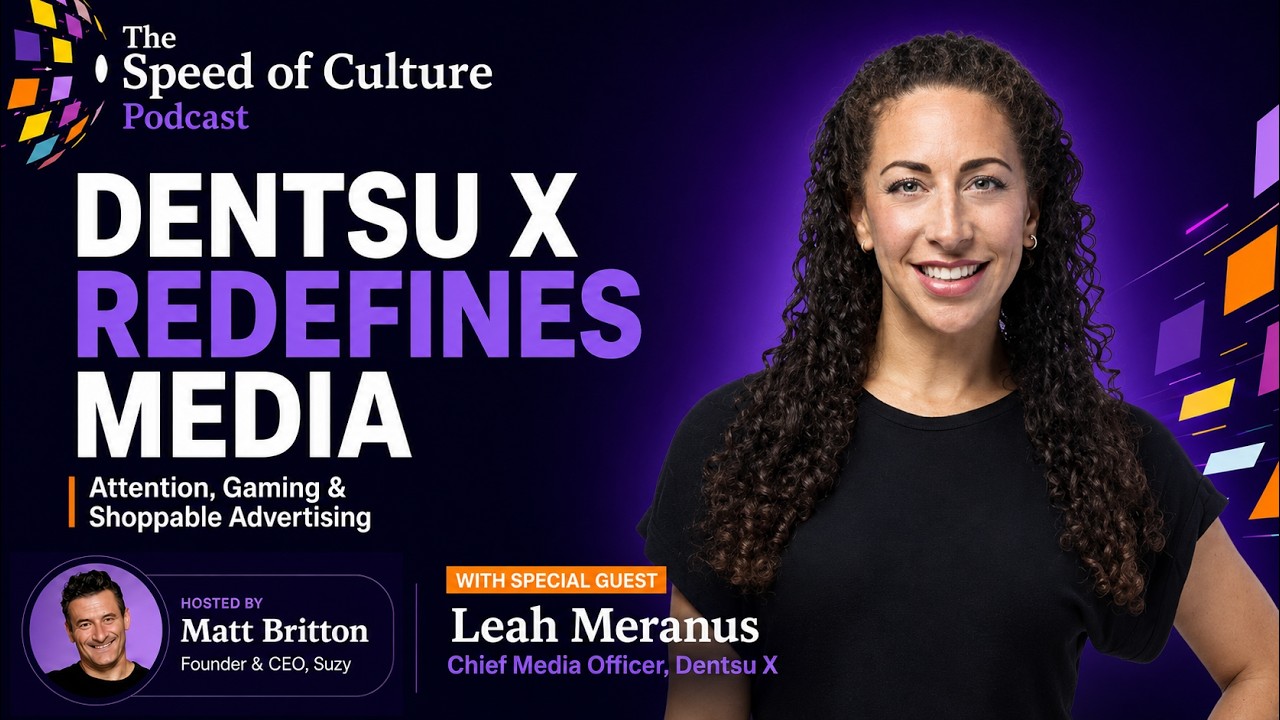
Leah Meranus, Chief Media Officer at Dentsu X, has spent nearly twenty years navigating this evolution from traditional to digital-first media strategies. Her career trajectory offers valuable insights into how marketing leaders think about media planning, consumer behavior trends, and the strategic imperatives shaping modern advertising.
In a recent episode of The Speed of Culture podcast with founder and CEO of Suzy, the AI-powered consumer intelligence platform, Meranus discussed the critical shifts transforming media innovation, the persistent question of whether television is dead, emerging opportunities in gaming and blockchain technology, and how agencies like Dentsu X are positioning themselves to help clients thrive amid rapid change.
For marketing executives and brand leaders, understanding these dynamics is essential. The decisions made today about media investment, technology partnerships, and strategic direction will determine competitive positioning in 2023 and beyond. Meranus's insights from leading one of the world's largest media agencies, and her extensive experience across retail, beauty, luxury, quick-service restaurants, gaming, and electronics sectors, provide a masterclass in navigating the future of media.
Change is clearly occurring. The foundational challenge facing modern marketers is how to effectively allocate resources and attention across an increasingly fragmented media environment. Meranus articulates this challenge with clarity: nearly twenty years ago, her career began in a world of media scarcity, where executives could reasonably understand and optimize across perhaps a dozen major channels. Today, that simplicity has vanished.
This transformation reflects deeper shifts in how consumers engage with media. The rise of streaming services has fundamentally altered television consumption patterns, moving viewers from scheduled programming to on-demand content. Social media platforms have created new spaces for both entertainment and discovery.
Mobile devices have become primary screens for younger demographics. Gaming has evolved from niche entertainment to a mainstream cultural force commanding billions in annual spending. These shifts represent actual changes in where audiences spend time and attention.
Understanding these behavioral changes is foundational to effective media strategy. Brands cannot assume that messages crafted for traditional broadcast television will resonate when delivered through social media feeds or gaming environments. The context matters profoundly.
A thirty-second advertisement works differently in the middle of a YouTube video than in a chat stream during a Twitch broadcast. The intimacy of social media demands different tones and approaches than mass-market television. Gaming advertising requires integration with gameplay mechanics rather than interruption of content.
Meranus's tenure at Initiative, where the agency won Adweek's U.S. Media Agency of the Year award, demonstrates the tangible results that accrue from getting these dynamics right. Her work across diverse sectors shows that while channel proliferation creates complexity, it also creates opportunities for agencies and brands that develop sophisticated understanding of audience behavior across platforms.
What Differentiates Dentsu X in a Crowded Media Agency Landscape
Competition among media agencies has intensified as the value of media planning and buying has become increasingly transparent and measurable. In this environment, agencies must differentiate on dimensions beyond traditional media-buying efficiency. Meranus identifies talent retention and company culture as core competitive advantages for Dentsu X.
This perspective reflects a sophisticated understanding of modern competitive dynamics. The best talent gravitates toward organizations that invest in employee development, offer opportunities for skill diversification, and create environments where rising professionals can become experts in multiple domains.
In media agencies, this means creating career pathways where teams can develop expertise in traditional channels while simultaneously building capabilities in programmatic advertising, social media strategy, consumer analytics, and emerging platforms.
The strategic insight here applies broadly: in knowledge-intensive industries where human expertise is the primary value-delivery mechanism, organizational culture and employee development become competitive moats. Dentsu X's investment in creating an environment where talented people want to work represents a long-term competitive bet.
Employees who feel invested in, developed, and valued deliver superior work for clients. They also become brand ambassadors, attracting additional talent and building reputation in the market.
For marketers evaluating agency partners, Meranus's comments suggest that questions about an agency's approach to talent development and organizational culture should carry real weight in partner selection decisions. An agency that has solved the talent problem has partially solved the innovation problem.
Television: Evolution Rather Than Extinction
One of the most debated questions in marketing circles is whether television is dead. The data suggests a more nuanced narrative than either extreme position allows. Television viewership has declined, particularly among younger demographics.
Prime-time ratings have compressed as audiences fragment across streaming platforms. Demand for linear television ad inventory has softened. These are facts.
Yet television remains viable, Meranus argues, when positioned as part of a holistic marketing approach rather than as the foundation of media strategy. This represents an important reframing.
Television has moved from being a near-monopoly on mass-audience reach to being one tool among many. The channel continues to deliver long-form content engagement and maintains genuine relevance for certain audience segments. The key strategic question is not whether television is dead but rather how to deploy television strategically within a diversified media mix.
This evolution reflects broader changes in media consumption. As streaming services proliferate and app fatigue rises, consumers are showing signs of fatigue from the subscription model and the fragmentation it creates.
This dynamic may create opportunities for traditional television in 2023 and beyond if networks position themselves as simplified alternatives to complex app ecosystems. The format may not return to previous dominance, but declarations of its complete demise appear premature.
Meranus's comments also highlight the importance of treating television as a product category rather than as a legacy incumbent. Modern media planning requires asking:
- What specific objectives does television accomplish?
- For which audience segments does television represent the efficient or effective choice?
- How should television creative adapt to viewing contexts increasingly characterized by streaming and on-demand consumption?
This product-thinking approach allows television to compete on merits within a diversified media strategy.
Gaming: A $300 Billion Opportunity Still in Early Stages
If television represents evolution, gaming represents revolution. The gaming industry has grown to become a $300 billion market larger than music and film combined. Yet despite its enormous scale, gaming remains under-indexed in many brand marketing strategies.
Meranus identifies this gap as a significant opportunity for forward-thinking marketers willing to invest in understanding and engaging gaming audiences.
The scale of gaming deserves emphasis. The installed base of gamers globally exceeds 3 billion people. Gaming communities span demographics from early childhood through retirement.
Gaming environments offer unique opportunities for brands to engage audiences in experiences rather than through traditional advertising. Games reward attention and create emotional investment in ways that passive media consumption cannot match.
Dentsu X's strategic response has been to invest in gaming advertising capabilities through partnerships with platforms like Twitch and technologies like Frameplay. This represents a recognition that gaming is not a niche opportunity but a fundamental shift in how younger and increasingly diverse audiences consume media and entertainment.
The investment also reflects an important principle: agencies that lead in emerging channels tend to differentiate themselves in client perception and in talent attraction.
For individual brands, gaming presents opportunities ranging from straightforward in-game advertising to branded gaming experiences and esports sponsorships. The key challenge, and where agency expertise matters, is moving beyond treating games as simply another media channel and instead understanding the community dynamics, cultural context, and creative approaches that resonate within gaming environments.
A poorly executed game ad can feel tone-deaf and erode brand perception. A sophisticated approach that respects gaming culture can build genuine affinity.
Blockchain, Web3, and Emerging Technology: Hype Versus Viability
The discussion around cryptocurrency, blockchain, and Web3 in marketing circles often veers between uncritical enthusiasm and dismissive skepticism. Meranus offers a balanced perspective rooted in professional experience: blockchain technology offers genuine promise in areas like interoperability, efficiency, and accountability, yet the mainstream adoption timeline remains uncertain.
This measured outlook reflects market reality. Web3 and blockchain technologies did not achieve the rapid mainstream adoption that early advocates predicted. Many pilot programs and experiments have stalled.
The hype cycle has moved toward the “trough of disillusionment” in Gartner's famous framework. Yet the underlying technology continues development, and use cases continue to emerge in areas like digital collectibles, loyalty programs, and supply-chain verification.
For marketing leaders, the lesson is clear: maintain awareness of these technologies and their potential applications without over-investing based on hype alone. The question is not whether to embrace blockchain fully or to dismiss it entirely, but rather how to monitor developments and experiment thoughtfully.
This balanced approach allows organizations to capture value if Web3 delivers on its promises while avoiding the sunk-cost fallacy of continuing investments in failed initiatives.
Building Organizational Capabilities for a Changing Media Environment
The broader insight emerging from Meranus's discussion is that media agencies, and the brands that work with them, must continuously evolve capabilities to stay relevant as the landscape shifts. Dentsu X's partnership with GWI, a market research firm, for enhanced analytics capabilities, demonstrates this principle.
The message is clear: success requires intentional investment in the tools, partnerships, and expertise needed to navigate emerging channels and platforms.
For brands working with agencies, this suggests several strategic imperatives:
- Ensure your agency partners are actively investing in emerging channel expertise rather than defending legacy capabilities.
- Evaluate partnerships not just on current performance but on demonstrated commitment to continuous evolution.
- Be willing to experiment with new channels and approaches, recognizing that early-mover advantages in emerging media often accrue significant returns.
The organizations best positioned for success in 2023 and beyond will be those that maintain strategic flexibility while avoiding reactive thrashing. This requires thoughtful evaluation of consumer behavior trends, honest assessment of where audiences are spending time and attention, and disciplined testing of hypotheses about emerging opportunities.
Key Takeaways for Business Leaders
- Media fragmentation is permanent: The shift from scarcity to abundance of channels represents a structural change, not a temporary disruption. Effective marketing requires developing competence across diverse platforms rather than optimizing within a single dominant channel.
- Organizational culture drives competitive advantage: In talent-intensive industries like media agencies, the ability to attract and develop exceptional people directly determines innovation capacity and client outcomes. Culture investments should be treated as strategic imperatives, not nice-to-haves.
- Television evolves rather than disappears: Legacy channels retain value when positioned as part of diversified strategies. The question is not whether to use television but how to deploy it efficiently alongside newer platforms and approaches.
- Gaming represents a genuine $300 billion opportunity: Many brands remain under-exposed to gaming audiences and gaming marketing opportunities. Sophisticated brands should develop gaming literacy and experiment with engagement approaches that respect gaming community culture.
- Technology hype cycles are predictable: Blockchain, Web3, and similar emerging technologies will experience cycles of hype and disillusionment. Maintain awareness and conduct thoughtful experimentation without over-committing based on hype alone.
Frequently Asked Questions
How should brands approach media agency selection in an era of channel proliferation?
Evaluate agencies not just on current media-buying efficiency but on demonstrated commitment to emerging channels, organizational culture, and talent development practices. Ask specifically about agency investment in emerging platforms and their track record of delivering results in new channels.
The agencies that will differentiate in coming years are those investing ahead of mainstream adoption in areas like gaming, social commerce, and new platforms.
Is television still a viable channel for brand marketing in 2023?
Yes, but with important caveats. Television remains effective for certain objectives, audience segments, and creative approaches.
However, television should be positioned as one element within a diversified media strategy rather than as the foundation. The key is matching television deployment to specific strategic objectives, awareness building for certain demographics, long-form storytelling, or reaching audiences in specific contexts, rather than assuming television should receive a standard allocation.
How should brands think about gaming as a marketing channel?
The $300 billion scale of gaming combined with its relatively under-indexed investment from many brands suggests significant opportunity. However, success requires moving beyond treating games as simply another media channel.
Brands must invest in understanding gaming communities, culture, and mechanics. This might mean exploring in-game advertising, gaming partnerships, esports sponsorships, or branded gaming experiences, but only after developing genuine understanding of what resonates authentically within gaming contexts.
What should brands do with emerging technologies like blockchain and Web3?
Maintain awareness and conduct thoughtful, limited-scope experiments without betting the organization on uncertain adoption. The technology may deliver on its promises, but current evidence suggests mainstream adoption timelines are longer than hype suggested.
The balanced approach allows organizations to learn, capture value if adoption accelerates, and avoid over-committing to unproven approaches.
Looking Ahead
The media landscape will continue evolving with disruptive force. New platforms will emerge. Consumer behavior will continue shifting. Technology will create both opportunities and complexities.
The imperatives for marketing leaders remain constant, however: develop genuine understanding of where audiences spend time and attention, invest in the capabilities needed to engage audiences authentically in those environments, build organizational cultures that attract and develop exceptional talent, and maintain strategic flexibility to adapt as conditions change.
Leah Meranus's insights from nearly twenty years of navigating media evolution offer valuable guidance for leaders facing these challenges. The lesson, ultimately, is that media innovation is not about chasing every new trend but about developing systematic approaches to understanding change, evaluating opportunities, building capabilities, and deploying resources with discipline and intentionality.
For deeper insights into media innovation, consumer behavior trends, and marketing strategy, explore The Speed of Culture podcast, hosted by Matt Britton, founder and CEO of Suzy, an AI-powered consumer intelligence platform. Learn more about cutting-edge marketing approaches and leadership perspectives through Matt Britton's AI keynote speaking engagements, or discover comprehensive AI and consumer strategy insights in Generation AI. For expert guidance on designing your speaking program, visit Speaker HQ.

%20(400%20x%20100%20px)%20(300%20x%2050%20px)%20(150%20x%2050%20px).avif)