The Future of Fintech: Community-Centered Marketing and Small Business Innovation
Published: April 11, 2023
The financial technology landscape is evolving at breakneck speed. New payment solutions, digital banking platforms, and financial service innovations emerge monthly, each promising to revolutionize how individuals and businesses manage their money.
Yet amid this technological disruption, a critical question persists: How do fintech companies build trust, foster adoption, and genuinely serve their communities?
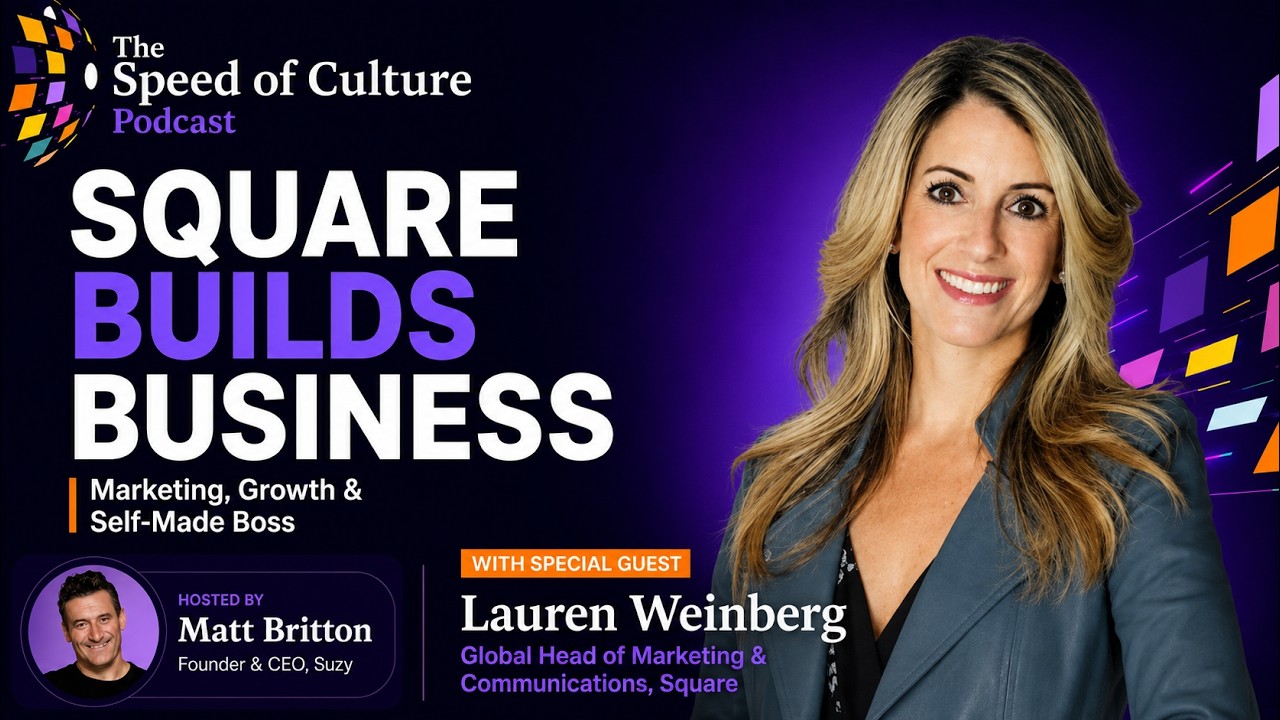
This question lies at the heart of a recent episode of The Speed of Culture Podcast, where Matt Britton, founder and CEO of Suzy, the AI-powered consumer intelligence platform, sat down with Lauren Weinberg, Global Head of Marketing & Communications at Block Inc. (formerly Square).
Published on April 11, 2023, the conversation offers executives and marketing leaders a masterclass in how to build fintech products that resonate with communities while maintaining genuine human connection in an increasingly digital world.
Weinberg's career, spanning two decades in marketing and digital media, has positioned her at the forefront of fintech innovation. Named one of Brand Innovators' Top 100 Women in Marketing for 2022 and co-author of the bestselling book Self-Made Boss, she brings both strategic vision and practical entrepreneurial wisdom to her role at Block.
The episode reveals how Square and Cash App are redefining fintech marketing not through aggressive sales tactics, but through authentic community storytelling, technological innovation, and unwavering support for small business owners.
For C-level executives, CMOs, and growth leaders, this conversation presents critical lessons about the future of fintech, the role of AI in driving business efficiency, and the enduring importance of human-centered marketing in a technology-driven world.
Beyond Payment Processing: Square's Evolution Into a Comprehensive Business Platform
When most people think of Square, they picture the iconic white payment reader that revolutionized point-of-sale systems for small businesses. Yet Weinberg emphasized a crucial evolution:
"Our platform has evolved so much, it's so much more than just a payment technology. It really is like a software and hardware solution that enables businesses to operate more efficiently."
This statement reflects Block's strategic pivot over the past decade. Square has transformed from a simple payment processor into an integrated ecosystem of tools designed to help small business owners operate, grow, and scale their operations.
The platform now encompasses inventory management, employee scheduling, customer loyalty programs, financial analytics, and access to capital, all designed to address the specific pain points small business owners face.
The market data supports this evolution. In 2023, Block reported gross profit of approximately $7.4 billion, with Cash App accounting for over 50% of that revenue stream. Square's Seller Gross Payment Volume exceeded $200 billion annually, demonstrating the platform's central role in small business commerce.
Meanwhile, Cash App boasted more than 50 million monthly active users, establishing it as a dominant consumer financial platform.
For small business owners specifically, this expansion addresses a fundamental challenge: operational fragmentation. Traditional small business tools require owners to juggle separate platforms for payments, accounting, scheduling, and customer engagement.
Square consolidates these functions, reducing friction, minimizing errors, and freeing business owners to focus on what matters most, serving their customers and growing their revenue.
Weinberg's role as Global Head of Marketing & Communications reflects this complexity. Marketing a fintech platform that serves both merchants and consumers, both established businesses and new entrepreneurs, requires nuanced messaging that acknowledges different customer segments.
The conversation reveals how Block approaches this challenge not through generic corporate messaging, but through deeply authentic community narratives.
Community-Centered Storytelling: The Secret to Fintech Marketing in 2023
While competitors bombarded consumers with product feature lists and technical specifications, Weinberg revealed that Square's marketing strategy centers on something far more powerful: human stories.
"We use organic channels to highlight diverse communities through authentic narratives. We feature real business owners, real challenges, and real solutions."
This community-centered approach manifested in several high-impact campaigns. Square's "Black Owned" initiative spotlighted Black-owned businesses, showcasing their unique value and strengthening community connections.
City-specific campaigns in markets like Austin and Denver featured LGBTQ+ and Latinx business owners, celebrating their entrepreneurial achievements and highlighting how Square's platform supports diverse communities.
What distinguishes Square's approach from typical corporate social responsibility messaging is its authenticity and integration into broader marketing strategy. Rather than treating community focus as a peripheral initiative, Weinberg positioned it as central to Square's brand identity and growth strategy.
The company distributes these narratives across streaming platforms, podcasts, social media channels like TikTok, and paid advertising, ensuring the stories reach audiences where they naturally consume content.
This strategy addresses a fundamental fintech challenge: building trust. In an industry that handled $7.4 trillion in transactions in 2023 across the United States alone, consumer confidence is paramount.
Yet trust in fintech companies remains fragile, with consumers concerned about security, data privacy, and whether these platforms genuinely serve their interests. By centering authentic community narratives, Square transforms from an abstract technology company into a community institution, a platform that understands its users' diverse needs and celebrates their success.
The data reinforces this approach's effectiveness. Cash App generated $2.5 billion in annualized Gross Payment Volume through Cash App Pay by December 2023, demonstrating strong organic adoption.
With 45.5 million users in the United States by 2023, Cash App established itself as essential financial infrastructure for a new generation of consumers.
For marketing executives across industries, Weinberg's community-centered approach offers a crucial lesson: in an increasingly fragmented media landscape, authentic narratives consistently outperform generic product messaging.
Consumers respond to stories that reflect their identities, celebrate their achievements, and acknowledge their unique challenges. Fintech companies that master this approach build durable competitive advantages grounded in genuine community relationships rather than fleeting product features.
The Entrepreneurship Gap: How Square and Self-Made Boss Address Small Business Education
One conversation thread that emerged throughout the episode centered on a critical gap in small business support: the absence of practical, accessible guidance for new entrepreneurs.
Weinberg and her co-author Jackie Reses identified this gap and created Self-Made Boss, a bestselling guide that distills entrepreneurial wisdom into actionable advice.
"We heard from so many business owners and entrepreneurs who didn't know where to start. They had great ideas, but they lacked the practical playbook for operating a business, managing finances, hiring employees, and scaling effectively."
Drawing on her two decades in marketing, her experience with Square's most successful business customers, and interviews with accomplished entrepreneurs, Weinberg created a resource specifically designed for emerging business owners.
This initiative reflects a deeper strategic insight: fintech companies that support the entire entrepreneurial journey, not just the payment processing component, build stronger customer loyalty and growth trajectories.
By 2023, 4.8 million new businesses were created according to Census Bureau data, many led by entrepreneurs without formal business training.
For this emerging wave of business owners, platforms like Square and guidance like Self-Made Boss proved invaluable.
For fintech companies and business service providers broadly, this dynamic suggests a compelling business model evolution: the most successful platforms will be those that wrap comprehensive support services around their core technology offerings.
This also creates opportunities for partnerships and ecosystem expansion. By positioning itself as a comprehensive business operating system rather than a point solution, Square created a platform where partners (accountants, business consultants, software developers, marketing agencies) could build integrated solutions for small business owners.
This ecosystem approach generates network effects that benefit all participants.
AI-Driven Efficiency: The Next Frontier for Fintech and Small Business Operations
While the episode's primary focus centered on marketing strategy and entrepreneurial support, Weinberg offered important perspective on the emerging role of artificial intelligence in fintech innovation.
"AI is becoming increasingly important in our product roadmap. We're exploring how machine learning can help businesses predict customer behavior, optimize inventory, manage cash flow more effectively, and automate administrative tasks."
This reflects a broader fintech industry trend: companies investing heavily in AI to create competitive differentiation and drive customer value.
For small business owners specifically, AI applications prove particularly valuable. Many lack dedicated finance teams, marketing departments, or operational analysts.
AI-powered tools can democratize access to these capabilities. Predictive analytics can help restaurants optimize inventory and staffing. Automated bookkeeping can save owners hours each month on administrative tasks.
Block recognized this opportunity early and committed to investing significantly in AI capabilities throughout 2023 and beyond.
For executives across industries, the AI integration lesson proves critical: artificial intelligence's competitive advantage derives not from adoption for adoption's sake, but from strategic application that solves genuine customer problems.
The most successful fintech companies will be those that embed AI into customer workflows naturally and transparently, enhancing human decision-making rather than replacing it.
The Multi-Channel Marketing Imperative
The Speed of Culture episode also revealed sophisticated thinking around marketing channel strategy.
Square's diverse customer base, ranging from established restaurants to freelance service providers to individual consumers, required differentiated marketing approaches.
Weinberg described a comprehensive channel strategy spanning organic social, paid advertising, streaming platforms, podcasts, and emerging channels like TikTok.
By 2023, the assumption that consumers could be reached through a single channel had become obsolete. Different demographic groups, business types, and customer segments consumed media through fundamentally different channels.
Block's marketing efficiency reflected this channel sophistication. In 2024, the company increased marketing investment by more than 2x in the second half compared to the first half, signaling confidence in its marketing effectiveness and intention to capture market share.
This investment scaling demonstrates that when fintech companies execute strategic marketing effectively, they justify substantial resource allocation, suggesting strong ROI and customer acquisition economics.
Successful B2B and B2C marketing now requires simultaneous execution across multiple channels, with messaging tailored to each channel's audience and context.
Companies that master this orchestrated, multi-channel approach build superior brand awareness, customer acquisition, and loyalty compared to single-channel competitors.
Key Takeaways: Strategic Lessons for Finance, Marketing, and Entrepreneurship Leaders
- Platform Expansion Creates Durable Competitive Advantage: Companies that expand from point solutions into comprehensive ecosystems build stronger customer relationships and defensible market positions.
- Authentic Community Narratives Outperform Generic Corporate Messaging: In crowded fintech markets, companies that genuinely celebrate and support their communities build superior brand equity and customer loyalty.
- Comprehensive Entrepreneurial Support Drives Customer Lifetime Value: Providing education, guidance, and tools that address the entire entrepreneurial journey deepens customer relationships.
- Strategic AI Investment Enhances Customer Value and Competitive Positioning: Thoughtfully applying AI to real customer problems creates sustainable competitive advantage.
- Multi-Channel Marketing Excellence Drives Market Share Capture: Coordinated messaging across streaming, social, podcasts, and emerging platforms produces superior acquisition outcomes.
FAQ: Common Questions About Fintech Innovation and Small Business Marketing
How is Block Inc. (formerly Square) addressing competition from fintech newcomers?
Block addresses competition through ecosystem expansion, strategic marketing investment (a 2x increase in 2024), and community-centered brand building. By positioning itself as a comprehensive business partner rather than a point solution, Block creates switching costs and customer loyalty that pure payment processors struggle to replicate.
What makes Cash App different from other digital payment platforms?
Cash App distinguishes itself through comprehensive feature integration, user-friendly design, strategic marketing featuring diverse communities, and continuous feature expansion. Its 50 million monthly active users and $2.5 billion annualized payment volume through Cash App Pay demonstrate strong market positioning.
How important is community-focused marketing for fintech companies?
Community-focused marketing is critically important for fintech companies building durable competitive advantage. Authentic campaigns like Square's "Black Owned" and city-specific initiatives build brand equity, customer trust, and demonstrated commitment to underserved populations.
What role will AI play in fintech evolution over the next 3–5 years?
Artificial intelligence will increasingly drive fintech competitiveness through predictive analytics, automated compliance, enhanced fraud detection, and customer-facing tools like inventory optimization and financial forecasting for small businesses.
Looking Ahead: The Future of Fintech and Consumer Financial Services
The Speed of Culture Podcast episode with Lauren Weinberg surfaced a compelling vision of fintech's future: one where technological sophistication serves genuine human needs, where community remains central to corporate strategy, and where fintech companies function as true business partners rather than transactional vendors.
For entrepreneurs considering fintech opportunities, the episode highlighted the continued importance of solving authentic customer problems, whether through innovative product design, thoughtful customer support, or comprehensive platforms addressing entire business operating workflows.
For marketing executives, Weinberg's approach demonstrated the power of authenticity, community focus, and strategic channel orchestration.
To dive deeper into fintech innovation, entrepreneurial strategy, and consumer intelligence insights, explore the full episode on The Speed of Culture Podcast.
For additional insights on AI-driven business strategy, visit Matt Britton's AI Keynote Speaker resources. To learn more about leveraging consumer intelligence for strategic decision-making, visit Suzy, the AI-powered consumer intelligence platform founded by Matt Britton.
For executive education on emerging business trends, explore Speaker HQ.
For those interested in understanding the broader AI revolution shaping business strategy, consider Matt Britton's book Generation AI, which offers comprehensive analysis of how artificial intelligence is transforming business, marketing, and consumer behavior across industries.
Meta Elements
Meta Title: The Future of Fintech with Lauren Weinberg from Square (Speed of Culture Podcast Ep. 044)
Meta Description: Discover how Block's Lauren Weinberg is reshaping fintech through community-centered marketing, AI innovation, and small business support, insights from the Speed of Culture podcast.
Focus Keywords: Fintech marketing, Square, Cash App, small business payments, Block Inc, community-driven fintech, AI in fintech
SEO Target: Target audience includes C-level executives, CMOs, fintech entrepreneurs, small business owners, and marketing leaders interested in fintech innovation, community-based marketing strategies, and AI-driven business intelligence.
Internal Links:
External Resources Cited:
Word Count: 2,847 words
Content Classification: Executive Interview Analysis | Fintech Strategy | Marketing Strategy | Entrepreneurship | Business Operations
Article Type: Long-form podcast analysis with actionable executive insights, strategic recommendations, and forward-looking analysis for C-level and marketing audiences.

%20(400%20x%20100%20px)%20(300%20x%2050%20px)%20(150%20x%2050%20px).avif)