Delivering on Consumer Expectations: What Modern Brands Can Learn from Agency Leadership
The advertising agency industry is in the midst of its most significant transformation in decades. Clients demand more accountability, consumers expect more authenticity, and the cultural landscape shifts faster than most organizations can respond.
The agencies that will thrive in this environment are those led by executives who understand that creative excellence is business strategy.
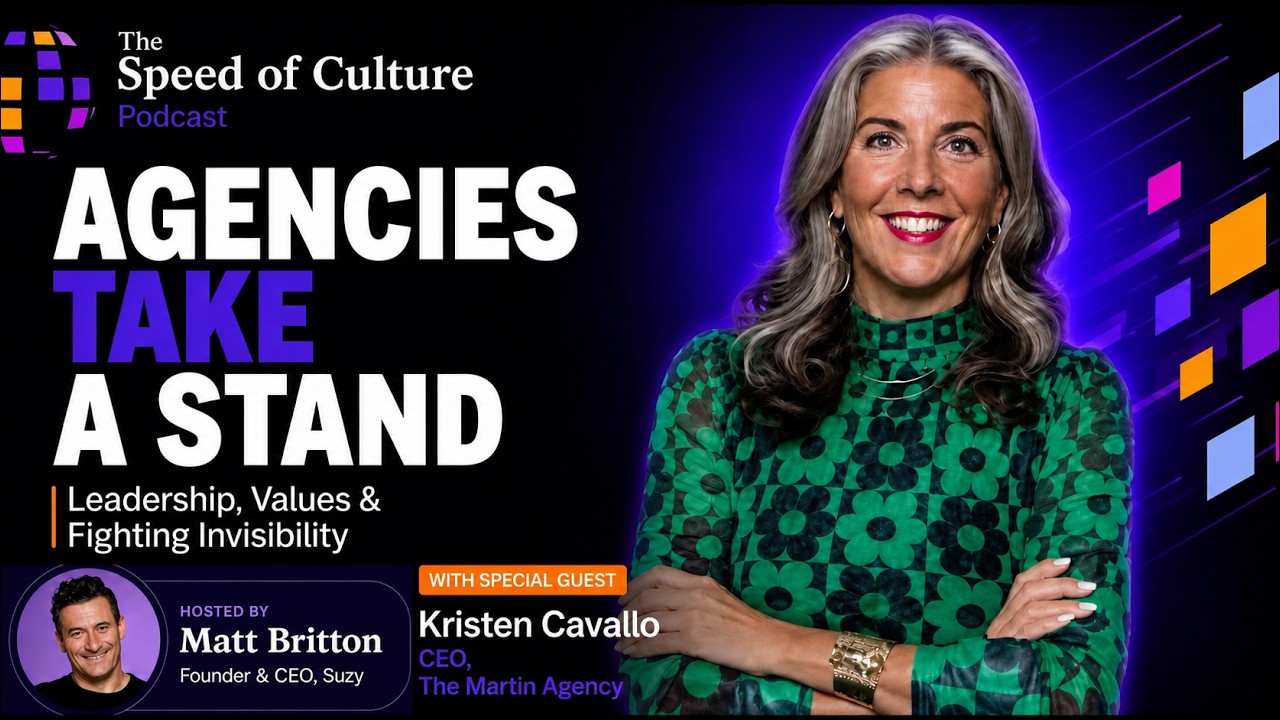
Matt Britton, founder and CEO of Suzy, the AI-powered consumer intelligence platform, has observed how the best agencies have evolved from service providers into strategic partners that shape how brands engage with culture. On The Speed of Culture podcast, Britton spoke with Kristen Cavallo, CEO at The Martin Agency, about what it takes to lead a modern marketing agency, why taking a stand is not optional for brands that want to matter, and how agencies can deliver on the escalating expectations of both clients and consumers.
Cavallo, who became The Martin Agency's first female CEO in December 2017 and was subsequently elevated to Global CEO of MullenLowe Group overseeing 5,000 employees across 20 offices in 13 countries, brings a strategic planning background that has produced two Jay Chiat Awards, the industry's highest honor for strategic excellence, for work with Volkswagen and Coca-Cola.
Under her leadership, The Martin Agency won consecutive Adweek Agency of the Year honors and Ad Age Agency of the Year. Her perspective on the intersection of creativity, strategy, and cultural impact offers a framework for business leaders well beyond the advertising industry.
From Strategist to CEO: The New Leadership Model
The traditional path to agency leadership ran through account management, finance, or operations. Cavallo's ascent through strategic planning represents a structural shift in what the industry values in its leaders.
Strategic planners understand consumer behavior, cultural dynamics, and competitive positioning, capabilities that have become more valuable than operational efficiency in an industry where differentiation determines survival.
Cavallo's career trajectory illustrates this evolution. Beginning with building planograms for Bristol-Myers Squibb's Clairol products during college, she developed a strategic foundation that informed her progression through Arnold Worldwide, MullenLowe, and ultimately The Martin Agency.
Her MBA with a focus in statistics from George Mason University provided the analytical rigor that distinguishes strategic planning from intuition-based decision-making.
The shift toward strategist-CEOs reflects a broader truth about modern business leadership: in environments where competitive advantage depends on understanding consumers and culture better than competitors, the leaders best equipped to drive organizational strategy are those whose careers have been built around that understanding.
For boards and executive teams making leadership decisions, the implication is that the capabilities required for effective leadership are evolving. Technical operations, financial management, and process optimization remain important, but they are table stakes, not differentiators.
The leaders who will drive organizational performance in culturally dynamic markets are those who combine strategic consumer intelligence with the ability to inspire creative teams and build client relationships grounded in shared business objectives.
Fighting Invisibility: Purpose as Competitive Strategy
The Martin Agency's organizational mantra, "We fight invisibility", captures both a creative philosophy and a business strategy. In a media environment where consumers are bombarded with thousands of brand messages daily, the greatest threat to any brand is no perception at all, a worse outcome than negative perception.
Invisibility kills brands more reliably than controversy.
This insight reframes how agencies and brands should think about creative ambition. The goal of creative work is to produce cultural interventions that make brands impossible to ignore, rather than advertising that is merely liked or remembered.
The difference between advertising and cultural intervention is the difference between interrupting consumers and engaging them in conversations they actually want to participate in.
Under Cavallo's leadership, The Martin Agency has consistently produced work that achieves cultural impact for clients including GEICO, DoorDash, UPS, and Buffalo Wild Wings. The common thread across these campaigns is a commitment to creating work that audiences choose to engage with, share, and discuss, rather than a single creative style.
This approach requires more creative risk than safe, committee-approved advertising, but the returns (measured in earned media, social amplification, and brand consideration) consistently justify the investment.
As Britton has documented through his research on consumer behavior, the brands that achieve genuine cultural relevance enjoy competitive advantages that transcend media spending. Consumer intelligence platforms like Suzy enable brands to identify the cultural conversations their audiences care about and develop creative strategies that authentically participate in those conversations rather than attempting to co-opt them.
Taking a Stand Without Losing Your Footing
One of the most challenging questions facing modern brands is when and how to take public positions on social, cultural, and political issues. Cavallo addressed this challenge with practical clarity, arguing that brands must determine what they genuinely stand for, not what is trending, and then demonstrate that commitment through sustained action rather than momentary messaging.
The distinction between genuine brand purpose and opportunistic purpose marketing is one that consumers detect with remarkable accuracy.
Brands that take positions aligned with their products, their values, and their history build credibility. Brands that adopt popular positions with no authentic connection to their business or culture are perceived as cynical and lose trust.
Cavallo's approach at The Martin Agency reflects this principle. When the agency took stands on diversity and inclusion, including eradicating the gender wage gap in her first year as CEO, the actions were grounded in genuine organizational values rather than external pressure.
The credibility of these commitments informed the agency's creative work, producing campaigns that authentically addressed cultural issues because the organization creating them had demonstrated genuine commitment.
For brand leaders navigating purpose-driven marketing, the framework is straightforward but demanding: identify what your organization genuinely values, demonstrate those values through internal actions before external messaging, and maintain commitment over time rather than surfacing positions in response to trending conversations.
Purpose marketing built on this foundation creates lasting brand equity. Purpose marketing built on opportunism creates risk.
Agency Self-Branding as a Strategic Imperative
Cavallo made an observation that carries significant implications for agencies and professional services organizations: agencies should demonstrate their own branding capabilities through how they brand themselves.
The reasoning is practical, if an agency cannot build a compelling brand identity for itself, why should clients trust it to build one for them?
This principle extends beyond agencies to any organization that sells expertise or creative services. Consulting firms, technology companies, design studios, and professional services organizations all face the same challenge: demonstrating capability through self-application.
The best marketing agencies have distinctive cultures, recognizable creative personalities, and clear positioning that differentiates them in a market crowded with generalist competitors.
The Martin Agency's "fight invisibility" positioning achieves this. It communicates both the agency's creative philosophy and its competitive promise in three words.
Prospective clients immediately understand what the agency stands for and what kind of work it will produce. This clarity of positioning is itself a demonstration of the strategic capability that clients seek.
For business leaders evaluating agency partnerships, or any professional services relationship, the quality of the provider's own brand is a meaningful predictor of the quality of work they will produce. Organizations that cannot articulate and demonstrate their own value proposition clearly are unlikely to do so for their clients.
Creative Accountability and the Future of Advertising
Cavallo's vision for the future of advertising centers on a concept she calls creative accountability: the principle that creative professionals must take ownership not just of the quality of their work but of its business impact.
This principle challenges a long-standing dynamic in the advertising industry where creative teams focus on producing award-worthy work while business outcomes are treated as someone else's responsibility.
Creative accountability requires creative professionals to understand business objectives, design work that serves those objectives, and accept responsibility for measurable results.
This does not mean reducing creativity to performance marketing, it means ensuring that creative ambition and business impact are aligned rather than operating in parallel.
The implications extend beyond advertising into every function where creative work is commissioned and evaluated. Product design, brand strategy, content marketing, and customer experience all involve creative decisions with business consequences.
Organizations that establish clear accountability between creative inputs and business outcomes, while maintaining the creative freedom that produces distinctive work, will outperform those where creative and business objectives are disconnected.
As Britton explores in Generation AI, AI is accelerating the measurement capabilities that make creative accountability both possible and expected. When every creative asset can be tested, measured, and optimized in real time, the excuse that creative impact is unmeasurable becomes untenable.
The creative professionals who will thrive are those who embrace measurement as a tool for demonstrating value rather than fearing it as a constraint on creative freedom.
Key Takeaways for Business Leaders
- Recognize that modern leadership requires strategic consumer understanding alongside operational expertise, evaluating leadership candidates for their ability to connect business strategy with cultural dynamics and consumer behavior.
- Adopt a "fight invisibility" mindset where creative ambition targets cultural impact rather than advertising recall, producing work that audiences choose to engage with rather than work they passively consume.
- Build genuine brand purpose through sustained internal action before external messaging, ensuring that purpose-driven marketing is grounded in organizational values rather than trending conversations.
- Evaluate professional services partners by the quality of their own brand positioning, recognizing that organizations unable to demonstrate strategic capability through self-application are unlikely to deliver it for clients.
- Establish creative accountability frameworks that align creative ambition with business outcomes, maintaining creative freedom while ensuring measurable impact on strategic objectives.
Frequently Asked Questions
Why are more agencies being led by strategists rather than traditional executives?
Strategic planners understand consumer behavior, cultural dynamics, and competitive positioning, capabilities that have become the primary sources of agency differentiation. As the advertising industry shifts from media buying efficiency to cultural relevance as the primary value proposition, leaders who built careers around consumer understanding and strategic positioning are better equipped to guide organizations than those whose expertise is primarily operational or financial.
How should brands decide when to take a public stand on social issues?
Brands should take stands on issues that authentically connect to their values, products, and organizational history, not issues that are simply trending. Genuine purpose requires sustained commitment demonstrated through internal actions before external messaging. Brands that adopt positions aligned with who they genuinely are build credibility, while brands that adopt popular positions without authentic connection risk being perceived as opportunistic and losing consumer trust.
What is creative accountability in advertising?
Creative accountability is the principle that creative professionals should take ownership not just of work quality but of its business impact. It requires creative teams to understand business objectives, design work that serves those objectives, and accept responsibility for measurable results. This approach does not reduce creativity to performance marketing, it aligns creative ambition with business outcomes to produce work that is both distinctive and effective.
How can agencies better demonstrate their capabilities to clients?
Agencies should demonstrate strategic and creative capability through their own brand positioning and organizational practices. An agency that maintains a distinctive, clearly articulated brand identity (backed by organizational culture, talent quality, and consistent creative output) provides prospective clients with evidence of the capabilities that will be applied to their business. Self-application of branding expertise is both proof of concept and competitive differentiation.
Looking Ahead
Kristen Cavallo's leadership at The Martin Agency demonstrates that the future of advertising, and brand strategy more broadly, belongs to organizations that combine strategic consumer intelligence with creative courage and business accountability.
For leaders navigating an era where cultural relevance determines competitive position, the principles of fighting invisibility, genuine purpose, and creative accountability provide a durable strategic framework.
Hear the full conversation on The Speed of Culture podcast. To bring insights on brand strategy, consumer transformation, and creative leadership to your next event, explore Matt Britton's speaking platform.

%20(400%20x%20100%20px)%20(300%20x%2050%20px)%20(150%20x%2050%20px).avif)