Opening Section
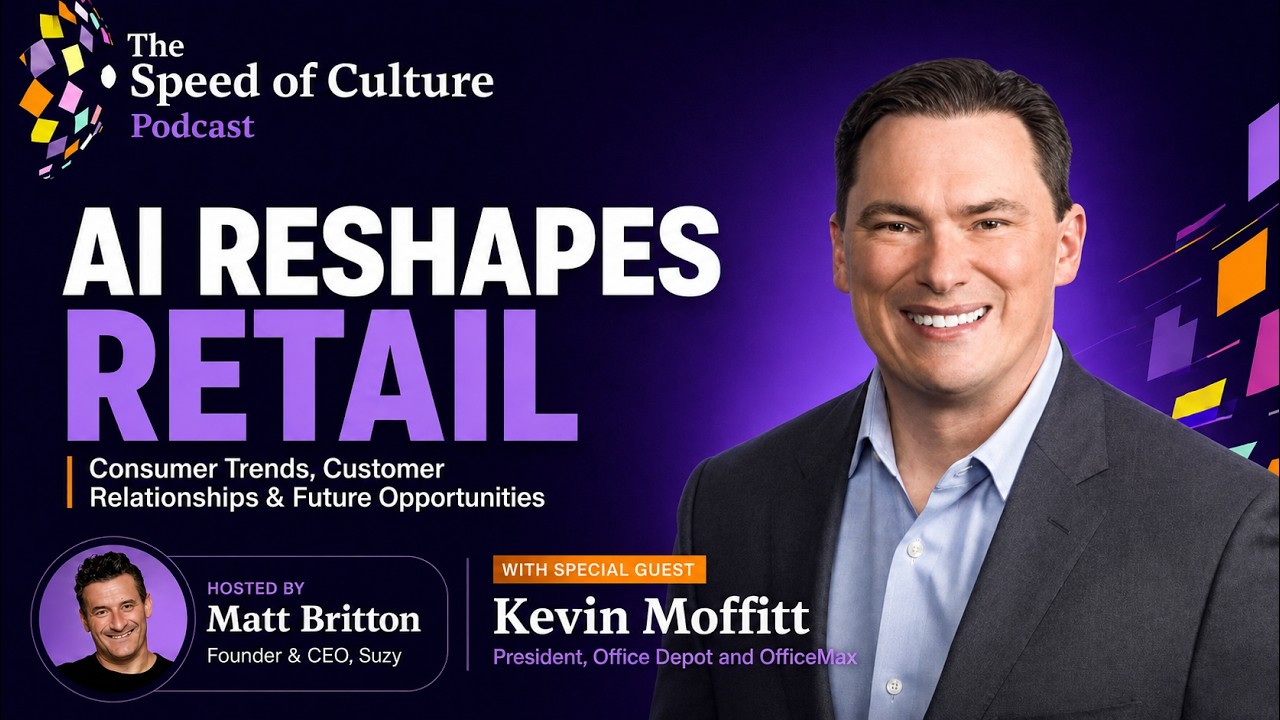
The retail industry stands at an inflection point. As artificial intelligence reshapes business operations across sectors, few leaders are positioned to speak about the transformation with the clarity and vision of Kevin Moffitt, President of Office Depot and OfficeMax.
In a recent episode of The Speed of Culture podcast hosted by Matt Britton, founder and CEO of Suzy, the AI-powered consumer intelligence platform, Moffitt explores how legacy retailers can harness emerging technologies to remain competitive while maintaining the human touch that customers value.
The conversation between Britton and Moffitt cuts to the heart of a critical business challenge: How do retailers balance automation with personalization? How do they prepare their workforces for an AI-driven future? And perhaps most importantly, how do they help customers (whether small business owners, educators, or home office workers) imagine and achieve their own definitions of success?
Matt Britton's platform, Suzy, exemplifies the consumer intelligence capabilities that businesses increasingly depend on to understand rapidly evolving customer preferences. In this episode, Moffitt demonstrates why Office Depot's commitment to leveraging AI is about elevating human relationships rather than replacing them.
He shares strategic insights about retail transformation, the evolution of customer service, and the opportunities that emerge when organizations embrace technological change with intentionality and purpose.
This conversation is essential listening for retail leaders, entrepreneurs, marketing professionals, and anyone seeking to understand how enterprise organizations are adapting to an AI-powered world. The insights Moffitt shares extend far beyond Office Depot; they illuminate a framework for thinking about technology adoption, competitive positioning, and long-term value creation in industries experiencing rapid disruption.
The AI Revolution in Retail: From Internet 2.0 to Generational Transformation
Kevin Moffitt doesn't view artificial intelligence as merely another technological advancement. He sees it as a generational shift comparable to the emergence of the internet itself.
“When you think about artificial intelligence and biotech, there's just going to be so many opportunities for people to do things that literally don't exist right now.”
This perspective is crucial for understanding modern retail strategy. Unlike previous digital transformations that primarily affected business processes, AI fundamentally changes how retailers can understand, anticipate, and serve their customers.
The technology creates new possibilities for personalization at scale, something that was mathematically impossible just five years ago.
For Office Depot and OfficeMax, a company with over 1,200 physical locations and a robust ecommerce presence, AI represents both an opportunity and a necessity. The retail landscape has become hypercompetitive, with customers expecting seamless experiences across channels, personalized product recommendations, and efficient service.
Meeting these expectations at scale, while maintaining healthy profit margins, requires systematic automation of routine tasks.
Moffitt's vision for AI in retail encompasses several interconnected layers. At the foundation, AI handles operational efficiency, automating inventory management, optimizing supply chains, and reducing manual data entry.
At the next level, AI enhances customer interactions by providing associates with real-time consumer insights. At the highest level, AI enables strategic decision-making by processing vast datasets to identify emerging trends before competitors.
The key insight from Moffitt's perspective is that each layer of AI implementation serves a singular purpose: freeing human capital for high-value interactions. This means redirecting employee effort toward activities that require judgment, empathy, and creative problem-solving rather than cutting headcount. The goal is transformation rather than replacement.
Understanding Office Depot's “Imagine Success” Strategy and Customer Segmentation
Office Depot and OfficeMax serve three distinct customer segments: small businesses, educational institutions, and home office workers. Each group has fundamentally different needs, pain points, and definitions of success.
Recognizing this diversity is central to understanding how Moffitt applies AI strategically.
The company's unifying brand philosophy, “Imagine Success”, acknowledges that success is not a one-size-fits-all concept. For a small business owner struggling with cash flow, success might mean accessing affordable office solutions that help maintain competitiveness.
For an educator, success means having resources to inspire students and manage administrative burdens. For a home office worker navigating the flexibility of remote work, success means creating an environment that enables productivity and professional presence during video calls.
This segmentation approach is where consumer intelligence becomes invaluable. Suzy, the AI-powered platform founded by Matt Britton, exemplifies how brands gather, analyze, and act on consumer sentiment and behavioral data.
By understanding what “success” means to each customer segment, Office Depot can tailor messaging, product assortment, and service approaches to resonate authentically with distinct audiences.
The strategic value of this approach cannot be overstated. Many retailers attempt to serve multiple customer types with generic messaging and uniform product strategies. This approach invariably leaves money on the table.
By contrast, Office Depot's segmented strategy allows the company to:
- Speak directly to segment-specific pain points: Small businesses face working capital constraints; educators face budget pressures; home office workers prioritize aesthetics and ergonomics.
- Optimize product assortment by location: Physical stores can be configured to emphasize products most relevant to their local customer base.
- Create targeted marketing campaigns: Different segments consume media differently and respond to different value propositions.
- Develop segment-specific partnerships: Office Depot can collaborate with business associations, educational suppliers, or furniture manufacturers based on customer group priorities.
Moffitt's articulation of this strategy demonstrates executive maturity about the complexity of modern retail. Success in 2024 and beyond requires understanding that customers are not interchangeable units but individuals with distinct circumstances, aspirations, and definitions of what “success” means to them.
Automating Low-Value Interactions While Elevating Human Connections
Perhaps the most misunderstood aspect of AI implementation in customer service is the assumption that automation means eliminating human interaction. Kevin Moffitt's perspective corrects this misconception entirely.
His vision is to “completely overhaul customer service, with low-value interactions becoming automated, allowing for more human-to-human interactions for high-value situations.”
This is a strategic framework with profound implications, well beyond semantics.
Low-value interactions typically include routine inquiries that customers already know the answers to: product availability, store hours, shipping status, basic warranty information, return procedures, and account access resets.
These interactions are important, but they don't typically create competitive advantage or deepen customer relationships. They're often frustrating for both customers and employees because they consume time without generating meaningful value.
Automating these interactions through chatbots, self-service portals, and intelligent knowledge bases creates multiple benefits:
- Reduced wait times: Customers get instant answers rather than waiting for an employee to become available.
- Consistent information: Automation ensures that all customers receive accurate, standardized responses.
- Freed employee capacity: When associates aren't fielding routine questions, they can focus on customers with complex needs.
- Improved employee satisfaction: Employees prefer solving complex problems and helping customers over answering repetitive questions.
High-value interactions, by contrast, are where AI-empowered employees truly distinguish Office Depot from competitors.
When a small business owner walks into a store unsure how to create a professional office environment on a limited budget, the associate can now leverage:
- Historical purchase data: AI systems understand what this customer has bought previously and what needs remain unmet.
- Behavioral insights: Algorithms can identify patterns in how the customer shops and what factors influence their decisions.
- Inventory optimization: The associate knows exactly what's in stock, what's profitable, and what alternatives meet the customer's needs.
- Personalization at scale: The AI provides recommendations specific to this customer's business type, industry, and budget parameters.
This is the essence of Moffitt's AI vision: machines handle scale, humans provide judgment and empathy. Technology amplifies human capability rather than replacing it.
Building Competitive Advantage Through Omnichannel Consistency and Real-Time Data
Office Depot's omnichannel strategy (integrating physical stores, ecommerce, mobile apps, and customer service channels) is increasingly table stakes in retail. But implementing true omnichannel consistency remains technically and organizationally challenging.
This is where AI and platforms like Suzy create competitive advantage.
Moffitt emphasizes that Office Depot must monitor and respond to evolving media trends to maintain relevant marketing messaging across all channels. Short-form video content, for instance, has become central to how younger consumers (and increasingly, consumers of all ages) discover and evaluate products.
An enterprise that optimizes its messaging for traditional search and email but ignores TikTok, Instagram Reels, and YouTube Shorts will inevitably reach fewer potential customers.
The scale of data that modern retailers generate is staggering. Office Depot captures signals from thousands of daily transactions, website interactions, social media mentions, and customer service conversations.
Without AI to process this data, these signals are merely noise. With AI, they become strategic intelligence:
- Demand forecasting: AI can predict which products will be popular in which locations before demand spikes, enabling better inventory management.
- Dynamic pricing: Algorithms can optimize pricing in real-time based on demand, competition, inventory levels, and customer segments.
- Churn prediction: By identifying customers likely to stop shopping at Office Depot, the company can proactively intervene with targeted offers or service improvements.
- Sentiment analysis: Understanding how customers feel about products, stores, and the brand itself enables rapid response to issues before they escalate.
The competitive advantage isn't in having access to data, all retailers collect data. The advantage comes from systematically converting data into action faster than competitors can react.
Office Depot's investment in AI systems, combined with human expertise in retail strategy, creates a flywheel: better data analysis drives better decisions, which improve customer satisfaction, which generates better data.
Preparing the Workforce and Building Careers in an AI-Driven Economy
Kevin Moffitt brings a unique perspective to the workforce conversation because his own career illustrates the reality he describes. Twenty years ago, the role he now occupies, a senior ecommerce executive at a major retailer, didn't exist.
There were no job postings for “VP of ecommerce” in 1994. The position emerged as internet commerce became economically viable and strategically important.
Similarly, roles that will be critical in 2030 likely don't have formal job titles yet. This reality has profound implications for how companies recruit, develop, and retain talent.
“Remain curious, as emerging industries will create unimagined opportunities.”
This advice applies equally to established employees seeking to future-proof their careers. Rather than fearing AI as a threat, employees should view it as an opportunity to develop new skills and focus on uniquely human capabilities.
Office Depot can invest in training programs that teach employees how to work effectively with AI systems, interpret AI recommendations, and leverage data insights in customer conversations.
The organizational implication is equally important. Companies that successfully navigate technological disruption are those that view their workforce as assets to be upskilled rather than costs to be minimized.
This requires investment in:
- Continuous learning programs: Providing employees with access to training in new tools, technologies, and methodologies.
- Career path clarity: Showing employees how their roles will evolve and what advancement opportunities exist in an AI-augmented organization.
- Change management support: Helping employees understand why changes are happening and how they personally benefit.
- Knowledge transfer: Creating systems where experienced employees can teach AI systems (and newer employees) what they've learned over decades.
Moffitt's perspective, viewing AI as a generational opportunity rather than a threat, creates organizational culture that attracts and retains talent. People want to work for leaders and companies that believe in their future.
Key Takeaways
- AI as generational transformation: Kevin Moffitt positions AI alongside the internet itself as a transformational technology that will create entirely new industries and career opportunities that don't yet exist.
- Segmentation enables personalization: Office Depot's “Imagine Success” philosophy recognizes that three distinct customer groups have fundamentally different definitions of success, enabling targeted strategies.
- Automation frees human potential: Low-value interactions should be automated, freeing employees to focus on high-value situations where judgment, empathy, and personalized problem-solving drive customer satisfaction and loyalty.
- Data + AI + human expertise = competitive advantage: Processing vast datasets to identify trends, anticipate customer needs, and optimize decisions faster than competitors creates sustainable competitive advantage in omnichannel retail.
- Workforce development is strategic necessity: Leaders who view AI as an opportunity to upskill employees and create new career paths build organizations that attract talent and successfully navigate technological disruption.
Frequently Asked Questions
How is Office Depot using AI differently than other major retailers?
Kevin Moffitt's approach emphasizes automating low-value interactions while empowering store associates with real-time customer data to provide exceptional personalized service. Rather than replacing employees, this strategy amplifies their effectiveness by giving them better information and freeing their time for high-value interactions.
Office Depot's focus on three distinct customer segments allows the company to tailor AI-driven recommendations and messaging to what “success” means for each group.
What does “Imagine Success” mean as a retail strategy?
“Imagine Success” is Office Depot and OfficeMax's unifying brand philosophy acknowledging that success means different things to different customers. By segmenting customers and understanding their specific definitions of success, Office Depot can tailor product assortment, messaging, and service to resonate authentically with each group.
How does Suzy's consumer intelligence platform fit into Office Depot's strategy?
Suzy, the AI-powered consumer intelligence platform founded by Matt Britton, exemplifies the tools modern retailers use to gather and analyze consumer sentiment, behavior, and preferences.
These platforms help companies like Office Depot understand what customers are saying about products, competitors, and brands across digital channels, informing product development, marketing messaging, customer service strategy, and competitive positioning.
What should employees do to prepare for an AI-driven retail environment?
Moffitt advises professionals to remain curious and develop comfort with new tools and methodologies. Rather than fearing AI, employees should view it as an opportunity to focus on uniquely human capabilities, judgment, empathy, creativity, and complex problem-solving.
Companies investing in employee training, clear career paths, and change management create organizations where employees thrive rather than resist technological transformation.
Looking Ahead: The Future of Retail Intelligence and AI-Driven Customer Experience
The conversation between Matt Britton and Kevin Moffitt illuminates a critical insight: the future of retail belongs to companies that successfully integrate consumer intelligence, human expertise, and technological capability.
Neither artificial intelligence alone nor human talent alone can compete. But organizations that combine machine learning capabilities with experienced retail professionals who understand customer psychology and business fundamentals become nearly impossible to disrupt.
Office Depot's strategy under Moffitt's leadership exemplifies this integration. The company is betting on technology to enhance retail rather than replace it.
This nuanced approach, neither dismissing AI's potential nor overselling it as a panacea, is precisely what separates thriving enterprises from those that chase technological trends without strategic coherence.
For retail leaders seeking to navigate the AI transformation, Moffitt's framework offers actionable guidance:
- Segment your customers strategically and understand what “success” means to each group.
- Automate ruthlessly in areas where human judgment isn't required.
- Empower your people by giving them better data, better tools, and clearer purpose.
- Monitor emerging media and consumer trends to maintain relevance across channels.
- Invest in workforce development so employees see AI as an opportunity, not a threat.
The Speed of Culture podcast explores exactly how leading brands and executives are adapting to rapid cultural and technological change.
For businesses seeking to leverage consumer intelligence to inform strategy, the examples discussed in this episode are made possible by platforms like Suzy, enabling brands to understand and act on consumer behavior at scale.
Matt Britton, beyond hosting the podcast, is an authority on consumer behavior, generational trends, and AI's impact on marketing. His book Generation AI explores these themes in depth.
Those interested in how AI is reshaping consumer behavior and marketing strategy will find his perspective essential. Executives and marketing leaders can learn more about his work as an AI keynote speaker or explore booking information through Speaker HQ.

%20(400%20x%20100%20px)%20(300%20x%2050%20px)%20(150%20x%2050%20px).avif)