April 26, 2022
How a 200-Year-Old Brand Pivoted to Athleisure Wear During the Pandemic

Ken Ohashi
CEO
This is some text inside of a div block.
This is some text inside of a div block.
LISTEN ANYWHERE YOU FIND YOUR PODCASTS
%20(400%20x%20100%20px)%20(300%20x%2050%20px)%20(150%20x%2050%20px).avif)

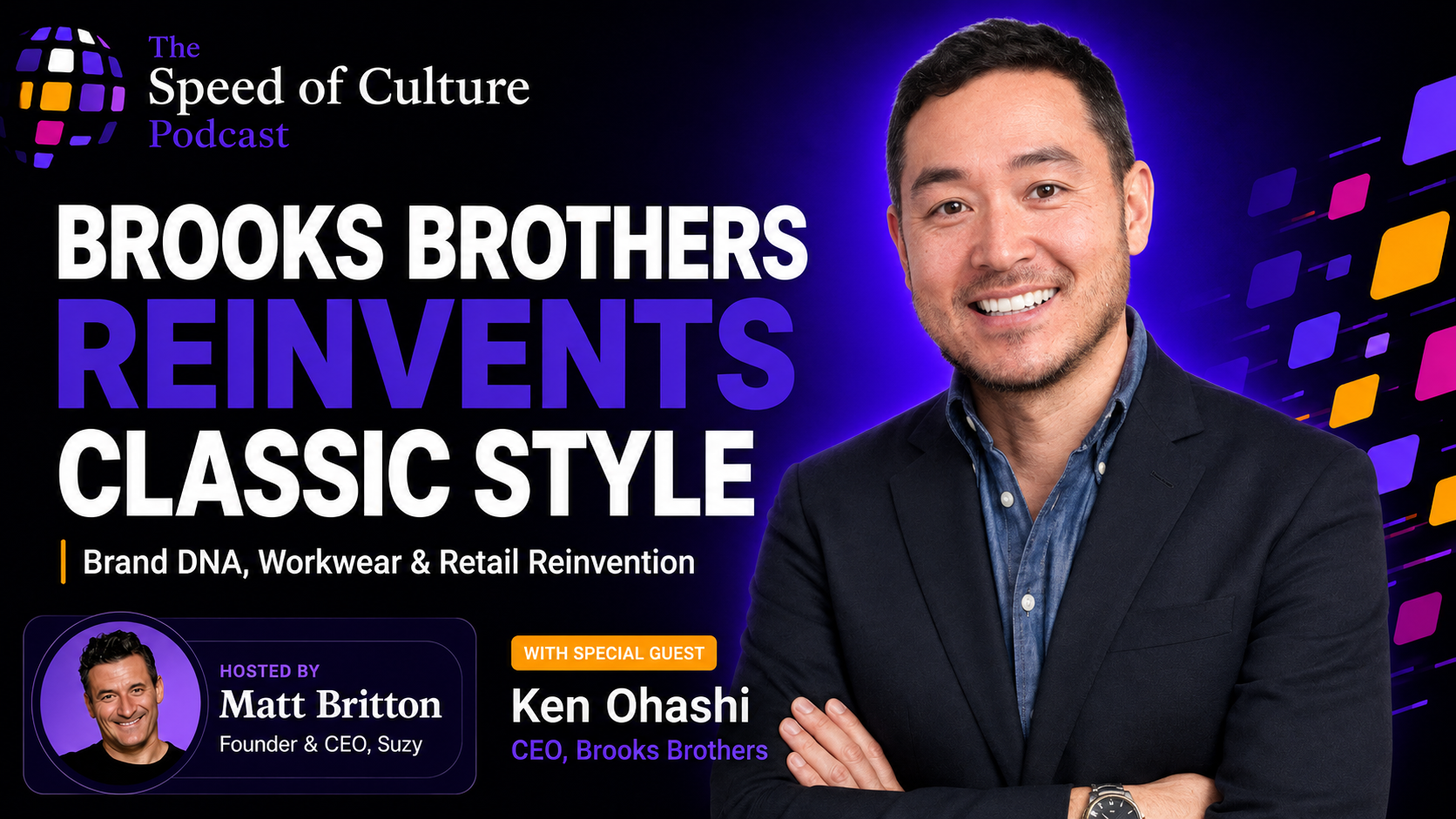
When a global pandemic shutters offices worldwide, what happens to a brand built on the suit-and-tie culture of corporate America? For Brooks Brothers, the brand that invented the navy blazer, pioneered men's ready-to-wear fashion, and dressed 40 U.S. presidents, the answer was not retreat but reinvention.
Matt Britton, founder and CEO of Suzy, the AI-powered consumer intelligence platform, has consistently emphasized that the brands surviving disruption are those that understand their core DNA well enough to evolve without losing their identity.
On The Speed of Culture podcast, Britton spoke with Ken Ohashi, CEO of Brooks Brothers, about how he acquired the iconic brand during the pandemic and transformed it from a company emerging from bankruptcy into a billion-dollar enterprise posting record revenue.
Ohashi's journey, from son of Japanese immigrants in Elmont, New York, to the first minority and openly gay CEO in Brooks Brothers' 200-year history, offers a masterclass in brand transformation during disruption. His strategy for pivoting a heritage brand to athleisure wear while preserving its foundational identity holds lessons that extend far beyond the fashion industry.
For every business leader navigating an era of accelerating change, the Brooks Brothers transformation demonstrates that understanding your brand's DNA is the prerequisite for meaningful innovation.
When Ohashi's team at Authentic Brands Group and Simon Property Group acquired Brooks Brothers in 2020, the timing could not have seemed worse. Offices were closing, remote work was becoming the norm, and the entire premise of a brand synonymous with formal business attire appeared to be evaporating.
Less than 25% of Brooks Brothers' business was sportswear at the time of acquisition. The conventional wisdom, amplified by countless trend pieces declaring the death of the suit, suggested that Brooks Brothers was a relic of a pre-pandemic world.
Ohashi saw something different. Rather than abandoning the brand's heritage, he recognized that Brooks Brothers' DNA contained elements that could translate powerfully into the athleisure and sportswear categories that consumers were gravitating toward.
The strategy required two critical decisions. First, Ohashi hired Michael Bastian as Creative Director, bringing in a designer who understood both American heritage and modern casual aesthetics.
Second, he relocated all design and product decisions from Europe back to the United States, closing the Italy office and establishing New York as the creative center. This was an aesthetic reset that repositioned the brand's creative lens through an American perspective, well beyond a logistical change.
The results were striking. By December of the pivot year, Brooks Brothers had achieved its target of 50% sportswear revenue for men, doubling the category's share of business.
The brand launched an athleisure program featuring premium PK fabric with monogram customization options, and 25% of sweatpants sold carried personalized monograms. Consumers wanted the Brooks Brothers imprimatur on their casual wear just as much as on their suits.
For business leaders, this demonstrates a crucial principle: brand equity, when properly understood, is transferable across product categories.
Brooks Brothers' transformation succeeds because Ohashi understood that brand DNA is defined by values, craftsmanship standards, and cultural associations, rather than by product categories.
Over its 200-year history, Brooks Brothers had consistently been a brand of innovation, not tradition alone. The company invented the navy blazer. It created the button-down collar shirt. It pioneered men's ready-to-wear clothing at a time when everything was custom-made.
It introduced seersucker to American fashion. It executed the first collaboration with Lacoste and was among the first American brands to expand internationally, with a Japanese business spanning more than four decades.
When Ohashi distilled these innovations down to their essence, he found a brand defined by quality craftsmanship, American ingenuity, and the aspiration to help every person look and feel their best through life's milestones, weddings, first job interviews, proms, and beyond.
That brand promise did not require a suit. It required excellence in whatever category Brooks Brothers chose to enter.
This insight carries implications that extend far beyond fashion. As Britton notes in his work advising Fortune 500 companies on consumer strategy, every organization has a brand DNA that can serve as either a constraint or a launchpad for growth.
The difference lies in whether leaders understand that DNA at a level deep enough to separate the permanent from the circumstantial. Brooks Brothers' permanent DNA was excellence in American style. The circumstantial element was that this excellence had historically been expressed primarily through formal wear.
Once Ohashi separated these two layers, the path to athleisure became not just possible but natural.
Ohashi's transformation extended beyond product strategy into a complete overhaul of Brooks Brothers' marketing approach. Historically, the brand invested in beautiful campaigns designed for billboards, catalogs, and in-store signage, traditional media vehicles that matched the brand's heritage positioning.
The new Brooks Brothers replaced that model with a digital-first, social-media-driven content strategy built around what Ohashi calls "microstories and microshoots."
Social media is the new billboard.
Instead of large-scale campaigns requiring months of planning and production, the brand now conducts short, half-day photo and video shoots designed for rapid deployment across digital channels. Content is created in collaboration with influencers and distributed in real-time, creating a dynamic, living brand narrative rather than static seasonal campaigns.
The FILA collaboration that Brooks Brothers launched served as a testing ground for this new content approach, allowing the team to experiment with different channels, formats, and influencer partnerships.
The learning was immediate, influencer-driven content significantly outperformed company-created corporate content.
This is consistent with broader consumer trends that Britton has documented extensively. Consumers, particularly Gen Z and younger millennials, respond to content that feels participatory rather than presentational.
A brand like Brooks Brothers, with nearly $200 million in e-commerce business, needs digital content that drives both brand affinity and direct commerce. The microstory approach achieves both objectives simultaneously.
For marketing leaders managing heritage brands, the lesson is clear: digital transformation is about finding new expression channels that preserve brand values while meeting consumers where they are, rather than abandoning brand identity.
The craft and quality that defined Brooks Brothers' print campaigns can translate into digital content when the creative direction prioritizes authenticity over production polish.
One of the most forward-thinking elements of Ohashi's strategy is Brooks Brothers' commitment to sustainability through product longevity. In an era of fast fashion and disposable consumption, Brooks Brothers is positioning quality and craftsmanship as inherently sustainable.
As Ohashi noted, an average Brooks Brothers suit can easily last a decade, a lifespan that reduces the environmental impact per wear to a fraction of what fast-fashion alternatives produce.
The brand uses Supima cotton, the top 1% of cotton grown in the United States, which is more energy-efficient and requires less water to produce than conventional cotton.
Beyond material choices, Brooks Brothers has embraced the circular economy through innovative programs. The brand launched a vintage shop on its website where customers can purchase pre-owned Brooks Brothers pieces, some dating back decades.
Customer stories reinforce the brand narrative: one customer shared a Brooks Brothers jacket from their grandfather that was 56 years old and still in excellent condition.
The brand has also tested rental models similar to Rent the Runway, ensuring that premium Brooks Brothers products are accessible for life milestones regardless of budget.
This sustainability strategy is a competitive differentiator that resonates deeply with younger consumers, as well as good corporate citizenship. Research consistently shows that Gen Z and millennial consumers prefer brands with demonstrable sustainability commitments.
By framing sustainability through the lens of quality craftsmanship and product longevity, Brooks Brothers avoids the performative sustainability marketing that consumers have learned to distrust. The approach aligns the brand's heritage values with contemporary consumer expectations in a way that feels authentic rather than manufactured.
Behind every successful brand transformation is a team capable of executing the vision. Ohashi shared his philosophy on talent selection, emphasizing that the first step is ensuring alignment between a candidate's aesthetic sensibility and the brand's creative direction.
Beyond aesthetic fit, Ohashi looks for team players who share a vision for the business and demonstrate collaborative instincts.
His indicators are revealing: the best hires talk about how their team helped them succeed rather than claiming credit individually. They reference cross-functional partnerships. They use "we" more than "I" when describing accomplishments.
These signals predict whether someone will thrive in the collaborative environment required for brand transformation.
With 11 executives who need to operate in alignment, Ohashi's leadership model emphasizes collective direction over individual brilliance.
His decision to bring in Michael Bastian as Creative Director first, before any other executive hire, demonstrates the strategic prioritization of creative vision as the foundation for everything else.
For business leaders navigating transformation, the talent lesson is crucial: transformation requires people who can simultaneously honor heritage and drive innovation.
Finding that balance in a single hire is rare, which is why building a complementary team is essential. Each function (design, merchandising, marketing, e-commerce) must align around a shared creative vision while bringing distinct expertise to execution.
Brooks Brothers achieved its athleisure pivot by distilling the brand's 200-year heritage down to its core DNA (quality craftsmanship, American ingenuity, and aspirational style) and applying those principles to sportswear categories.
Under CEO Ken Ohashi, the brand hired Creative Director Michael Bastian, relocated design operations to New York, and launched premium athleisure lines that carried the Brooks Brothers imprimatur. Within months, sportswear grew from 25% to 50% of men's business.
Legacy brands should recognize that brand DNA is defined by values and craftsmanship standards, not product categories. The key lesson from Brooks Brothers is that heritage is an asset when properly understood and reapplied.
Brands must separate permanent identity elements from circumstantial product associations, embrace digital-first marketing strategies, and build leadership teams capable of honoring tradition while driving innovation.
Brooks Brothers frames sustainability through product longevity and material quality rather than disposable fashion cycles. The brand uses Supima cotton, one of the most sustainable premium cottons available, and promotes products designed to last decades.
Initiatives include a vintage shop featuring pre-owned pieces, rental program testing, and storytelling around generational product durability that reinforces both sustainability and brand heritage.
Digital content strategy enables heritage brands to reach contemporary consumers where they engage, on social platforms and through mobile-first experiences.
Brooks Brothers replaced traditional billboard and catalog campaigns with microstories and microshoots designed for social media distribution, collaborating with influencers and producing real-time content. This approach preserves brand quality standards while adapting the communication format to match modern consumer expectations and behaviors.
The Brooks Brothers transformation under Ken Ohashi represents a blueprint for heritage brands navigating disruption. By understanding brand DNA at its deepest level and expressing it through new product categories, digital content strategies, and sustainability initiatives, legacy businesses can remain relevant without sacrificing the identity that made them iconic.
As Matt Britton explores through The Speed of Culture podcast, the most important conversations in business today center on how leaders adapt to accelerating cultural change.
To bring these insights on brand transformation, consumer trends, and the future of business to your next leadership event, explore Matt Britton's keynote platform or connect with his team directly.