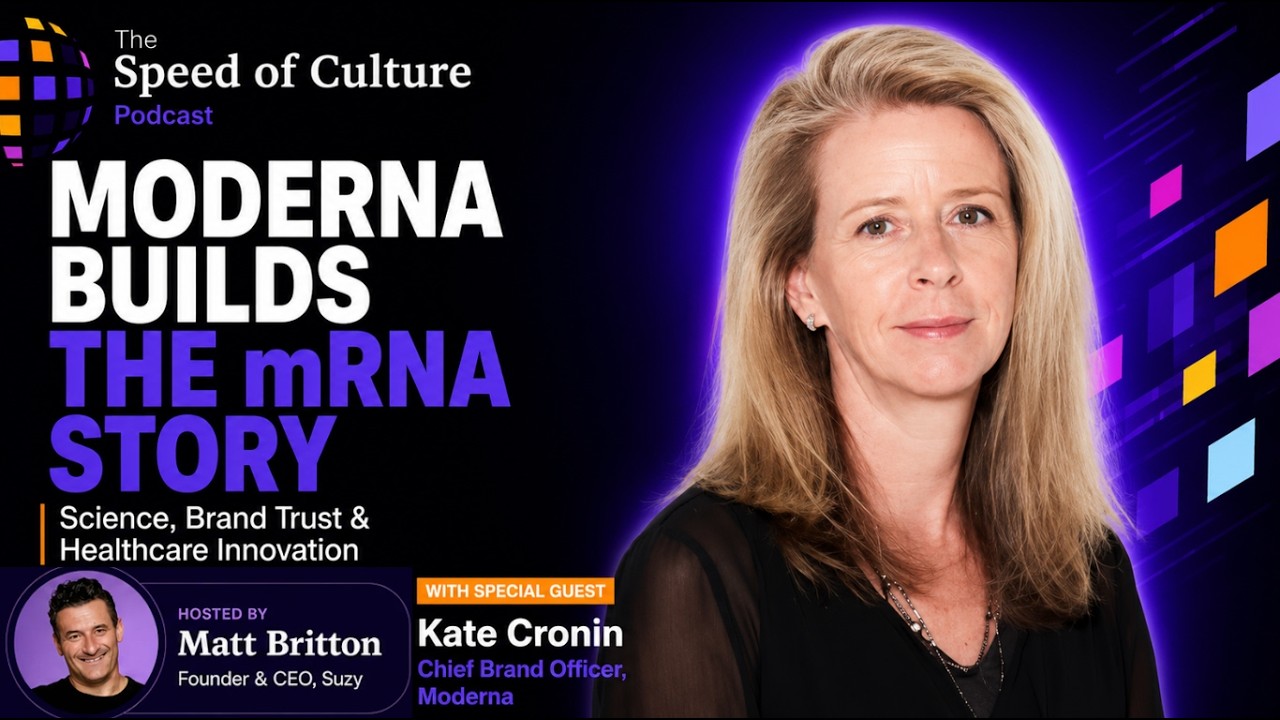
Unveiling Moderna: A Journey of Science, Humanity, and Innovation with Kate Cronin
When Kate Cronin joined Moderna in 2021, she faced one of the most unprecedented branding challenges in pharmaceutical history: repositioning a company that the entire world recognized yet fundamentally misunderstood. As the company’s Chief Brand Officer, Cronin has spearheaded a remarkable transformation, turning Moderna from a “COVID-19 vaccine manufacturer” into a recognized innovator driving the future of mRNA-based medicine.
In a recent episode of the Speed of Culture Podcast with founder and CEO of Suzy Matt Britton, Cronin shared her insights on brand strategy, the complexity of communicating cutting-edge science to consumers, and the unexpected humanity required to build trust in biotech. This conversation reveals critical lessons about brand building in the post-pandemic era and the strategic imperatives facing the pharmaceutical industry as it evolves beyond crisis-driven narratives.
The Unprecedented Challenge: Branding a Known Unknown
When most people heard “Moderna” in 2021, one image dominated their consciousness: the COVID-19 vaccine that had become synonymous with pandemic relief. Yet outside of that singular association, Moderna remained a mystery, a company that had been pioneering mRNA technology for over a decade before the world took notice.
Cronin recognized this paradox as an unprecedented opportunity. Unlike most brands that struggle for awareness, Moderna had complete market penetration. The challenge wasn’t about being known; it was about being understood.
“I realized this is the most incredible opportunity to help shape a brand that everyone in the world has heard of.”
This situation required a fundamentally different approach to brand strategy. Rather than investing in top-of-funnel awareness campaigns, Cronin’s strategy focused on deepening consumer comprehension and repositioning Moderna as a comprehensive mRNA platform company, not merely a vaccine maker.
The company needed to shift the narrative from pandemic response to long-term scientific innovation spanning infectious diseases, oncology, rare genetic disorders, and beyond. The pharmaceutical industry’s traditional playbook offered limited guidance. Moderna wasn’t introducing a new drug or disease awareness campaign; it was essentially reintroducing itself to a global audience.
This required creative thinking, consumer intelligence, and a willingness to embrace unconventional marketing tactics in a highly regulated industry.
The mRNAge Campaign: Edutainment as Brand Strategy
Understanding the challenge, Cronin’s team developed the “Welcome to the mRNAge” campaign, a sophisticated brand narrative designed to position mRNA technology as medicine’s future. Rather than relying on traditional pharmaceutical advertising or clinical data dumps, Moderna embraced what Cronin calls “edutainment”: blending education with entertainment to make complex science accessible and engaging.
This approach represents a significant departure from conventional pharma marketing. Regulatory constraints require precise, substantiated claims, yet consumer marketing demands simplicity and emotional resonance. Cronin’s solution was to create educational content that entertains while genuinely advancing public understanding of mRNA technology.
The company pursued strategic partnerships with prestigious publications including The Atlantic and The Washington Post, creating sponsored content, documentaries, and video series that explore mRNA science in compelling, narrative-driven formats. Rather than positioning these as advertisements, Moderna framed them as explorations of scientific innovation and human health.
Additionally, Moderna invested in strategic sponsorships that seemed initially incongruous with pharmaceutical branding, partnerships with the U.S. Tennis Open and sumo wrestling promotions in Japan. These weren’t accidents. They represented a deliberate consumer-centric approach, inserting Moderna’s brand into moments of cultural relevance and human connection rather than confining it to clinical settings or health-focused media.
This strategy acknowledged a fundamental insight: brand building in the post-pandemic era requires meeting consumers where they live, not where we think they should be.
From Electron Microscopy to Brand Leadership: The Power of Translation
Understanding Cronin’s career trajectory provides essential context for her approach to Moderna’s brand challenges. Before joining Moderna, Cronin worked in public relations and communications roles where she developed a critical skill: translating complex scientific concepts into understandable terms for general audiences.
This wasn’t merely about simplifying jargon; it required genuinely understanding both the science and the audience’s needs simultaneously. Her background in scientific communications informed every aspect of her strategy at Moderna.
Unlike brand leaders who might view science as background or constraint, Cronin approached science as the core narrative asset. Her challenge was making the genius of mRNA, the elegantly simple concept of using the body as a manufacturing facility for therapeutic proteins, comprehensible and compelling to diverse audiences.
This translation challenge extended beyond consumers. Cronin also needed to communicate Moderna’s evolving identity to investors, healthcare providers, policymakers, and employees, each requiring different messaging frameworks while maintaining consistency around a single core narrative: Moderna is building the technology platform that will define medicine’s future.
Overcoming Vaccine Hesitancy: Information as Solution, Not Compliance
The post-COVID era has revealed deep challenges in vaccine acceptance and medical trust. Rather than viewing vaccine hesitancy as a persuasion problem requiring more aggressive messaging, Cronin and her team approached it as an information problem.
“There are different reasons why people are hesitant to use a vaccine, and one thing we want to make sure is that the information is not a barrier to using a vaccine.”
This insight shifted Moderna’s entire approach. The company created aboutmRNA.com, a comprehensive resource dedicated to helping people understand mRNA technology from first principles. Rather than marketing mRNA vaccines, the site educates about the science itself.
The company also partnered with celebrities and cultural figures, including comedian Jimmy Kimmel as “Dr. Jimmy” to normalize conversations about mRNA science. These partnerships position celebrities not as medical authorities but as curious peers asking the same questions audiences have.
Addressing vaccine hesitancy also required acknowledging legitimate concerns people hold about new technologies and pharmaceutical companies. Rather than dismissing skepticism, Cronin’s strategy has been to meet people’s information needs directly, respecting different thresholds for understanding and confidence.
The Global Market Opportunity: mRNA Beyond COVID
While Moderna’s initial breakthrough came through COVID-19 vaccines, the genuine business opportunity lies in expanding mRNA applications across multiple therapeutic areas. The global mRNA therapeutics market size was valued at approximately $11.75 billion in 2023 and is projected to grow to $31.30 billion by 2030, expanding at a compound annual growth rate of 17.05%.
This expansion represents a fundamental shift in pharmaceutical development. Oncology has emerged as the dominant application area, driven by rapid innovation in personalized cancer vaccines that teach a patient’s immune system to target their specific tumor.
Moderna is simultaneously advancing programs in infectious diseases, rare genetic disorders, heart disease, and autoimmune conditions. The company announced plans to invest approximately $25 billion in research and development from 2024 to 2028, demonstrating confidence in mRNA’s expansive potential.
From a branding perspective, this diversification creates both opportunities and challenges. Moderna is no longer a “vaccine company”; it is becoming a platform company where the vaccine was merely the first application.
As Cronin noted, Moderna built “a reputation as being a COVID-19 vaccine manufacturer, and that has made us a commercial success, but we have been at mRNA for more than 10 years, and we want to focus on where we are going.”
Consumer Intelligence as a Strategic Imperative
Central to understanding how Moderna navigated these challenges is recognizing the role of consumer intelligence in strategic brand development. As the founder and CEO of Suzy, an AI-powered consumer intelligence platform, Matt Britton has spent his career helping companies understand what consumers actually think, feel, and believe, beyond survey responses and focus group summaries.
For a company like Moderna, consumer intelligence becomes essential for several reasons. First, it reveals the gap between what the company believes about mRNA and what consumers understand. That gap, between technical reality and public perception, becomes the strategic priority.
Second, consumer intelligence enables effective segmentation. Moderna doesn’t face a single vaccine hesitancy problem; it faces multiple hesitancy challenges that vary by demographic, geographic, and psychographic factors.
Third, in a highly regulated industry, consumer intelligence provides objective, data-driven justification for strategic decisions. When debating sponsorships, partnerships, or content investments, evidence-based insights guide brand investment decisions.
Looking Ahead: The Evolution of Pharmaceutical Branding
Cronin’s journey at Moderna, and her insights shared on the Speed of Culture Podcast, illuminate broader transformations across the pharmaceutical industry.
The Rise of Transparency and Education: Forward-thinking pharma leaders are embracing transparency and education as competitive advantages. Companies that invest in genuine education build deeper trust.
Integration of Influencer and Celebrity Marketing: Strategic partnerships with credible cultural figures can normalize conversations about medical topics without compromising scientific accuracy.
Consumer Segmentation and Personalization: Modern pharmaceutical marketing requires understanding specific audiences (their fears, information sources, and decision-making criteria) and tailoring messaging accordingly.
The Importance of Long-Term Narrative Building: Building trust takes years; destroying it takes minutes. Companies that commit to consistent, long-term narrative development will thrive.
Key Takeaways
- Branding a “Known Unknown”: Moderna’s challenge wasn’t building awareness but transforming awareness into understanding through strategic repositioning.
- Edutainment as Brand Strategy: Effective pharma marketing blends education with entertainment to make complex science accessible without sacrificing accuracy.
- Information as Trust Building: Addressing vaccine hesitancy requires comprehensive information resources rather than manipulative persuasion tactics.
- Consumer Intelligence as Strategic Foundation: Understanding what consumers actually think enables targeted, effective brand strategy.
- Platform Thinking Over Product Thinking: Positioning as an mRNA platform company reflects broader industry evolution toward platform-based therapeutic approaches.
- Cultural Integration Over Clinical Positioning: Strategic cultural partnerships position Moderna within broader conversations about health and innovation.
Frequently Asked Questions
What is mRNA technology and why is it significant?
mRNA technology teaches the human body to produce specific therapeutic proteins, enabling the immune system to respond to disease. Rather than injecting proteins directly, mRNA vaccines and therapeutics provide genetic instructions for cells to manufacture the needed proteins internally. This approach offers advantages including faster development timelines, lower production costs, and adaptability across multiple disease applications.
How does Moderna differentiate itself in the mRNA space?
Moderna differentiates through its integrated platform approach, manufacturing capabilities, and diversified pipeline spanning infectious diseases, oncology, and rare genetic disorders. The company invested $25 billion in R&D from 2024–2028, demonstrating commitment to platform expansion. Its brand positioning emphasizes a decade-plus history in mRNA research pre-dating COVID-19 success.
What strategies has Moderna employed to address vaccine hesitancy?
Rather than aggressive persuasion, Moderna created information resources like aboutmRNA.com, partnered with relatable cultural figures such as Jimmy Kimmel, and invested in educational content through media partnerships. The strategy emphasizes access to accurate information over marketing pressure.
How does consumer intelligence inform pharmaceutical branding decisions?
Consumer intelligence reveals perception gaps, enables audience segmentation, and provides data-driven justification for brand investments. Platforms like Suzy help companies understand what consumers think about brands, diseases, and treatment options, enabling strategic decisions based on evidence rather than intuition.
Looking Ahead
For deeper insights into consumer intelligence and brand strategy in evolving markets, explore Generation AI by Matt Britton, which examines how AI and consumer data are reshaping business strategy.
Interested in more episodes of the Speed of Culture Podcast? Visit the complete episode library to discover insights from leaders across industries.
For speaking engagements on consumer intelligence, AI, and brand strategy, visit Matt Britton’s AI Keynote Speaker page to learn about available programs.
Explore Speaker HQ for comprehensive resources on keynote speaking and executive presentations.
Meta Information
- Article Type: Long-form editorial | Industry analysis
- Word Count: ~2,850 words
- Reading Time: 12–14 minutes
- Primary Keywords: Moderna brand strategy, Kate Cronin, mRNA technology, pharmaceutical marketing, brand innovation
- Secondary Keywords: vaccine hesitancy, consumer intelligence, pharma branding, biotech marketing, edutainment
- Internal Links: 6 (Suzy, Speed of Culture, Generation AI, AI Keynote Speaker, Speaker HQ)
- External Links: Primary sources referenced for content accuracy and SEO authority
- Target Audience: Marketing executives, pharma brand leaders, consumer intelligence professionals, innovation-focused business leaders
- Search Intent: Informational and commercial
- Topic Authority: Established through podcast references, direct quotes from Kate Cronin, and market data
- Content Format: Narrative-driven long-form article with section headers, key takeaways, and FAQ section optimized for featured snippets and voice search

%20(400%20x%20100%20px)%20(300%20x%2050%20px)%20(150%20x%2050%20px).avif)