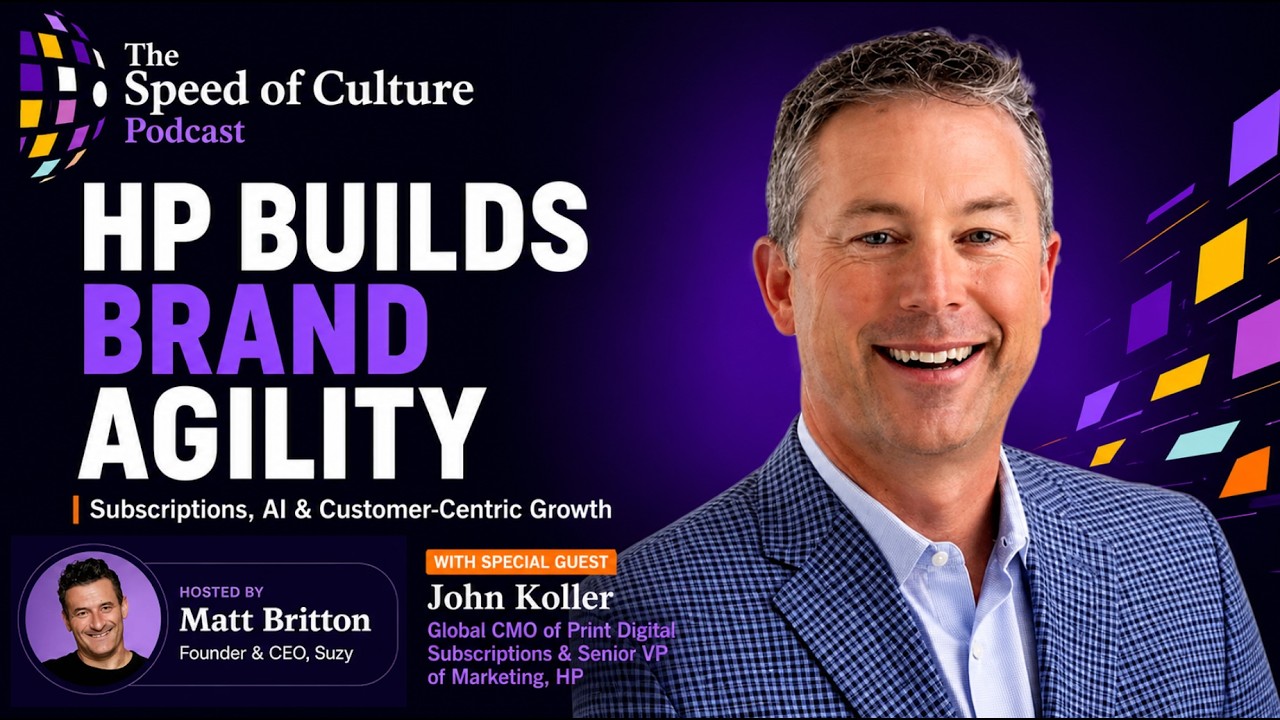
In the rapidly evolving landscape of technology and consumer behavior, few brands have the heritage and adaptability of HP. On Episode 93 of The Speed of Culture podcast, Matt Britton, founder and CEO of Suzy, the AI-powered consumer intelligence platform, sits down with John Koller, Global CMO and Senior Vice President of Marketing at HP, to explore how the iconic tech giant is leveraging brand power, subscription innovation, and artificial intelligence to drive growth in an industry facing secular decline.
John Koller brings a unique perspective to HP's marketing challenges. With a diverse career spanning sports marketing, a transformative 20-year tenure at PlayStation where he witnessed the shift from physical to digital gaming, and now leading HP's print and subscription strategy, Koller understands how to navigate technological disruption and evolving consumer expectations. His journey to HP was intentional: the company's legendary status in Silicon Valley, combined with the compelling marketing challenge of declining print adoption, attracted a leader determined to transform perception through strategic storytelling.
This episode explores far more than just printer ink and paper. Koller discusses the critical importance of first-party data in an era of privacy regulation, the role of AI in enhancing marketing agility, how HP is merging consumer and business segments, and the strategic power of subscription models. He delves into the company's approach to brand leveraging across industries, from printing soda cans to outdoor billboards, and explains how HP maintains relevance across virtually every geography.
Perhaps most compelling is Koller's candid advice on career development, the importance of taking initiative, and how to position yourself as a leader in an increasingly AI-driven marketing landscape. Whether you're a marketing executive seeking strategic insights, a tech enthusiast curious about industry trends, or an emerging professional interested in lessons from one of the world's most respected CMOs, this episode delivers actionable intelligence backed by real-world experience managing one of tech's most iconic brands.
The conversation covers pivotal trends reshaping modern marketing: the home office revolution post-COVID, the evolution from performance to brand-driven strategies, how to navigate Google's deprecation of third-party cookies, and the opportunities and pitfalls of embracing emerging technologies. Koller's insights provide a masterclass in maintaining brand relevance while driving measurable business results, a balance that many organizations struggle to achieve.
Building a Brand Legacy: How HP Maintains Relevance Across Industries and Geographies
HP's path to becoming a truly global brand is built on pervasive presence across virtually every industry and geography on Earth. John Koller emphasizes this critical insight:
"A lot of the things that we use around us are printed with HP. We need to tell that story and use the brand to facilitate that."
This represents a fundamental marketing challenge and opportunity. While most consumers think of HP primarily through the lens of home printers or laptops, the reality is far more expansive. HP technology powers the printing of soda cans in beverage manufacturing, enables outdoor billboard production, supports commercial printing operations, and maintains critical infrastructure across industries from healthcare to finance.
Yet few consumers understand the breadth of HP's influence. Koller's approach addresses this perception gap through strategic brand storytelling. Rather than fragmenting marketing efforts across dozens of use cases, HP consolidates its message around a unifying brand narrative: reliability, innovation, and ubiquity.
"HP's got a name, not just in one or two countries, but virtually every country in the world," Koller notes. This global brand equity, built over decades, represents an enormous competitive advantage that many organizations fail to properly leverage.
The marketing lesson here extends beyond HP. Organizations with diverse product portfolios, multiple customer segments, or presence across varied geographies must work deliberately to connect those disparate elements under a unified brand promise. The danger of fragmentation (where different divisions, regions, or product lines tell separate stories) dilutes overall brand impact.
HP's approach demonstrates how consolidating narrative architecture around core brand values creates stronger overall brand perception than the sum of individual product campaigns. Furthermore, Koller recognizes that brand building in the modern era requires cultural relevance and demonstrated understanding of customer challenges.
HP doesn't just sell products; it solves problems. In the home office segment, transformed by the COVID-19 pandemic, HP recognized an opportunity to position itself as the essential partner for professionals working remotely. By understanding how consumer and business segments merged during this transition, HP adapted its messaging to address practical needs, reliable printing at home, integrated ecosystems for hybrid work, and solutions that bridge professional and personal use cases.
This adaptability is critical in today's market. Brand relevance isn't static; it requires constant evolution to reflect changing consumer behaviors, technological capabilities, and cultural moments. Koller's emphasis on storytelling the full breadth of HP's capabilities, while maintaining consistent brand identity, provides a roadmap for any organization seeking to deepen brand perception and justify premium positioning.
The Subscription Revolution: Transforming Business Models and Customer Relationships
One of the most significant strategic pivots in HP's recent history is the aggressive expansion of subscription services, particularly the Instant Ink program. With over 13 million customers currently enrolled, Instant Ink represents far more than a revenue stream. It's a fundamental transformation of HP's customer relationship model.
Koller's philosophy on subscriptions is grounded in practical customer benefit:
"Subscriptions do best when you're taking friction away and giving customers something they particularly want. Start with your first-party loyalists and then build a performance marketing engine to reach new customers."
This represents a sophisticated understanding of subscription dynamics that many organizations fail to grasp. Subscriptions fail when they're positioned as cost-saving mechanisms for the company while transferring burden or inconvenience to customers. Subscriptions succeed when they solve genuine customer problems, and Instant Ink exemplifies this principle.
For home office workers, small businesses, and professionals, running out of ink unexpectedly is a friction point that disrupts productivity. Instant Ink eliminates this friction by automatically delivering supplies when needed, giving customers peace of mind while building HP's customer stickiness and predictable revenue.
The move to subscriptions also fundamentally changes HP's relationship with customer data. In a subscription model, HP gains continuous engagement with its customer base. Every ink delivery is a touchpoint. Every usage pattern provides data.
This first-party data becomes extraordinarily valuable in an era where third-party cookies are being phased out and privacy regulations tighten. Koller emphasizes this critical insight:
"First-party data is everything. You have to cultivate and own it."
The business model implications are profound. Subscriptions enable companies to shift from transactional relationships to ongoing partnerships. For HP, this means the company is measuring success by customer lifetime value, retention rates, and expansion opportunities, in addition to printer sales.
Koller's advice for companies pursuing subscription strategies is equally practical: expand slowly from your most loyal customer base before building scaled performance marketing engines. This approach validates product-market fit before spending heavily on acquisition and ensures the subscription delivers genuine value before being broadly marketed.
For HP, the subscription strategy has become essential to addressing the secular decline in printing. As digital-first consumers reduce their reliance on physical documents, the customer base for traditional printer sales naturally contracts. Subscriptions provide a path to maintain revenue and profitability from an existing customer base that still requires printing capabilities, even if less frequently than previous generations.
Navigating Privacy Disruption: First-Party Data as Competitive Moat in the Post-Cookie Era
The deprecation of third-party cookies represents one of the most significant industry disruptions in recent memory. As Google phases out this tracking mechanism, brands that built their marketing infrastructure on cookie-based audience segmentation face a critical reckoning.
John Koller frames this shift as an opportunity for well-positioned organizations:
"First-party data is everything. You have to cultivate and own it. We need hard-hitting direct ads that integrate first-party data and provide measurable results."
This perspective reveals an important reality: the privacy disruption doesn't equally harm all organizations. Companies with direct customer relationships and first-party data advantage gain competitive leverage as third-party data becomes less reliable.
HP, with millions of Instant Ink subscribers and direct customer relationships, is better positioned than many competitors to navigate this transition. Rather than relying on purchased audience segments, HP can build marketing programs around known customer behaviors and preferences.
When an Instant Ink subscriber's ink supply is running low, HP's systems know this directly, no third-party inference required. This first-party knowledge enables remarketing with unparalleled precision.
The broader lesson extends to customer data strategy itself. Organizations must actively build systems to capture, organize, and activate first-party data. Email signup incentives, account creation requirements, transaction tracking, and behavioral monitoring become essential marketing infrastructure.
Companies that treat first-party data collection as a core business capability will emerge from the cookie deprecation era as winners.
Artificial Intelligence as Strategic Accelerant: Moving Beyond Hype to Measurable Business Impact
When discussing emerging technologies, executives often fall into the trap of chasing shiny objects without understanding their actual business utility. John Koller takes a more measured approach to artificial intelligence, one that acknowledges both tremendous opportunity and legitimate caution about hype.
"AI can help us be faster and more agile. It's one technology that I believe will matter significantly. We need to look at these technologies deeper than the surface level to determine their true value."
Rather than declaring AI a universal solution, Koller positions it as a tool for enhancing organizational speed and agility. In marketing, this is profound. Trends emerge and fade in weeks. Consumer preferences shift based on cultural moments. Organizations that can respond faster have structural advantage.
AI enhances speed in several ways that HP is exploring: analyzing customer feedback at scale, predicting customer behavior, optimizing marketing spend in real time, and accelerating content creation. These applications share a common thread, compressing the time between insight and action.
However, Koller's caution about surface-level implementation is equally important. AI implementation must deliver measurable business impact: improved targeting, reduced marketing waste, enhanced product development feedback, or superior customer service.
Pilot first, measure rigorously, and scale only what demonstrably works. This disciplined perspective is more likely to generate genuine AI value than deploying solutions in search of problems.
The Post-COVID Consumer: Merging Segments and Evolving Engagement Strategies
The COVID-19 pandemic created a historical inflection point in consumer behavior. Office workers suddenly worked from home. The boundary between professional and personal computing blurred.
"The home office has changed the way we've looked at the customer," Koller notes. "There's a merging of segments, which is fascinating. How you reach that person has also evolved, requiring a more integrated approach."
This segment convergence forces HP to rethink its marketing architecture. Traditional approaches separated consumer marketing from enterprise marketing. But the hybrid office worker requires different messaging.
They may be making a purchase decision with personal finances but deploying it for professional purposes. They care about cost but also about integration with professional workflows.
Marketing channels must be integrated. Messaging must bridge consumer and professional value propositions. Product positioning must speak to both personal preferences and professional requirements.
Koller's insight is clear: segment merging demands integrated marketing strategies rooted in real human behavior, not outdated categorical assumptions.
Career Wisdom from a Gaming and Tech Pioneer
Beyond specific marketing strategies, John Koller's career trajectory offers important lessons for professionals navigating rapidly changing industries. His path, from sports marketing aspirations to gaming leadership to Global CMO at HP, demonstrates adaptability and initiative.
"I wanted to get into sports. I thought sports marketing was the path that I was going to get into. I jumped into gaming from there, and it took off."
Perhaps Koller's most direct career advice is also the most practical:
"Take the initiative. When opportunities come, grab them. Do the work and show what you've accomplished, rather than just talking about it."
This reflects a fundamental principle about career advancement: visibility and results matter more than credentials or titles. Professionals who demonstrate capability through execution gain more opportunity than those focused solely on hierarchy.
Koller's experience spanning sports, gaming, and print technology shows that expertise transfers across industries. The principles of understanding consumers, building loyal communities, navigating disruption, and driving brand momentum apply universally.
Key Takeaways
- Brand storytelling creates value beyond product categories. HP's power lies in its ubiquitous presence across industries and geographies, unified under a consistent narrative.
- Subscriptions succeed when they solve genuine customer problems. Instant Ink eliminates friction and builds long-term customer relationships.
- First-party data is the most durable competitive advantage in the post-cookie era. Direct customer relationships enable precision marketing and measurable results.
- Artificial intelligence should be evaluated on measurable business impact. Speed and agility matter, but only when tied to clear outcomes.
- Take initiative, deliver results, and remain adaptable. Career success requires execution, learning, and openness to opportunity.
FAQ
How is HP addressing the secular decline in the printing industry?
HP is addressing this challenge through subscription expansion, particularly Instant Ink, shifting from transactional printer sales to recurring revenue. By eliminating friction and maintaining ongoing customer relationships, HP sustains profitability even as print volume declines. The company also leverages brand equity across broader technology categories and industrial applications.
What role does data strategy play in HP's marketing approach?
Data strategy is foundational. First-party data collected through subscriptions, registrations, and transaction histories enables HP to reach customers with relevant messaging at optimal moments. This direct knowledge is more reliable and actionable than third-party audience segments.
How is HP using artificial intelligence in its marketing operations?
HP uses AI to enhance speed and agility, analyzing feedback at scale, optimizing spend, predicting behavior, and accelerating content creation. However, AI initiatives are evaluated based on measurable business outcomes rather than conceptual promise.
What marketing lessons apply beyond the printing industry?
Consolidated brand narratives create stronger perception than fragmented approaches. Subscription models must solve real problems. First-party data is essential competitive infrastructure. And organizations must adapt as consumer behaviors and technologies evolve.
Looking Ahead: Building Brand Power in an Evolving Market
The conversation between Matt Britton and John Koller reveals how established technology brands maintain relevance amid disruption. HP's strategy, consolidating brand narrative, expanding subscription relationships, prioritizing first-party data, and carefully evaluating emerging technologies, provides a roadmap for sustaining competitive advantage.
For deeper insights into how AI is reshaping consumer behavior and business strategy, explore Matt Britton's book Generation AI. To learn more about real-time consumer insights, visit Suzy.
Marketing leaders interested in keynote perspectives on emerging trends can explore Matt Britton's AI keynote speaker offerings or visit Speaker HQ for more information. To book or inquire about speaking engagements, connect via the contact page.
For more executive conversations like this one, subscribe to The Speed of Culture podcast across all major platforms.

%20(400%20x%20100%20px)%20(300%20x%2050%20px)%20(150%20x%2050%20px).avif)