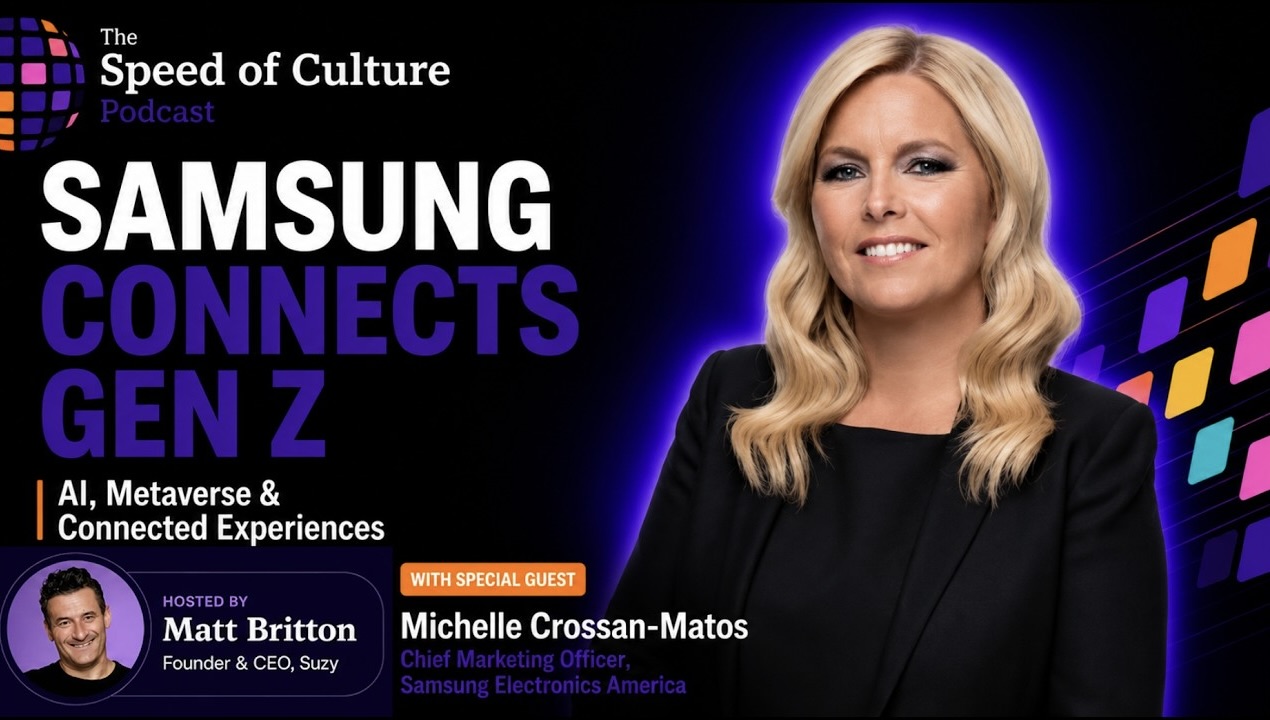
Matt Britton, founder and CEO of Suzy, the AI-powered consumer intelligence platform, recently sat down with Michelle Crossan-Matos, CMO at Samsung Electronics America, to discuss how legacy brands are revolutionizing their approach to reach younger audiences through sustainability initiatives and cutting-edge innovation.
This conversation reveals the strategic imperative for established corporations to evolve their marketing narratives, leverage emerging technologies like Web3 and the metaverse, and commit to meaningful environmental practices that resonate with Gen Z values.
Crossan-Matos brings decades of experience from some of the world's most influential consumer brands (including P&G, Unilever, Johnson & Johnson, SharkNinja, and Ulta Beauty) to Samsung's transformation as a consumer-centric innovation leader.
Her insights underscore a critical reality: today's most successful brands don't simply sell products; they champion causes and create cultural movements that align with the worldviews of younger generations who demand authenticity, transparency, and tangible corporate responsibility.
Samsung's multifaceted approach, from ocean-bound plastics in Galaxy devices to AI-powered energy management through SmartThings Energy, demonstrates how innovation and sustainability can coexist as competitive advantages.
This episode explores the philosophical and practical frameworks that enable legacy companies to remain relevant in an era of rapid technological disruption, while also examining how marketing leaders can harness data-informed creativity to build deeper connections with Gen Z consumers who are reshaping global markets.
The Evolution of Samsung's Consumer Marketing Strategy
Samsung Electronics America is undergoing a profound transformation under Crossan-Matos's leadership, shifting from a purely technology-focused positioning to a consumer-centric innovation narrative that speaks directly to Gen Z values and aspirations.
This strategic pivot represents far more than a cosmetic rebranding effort; it reflects a fundamental reconceptualization of how a global technology powerhouse engages with younger audiences who have grown up in a hyperconnected, sustainability-conscious world.
The company's marketing evolution centers on three interconnected pillars: technological innovation, environmental stewardship, and cultural relevance in emerging digital ecosystems.
The "Unfold Your World" campaign for the Galaxy Z Flip exemplifies this new approach, moving beyond specifications and performance benchmarks to emphasize personal transformation, self-expression, and the freedom to reimagine one's digital lifestyle.
This messaging directly appeals to Gen Z's core values around authenticity and individual identity. Rather than competing solely on processing power or screen resolution, traditional metrics that commoditize technology, Samsung now positions its products as enablers of personal possibility and cultural participation.
Crossan-Matos's career trajectory reveals the strategic blueprint she's bringing to Samsung.
Her previous roles at P&G navigated global brand positioning across diverse consumer segments; at Unilever she managed integrated marketing strategies for health and sustainability initiatives; at Johnson & Johnson she oversaw consumer healthcare brand transformation; as CMO at Ulta Beauty she drove digital-first beauty retail innovation; and at SharkNinja she accelerated growth through agile marketing approaches for kitchen and home appliances.
Each of these experiences has equipped her with deep knowledge of how to authentically communicate brand purpose while maintaining rigorous accountability to business metrics.
Her educational background, including a degree from the University of Strathclyde in Glasgow and executive education at Columbia Business School, reflects a commitment to continuous learning and intellectual rigor.
Notably, Crossan-Matos credits her personal discipline as a fundamental driver of her professional success.
Her 5 a.m. wake-up routine, maintained throughout her career regardless of geographic location or time zone challenges, exemplifies the discipline she believes enables creativity and strategic clarity.
This perspective, that discipline is not antithetical to innovation but rather its prerequisite, shapes how she approaches Samsung's transformation.
Sustainability as Strategic Imperative and Consumer Expectation
One of the most compelling dimensions of Samsung's evolution under Crossan-Matos's leadership is the company's integration of sustainability principles into its core marketing narrative and product development strategy.
This represents a significant departure from the traditional corporate sustainability playbook, where environmental initiatives are often relegated to separate corporate responsibility departments with limited consumer-facing visibility.
Instead, Samsung is embedding sustainability into the very DNA of its consumer brands, making environmental stewardship inseparable from innovation and performance.
Samsung's commitment to achieving net-zero emissions by 2050 provides a concrete, measurable framework against which the company's sustainability claims can be evaluated.
This long-term commitment signals serious intent to investors, regulators, employees, and consumers, particularly younger audiences who are increasingly skeptical of corporate greenwashing.
However, Crossan-Matos recognizes that ambitious long-term targets must be accompanied by visible near-term actions that demonstrate progress and accountability.
The integration of ocean-bound plastics into Galaxy device manufacturing exemplifies this philosophy.
Rather than treating sustainability as a separate initiative marketed through specialized channels, Samsung incorporates recycled ocean plastics directly into flagship consumer products that millions of people use daily.
This approach accomplishes several objectives simultaneously: it reduces plastic waste in marine environments, demonstrates tangible environmental impact, creates compelling marketing content that connects products to positive environmental outcomes, and appeals directly to Gen Z consumers who expect their technology purchases to reflect their environmental values.
The strategic partnership between Samsung and Patagonia further illustrates how sustainability can become a brand differentiator and cultural statement.
Patagonia's uncompromising commitment to environmental protection and social responsibility gives Samsung credibility within Gen Z communities where brand authenticity is paramount.
This partnership extends beyond co-marketing to encompass shared values and aligned business practices, creating a narrative that resonates with consumers who view their purchasing decisions as expressions of their worldview.
Samsung's Eco-Packaging programs for home appliances represent another dimension of this sustainability commitment.
By redesigning packaging to reduce materials, utilize recyclable components, and minimize environmental impact throughout the product lifecycle, from manufacturing through end-of-life recycling, Samsung addresses consumer concerns about corporate environmental responsibility while also identifying operational efficiencies.
These programs demonstrate that sustainability and profitability are not opposing forces but rather complementary objectives when approached with genuine commitment and creative problem-solving.
Innovation, Web3, and the Metaverse as Gen Z Engagement Platforms
Crossan-Matos emphasizes that Samsung's exploration of Web3 technologies, metaverse experiences, and AI-driven innovation reflects not merely technological fascination but genuine recognition of where younger audiences are organizing their social lives, building communities, and developing their cultural identities.
Gen Z's adoption of gaming platforms, virtual worlds, and decentralized digital ecosystems represents a fundamental shift in how younger demographics engage with brands, peers, and the broader cultural landscape.
The metaverse, while still in its nascent stages of development and adoption, offers profound opportunities for brands willing to invest in authentic, creative experiences that go beyond traditional advertising models.
Samsung's approach involves gamification and socialization features that create genuine value for participants, rather than cynical brand insertion into existing digital spaces.
This represents a meaningful distinction between opportunistic marketing and genuine brand community building.
Web3 and blockchain technologies, when approached thoughtfully, enable new forms of consumer engagement, ownership, and value creation.
For Samsung, exploring these technologies reflects both strategic positioning to serve future-oriented consumers and genuine curiosity about how decentralized digital ecosystems might reshape consumer technology expectations.
Rather than dismissing emerging technologies as passing trends, Crossan-Matos advocates for experimental engagement that develops organizational capabilities while testing consumer reception.
SmartThings Energy represents a convergence of AI innovation, consumer sustainability interests, and practical product development.
This AI-based energy management system allows consumers to monitor, understand, and optimize their energy consumption in real time.
For Gen Z consumers increasingly concerned about climate change and seeking ways to reduce their personal environmental footprint, SmartThings Energy offers tangible agency and measurable impact.
The platform transforms energy management from a passive utility function into an active engagement opportunity, creating value for both consumers and the broader energy system.
“Data-informed creativity produces the most innovative results.”
This approach to innovation, grounding emerging technology exploration in genuine consumer needs and authentic brand purpose, represents the antithesis of innovation theater.
By leveraging Suzy and similar consumer intelligence platforms, marketing leaders can test ideas, validate assumptions, and iterate rapidly based on authentic consumer insights rather than relying on organizational groupthink or external hype cycles.
Discipline, Creativity, and the Responsibility of Legacy Brands
A recurring theme throughout Crossan-Matos's career philosophy is the conviction that discipline enables, rather than constrains, genuine creativity.
This perspective offers valuable guidance for established enterprises navigating rapid technological and cultural change.
Legacy brands often struggle to balance the systematic processes that built their market position with the flexibility and experimentation required to remain competitive in dynamic markets.
Crossan-Matos suggests that this is not a genuine dilemma but rather a false dichotomy rooted in misunderstanding the nature of creative work.
Discipline, in this context, encompasses rigorous analytical thinking, commitment to consumer insights, systematic testing of hypotheses, and honest evaluation of results.
These practices do not stifle creativity; they channel creative energy toward outcomes that matter to consumers and the business.
A marketer operating without analytical discipline risks creating brilliant campaigns that fail to resonate with target audiences or drive meaningful business outcomes.
Conversely, a marketer operating without creative ambition risks producing technically sound work that fails to move consumers emotionally or culturally.
Crossan-Matos's personal discipline (exemplified by her 5 a.m. wake-up routine, regardless of circumstances) reflects her understanding that consistency creates conditions for both strategic clarity and creative breakthroughs.
Early morning hours provide uninterrupted time for reflection, reading, strategic thinking, and personal development.
This discipline creates mental space for the kinds of imaginative leaps that characterize exceptional marketing strategy.
Beyond individual discipline, Crossan-Matos articulates a compelling perspective on legacy brands' responsibility to serve as catalysts for younger minds.
Established corporations possess resources, platforms, distribution networks, and accumulated knowledge that smaller, earlier-stage organizations cannot match.
This concentration of power and resources carries commensurate responsibility to deploy these assets in service of positive cultural and environmental outcomes, not merely shareholder returns.
This perspective aligns closely with Generation AI, Matt Britton's exploration of how younger generations expect corporations to contribute meaningfully to solutions for pressing global challenges.
The most sophisticated companies are recognizing that long-term shareholder value depends increasingly on maintaining social license to operate, the broad permission from society and communities to conduct business.
Generation Z and younger consumers are withholding this social license from corporations perceived as environmentally destructive, socially irresponsible, or authentically disconnected from stated values.
Brands that meaningfully advance sustainability, champion innovation that solves genuine problems, and demonstrate authentic commitment to purposes beyond profit are building durable competitive advantages while contributing to positive change.
The Speed of Culture and Real-Time Marketing Responsiveness
Samsung's marketing transformation occurs within the context of what Speed of Culture describes as the accelerating pace at which cultural trends emerge, gain momentum, and either establish themselves as lasting shifts or fade as temporary phenomena.
Crossan-Matos's experience across multiple global corporations has given her deep appreciation for how traditional, hierarchical decision-making processes can create organizational lag in responding to cultural moments and emerging consumer preferences.
The traditional quarterly planning cycle, annual budget allocation, and multi-layer approval processes that characterize many large corporations are increasingly misaligned with the temporal dynamics of digital culture.
Viral moments, trending conversations, and emergent consumer behaviors often unfold across days or hours, not quarters or fiscal years.
This creates acute pressure for marketing organizations to develop more agile decision-making capabilities while maintaining the strategic coherence that guides long-term brand building.
Crossan-Matos's approach involves establishing clear strategic frameworks and brand principles that can empower frontline teams to make real-time decisions without constant escalation and approval processes.
Rather than prescribing specific tactical executions, effective strategic guidance creates decision rules and cultural norms that enable rapid response within defined parameters.
This approach requires trust, clear communication, and systems that provide teams with real-time consumer feedback.
This is precisely the kind of challenge that Suzy and similar consumer intelligence platforms are designed to address.
Real-time consumer insights, rapid survey methodology, and AI-powered analysis enable marketing teams to validate hunches against actual consumer preferences, test messaging variations, and adjust tactics in response to emerging feedback.
In the context of Samsung's diverse, global portfolio addressing multiple consumer segments, the ability to gather fresh consumer insights rapidly creates genuine competitive advantage.
Key Takeaways for Business Leaders
- Sustainability as Competitive Advantage: Legacy brands that authentically integrate environmental and social responsibility into core product narratives and marketing strategies are building durable competitive advantages with Gen Z consumers while creating operational efficiencies through resource optimization.
- Data-Informed Creativity Drives Results: The most innovative marketing combines rigorous analytical thinking, consumer insights, and systematic testing with imaginative creative work. Discipline enables creativity rather than constraining it.
- Emerging Technologies Require Experimental Engagement: Web3, metaverse experiences, and AI applications offer genuine opportunities for brand engagement with younger audiences, but only when approached with authenticity, genuine value creation, and willingness to learn from results rather than merely inserting brands into existing trends.
- Organizational Agility and Speed Matter: The accelerating pace of cultural change demands marketing organizations that can gather consumer insights rapidly, test hypotheses quickly, and adjust tactics based on real-time feedback while maintaining strategic coherence and brand integrity.
- Purpose-Driven Marketing Requires Genuine Commitment: Consumers, particularly younger demographics, are highly sensitive to the gap between stated corporate values and actual business practices. Long-term competitive advantage depends on authentic, measurable commitment to purposes beyond profit, not superficial purpose positioning.
Frequently Asked Questions
How can established brands authentically engage with Gen Z without appearing inauthentic or opportunistic?
Authentic engagement requires moving beyond surface-level trend adoption to genuine understanding of what Gen Z consumers actually value: environmental responsibility, transparency, authentic self-expression, and brands that demonstrate through actions, not merely messaging, that they share their values.
This involves allocating real resources to sustainability initiatives, investing in product innovations that solve genuine problems, engaging transparently about challenges and failures, and empowering younger employees and community members to shape brand strategy.
Organizations that involve Gen Z voices in strategic decision-making, rather than simply marketing to them, demonstrate genuine respect for their perspective and agency.
What role should legacy brands play in driving sustainability and social innovation?
Legacy brands possess accumulated resources, distribution capabilities, supply chain expertise, and consumer trust that position them uniquely to drive systemic change at scale.
A company like Samsung can impact sustainability outcomes far more significantly than a startup because of its manufacturing scale, supply chain reach, and consumer influence.
The question is whether these assets are deployed in service of genuine positive impact or merely superficial purpose-positioning.
Brands that treat sustainability as a strategic imperative (reshaping product design, supply chains, packaging, and energy use) are building long-term shareholder value while contributing meaningfully to environmental challenges.
Those that treat sustainability as a marketing message divorced from actual business practices risk significant reputation damage as consumers, regulators, and employees increasingly scrutinize the gap between claims and actions.
How should marketing leaders approach Web3 and metaverse opportunities without chasing trends?
The key distinction is between authentic engagement and trend-chasing.
Genuine engagement involves asking whether these technologies address actual consumer needs or enable experiences that consumers genuinely value.
For younger audiences increasingly organizing their social lives within gaming platforms and virtual worlds, these spaces represent authentic consumer attention and engagement opportunities, not passing fads.
However, brands should focus on creating genuine value within these ecosystems rather than cynical brand insertion.
This might involve creating games or experiences that entertain and engage, enabling ownership and social features that communities value, or solving problems that participants face.
Testing these approaches with real consumer feedback, being willing to fail and iterate, and maintaining strategic coherence with overall brand positioning helps distinguish meaningful innovation from expensive experiments.
How can organizations balance long-term strategic consistency with the need for real-time tactical agility?
This requires clear separation between strategic principles and tactical execution.
Strategic frameworks should articulate core brand purpose, target consumer insights, key brand values, and long-term competitive positioning.
These should remain relatively stable and guide decision-making across the organization.
Tactical execution (specific campaigns, messaging variations, channel selection, timing of communications) should be far more flexible and responsive to real-time consumer feedback and cultural moments.
Organizations that articulate clear strategic direction while empowering teams to adjust tactics based on emerging insights can achieve both consistency and agility.
Consumer intelligence platforms that provide real-time feedback enable this balance by grounding tactical decisions in actual consumer response rather than organizational assumptions.
Looking Ahead
Michelle Crossan-Matos's leadership at Samsung exemplifies the sophistication required to navigate the convergence of rapid technological change, rising consumer expectations around sustainability, and the profound cultural shifts driving younger demographic behavior.
Her career trajectory, from P&G's global brand strategies through specialized roles at Unilever, Johnson & Johnson, SharkNinja, and Ulta Beauty, to Samsung's consumer marketing transformation, demonstrates that the most effective marketing leaders maintain both strategic consistency and tactical flexibility, ground creative ambition in rigorous analytical thinking, and recognize that authentic brand building requires genuine commitment to purposes beyond immediate profit.
For business leaders navigating similar challenges in their organizations, the key insights are straightforward though demanding in execution: understand your Gen Z and younger audiences with genuine depth through consumer research and direct engagement; commit authentically to sustainability and social purpose initiatives that align with your business capabilities; explore emerging technologies experimentally but maintain rigorous evaluation of genuine consumer value; develop organizational capabilities for rapid insight gathering and tactical adjustment; and maintain discipline and clear strategic principles even while embracing creative experimentation.
For more insights on generational consumer trends and AI-powered strategy, explore Generation AI: The Book.
To learn more about rapid consumer intelligence gathering, visit Suzy.
For additional perspectives on leadership and innovation, explore Matt Britton's Speaker HQ and inquire about his AI keynote speaking engagements.

%20(400%20x%20100%20px)%20(300%20x%2050%20px)%20(150%20x%2050%20px).avif)