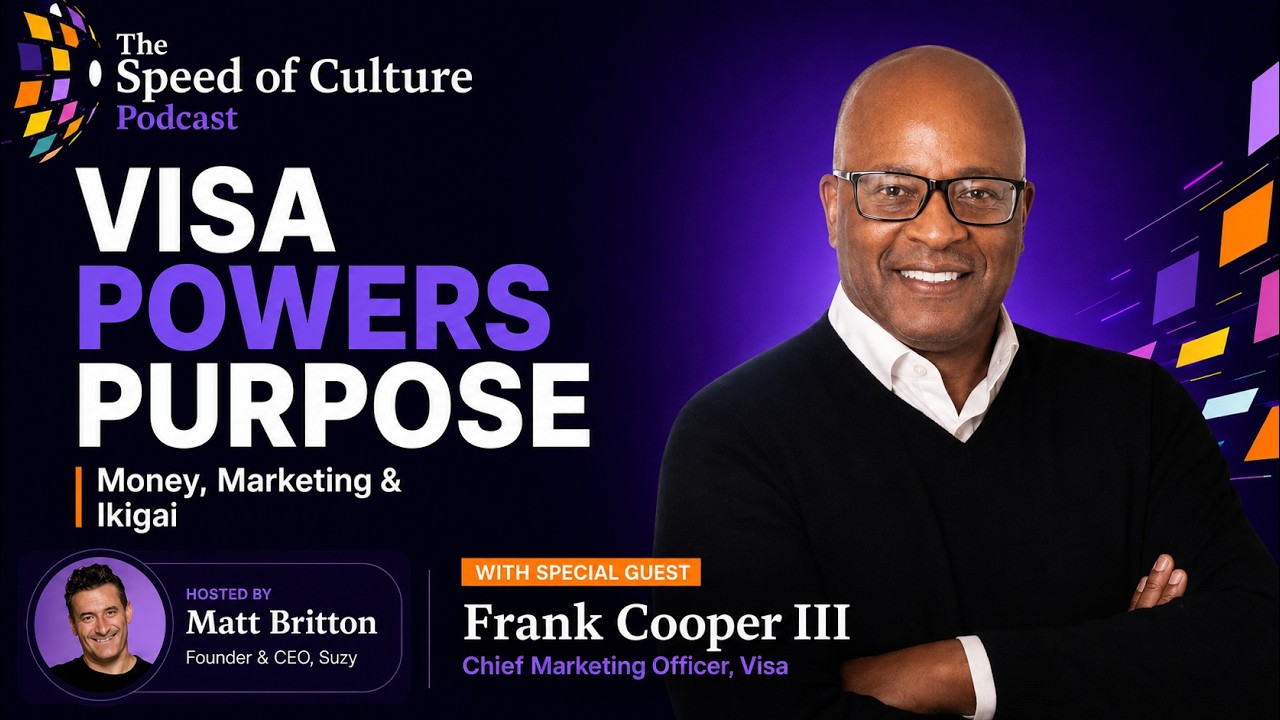
In an era where cultural trends move at lightning speed and technology reshapes business overnight, the most successful marketers are those who refuse to play it safe. This is precisely why Matt Britton, founder and CEO of Suzy, the AI-powered consumer intelligence platform, sat down with Frank Cooper III, Chief Marketing Officer at Visa, to discuss how enterprises stay ahead of the curve.
Recorded on March 21, 2023, this episode of Speed of Culture, the podcast exploring the intersection of consumer behavior, marketing innovation, and cultural momentum, revealed insights that matter to every CMO, brand strategist, and digital leader navigating today's rapidly evolving landscape.
Frank Cooper III's trajectory tells a story of deliberate boundary-crossing between entertainment, culture, and commerce. His resume reads like a masterclass in brand building: co-founder of Urban Box Office Networks (UBO); Vice President of Interactive Marketing at America Online (AOL); senior roles at Motown Records and Def Jam Recordings; Chief Creative Officer and CMO of BuzzFeed; CMO of Global Consumer Engagement at BlackRock; and now CMO at Visa, leading global consumer engagement and brand strategy.
This is a resume constructed by someone who understands that culture, technology, and commerce are inseparably linked.
From Hip-Hop to Harvard: Building a Career at the Intersection of Culture and Commerce
Frank Cooper III's early career shaped a philosophy that permeates his approach today: culture is the foundation of all human connection. This understanding emerged from lived experience in music, entertainment, and digital media rather than from business school case studies.
Cooper's first significant role came through co-founding Urban Box Office Networks, the largest internet company dedicated to urban lifestyle and minority markets. In the late 1990s and early 2000s, when many mainstream companies dismissed minority and urban markets as niche, UBO bet big on this demographic. The lesson was clear: staying ahead means recognizing cultural power before the mainstream does.
His subsequent roles at AOL, Motown Records, and Def Jam deepened his understanding of how culture moves. At AOL, Cooper managed music sales and marketing programs, teaching a tech company to speak the language of entertainment. At Motown and Def Jam, he was stewarding cultural movements, not just marketing music.
BuzzFeed marked another inflection point. As CMO during its explosive growth, Cooper focused on branded content and entertainment partnerships, demonstrating that in an era of fragmented attention, the most effective marketing involves creating things people actually want to consume.
BlackRock was perhaps the most unexpected move. Overseeing consumer engagement for the world's largest asset management company required translating financial complexity into language that resonated with everyday consumers while maintaining institutional rigor. The insight: every enterprise exists within culture and must engage authentically with it.
At Visa, Cooper now applies decades of learning to one of the world's most important financial infrastructure companies. The challenge is existential: how does a company built on centralized payment processing align itself with emerging technologies like blockchain and decentralized finance?
The CMO's Challenge: Staying Ahead vs. Staying Relevant
The episode focuses on a defining paradox of contemporary marketing: how to stay ahead of cultural and technological trends while remaining authentic to your core audience. For Visa, this tension is particularly acute.
Visa's power derives from its role as trusted intermediary in global commerce. The 60+ year-old company processes trillions of dollars annually and represents financial stability. Yet cryptocurrency, blockchain, decentralized finance (DeFi), and Web3 challenge traditional models of centralized payment processing.
Rather than viewing emerging technologies as threats, forward-thinking enterprises frame them as tools that can enhance their core mission. At Visa, that means exploring how blockchain and Web3 can expand financial inclusion, increase transaction speed, and create new forms of commerce.
Staying ahead requires three things:
- Intellectual humility, recognizing that you don't know everything and must learn from emerging communities.
- Cultural listening, understanding motivations and behaviors before making tactical decisions.
- Experimentation, building capabilities in emerging areas without requiring immediate mature ROI.
Cooper emphasizes that CMOs must think beyond quarterly earnings. Strategic bets on emerging cultural and technological moments may not pay off immediately, but they build long-term advantage.
Digital Transformation: Beyond Technology to Organizational Change
Digital transformation is about rethinking how organizations operate and engage with customers. At Visa, this requires reconceptualizing payment itself.
Historically, a payment was a transaction: initiated, processed, completed. But emerging technologies introduce new possibilities. What if payments are conditional and automated? What if they respond to real-world triggers? What if the payment network becomes a platform for entirely new commerce experiences?
This mindset, treating a mature business like a startup, is essential for staying ahead. Industries like music have already experienced radical disruption, forcing leaders to adapt or fade. Visa's opportunity lies in ensuring its infrastructure supports emerging systems rather than resisting them.
Successful digital transformation also requires organizational alignment. If marketing champions Web3 but engineering lacks resources to build in those spaces, transformation stalls. Cooper's role involves ensuring coherence across functions so that innovation isn't isolated but embedded across the enterprise.
Web3, NFTs, and the Future of Commerce
In early 2023, NFTs and blockchain-based payments dominated headlines. Some enterprises rushed in; others dismissed the space entirely. Cooper suggests a measured middle path.
Blockchain represents real innovation in how value, identity, and ownership are managed. However, many early NFT use cases prioritized spectacle over substance. For Visa, the opportunity isn't to become a blockchain company but to ensure its network functions seamlessly within emerging digital economies.
If someone buys an NFT, they should be able to pay with Visa. If a creator monetizes content via blockchain systems, Visa should facilitate that transaction. If decentralized platforms need fiat on/off ramps, Visa can provide them.
This approach positions Visa as infrastructure that enables participation rather than a speculative player. It allows the company to capture value from Web3 growth without abandoning its core identity of trust and reliability.
Consumer Intelligence and Agile Marketing in a Fast-Moving Landscape
Throughout the conversation, Cooper underscores the importance of consumer intelligence, understanding not just what consumers say, but what they actually do. In rapidly shifting markets, real-time insights are critical.
This is where platforms like Suzy become essential. Annual research cycles are too slow. By the time a study concludes, cultural conditions may have already shifted.
At Visa, understanding global preferences (across demographics, regions, and technological adoption curves) requires agile methodologies. Organizations must test, learn, iterate, and scale what works. Minimum viable initiatives reduce risk while accelerating insight.
The competitive advantage belongs to organizations that can listen, interpret, and act quickly.
The Case for Thoughtful Experimentation
A consistent theme in Cooper's career is the importance of making strategic bets without demanding immediate ROI. This applies to investments in blockchain, NFTs, and cultural communities alike.
These investments build optionality and capability. If an enterprise invests early in understanding emerging systems, it is prepared when those systems reach mainstream adoption. Waiting until technologies mature often means arriving too late.
The principle extends beyond technology. Cultural moments require early recognition and authentic engagement. Supporting emerging communities builds long-term brand equity that cannot be manufactured overnight.
Organizations that stay ahead of cultural and technological change do so not through hype-chasing, but through deliberate engagement, continuous learning, and strategic experimentation.
Key Insights for Leaders
- Cultural fluency matters as much as strategy. Leaders must engage with emerging platforms, communities, and ideas.
- Evaluate emerging technologies strategically. Ask how they enhance your core offering, not whether they are trending.
- Speed and agility outperform perfection. Rapid experimentation beats extended planning cycles.
- Authenticity builds equity. Genuine cultural engagement resonates more than performative marketing.
- Talent determines trajectory. Diverse, culturally fluent teams drive smarter decisions.
FAQ
How should enterprises approach Web3 and blockchain if they're unsure about long-term viability?
Enterprises should invest in understanding how blockchain and Web3 function, experiment with pilot programs, and assess how these technologies enhance their core offering. This builds capability without requiring immediate large-scale bets.
What organizational changes are necessary to stay ahead of trends?
Organizations need real-time consumer intelligence, faster decision-making structures, cultural expertise within teams, and leadership that values calculated risk-taking and continuous learning.
How can a mature company like Visa position itself as innovative?
By applying its core strength, trusted payment processing, to emerging technologies and markets. Innovation does not require abandoning stability; it requires extending it into new arenas.
Why is consumer intelligence more important today?
Cultural and technological shifts happen faster than ever. Annual research cycles are insufficient. Organizations need continuous monitoring and agile insight capabilities to remain competitive.
Looking Ahead
The conversation between Matt Britton and Frank Cooper III captures a pivotal moment in enterprise thinking. While technologies evolve and hype cycles rise and fall, the underlying principle remains constant: stay curious, stay experimental, and stay aligned with culture.
For more insights on consumer behavior and emerging technologies, explore the Speed of Culture podcast. To learn more about real-time consumer intelligence, visit Suzy. For keynote presentations and strategic consulting on AI and digital transformation, visit AI Keynote Speaker, explore Generation AI, or connect via Contact.

%20(400%20x%20100%20px)%20(300%20x%2050%20px)%20(150%20x%2050%20px).avif)