Democratizing Technology for All: Bridging the Generational Gap in Tech Marketing
In an era where AI dominates headlines and consumer expectations shift rapidly, technology companies face an unprecedented challenge: reaching younger generations who demand transparency, inclusivity, and purpose-driven innovation. Lenovo's approach to this challenge offers valuable lessons for enterprise marketers and technology leaders navigating the rapidly evolving landscape of consumer behavior and brand engagement.
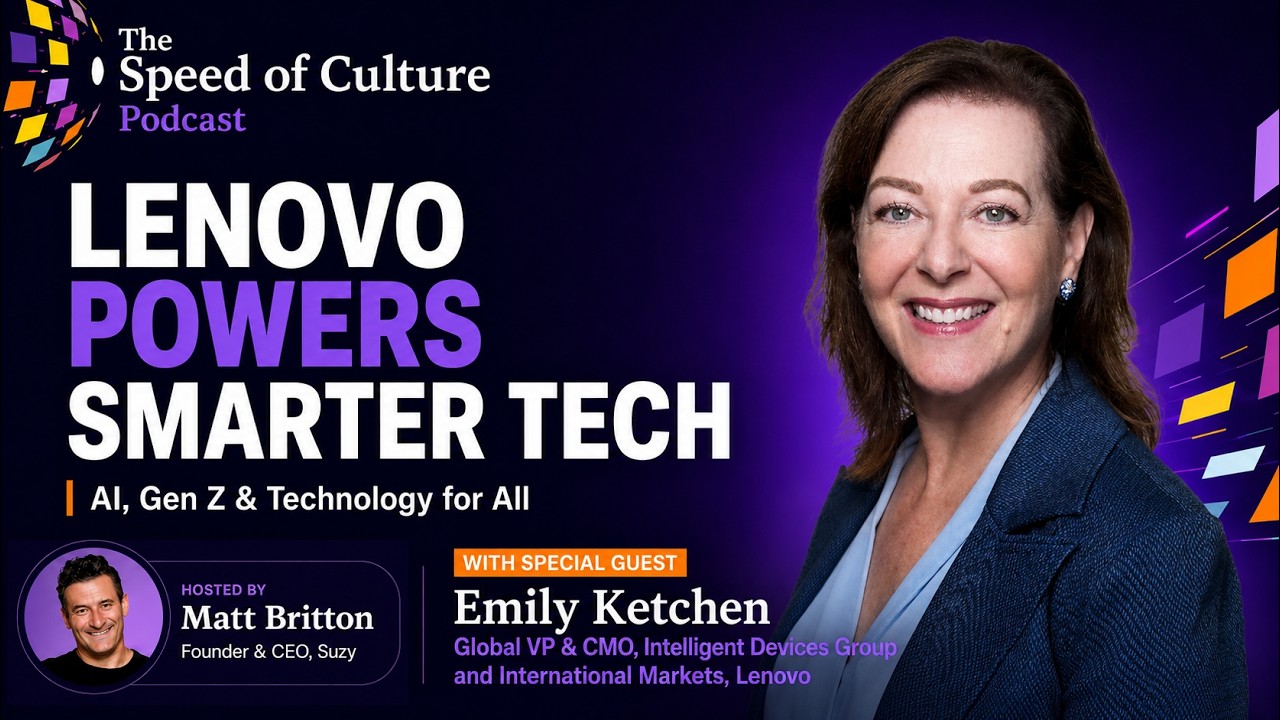
On October 24, 2023, Emily Ketchen, Global VP and CMO of Intelligent Devices Group and International Markets at Lenovo, joined Matt Britton, founder and CEO of Suzy, the AI-powered consumer intelligence platform, on Speed of Culture to discuss how Lenovo is democratizing smarter technology for all.
Their conversation explored critical themes that define modern marketing strategy: generational marketing nuances, AI adoption in enterprise marketing, diversity in tech leadership, and the business imperative of building inclusive technology ecosystems.
This episode, produced in collaboration with Adweek and hosted as part of Suzy's thought leadership platform, reveals how a legacy technology company is reimagining its brand narrative and product positioning to resonate with Millennials and Gen Z, demographics that now drive purchasing decisions across multiple categories.
The Evolution of Generational Marketing: Understanding the Disconnect
One of the most compelling insights from Emily's discussion centers on a fundamental challenge facing contemporary technology companies: the generational gap in leadership and marketing strategy. Over the past decade, C-suite executives, primarily Gen Xers and Baby Boomers, have inherited the responsibility of marketing to Millennials and Gen Z.
Yet these leadership cohorts grew up in fundamentally different technological and cultural contexts. This disconnect manifests in how brands communicate value propositions.
Traditional corporate marketing emphasized top-down messaging: companies told consumers what they needed and why they should buy. This approach worked effectively for generations accustomed to hierarchical information distribution and limited consumer choice.
However, Millennials and Gen Z possess what Emily describes as “fundamentally different requirements and expectations of brands and marketers.”
“Gen Z has a whole different set of requirements and expectations of brands and marketers. What defines Millennials and Gen Z is this notion of far more porous brands. They want to be heard. They want to be seen. They want to be part of the brand.”
The defining characteristic of these younger generations is what she terms “porous brands”, organizations that demonstrate transparency, invite consumer participation, and position customers as co-creators of brand meaning rather than passive recipients of messaging.
This shift has profound implications for technology marketing. Consumer intelligence platforms like Suzy have emerged precisely because brands recognize the necessity of understanding these evolving expectations at scale.
Real-time consumer feedback and sentiment analysis become competitive advantages when brand perception shifts as rapidly as technology innovation cycles.
Lenovo's Differentiation Strategy: Making Technology Accessible
In a technology market dominated by Apple and Microsoft, Lenovo has carved out a distinctive positioning centered on accessibility and democratization. While premium brands emphasize exclusivity and cutting-edge innovation, Lenovo's strategy prioritizes high-quality technology at price points that serve broader consumer segments and enterprise markets.
Emily emphasized this philosophy through concrete examples. Lenovo's Legion gaming brand recently launched a campaign targeting the underrepresented female gaming community, a strategic move that resonates powerfully with Gen Z and Millennial audiences who increasingly demand brands take authentic positions on representation and inclusivity.
Similarly, the Lenovo ThinkPhone by Motorola illustrates how established brands can extend their equity into adjacent markets. By incorporating ThinkShield security features, leveraging Lenovo's enterprise reputation, into a business-centric mobile solution, the company demonstrates how B2B credibility can enhance B2C product positioning.
This cross-market strategy reflects sophisticated brand architecture thinking that recognizes how modern consumers evaluate products across multiple contexts and use cases.
The democratization philosophy extends beyond product features to product accessibility. In discussions about AI innovation and technological advancement, Emily emphasized that Lenovo's mission remains making “smarter technology for all”, recognizing that sustainable competitive advantage in mature markets comes from capturing growth opportunities in underserved segments rather than perpetually chasing premium market positioning.
AI's Role in Marketing: Opportunity and Caution
Among the most significant developments in technology marketing is the rapid adoption of AI-powered tools in strategic planning and execution. ChatGPT and similar large language models have captured enterprise attention by offering high-quality insights that can accelerate research, ideation, and content development processes.
Rather than viewing AI as a threat to human creativity, Emily positions these tools as “complementary rather than replacing human creativity.”
However, her perspective emphasizes crucial guardrails. While AI excels at identifying patterns and synthesizing information, it lacks the moral reasoning necessary to distinguish right from wrong.
This limitation has profound implications for brand strategy. Emily advocates for clear company policies governing AI adoption, ensuring that strategic decisions informed by AI analysis receive human validation against company values, brand positioning, and ethical considerations.
For organizations building consumer intelligence capabilities, this means developing frameworks where AI-generated insights enhance human decision-making without allowing algorithmic bias or statistical patterns to override brand purpose.
As enterprises increasingly embed AI throughout marketing operations, Emily's emphasis on human judgment oversight becomes increasingly essential.
This perspective aligns with broader industry trends. Enterprise marketers adopting marketing operations platforms, marketing automation systems, and data analytics tools recognize that technology amplifies human capability, it does not replace strategic thinking.
The most sophisticated organizations view AI as a research and productivity tool that frees human talent to focus on strategy, creativity, and ethical considerations.
Diversity and Sponsorship: Building the Next Generation of Tech Leaders
Emily's commitment to advancing women and diversity in technology reflects a broader recognition that inclusive leadership produces better business outcomes. Her advocacy extends beyond diversity recruiting to what she characterizes as the critical distinction between mentoring, coaching, and sponsoring.
This distinction carries significant career implications. Mentoring provides advice and guidance; coaching develops skills; sponsoring actively advocates for advancement and opportunity.
For women advancing in technology, a field where representation remains below population benchmarks, sponsorship proves critical. By actively building a pipeline for female talent and creating inclusive environments, organizations like Lenovo cultivate leadership depth and benefit from diverse perspectives in strategic decision-making.
Emily's approach reflects research demonstrating that diverse teams produce more innovative solutions and better understand heterogeneous consumer markets. In technology specifically, where products increasingly shape how billions of people work and communicate, inclusive design and leadership become business imperatives rather than purely ethical considerations.
Her advocacy is grounded in personal conviction but also clear-eyed business recognition: markets increasingly demand representation in brand leadership and product development teams.
Companies that actively build diverse talent pipelines gain competitive advantages in attracting top talent, understanding diverse customer needs, and building authentic brand narratives around inclusion.
Marketing in the Age of Generational Complexity
Emily's discussion reveals how modern marketing requires simultaneous competency across multiple domains: consumer psychology, technology strategy, brand architecture, diversity and inclusion, and increasingly, AI and data science.
The polymath marketer, someone combining strategic thinking with cultural fluency, technical understanding with creative vision, becomes increasingly valuable.
For technology companies, this complexity intensifies. Product innovation cycles accelerate, consumer expectations for transparency and authenticity rise, and generational diversity in both leadership and customer bases creates multicultural communication challenges.
Organizations that develop marketing talent capable of navigating these complexities while maintaining authentic brand narratives gain significant competitive advantages.
The Speed of Culture podcast itself represents an evolution in how brands share their stories. Rather than relying exclusively on advertising and press releases, forward-thinking organizations engage in conversational narratives with thought leaders who reach influential audiences.
Matt Britton's platform provides executives like Emily access to audiences of marketers, entrepreneurs, and strategic thinkers actively seeking to understand how successful organizations navigate contemporary business challenges.
The AI PC and Edge Computing Revolution
While Emily's discussion centered primarily on marketing strategy and leadership philosophy, it occurred at a pivotal moment in technology history.
Lenovo's broader business strategy encompasses significant investment in AI PC innovation and edge computing solutions, markets where the company has positioned itself as a leader in making advanced technology accessible.
The emergence of AI-ready PCs with built-in neural processing units represents a democratization of AI capability previously available only through cloud services and expensive infrastructure.
By embedding AI processing capability directly in personal devices, Lenovo and other manufacturers make sophisticated AI applications available to broader user populations.
This technological development reinforces Emily's brand narrative about democratizing technology. Just as legacy technology companies must adapt marketing approaches for younger generations, they must also democratize access to emerging technologies that were previously restricted to enterprise and premium segments.
Key Takeaways from Emily Ketchen's Vision for Lenovo's Future
- Generational Marketing Requires Authentic Engagement: Success with Millennials and Gen Z demands moving beyond top-down messaging toward transparent, participatory brand narratives that position consumers as partners in brand meaning-making.
- Differentiation Through Accessibility: In mature technology markets, competitive advantage increasingly derives from making innovative technology available at price points and through product configurations that serve broader market segments rather than exclusively pursuing premium positioning.
- AI as Strategic Amplifier, Not Replacement: Organizations that effectively leverage AI for research, analysis, and productivity while maintaining human judgment over strategic decisions gain competitive advantages without surrendering ethical oversight or creative vision.
- Diversity as Business Imperative: Building inclusive leadership pipelines and creating environments where underrepresented groups advance meaningfully reflects both ethical commitment and pragmatic business strategy in increasingly diverse markets.
- Brand Authenticity Demands Consistency: Whether through gaming campaigns featuring female gamers or product decisions extending enterprise security into consumer products, successful brands ensure alignment between stated values and actual business decisions.
Looking Ahead: The Future of Technology Leadership and Marketing
As technology continues reshaping business and society, the challenges Emily described, bridging generational divides, leveraging AI responsibly, building inclusive organizations, and maintaining authentic brand narratives, will only intensify.
Organizations that develop marketing leadership capable of addressing these challenges while maintaining strategic clarity gain significant competitive advantages.
For marketing professionals, technology leaders, and entrepreneurs seeking to understand contemporary brand strategy, Emily's perspective offers valuable guidance.
Successful technology marketing no longer depends exclusively on product features or performance specifications. Instead, it requires deep understanding of consumer psychology across generational cohorts, commitment to authentic brand positioning, responsible technology adoption, and visible dedication to inclusive growth.
Lenovo's approach, emphasizing democratization, accessibility, and authentic engagement with younger consumers, offers a template for how legacy technology companies can remain competitive in markets shaped by generational shifts, technological acceleration, and consumer demand for transparency and purpose.
To explore these themes further and hear directly from Emily Ketchen about Lenovo's brand philosophy and marketing strategy, listen to the complete episode on Speed of Culture or visit the Suzy blog for additional resources on consumer intelligence and marketing strategy.
Frequently Asked Questions About Technology Marketing and Generational Engagement
How can technology companies effectively market to Gen Z when their leadership grew up in pre-internet environments?
The key lies in hiring diverse marketing talent that includes Gen Z and Millennial perspectives, then empowering these teams to guide strategy.
Additionally, investing in consumer intelligence tools and real-time feedback mechanisms helps leaders understand evolving expectations despite different personal backgrounds.
Companies must also commit to transparency, acknowledging knowledge gaps rather than pretending to understand audiences they don't truly know.
What are the primary differences between Millennial and Gen Z brand expectations?
While both generations value authenticity and transparency, Gen Z demonstrates even stronger expectations around representation, environmental responsibility, and authentic brand activism.
Both generations expect brands to acknowledge mistakes and demonstrate growth, but Gen Z particularly demands that brands take clear positions on social and political issues.
Both generations also expect seamless omnichannel experiences and personalized communication based on demonstrated understanding of individual preferences.
How should marketers approach AI adoption without compromising brand authenticity?
Successful AI adoption in marketing requires clear policies distinguishing between AI-supported analysis (appropriate) and AI-driven strategic decisions (requiring human validation).
Use AI to accelerate research, identify patterns in consumer data, and suggest creative directions, but reserve human judgment for decisions about brand positioning, ethical considerations, and strategic direction.
Transparency with consumers about AI usage also builds trust rather than undermining it.
What specific sponsorship strategies help women advance in technology industries?
Effective sponsorship goes beyond visibility to active advocacy. Male executives in positions of power should leverage their influence to open doors for female talent, advocate for their advancement, and provide honest feedback about career development.
Similarly, women in senior positions should reciprocate by sponsoring emerging female talent.
Organizations should also institutionalize mentoring and sponsoring through formal programs that track advancement metrics.
Connect With Matt Britton and Suzy
For additional insights on consumer intelligence, marketing strategy, and the intersection of AI and brand building, explore resources at Suzy's consumer intelligence platform.
Matt Britton also shares perspectives on AI and consumer behavior through his book Generation AI, available for those seeking deeper exploration of how artificial intelligence is reshaping consumer expectations and business strategy.
For organizations looking to build thought leadership presence similar to Speed of Culture, consider connecting with Matt Britton's AI keynote speaker services or exploring Speaker HQ for guidance on developing executive communication capabilities.

%20(400%20x%20100%20px)%20(300%20x%2050%20px)%20(150%20x%2050%20px).avif)