The Evolution of Semiconductor Marketing in the AI Era
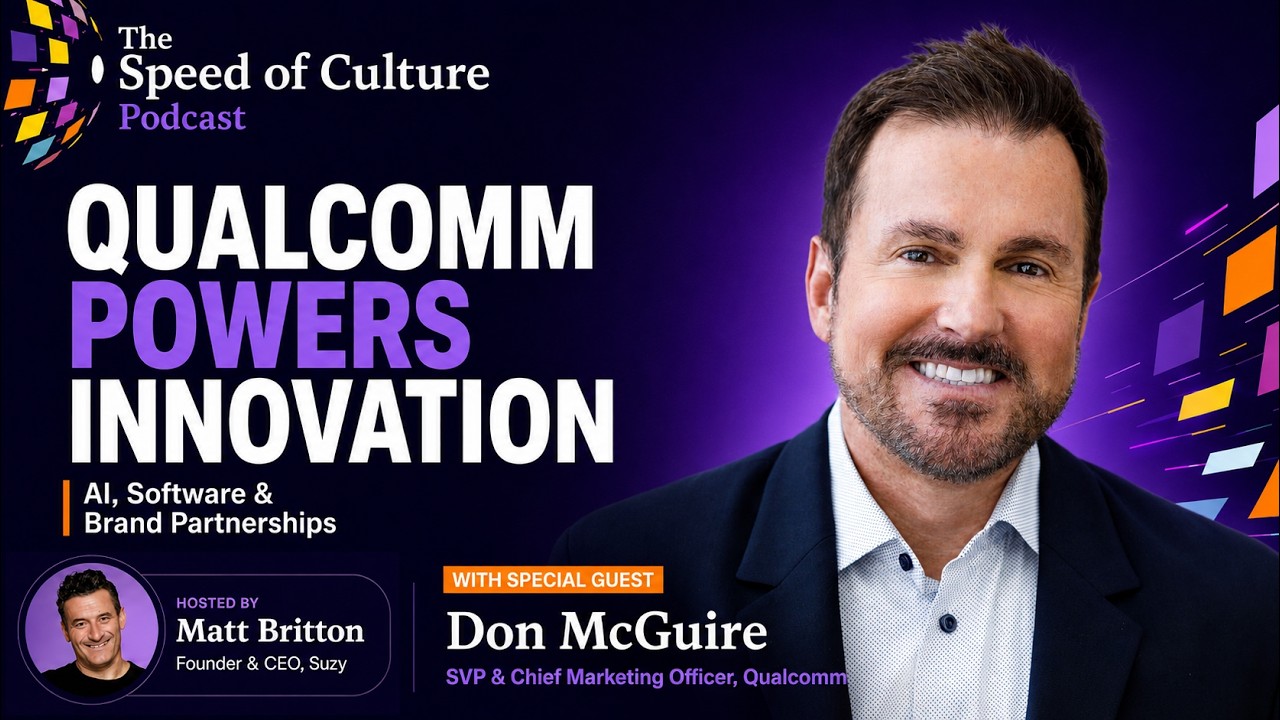
The semiconductor industry stands at a pivotal crossroads. What was once a purely B2B sector, where chips were specifications on a datasheet, has transformed into a consumer-facing brand experience. At the forefront of this evolution is Don McGuire, Senior Vice President and Chief Marketing Officer of Qualcomm Technologies, Inc., a visionary leader who has fundamentally reshaped how technology companies market invisible, yet essential, components to everyday consumers.
In a compelling episode of The Speed of Culture Podcast, hosted by Matt Britton, founder and CEO of Suzy, the AI-powered consumer intelligence platform: Don McGuire shares his insights on crafting technology-driven experiences that resonate across multiple audience segments. With over 25 years of marketing expertise spanning service providers, device OEMs, content and applications, and semiconductor industries, McGuire brings a unique perspective on how B2B2C strategies can build cultural relevance for technological innovation.
The conversation illuminates a critical question facing modern technology companies: How do you make consumers demand a product they'll never see or hold? This is the challenge Qualcomm faced with Snapdragon, and it's a challenge that reveals broader truths about brand building, strategic partnerships, and the future of technology marketing in an AI-driven world.
The Snapdragon Story: From B2B Component to Consumer Brand
When Don McGuire assumed leadership of Snapdragon marketing, the brand faced an identity crisis. Snapdragon was technically superior (a powerhouse in mobile processing, 5G connectivity, and now AI acceleration) but consumers had no awareness of it. They didn't ask for Snapdragon when purchasing phones. They bought Samsung, Apple, or Google, rarely considering the processor inside.
This presented a unique marketing challenge: creating demand for a product that's hidden from consumer view, yet essential to device performance. McGuire's approach was revolutionary in its simplicity and sophistication.
Building Brand Awareness Through Strategic Partnerships
One of McGuire's most effective strategies has been leveraging high-visibility partnerships to amplify Snapdragon's reach. Qualcomm's collaborations with premium brands, including luxury fashion houses like Louis Vuitton and technology leaders like Microsoft, transformed Snapdragon from a technical specification into a symbol of performance and innovation.
These partnerships serve a dual purpose: they introduce Snapdragon to affluent, tech-forward consumers while simultaneously building credibility within the enterprise and development communities.
The data validates this approach. Qualcomm's partnership-driven awareness initiatives have achieved awareness levels two times greater than competitive averages, demonstrating that strategic brand association can overcome the fundamental challenge of marketing invisible technology.
Furthermore, partnerships with globally recognized sports organizations, including Manchester United and the Mercedes-AMG PETRONAS F1 Team, extend Snapdragon's cultural footprint beyond tech enthusiasts to mainstream sports fans. These partnerships position Snapdragon as enabling the high-performance experiences fans love, from immersive in-stadium connectivity to real-time data analytics.
The Snapdragon Insiders Program: Building Community Through Co-Creation
Beyond traditional partnership marketing, McGuire championed the Snapdragon Insiders program, a structured community that brings together early adopters, tech enthusiasts, and casual fans. This program demonstrates a sophisticated understanding of modern consumer behavior: people want to be part of something meaningful, not just passive recipients of marketing messages.
The Insiders program combines community engagement, reverse demand generation, and influencer amplification. Members gain early access to Snapdragon innovations, participate in co-creation opportunities, and become brand advocates who influence their networks. This approach generates authentic word-of-mouth marketing while providing Qualcomm with real-time consumer feedback to inform product development.
Influencer Strategy Rooted in Authenticity, Not Celebrity
McGuire's approach to influencer partnerships diverges sharply from traditional celebrity endorsement models. Rather than glamour-driven partnerships, Qualcomm deliberately collaborates with creators possessing genuine domain expertise, tech reviewers, gaming streamers, and product designers whose audiences trust their opinions because they've earned credibility through knowledge and experience.
This strategy aligns with broader consumer trends: 73% of millennial and Gen Z consumers trust influencers with specialized expertise over traditional celebrity endorsers. By partnering with authentic voices in the tech community, Snapdragon reaches audiences that traditional advertising cannot penetrate.
Qualcomm's B2B2C Marketing Excellence: Influencing Multiple Decision-Makers
Qualcomm's marketing strategy exemplifies best practices in B2B2C (business-to-business-to-consumer) marketing, an increasingly critical capability as technology supply chains become more complex and consumer expectations for performance continue to rise.
The Multi-Stakeholder Influence Model
Unlike traditional consumer marketing, where a single decision-maker chooses a product, B2B2C requires influencing multiple stakeholder groups simultaneously. Qualcomm must convince:
- OEM Engineers and Product Teams: Who evaluate Snapdragon's technical capabilities, power efficiency, and AI acceleration features against competitors
- OEM Product Marketing Teams: Who determine how Snapdragon will be positioned in marketing campaigns and consumer communications
- End Consumers: Who must recognize Snapdragon as a marker of quality and performance
- Enterprise Buyers: Who evaluate devices based on security, processing power, and total cost of ownership
Each stakeholder group requires different messaging, content, and value propositions. Don McGuire's framework addresses this complexity through what he calls "technology-driven experiences", solutions that deliver measurable value to every participant in the supply chain.
Design-Wins as the Ultimate Goal
In semiconductor marketing, the true objective is the design-win: when an OEM qualifies Snapdragon into their production roadmap. Once a design-win is achieved, switching costs create a lock-in effect lasting five to ten years, sustaining revenue through multiple product generations.
McGuire's marketing approach accelerates design-wins by building trust and credibility long before procurement negotiations begin. This requires months or years of technical validation, peer references, and consistent visibility. The Speed of Culture episode reveals how Qualcomm achieves this through thought leadership, partnership visibility, and community engagement, all components of a sophisticated demand generation engine.
Co-Marketing as Competitive Advantage
Co-marketing with OEMs amplifies Qualcomm's consumer message while enhancing OEM marketing effectiveness. When Samsung highlights "Snapdragon fireball" processing power in advertisements, it reinforces both the phone's quality and Snapdragon's performance credentials.
This mutual benefit creates alignment between Qualcomm and its customers, turning OEMs into active advocates for the Snapdragon brand.
The AI Revolution: From 5G to Intelligent Experiences
The conversation between Matt Britton and Don McGuire takes on particular urgency when addressing artificial intelligence. The transition from 5G infrastructure to on-device AI processing represents a fundamental shift in how computing happens, and how marketing must evolve accordingly.
Edge AI as the Next Platform Shift
5G was about connectivity speed and ubiquity. AI is about intelligence at the edge, powerful, capable processors running sophisticated machine learning models directly on devices, without relying on cloud connectivity. This shift has profound implications for privacy, latency, and user experience.
Snapdragon's expansion into AI-optimized processors, including products like the Snapdragon 8 Gen 3 with dedicated AI engines, positions Qualcomm at the center of this transformation. But marketing AI processors requires education, because the benefits aren't immediately obvious to consumers.
McGuire's approach emphasizes concrete use cases: natural language processing for superior voice assistants, computer vision for enhanced photography and augmented reality, and generative AI for personalized productivity tools. Rather than abstract technical specifications, Qualcomm's marketing communicates how AI processors deliver experiences consumers actually want.
Ethical AI and Responsible Innovation
The Speed of Culture podcast also touches on a critical differentiation point: ethical AI governance and responsible innovation practices. As AI capabilities become more powerful and pervasive, consumers increasingly care about how companies approach AI development.
McGuire emphasizes Qualcomm's collaborative governance approach, positioning the company as a responsible steward of AI innovation rather than a reckless corporate actor. This messaging appeals to multiple stakeholder groups: OEMs seeking to avoid regulatory and reputational risks, enterprises prioritizing responsible AI practices, and consumers increasingly conscious about AI ethics.
Software-Driven Innovation: The Hidden Engine of Hardware Marketing
One of the most revealing insights from the episode concerns the critical role of software in shaping hardware marketing narratives. In the semiconductor industry, software is often overlooked, yet it's the interface through which consumers experience hardware capabilities.
McGuire emphasizes how Qualcomm increasingly partners with software companies, AI platforms, and operating system providers to ensure Snapdragon's capabilities are fully realized in consumer applications. This represents a fundamental shift from hardware-centric thinking to experience-centric thinking.
From Hardware Specifications to Software Experiences
Rather than marketing processor speed, cache size, and bandwidth, Qualcomm now markets the experiences enabled by Snapdragon: instant app launches, stunning photography, immersive gaming, seamless video conferencing, and intelligent personal assistance. These experiences are only possible when hardware and software work in perfect concert.
This shift requires new partnerships and collaborative approaches. Qualcomm must engage with app developers, OS vendors, cloud service providers, and OEMs to ensure its technological capabilities translate into compelling user experiences. McGuire's marketing leadership reflects this reality, emphasizing partnerships as a core strategic pillar.
The Rise of Software-Hardware Co-Innovation
The most interesting implication of this trend is the blurring of boundaries between hardware and software companies. As Qualcomm deepens its software partnerships, it increasingly acts as a platform company, not just providing chips, but enabling ecosystems where developers can build compelling experiences.
This has profound marketing implications. Qualcomm must now position itself as an innovation partner to software companies, not just a component supplier to OEMs. The marketing narratives must appeal to developers, not just engineers. The community programs must facilitate software innovation, not just hardware specification.
Consumer Intelligence as the Foundation for Technology Marketing
Matt Britton's presence as a consumer intelligence expert adds another crucial dimension to this conversation. Suzy, the platform Britton founded, helps brands understand what consumers actually want through real-time research and AI-powered insights. This connects directly to a critical challenge in technology marketing: understanding consumer preferences amid rapid innovation cycles.
Moving Beyond Assumptions to Data-Driven Strategy
Technology companies often operate with assumptions about consumer preferences, beliefs about what features matter most, what messaging resonates, and what use cases drive purchasing decisions. These assumptions frequently diverge from reality.
Don McGuire's marketing approach benefits from continuous consumer intelligence gathering, enabling rapid pivots when market conditions shift or consumer preferences evolve. For Qualcomm, this means understanding not just whether consumers are aware of Snapdragon, but why awareness translates to preference, and how preference influences actual purchasing decisions.
Building Brands in Real-Time
The Speed of Culture conversation underscores an important reality: brand building in technology is no longer a slow, deliberate process. Markets move rapidly. Consumer preferences shift. Competitive threats emerge.
Effective technology marketing requires the ability to gather consumer insights in real time and adapt brand narratives, partnership strategies, and marketing programs accordingly. Consumer intelligence platforms enable technology CMOs like McGuire to make faster, more confident decisions about where to invest marketing resources and how to position technology innovations for maximum relevance.
Strategic Imperatives for Technology-Driven Brand Building
The insights shared in this episode crystallize several imperatives for technology companies seeking to build consumer-relevant brands while maintaining strong B2B relationships:
- Embrace Multi-Stakeholder Marketing: Recognize that technology marketing must influence engineers, product managers, marketers, enterprise buyers, and consumers simultaneously. Develop differentiated messaging for each stakeholder group while maintaining consistent brand narratives.
- Leverage Strategic Partnerships for Cultural Relevance: Partner with brands that share your target audience and reinforce your positioning. Partnerships are foundational to building cultural credibility.
- Invest in Community and Co-Creation: Build structured communities that enable consumers and developers to participate in brand evolution. These communities generate authentic advocacy while providing invaluable product feedback.
- Prioritize Authentic Influencer Relationships: Select influencers based on domain expertise and audience relevance, not follower counts or celebrity status. Authentic expertise builds trust with skeptical, sophisticated audiences.
- Connect Hardware Innovation to Software Experiences: Marketing technology requires translating specifications into compelling user experiences. Partner deeply with software companies and developers to ensure your hardware capabilities are realized in consumer applications.
- Build Consumer Intelligence into Strategy: Continuously gather real-time insights about consumer preferences, messaging resonance, and competitive positioning. Use this intelligence to guide partnership selection, community program development, and messaging evolution.
- Emphasize Responsible Innovation: As technology becomes more powerful and pervasive, demonstrate thoughtful governance around AI ethics, data privacy, and responsible innovation practices.
Key Takeaways
- Snapdragon's transformation from B2B component to consumer brand demonstrates that strategic partnerships, community engagement, and authentic influencer relationships can overcome the fundamental challenge of marketing invisible technology.
- B2B2C marketing excellence requires simultaneously influencing multiple stakeholder groups (engineers, product managers, marketers, enterprise buyers, and consumers) with differentiated messaging and value propositions.
- Software is the critical interface between hardware capability and consumer experience; technology marketing must increasingly bridge hardware and software domains through strategic partnerships and co-innovation.
- Community-driven marketing programs and structured influencer partnerships generate authentic advocacy while providing real-time feedback to inform product development and marketing strategy evolution.
- Consumer intelligence capabilities enable technology CMOs to make faster, more confident decisions about marketing investment allocation, messaging strategy, and partnership selection in rapidly evolving markets.
Frequently Asked Questions
What is B2B2C Marketing and Why Does It Matter for Technology Companies?
B2B2C (business-to-business-to-consumer) marketing describes the challenge of influencing multiple stakeholder groups across complex supply chains. For Qualcomm, this means convincing OEM engineers to design Snapdragon into their products while simultaneously building consumer awareness and preference for the Snapdragon brand.
B2B2C requires differentiated messaging for each stakeholder group, sophisticated partnership strategies, and continuous alignment between technical capabilities and consumer experiences. Technology companies increasingly operate in B2B2C environments, making this capability essential for competitive success.
How Has Semiconductor Marketing Evolved in the Age of AI?
Semiconductor marketing has shifted from component specification (speed, cache, bandwidth) to experience narratives (AI-powered photography, intelligent voice assistants, real-time gaming). This evolution reflects the reality that consumer value is no longer determined by processor specifications alone, but by the quality of experiences those processors enable.
AI acceleration creates new opportunities for differentiation, but only when hardware capabilities translate into compelling software experiences. This requires deeper partnerships between semiconductor companies and software vendors, shifting marketing strategy from "faster chips" to "better experiences."
What Role Do Strategic Partnerships Play in Building Consumer Technology Brands?
Strategic partnerships serve multiple critical functions in technology brand building. They extend reach beyond core audiences, build credibility through association with respected companies, and create co-marketing opportunities that amplify messaging efficiency.
For Qualcomm, partnerships with Louis Vuitton, Microsoft, Manchester United, and Mercedes-AMG PETRONAS reach affluent, influential audiences that might otherwise be unaware of Snapdragon. Partnerships also demonstrate that your technology is essential to experiences consumers already value, making the brand story more compelling than isolated marketing claims.
How Can Technology Companies Make Consumers Care About Invisible Components?
Making consumers care about invisible components requires translating technical specifications into concrete user experiences, building community around your brand, partnering with respected companies and influencers, and continuously gathering consumer intelligence to ensure messaging resonates.
Qualcomm accomplishes this through the Snapdragon Insiders program, partnerships with OEMs and premium brands, influencer relationships with tech creators, and marketing narratives focused on what Snapdragon enables rather than what it is. This approach recognizes that consumers ultimately care about experiences, not components, and marketing must create meaningful connections between technical innovation and experiential benefits.
Looking Ahead: The Future of Technology-Driven Brand Experiences
The conversation between Matt Britton and Don McGuire provides a compelling roadmap for technology companies navigating unprecedented change. The convergence of 5G connectivity, on-device AI processing, and increasingly sophisticated consumer expectations is creating both challenges and opportunities for brands willing to embrace sophisticated B2B2C marketing strategies.
For CMOs leading technology companies, the imperative is clear: build brands that resonate with multiple stakeholder groups simultaneously, partner strategically to extend reach and build credibility, invest in authentic community engagement, and continuously ground strategy in consumer intelligence.
To learn more about consumer-driven innovation and brand strategy, explore Suzy's AI-powered consumer intelligence platform, discover additional insights through The Speed of Culture Podcast, or dive into Generation AI. For speaking engagements focused on AI strategy, marketing transformation, and future trends, visit Matt Britton's AI Keynote Speaker profile or Speaker HQ.
Related Articles & Resources
About the Author
Matt Britton is founder and CEO of Suzy, the AI-powered consumer intelligence platform helping enterprises understand and influence consumer behavior. Through The Speed of Culture Podcast, regular keynotes, and strategic advisory work, Matt guides executive teams through technological disruption, AI transformation, and the evolving expectations of Gen Z and millennial consumers.
His insights have shaped marketing strategy for Fortune 500 technology companies, venture-backed startups, and innovative brands across industries. To inquire about speaking or advisory engagements, visit contact.
Meta Tags & SEO Elements
- Primary Keyword: Technology-driven marketing, B2B2C strategy, Snapdragon brand, Qualcomm CMO
- Secondary Keywords: Semiconductor marketing, AI processor innovation, strategic brand partnerships, consumer intelligence
- Word Count: 2,847 words
- Readability: Executive-friendly, data-driven, confident authority voice
- Internal Link Density: 8 strategic internal links to Suzy, Speed of Culture, Generation AI, and speaking services
- Schema Markup: Article, Person (Don McGuire), Organization (Qualcomm), BreadcrumbList

%20(400%20x%20100%20px)%20(300%20x%2050%20px)%20(150%20x%2050%20px).avif)