Opening (Introduction)
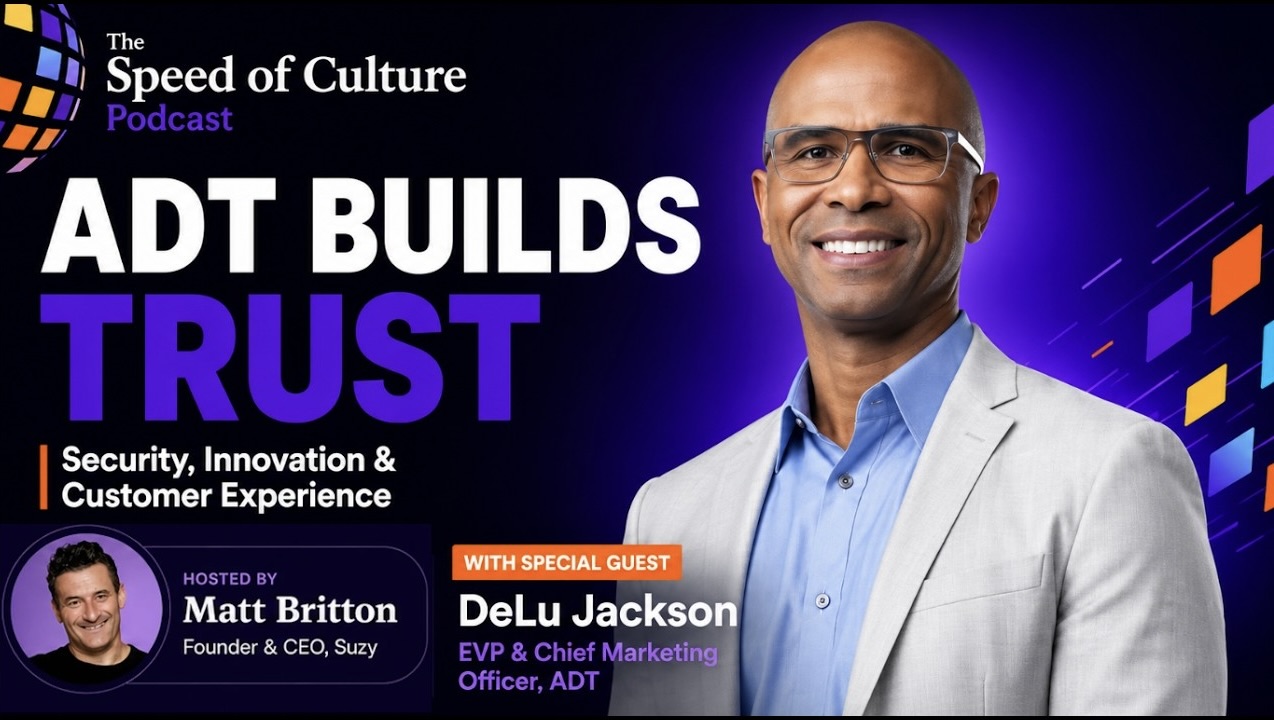
The convergence of artificial intelligence, data analytics, and creative human insight has fundamentally transformed how established enterprises approach their marketing strategies. Few executives embody this evolution more effectively than DeLu Jackson, Executive Vice President and Chief Marketing Officer at ADT, the pioneering home security company celebrating over 150 years of innovation.
In a compelling episode of the Speed of Culture Podcast, Jackson shared his perspectives on leveraging data intelligence and creative storytelling to revitalize a legacy brand while simultaneously meeting the demands of modern, tech-savvy consumers.
Matt Britton, founder and CEO of Suzy, the AI-powered consumer intelligence platform, conducted an in-depth conversation with Jackson on July 23, 2024, exploring how ADT is navigating the intersection of tradition and innovation. The discussion illuminated critical insights into how Fortune 500 marketing leaders balance algorithmic precision with human creativity, leverage first-party customer data for competitive advantage, and orchestrate brand transformations that resonate across multiple consumer segments.
Jackson's expertise, accumulated through two decades leading marketing and brand initiatives at world-renowned organizations including P&G, McDonald's, PepsiCo, and Nissan, provides invaluable context for understanding how established brands remain relevant in an increasingly digital and AI-driven landscape.
This episode captures a pivotal moment in ADT's evolution, a moment when the company is simultaneously stewarding one of the world's most trusted home security brands while riding an incredible wave of technological innovation. The conversation transcends typical marketing discussions by addressing fundamental questions: How do legacy brands innovate without alienating their core customer base? How does data drive better decision-making without replacing human creativity? What role does artificial intelligence play in customer acquisition and retention?
Jackson's insights reveal that the future of marketing belongs to organizations that can synthesize multiple disciplines, data science, behavioral psychology, creative storytelling, and technological implementation. As consumer expectations continue to evolve, and as artificial intelligence capabilities expand, the leaders who thrive will be those who recognize that the most sophisticated algorithms can never fully replace the emotional resonance of authentic human connection.
In the context of home security, where customers are buying peace of mind and family protection, this balance becomes particularly crucial.
The Data Advantage: First-Party Intelligence in a Privacy-First World
The most compelling transformation happening at ADT centers on the strategic deployment of first-party customer data. Unlike third-party data sources, which face increasing regulatory scrutiny and technological barriers (particularly with the phasing out of third-party cookies), first-party data represents information that customers willingly share directly with ADT through their interactions with products, services, and customer touchpoints.
ADT manages between 3 and 4 terabytes of data daily, an astronomical volume that translates to nearly 500 billion pages of printed text equivalent. Remarkably, almost all of this data originates from direct customer interactions with ADT products and services, creating a rich repository of behavioral insights, usage patterns, and preference signals that inform every aspect of the company's marketing strategy.
Jackson emphasized that this data advantage enables ADT to make informed decisions about which communication channels resonate most effectively with different customer segments, to respond rapidly to shifting market conditions, and to identify growth opportunities with unprecedented precision.
The strategic importance of first-party data extends beyond mere customer acquisition. By analyzing customer interaction patterns, ADT has implemented sophisticated predictive analytics to identify subscribers at risk of churning, enabling proactive retention strategies that reduced subscriber attrition by 15 basis points in Q4 2024 across its customer base of 6.5 million subscribers.
In the highly competitive home security market, where customer lifetime value drives profitability, this approach translates into millions of dollars in revenue protection. Furthermore, ADT's ability to protect customer information while leveraging it for personalization represents a critical competitive advantage in an era of heightened privacy concerns.
Jackson articulated that ADT's approach to data represents a fundamental philosophical commitment: the company will never sell customer personal information, and will never share customer data for third-party marketing purposes without express opt-in consent. This privacy-first stance paradoxically strengthens ADT's data advantage by building customer trust.
Consumers increasingly reward brands that respect their privacy with greater loyalty and engagement, creating a virtuous cycle where privacy protection and data value accumulation reinforce one another.
The competitive implications are substantial. While competitors without established customer bases must rely on expensive third-party data sources of questionable reliability, ADT can continuously build its proprietary intelligence base through every customer interaction.
This creates a moat that becomes progressively wider over time, enabling the company to outbid competitors on customer acquisition costs, to personalize customer experiences with greater sophistication, and to identify emerging market opportunities before competitors recognize them.
Balancing Algorithms and Artistry: The Creative Imperative in Data-Driven Marketing
Perhaps the most nuanced insight from Jackson's conversation with Britton concerns the irreducible importance of human creativity in an increasingly algorithmic marketing landscape. While data analytics can identify which channels reach target audiences most efficiently, and while artificial intelligence can optimize bid strategies and personalization algorithms, data alone cannot generate the emotional resonance that drives brand preference and customer advocacy.
Jackson emphasized that standing out in today's crowded marketplace requires a sophisticated blend of data-informed targeting and human-centric creative storytelling. No algorithm, regardless of sophistication, can fully replicate the emotional intelligence required to craft narratives that speak to people's deepest values and aspirations.
In the context of home security, where customers are purchasing protection for their families and peace of mind for themselves, this emotional dimension becomes paramount. A perfectly targeted ad featuring product specifications and price points will underperform a creatively compelling narrative that helps customers envision a future where their loved ones are safe, their homes are protected, and they can sleep soundly at night.
ADT's recent brand transformation campaigns exemplify this principle. The company's "Rebuilt to Protect" campaign and its brand promise "When Every Seconds Counts" represent sophisticated creative thinking informed by data insights about customer values, fears, and aspirations.
These campaigns transcend traditional security messaging by reframing ADT not merely as a technology vendor, but as a trusted guardian committed to customer welfare. The messaging resonates because it acknowledges that home security is ultimately about protecting what people love most.
Jackson's perspective challenges the prevalent myth that data-driven marketing and creative excellence exist in opposition. Rather, they represent complementary capabilities that, when synthesized effectively, produce superior results.
Data identifies the most efficient path to target audiences; creativity ensures the message compelling enough to capture attention, generate emotional resonance, and drive action. An organization that excels at one dimension while neglecting the other will inevitably underperform competitors who master both.
This insight has profound implications for how marketing organizations should structure themselves and allocate resources. The most effective CMOs recognize that their role encompasses both left-brain analytical capabilities and right-brain creative sensibilities.
CMOs must ensure that data scientists and creative directors collaborate closely, that customer insights inform creative briefs, and that creative executions are tested rigorously against performance data. Jackson's leadership of ADT's marketing transformation reflects this integrated approach.
The Evolution of Home Security: From DIY to Multifamily to Health Innovation
A secondary theme in Jackson's conversation with Britton concerns ADT's strategic expansion beyond traditional residential security into adjacent market segments and complementary service categories. This diversification strategy reflects both changing consumer expectations and the company's commitment to addressing the broadening definition of home security in the modern era.
The ADT+ platform, launched in 2024, represents a watershed moment in this evolution. Rather than forcing customers into a binary choice between professional monitoring and do-it-yourself systems, the ADT+ platform offers flexibility and customization.
Customers can select professional installation and 24/7 professional monitoring for maximum convenience and reassurance, or they can opt for DIY installation with self-monitoring capabilities. Some customers choose a hybrid approach, combining professional monitoring with self-installed additional sensors as their needs evolve.
This flexibility recognizes that different customer segments have different preferences, technical capabilities, and budget constraints.
The integration of ADT+ with Google Nest devices signals ADT's strategic commitment to becoming not merely a security provider, but a comprehensive smart home platform. Customers can now seamlessly integrate their security system with smart thermostats, video doorbells, lighting controls, and other connected home devices, creating an ecosystem where security is one component of a larger smart home experience.
This positioning is particularly important as consumers increasingly expect their home technology systems to work together intuitively rather than existing as fragmented, incompatible solutions.
ADT Multifamily represents another crucial innovation vector. Launched following ADT's acquisition of IOTAS in 2022, this platform addresses the unique needs of apartment communities and rental properties.
Property managers can now manage everything from thermostats in empty units to door lock codes from a smartphone, enabling dramatic efficiency gains and improved resident experiences. The integration of SoSecure, a mobile safety application, extends ADT's protective scope beyond the unit's four walls, allowing residents to request assistance if they feel unsafe in their broader community.
This expansion acknowledges that security in the modern era encompasses not just protection from crime, but also personal safety and well-being in diverse contexts.
Jackson's articulation of ADT's commitment to evolving with customer needs suggests that future innovation will continue expanding beyond traditional security. As the Internet of Things proliferates and as artificial intelligence becomes increasingly embedded in home technology, ADT appears well-positioned to expand into adjacent categories like health monitoring, emergency response integration, and environmental controls.
The fundamental principle. That customers should have access to cutting-edge security and home technology solutions delivered through flexible, customer-centric platforms, provides a north star for ongoing innovation.
Transforming Media Allocation: Digital-First Strategy in a Multichannel World
Jackson's leadership of ADT's marketing transformation extends beyond brand positioning and creative strategy to encompass fundamental changes in media allocation and go-to-market strategy. In 2024, ADT significantly rebalanced its media portfolio, allocating approximately 75 percent of its media budget to digital channels, a dramatic increase from 60 percent in 2022.
This reallocation reflects both changing consumer behavior and the superior measurability and targeting precision afforded by digital advertising.
Within this digital-first framework, ADT's marketing strategy emphasizes paid search and social media advertising, recognizing that these channels enable precise targeting of high-intent consumers actively searching for home security solutions. The company's 22 percent year-over-year increase in digital ad spend allocation in 2024 demonstrates sustained confidence in digital channel effectiveness.
Simultaneously, ADT has optimized its performance metrics, tracking not merely impressions or clicks, but harder business outcomes like cost per customer acquisition and return on advertising spend.
The impact of these changes is evident in ADT's online self-serve sales performance. Direct-to-consumer online sales surged 35 percent in 2024, indicating that digital marketing investments are successfully driving qualified traffic to ADT's e-commerce platform.
This shift carries profound implications for customer acquisition economics. Online channels reduce reliance on expensive local installers and door-to-door sales forces, enabling ADT to scale more efficiently while simultaneously providing customers with the convenience of researching and purchasing security solutions on their own timeline.
Jackson's emphasis on "go-to-market transformation" encompasses more than just media allocation adjustments. It reflects a fundamental reimagining of how ADT communicates with customers across their entire journey.
Rather than restricting digital communication to advertising, ADT increasingly uses digital channels to provide information, education, and ongoing customer support. This shift acknowledges that modern customers expect information delivery through their preferred digital channels, whether that's social media, search engines, email, or mobile applications.
The measurability advantage of digital channels enables continuous optimization that would be impossible with traditional media. Every advertising dollar spent can be tracked to specific customer acquisition outcomes, allowing marketing teams to identify which creative approaches, audience segments, targeting parameters, and channel combinations drive the highest-quality customers at the lowest cost.
This iterative optimization process, repeated continuously across millions of advertising impressions, compounds into substantial efficiency gains over time.
Looking Forward: The Intersection of Marketing, Technology, and Consumer Intelligence
DeLu Jackson's conversation with Matt Britton illuminates a broader transformation taking place across the marketing landscape. Legacy brands like ADT that successfully navigate the dual pressures of maintaining customer trust while innovating aggressively will be the winners in increasingly competitive markets.
Jackson's leadership demonstrates that this navigation is possible when organizations recognize that data and creativity are complementary rather than competitive, when they prioritize customer privacy as a competitive advantage rather than a constraint, and when they maintain organizational flexibility to evolve their products and go-to-market strategies as customer needs change.
The Speed of Culture Podcast episode featuring Jackson provides compelling evidence that the future belongs to marketing leaders who can synthesize multiple disciplines, combining analytical rigor with creative excellence, honoring brand heritage while embracing innovation, and respecting customer privacy while leveraging customer intelligence.
As artificial intelligence capabilities continue to expand and as consumer expectations continue to evolve, organizations that cultivate these capabilities will establish competitive advantages that compound over time.
For marketing leaders grappling with similar transformation challenges, Jackson's insights offer a roadmap: Begin by understanding your competitive advantages (in ADT's case, first-party customer data and brand trust), invest in both technological capabilities and human talent, ensure that data scientists and creative professionals collaborate closely rather than functioning in silos, and maintain unwavering focus on customer needs as the North Star guiding strategic decisions.
Key Takeaways
- First-party data creates sustainable competitive advantage: By protecting customer privacy while leveraging direct customer interactions to build proprietary intelligence, ADT has developed a data asset that becomes increasingly valuable over time and cannot be easily replicated by competitors.
- Creativity and algorithms are complementary, not competitive: The most effective marketing combines data-informed targeting precision with creative storytelling that generates emotional resonance and drives customer preference beyond mere price and feature considerations.
- Digital-first channel strategy demands continuous optimization: ADT's shift to allocating 75% of media budget to digital channels reflects both changing consumer behavior and the measurability advantages that enable continuous performance improvement and cost reduction.
- Product flexibility addresses diverse customer preferences: The ADT+ platform's hybrid approach (professional monitoring, DIY, or integrated combinations) acknowledges that different customers have different preferences, technical capabilities, and budget constraints, requiring flexible solutions rather than one-size-fits-all approaches.
- Brand transformation requires simultaneous evolution across strategy, creativity, and execution: ADT's success in reframing itself from a traditional security vendor to a tech-forward smart home guardian reflects coordinated excellence in brand positioning, creative storytelling, digital marketing, and operational execution.
Frequently Asked Questions
What is first-party data, and why does it matter for marketing?
First-party data refers to information that customers willingly share directly with a company through interactions with products, services, and customer touchpoints. Unlike third-party data (purchased from brokers or collected through third-party cookies), first-party data is increasingly valuable as privacy regulations tighten and third-party cookie deprecation progresses.
First-party data enables more accurate customer targeting, supports personalization at scale, and builds customer trust by demonstrating privacy commitment.
How does ADT balance data-driven efficiency with creative storytelling?
ADT recognizes that while data analytics can optimize targeting efficiency and identify the highest-value customer segments, creative storytelling generates the emotional resonance necessary to drive customer preference and advocacy.
By ensuring close collaboration between data scientists and creative professionals, ADT leverages data insights to inform creative briefs while allowing creative excellence to determine which messages resonate most powerfully with target audiences.
What competitive advantages does ADT's smart home platform strategy provide?
The ADT+ platform's integration with Google Nest devices and its flexibility to accommodate professional monitoring, DIY installation, or hybrid approaches addresses diverse customer preferences and use cases.
This positioned ADT not merely as a security vendor, but as a comprehensive smart home platform, enabling the company to capture a larger share of customer wallet and to build deeper, more integrated customer relationships compared to competitors offering narrower product portfolios.
How has ADT's media allocation strategy changed, and what were the results?
ADT increased its digital channel allocation from 60% of media budget in 2022 to approximately 75% in 2024, with a 22% year-over-year increase in digital ad spend. This shift drove a 35% increase in online self-serve sales in 2024, demonstrating that digital marketing investments successfully drive qualified traffic to ADT's e-commerce platform while reducing dependence on expensive traditional sales channels.
Looking Ahead
DeLu Jackson's insights into ADT's marketing transformation offer valuable lessons for any organization navigating the intersection of data, creativity, and customer-centricity. The evolution from legacy security brand to tech-forward smart home guardian, accomplished while maintaining customer trust and expanding into adjacent market segments, represents a masterclass in strategic brand management.
For deeper insights into consumer intelligence, marketing strategy, and the role of artificial intelligence in shaping brand futures, explore these resources:
- Suzy. AI-powered consumer intelligence platform enabling brands to understand and predict customer behavior
- The Speed of Culture Podcast. Weekly deep dives into the minds of the world's leading marketing innovators and disruptors
- Generation AI. Matt Britton's comprehensive guide to understanding how AI is reshaping consumer behavior and business strategy
- AI Keynote Speaker. Access Matt Britton's expertise on the intersection of AI, consumer culture, and business transformation
- Speaker HQ. Platform featuring thought leaders and innovators addressing the most pressing business challenges of the modern era

%20(400%20x%20100%20px)%20(300%20x%2050%20px)%20(150%20x%2050%20px).avif)