November 7, 2023
OLIPOP's Meteoritic Rise and the Future of Healthy Sodas with Co-Founder, David Lester
David Lester
Co-Founder
This is some text inside of a div block.
This is some text inside of a div block.
LISTEN ANYWHERE YOU FIND YOUR PODCASTS
%20(400%20x%20100%20px)%20(300%20x%2050%20px)%20(150%20x%2050%20px).avif)

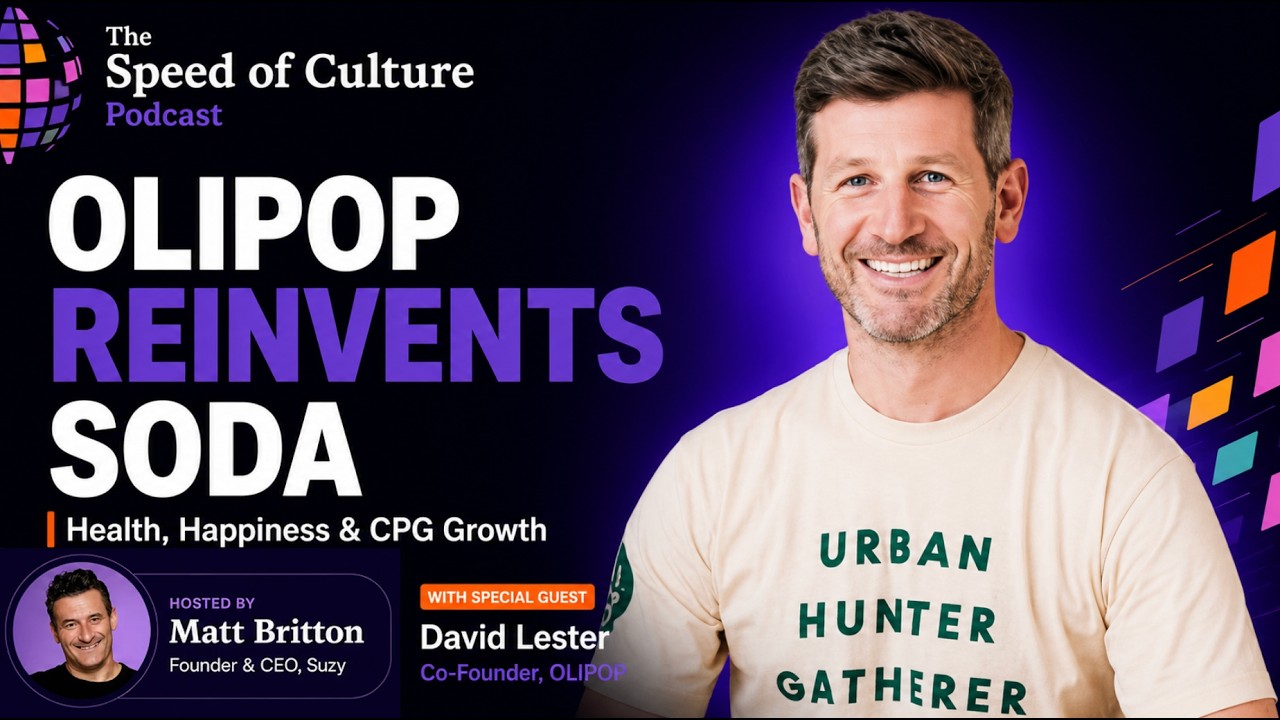
In the fast-paced world of consumer goods, few brands have disrupted entire categories as thoroughly as OLIPOP. In episode 77 of The Speed of Culture Podcast, Matt Britton, founder and CEO of Suzy, the AI-powered consumer intelligence platform, sat down with David Lester, co-founder of OLIPOP, to explore how a prebiotic soda brand captured the imagination, and consumer wallets, of millions seeking healthier beverage alternatives.
The conversation took place on November 7, 2023, and offered compelling insights into the meteoric rise of a brand that proved soda doesn't have to choose between taste and wellness. In just five years, OLIPOP scaled from startup vision to national distribution across major retail chains including Walmart and Target, achieving a valuation that reflects the market’s hunger for innovative, health-conscious alternatives.
Before launching OLIPOP, David Lester accumulated nearly a decade of experience in global brand marketing and innovation at some of the world’s most legendary beverage and spirits companies. His resume includes stints working with industry titans like Smirnoff, Gordon’s Gin, and Johnnie Walker, brands that shaped modern consumer preferences and marketing strategies.
Beyond OLIPOP, Lester co-founded Biome Body, a research venture focused on the intersection of health, science, and consumer behavior. This dual entrepreneurial focus reveals a leader deeply committed to understanding and solving real consumer problems.
The rise of OLIPOP reflects a broader shift in consumer preferences. Today’s “Happy Seekers” a term Lester uses to describe consumers mindful of their health and well-being when making purchase decisions, represent a demographic willing to pay premium prices for products that deliver both pleasure and purpose.
The global functional beverage market has experienced explosive growth, with healthy soda segments climbing double-digit percentages annually. OLIPOP’s success demonstrates that innovative founders who genuinely understand consumer psychology and market dynamics can not only enter saturated categories but transform them.
This episode of The Speed of Culture Podcast, presented in collaboration with Adweek, captures a pivotal moment in beverage industry evolution. For entrepreneurs, marketers, and brand strategists, Lester’s insights offer a masterclass in product innovation, consumer insight, and scaling a direct-to-consumer business in a hyper-competitive marketplace.
Creating and launching a soda brand requires far more than experimenting with flavors in a test kitchen. As David Lester emphasizes, successful beverage launches begin with a clear, compelling vision of what you intend to create.
For OLIPOP, the vision centered on a paradox: How can consumers enjoy the sensory pleasure of soda (the bubbles, the taste, the ritual) while supporting their health and wellness goals? This question became the north star guiding every product decision, from formulation to packaging.
Once the product foundation is established, selecting a name that can evolve into a comprehensive brand story becomes critical. OLIPOP’s name conveys simplicity and sophistication simultaneously.
It subtly references “oligosaccharides” the prebiotic fibers at the core of the product, while remaining accessible and memorable to mass-market consumers. The naming strategy reflects intentional brand architecture: memorable enough for retail shelves, sophisticated enough for Instagram, and functional enough to communicate unique positioning.
Lester breaks down the operational complexity that often intimidates first-time beverage entrepreneurs. Successful brands must orchestrate multiple moving parts as an integrated system:
A brilliant formula means nothing without compelling packaging. Stunning packaging fails without reliable distribution. And all of it requires capital from investors who believe in the vision.
What emerges from Lester’s narrative is a clear-eyed pragmatism about business fundamentals. Success demands the intersection of three elements: vision (the “why”), passion (the emotional fuel), and strategy (the operational roadmap).
Many founders excel at one or two. The exceptional ones integrate all three from day one.
Scaling a beverage brand is fundamentally a capital allocation challenge. Unlike software companies that can scale through pure code distribution, beverages require physical manufacturing, refrigerated logistics, and retail shelf space.
Lester reveals that the first fundraising round is invariably the hardest. Early-stage investors must believe in a vision not yet validated by market traction. By the second and third rounds, successful early metrics make investor conversations easier.
However, each round brings new strategic considerations: Who are you bringing into your cap table? What expertise and networks do they provide beyond capital? How will their expectations shape company culture and decision-making?
By year five of operations, OLIPOP achieved what many beverage brands consider the holy grail: national distribution in major retail chains. Securing shelf space at Walmart and Target represents validation from the world’s most sophisticated retail operators.
That OLIPOP, an independent brand, captured shelf space in a category long dominated by Coca-Cola and PepsiCo speaks to genuine disruption. Retailers recognized that consumer preferences were shifting meaningfully and chose to lead rather than follow.
Lester emphasizes maintaining a balanced view of business achievements while avoiding societal benchmarks. In the Instagram age, founders often use external metrics (valuation milestones, funding rounds, celebrity endorsements) to validate their work.
Yet sustainable success requires intrinsic measures: Are we solving the consumer problem we identified? Are we building healthy unit economics? Are our team members engaged and growing?
A brand can achieve rapid growth and still be fundamentally unhealthy if built on unsustainable economics or burnout culture. OLIPOP’s sustained growth suggests those lessons were internalized early.
Few entrepreneurs navigate today’s media landscape without confronting pressure to perform success before genuine success is achieved. Lester notes that young entrepreneurs often allocate resources toward polishing the appearance of success rather than investing in sustainable growth.
Social proof matters. A brand with hundreds of thousands of followers signals legitimacy. But when resources flow disproportionately toward optics instead of product development and operational excellence, the foundation becomes unstable.
Lester’s observation about authentic journeys and self-worth offers a profound takeaway. Entrepreneurs with genuine self-worth can tolerate ambiguity, criticism, and setbacks.
True success is about the value you offer and the lessons learned, not the valuation, not the Instagram followers, not the press mentions.
When a brand improves consumer health outcomes, provides meaningful employment, and creates products people genuinely love, that’s the foundation of sustainable success.
Lester argues that surrounding yourself with genuine support (mentors, advisors, authentic peers) counters the psychological pressures of social media. Real relationships provide grounding that no number of followers can match.
OLIPOP’s positioning around Happy Seekers reflects this philosophy. The community centers on shared values, health-conscious living, rather than manufactured lifestyle aspirations.
The concept of the Happy Seeker became the lens through which every OLIPOP decision was filtered. Many brands attempt broad appeal. OLIPOP chose precision.
Happy Seekers are health-conscious without being obsessive. They value wellness but refuse to sacrifice joy. They read ingredient labels yet don’t want their social lives to revolve around optimization.
Happy Seekers skew younger, female-leaning, and urban-to-suburban. They are digitally native, value transparency, and seek functional beverages with tangible health benefits.
Industry data shows prebiotic beverages and functional sodas have grown at 15–20% compound annual growth rates, while traditional soda volume has declined. This is genuine category creation driven by emerging values.
OLIPOP’s mission, ensuring no one misses out on the joy of soda while maintaining health standards, positions the brand not as a compromise but as innovation.
As highlighted on The Speed of Culture Podcast, successful brands navigate cultural shifts by building ahead of them. OLIPOP understood the direction of change and built accordingly.
The Happy Seeker framework offers lessons beyond beverages. Identify which consumer segment incumbents fail to address. Understand their values deeply. Build a complete brand optimized for that segment rather than attempting universal appeal.
While OLIPOP secured retail distribution, its growth reflects a strong direct-to-consumer (DTC) strategy. DTC provides multiple advantages for emerging beverage brands:
Retail did not replace DTC, it complemented it. Retail creates awareness and trial at scale, while DTC captures repeat purchase and deeper engagement.
This hybrid model has become standard for successful emerging CPG brands.
Securing shelf space requires delivering value to retailers. OLIPOP likely demonstrated strong turns per week, attractive margins, and traffic-driving potential.
DTC success provided proof of demand, strengthening retail negotiations.
OLIPOP focuses on prebiotic ingredients supporting digestive health while preserving the ritual of soda. The brand targets Happy Seekers rather than mass appeal and emerged at a time when health-conscious consumers reached critical mass.
Experience with Smirnoff, Gordon’s, and Johnnie Walker provided expertise in brand architecture, consumer psychology, premium positioning, and operational scale, directly applicable to functional beverages.
By focusing on premium, health-focused, or niche segments where willingness-to-pay justifies smaller production volumes. OLIPOP’s prebiotic positioning reflects this strategy.
DTC provides customer data, innovation insights, and higher-margin repeat purchases. Retail drives awareness, while DTC deepens relationships, creating a balanced, resilient model.
The conversation between Matt Britton and David Lester captures an inflection point in beverage history. The better-for-you category has moved from niche to mainstream, attracting investment and competitive response.
For entrepreneurs and marketers, the episode offers forward-looking insights:
Explore more insights through The Speed of Culture Podcast. For deeper consumer intelligence, visit Suzy.
Learn more about Matt Britton’s perspectives in Generation AI, explore his work as an AI keynote speaker, or visit Speaker HQ for speaking inquiries.
Episode Title: OLIPOP's Meteoristic Rise and the Future of Healthy Sodas with Co-Founder, David Lester
Podcast: The Speed of Culture Podcast
Host: Matt Britton, Founder & CEO of Suzy
Guest: David Lester, Co-Founder, OLIPOP
Release Date: November 7, 2023
Duration: 35 minutes
Available On: Suzy, Apple Podcasts, Spotify
Additional Coverage: Adweek