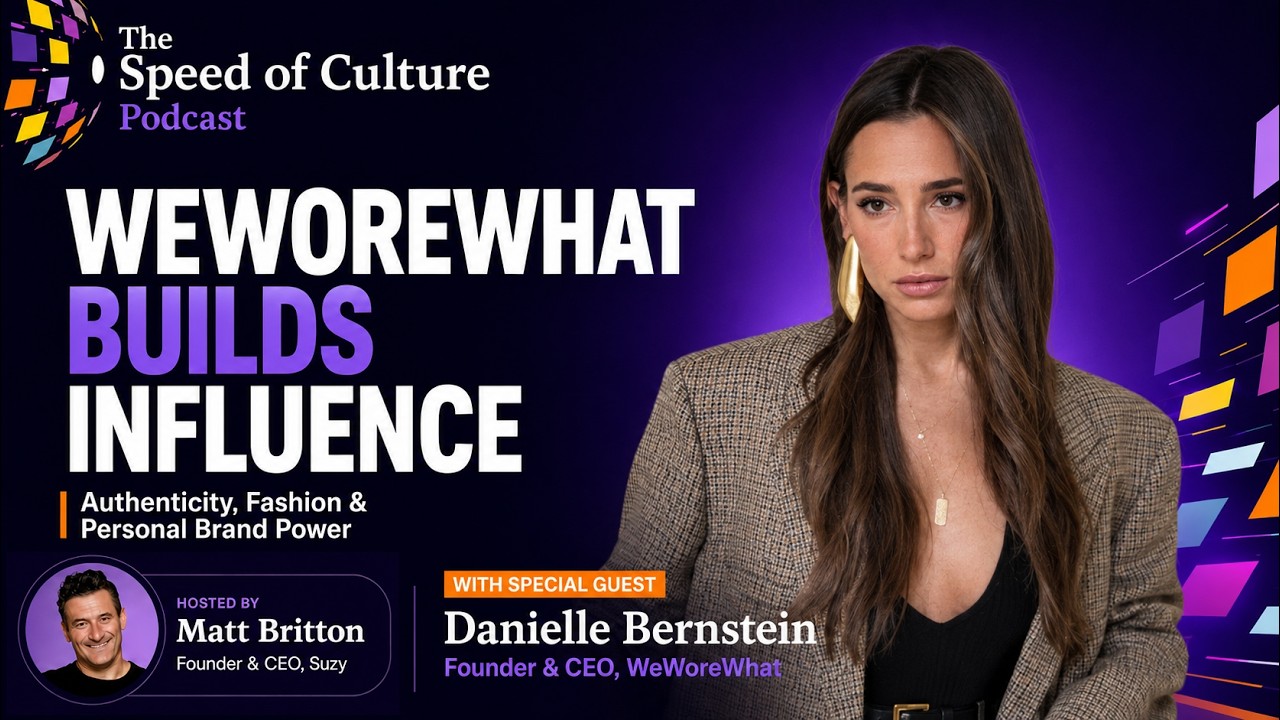
The Art of Authenticity: The Evolution of WeWoreWhat with Founder and CEO Danielle Bernstein
Episode 82: Speed of Culture Podcast
Air Date: December 12, 2023
Host: Matt Britton, Founder and CEO of Suzy
Guest: Danielle Bernstein, Founder and CEO of WeWoreWhat
Opening: From College Blog to Fashion Empire
In the dynamic landscape of digital entrepreneurship, few stories capture the essence of modern brand-building quite like Danielle Bernstein's journey with WeWoreWhat. During a compelling conversation on Episode 82 of the Speed of Culture Podcast, Matt Britton, founder and CEO of Suzy, the AI-powered consumer intelligence platform, sits down with Danielle Bernstein to explore how a college student's street-style blog transformed into a multi-million-dollar fashion empire.
Bernstein's trajectory, from amateur blogger to Forbes 30 Under 30 honoree to CEO navigating the complex intersection of influencer culture and corporate business strategy, offers invaluable insights into authenticity, innovation, and the changing nature of creator economy leadership.
Her story is not merely about personal success; it represents a fundamental shift in how consumer brands are built, scaled, and sustained in an era where trust, relatability, and genuine connection drive purchasing decisions. As the fashion industry continues to evolve, understanding Danielle Bernstein's approach to building WeWoreWhat provides essential lessons for entrepreneurs, marketers, and business leaders navigating the blurred lines between personal branding and corporate operations.
The Genesis of WeWoreWhat: Turning a College Project into a Cultural Movement
Danielle Bernstein's entrepreneurial journey began with an unlikely catalyst: a simple desire to share daily outfit inspiration. In 2010, as a student transferring from the University of Wisconsin-Madison to the Fashion Institute of Technology (FIT) in New York City, Bernstein recognized a gap in the digital landscape.
Her peers at schools without access to city fashion inspiration wanted authentic, relatable street-style ideas. This observation became the seed for WeWoreWhat.
"WeWoreWhat started as a street-style blog, photographing outfits around campus. It was meant to be a daily source of inspiration, and it evolved with the rise of Instagram."
The timing of WeWoreWhat's launch proved crucial. As Instagram emerged as a visual-first social platform in 2010-2011, Bernstein recognized the opportunity earlier than most. Rather than clinging to her blog format, she adapted, becoming an early adopter of the photo-sharing platform.
This flexibility, the ability to pivot with platform trends while maintaining her core mission of authentic style inspiration, would become a defining characteristic of her leadership approach.
The early years of WeWoreWhat represented a pivotal moment in the creator economy's development. The influencer industry as we know it today didn't exist. There were no established playbooks, no industry standards, and no clear pathways to monetization.
Bernstein, by necessity, became an innovator, making strategic decisions without historical precedent to guide her. She navigated copyright issues, platform algorithm changes, and the evolving social media landscape with intuition, experimentation, and an unwavering commitment to authenticity.
Her early success on Instagram created a network effect. As more followers engaged with her content, the platform's algorithm promoted her posts, attracting even more users. By the mid-2010s, WeWoreWhat had evolved from a niche college blog into a significant digital influencer presence, with hundreds of thousands of engaged followers seeking her perspective on fashion and lifestyle.
Building a Brand: The Transition from Influencer to Entrepreneur
The pivotal moment in Danielle Bernstein's evolution came in 2015 when she made the strategic decision to transform WeWoreWhat from a personal platform into a full-fledged brand with physical products. This transition was not merely about monetization; it represented a fundamental shift in how she conceptualized her business model and her role within it.
"WeWoreWhat became more than just a blog. It turned into a brand where I could own and sell my products, making it what it is today."
This pivot proved prescient. As the influencer marketing industry matured, brands increasingly realized that relying solely on sponsored content created inherent limitations. Commission-based income from brand partnerships meant Danielle's revenue was capped by her audience size and engagement rate.
By creating her own products, she transformed WeWoreWhat from a content platform into a retail business, capturing significantly higher profit margins and building genuine equity in a brand she owned outright.
The DTC (direct-to-consumer) fashion model offered particular advantages for influencer-founded brands like WeWoreWhat. Without the need for traditional wholesale distribution channels, retail markup layers, or department store relationships, Bernstein could:
- Control the entire customer experience, from product design to packaging to post-purchase engagement
- Capture data about her customers' preferences, buying patterns, and demographics
- Scale rapidly without negotiating with external retail partners
- Maintain brand authenticity by directly communicating with her audience about product quality, values, and creative vision
By 2023, this strategy had proven remarkably successful. WeWoreWhat achieved $30 million in revenue through its own website and select retail partnerships, with projections reaching $40 million.
The brand expanded beyond initial apparel categories to include accessories, jewelry, and plans for handbags and shoes. This evolution reflected not merely Bernstein's influence but her genuine understanding of her customer base, what they wanted, how they shopped, and what problems her brand could solve.
Navigating the Influencer-to-CEO Transition: Leadership, Authenticity, and Corporate Responsibility
Perhaps the most significant aspect of Danielle Bernstein's journey involves her successful navigation of the influencer-to-CEO transition. This evolution, often overlooked in discussions of creator economy success, presents unique challenges that many influencers fail to overcome.
The skills required to build a personal following (relatability, vulnerability, consistent engagement, and authentic storytelling) differ markedly from those required to lead a growing organization with employees, operations, supply chains, and corporate governance.
Bernstein approached this transition with intentionality. She made the difficult decision to bring in business expertise and strategic advisors while maintaining her position as the creative and cultural force behind the brand.
This balanced approach allowed her to:
- Delegate operational responsibilities to qualified professionals while maintaining her role in major strategic decisions
- Scale without losing authenticity, a challenge that has derailed many influencer-founded brands
- Build institutional knowledge within WeWoreWhat that didn't depend solely on her personal involvement
In the podcast conversation with Matt Britton, Bernstein emphasizes authenticity as a non-negotiable principle:
"I will never promote a product that I don't believe in or that I haven't tested myself. Authenticity and staying true to yourself are crucial when you're an influencer."
This commitment extends beyond marketing messaging. It shapes her product development process, vendor relationships, and customer communications.
Unlike traditional fashion brands that often operate at arm's length from their customers, WeWoreWhat maintains a direct, personal connection. Bernstein herself is often visible in brand communications, providing transparent insights into design decisions, fabric choices, and product inspiration.
This authenticity-first approach has proven strategically valuable. Research into influencer-founded DTC brands demonstrates that consumer trust and loyalty increase when founders remain genuinely involved in brand operations.
However, as brands scale, this involvement requires careful management. Bernstein has navigated this tension by:
- Being selective about public appearances and communications, focusing on moments where her direct involvement creates meaningful consumer value
- Building a team culture that embodies WeWoreWhat's values and aesthetic
- Maintaining creative control over major product categories and seasonal collections while delegating operational execution
- Remaining accessible through social media and direct customer communications while setting appropriate boundaries
The Creator Economy and the Art of Authentic Monetization
Danielle Bernstein's success story illuminates broader trends in the creator economy and the evolving definition of influencer value. In the early days of Instagram influencing, metrics were relatively simple: follower count, engagement rate, and estimated reach.
Brands paid for access to audiences, and the influencer's primary job was content creation and relationship maintenance with followers.
As the market matured, however, the most successful influencers, those like Bernstein who built lasting businesses, recognized that authentic audience relationships represented a deeper asset than raw metrics. These relationships created:
- Higher conversion rates when promoting products because followers already trusted the influencer's judgment
- Loyalty and repeat purchases that generated predictable revenue streams
- Franchise opportunities for product expansion, as existing customers were more likely to purchase from adjacent categories
- Premium pricing power, as authentic, engaged audiences were willing to pay more for products they trusted
WeWoreWhat's evolution reflects these principles. The brand's pricing strategy positions it in the contemporary luxury market, neither fast fashion nor true luxury, but accessible sophistication.
This positioning works precisely because Danielle Bernstein's audience trusts her taste and genuinely believes the products represent good value. A similar product from an unknown brand at the same price point would likely struggle to find customers.
Furthermore, Bernstein's genuine engagement with her audience has created a feedback loop. As customers purchase and wear WeWoreWhat products, they share photos and reviews, which Bernstein then features in her content, further validating purchases and encouraging new customers.
This organic, authentic cycle of content creation and customer engagement represents a new model of brand building, one that prioritizes relationship and trust over traditional advertising metrics.
Lessons for the Next Generation: Building Sustainable Creator Businesses
As the creator economy matures, Danielle Bernstein's journey offers critical lessons for aspiring influencers and entrepreneurs considering similar paths. Her experience demonstrates that sustainable creator businesses require:
Authenticity as Foundation, Not Aesthetic. In an era of algorithmic content and manufactured influencer personas, genuine authenticity creates competitive advantage. Bernstein's success stems partly from her willingness to be vulnerable, to acknowledge challenges, and to remain consistent with her values across different platforms and contexts.
Willingness to Pivot and Adapt. Bernstein didn't remain committed to any single platform or content format if better opportunities emerged. She moved from blogging to Instagram, then from influencing to direct-to-consumer retail, remaining flexible while maintaining her core mission and values.
Product-Market Fit Beyond Audience Size. Many influencers launch product lines that fail because they assume their followers will automatically purchase branded products. Bernstein's success reflects her deep understanding of her customer's actual needs and preferences. She designed products her audience genuinely wanted, not merely products that carried her name.
Building Business Infrastructure. The difference between successful and unsuccessful influencer transitions to entrepreneurship often comes down to hiring and operational discipline. Bernstein invested in building teams with expertise in supply chain management, logistics, customer service, and business operations. This infrastructure allowed her to scale without compromising quality or losing her personal brand.
Maintaining Audience Connection During Growth. As WeWoreWhat scaled, maintaining the intimate, authentic connection that built the initial audience required intentionality. Bernstein found ways to remain personally present in customer communications while acknowledging that she could no longer respond to every DM or comment individually.
Living Your Values. Bernstein has been vocal about her values regarding mental health, social responsibility, and business ethics. These are central to how she operates. This alignment between public statements and business practices builds credibility and customer loyalty.
The Future of DTC Fashion and Creator-Led Brands
As the conversation between Matt Britton and Danielle Bernstein demonstrates, the future of fashion retail increasingly involves creators who understand both the cultural zeitgeist and the mechanics of sustainable business operations.
Traditional fashion brands spent decades building heritage and cultural relevance through massive advertising budgets. Creator-led brands like WeWoreWhat achieve similar outcomes through authentic relationship building and genuine product innovation.
Looking ahead, Bernstein and similar founder-CEOs face both opportunities and challenges.
Opportunities include expansion into new product categories, geographic markets, and revenue streams (such as WeWoreWhat's expansion into jewelry and planned handbag and shoe lines). The brand can also leverage customer data to provide personalized styling recommendations, creating additional consumer touchpoints and value.
Challenges include maintaining authenticity and brand culture as organizations scale beyond the founder's direct involvement. As WeWoreWhat builds retail locations (including its NoHo pop-up store in New York), the challenge becomes ensuring that every customer interaction reflects the brand's core values.
Additionally, as Bernstein ages and her personal styling preferences evolve, the brand must determine how to refresh while maintaining the aesthetic consistency that drives customer loyalty.
Key Takeaways: The Art of Authenticity in Modern Brand Building
1. Authenticity Compounds Over Time. In her early years, Bernstein's authentic approach to styling and customer engagement might not have provided immediate competitive advantage. However, as social media matured and consumer skepticism toward influencer marketing increased, her consistent commitment to authenticity became her greatest asset.
This demonstrates that values-driven business practices pay dividends in the long term.
2. Platform Transitions Define Careers. Bernstein's willingness to transition from blogging to Instagram, and then to product-based retail, prevented her from becoming obsolete as technology and consumer preferences shifted.
The capacity to recognize trend shifts and adapt strategically, while maintaining core values, separates long-term successes from flash-in-the-pan influencers.
3. Influencer Influence Differs from Business Acumen. Building a large following represents only the first step in creator entrepreneurship. The subsequent challenge, transforming audience attention into sustainable business revenue while scaling operations, requires different skill sets, including operational management, financial discipline, and organizational leadership.
4. Customer Relationships Transcend Transactions. WeWoreWhat's success reflects a fundamental insight: customers who feel genuinely connected to a brand's founder make better decisions and demonstrate higher lifetime value.
This insight has led to a resurgence of founder visibility in DTC brands, contrasting sharply with traditional corporate brands' emphasis on anonymous operations.
5. Trust Cannot Be Manufactured. In the podcast conversation, Bernstein emphasizes that she would "never promote a product that I don't believe in or that I haven't tested myself." This principle, refusing easy money from brand partnerships that don't align with her values, reflects a long-term thinking approach.
Quick commissions pale in comparison to the lifetime customer value generated through consistent authenticity.
FAQ: Common Questions About Danielle Bernstein and WeWoreWhat
What made Danielle Bernstein successful as an influencer when so many others struggled?
Danielle Bernstein succeeded because she was an early adopter of Instagram, understood her audience's genuine needs, and prioritized authenticity over monetization opportunities.
While many influencers view their platforms primarily as advertising channels, Bernstein built WeWoreWhat as a genuine resource for style inspiration. This foundational difference created stronger audience loyalty, which translated to higher conversion rates when she launched her product line.
How did WeWoreWhat evolve from a fashion blog to a $30 million business?
The transition required three strategic shifts: (1) moving from blogging to visual-first Instagram content, (2) launching branded products that customers genuinely wanted rather than merely co-branded merchandise, and (3) building operational infrastructure (supply chain, customer service, logistics) that allowed the brand to scale while maintaining quality.
Bernstein also expanded beyond initial apparel categories to jewelry, accessories, and planned footwear lines, diversifying revenue streams.
What challenges does Danielle Bernstein face as an influencer-founder scaling a multi-million-dollar business?
The primary challenge involves maintaining authenticity and cultural relevance as the organization grows beyond her direct involvement.
As WeWoreWhat expands to retail locations and adds new categories, ensuring consistent brand experience requires building systems and teams that embody the brand's values without her personal presence in every interaction. Additionally, as trends evolve and consumer preferences shift, the brand must remain relevant while maintaining the aesthetic consistency that built its initial audience.
How does WeWoreWhat differentiate itself in the crowded contemporary fashion market?
WeWoreWhat differentiates through founder authenticity and direct-to-consumer positioning.
Unlike traditional fashion brands that operate at arm's length from customers, Danielle Bernstein remains personally visible in product development, customer communications, and brand strategy. This approach creates premium pricing power, customers willingly pay more because they trust the founder's judgment and taste.
The DTC model also eliminates wholesale margins, allowing WeWoreWhat to offer competitive pricing while maintaining healthy margins.
Looking Ahead: The Continuing Evolution of Creator-Led Brands
The conversation between Matt Britton and Danielle Bernstein, captured in Episode 82 of the Speed of Culture Podcast, offers a compelling snapshot of the creator economy at an inflection point.
As Suzy, the AI-powered consumer intelligence platform, continues analyzing consumer trends and behavior, patterns emerge suggesting that founder-led brands will increasingly dominate retail categories where authenticity, cultural relevance, and personal connection matter.
For entrepreneurs and marketers seeking to understand the future of retail and consumer brand building, studying Danielle Bernstein's journey provides essential insights. Her story demonstrates that in an era of information abundance and consumer skepticism, genuine authenticity, consistent values, and long-term thinking create sustainable competitive advantage.
For more insights on consumer trends, creator economy dynamics, and the future of retail, explore the Speed of Culture Podcast, hosted by Matt Britton. Additional resources on artificial intelligence and consumer behavior analysis are available through Suzy's platform and Matt Britton's thought leadership publications, including Generation AI: The Book.
For speaking engagements and consulting on AI, consumer insights, and founder-led brand strategy, visit Matt Britton's AI Keynote Speaker Page and Speaker HQ.
Meta Elements
Meta Title: The Art of Authenticity: Danielle Bernstein's Journey from Blogger to CEO | Speed of Culture Podcast
Meta Description: Explore how fashion influencer Danielle Bernstein transformed WeWoreWhat from a college blog into a $30M DTC fashion brand. Lessons in authenticity, entrepreneurship, and creator economy leadership.
Keywords: Danielle Bernstein, WeWoreWhat, influencer to CEO, DTC fashion, creator economy, fashion entrepreneurship, authentic branding, social media marketing, Instagram strategy, founder-led brands
Article Type: Business Strategy / Brand Case Study / Podcast Recap
Primary Keyword: Danielle Bernstein WeWoreWhat CEO authenticity
Secondary Keywords:
- Fashion influencer to entrepreneur
- DTC fashion brand strategy
- Creator economy success
- Influencer authenticity marketing
- Founder-led brand building
- Instagram fashion strategy
- Contemporary luxury fashion
- Consumer trust and brand loyalty
Originally published: February 2024
Episode: Speed of Culture Podcast, Episode 82
Original Air Date: December 12, 2023

%20(400%20x%20100%20px)%20(300%20x%2050%20px)%20(150%20x%2050%20px).avif)