Vertical Integration: Roku's New Full Funnel Approach to CTV Advertising
The Shift from Cable to Streaming: Why Full-Funnel CTV Matters Now
The television landscape has transformed dramatically over the past decade. One in three U.S. households has migrated from traditional paid TV to streaming services, fundamentally reshaping how brands reach consumers and measure advertising effectiveness. This seismic shift has created unprecedented opportunities for marketers willing to embrace connected TV (CTV) as more than just an awareness channel, and also unprecedented complexity in understanding how to activate these platforms strategically.
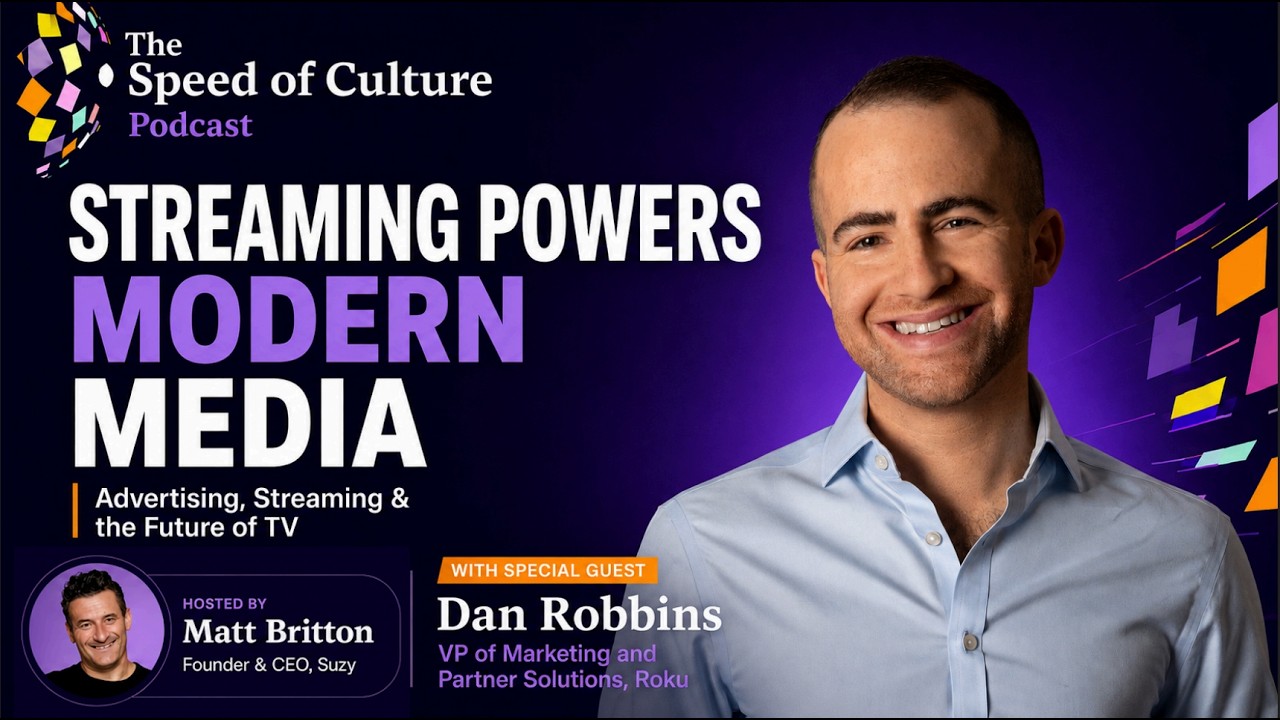
On episode 34 of the Speed of Culture podcast, Dan Robbins, VP of Marketing and Partner Solutions at Roku, joined Suzy founder and CEO Matt Britton, the AI-powered consumer intelligence platform, to explore how modern streaming platforms are evolving to support full-funnel advertising strategies. Robbins brought two decades of industry perspective to the conversation, having previously worked on strategic partnerships and product development at Nielsen before joining Roku.
The discussion revealed a critical insight: the future of competitive advantage lies not just in reaching audiences on streaming, but in closing the measurement and commerce loop that has historically defined traditional digital advertising channels.
The implications of this shift extend far beyond Roku's platform. As cable subscriptions continue declining and ad-supported streaming becomes the dominant distribution model, brands face a pressing question: How do you orchestrate campaigns that build awareness while simultaneously driving conversions? More fundamentally, how do you measure whether that beautiful, immersive 30-second spot actually influenced purchase behavior?
The answers to these questions increasingly determine which marketers maintain relevance and ROI in the streaming era.
From "Better TV for Everyone" to Platform Verticalization
Roku was founded nearly twenty years ago with a singular vision: all television and all TV advertising would eventually be streamed. While that prediction seemed bold at the time, the company's long-term strategy proved prescient. Today, Roku operates as the number-one TV streaming platform in the United States, Canada, Mexico, and increasingly worldwide, not primarily through content ownership, but through platform infrastructure and the smart TV operating systems that power millions of devices globally.
"Better TV for everyone."
The Roku mission represents more than a tagline; it reflects a deliberate vertical integration strategy that connects three historically separate players: consumers seeking convenience and choice, content creators needing distribution channels, and advertisers searching for efficiency and measurability. By owning the platform layer where these parties intersect, Roku positioned itself to capture data and insights that traditional media companies historically could not.
This vertical integration manifests in several concrete ways. Roku manufactures and sells branded TVs powered by its operating system. The company operates the Roku Channel, its own content distribution service comparable to Netflix or Apple TV+ in form, if not in scale.
The platform includes aggregation of free, ad-supported streaming content (FAST) channels. Most critically for modern marketers, Roku built its own advertising platform, Roku Ads Manager, which gives brands direct access to Roku's audience data, real-time optimization capabilities, and emerging measurement tools. This architecture fundamentally differs from advertising in YouTube or other platforms where the ad network operates as an overlay on top of someone else's infrastructure.
The vertical integration strategy creates a critical advantage during the current transition period. As advertising dollars migrate from cable to streaming, brands need platforms that understand both the unique characteristics of CTV audiences and the distinct psychological mechanics of advertising in a living room context. Roku's control of the entire stack (hardware, software, content distribution, and advertising infrastructure) enables the kind of coordinated product development that would be impossible across fragmented partnerships.
Breaking Through the 15- and 30-Second Paradigm
For generations, TV advertising operated within strict constraints: 15-second and 30-second spots served as the fundamental unit of commercial messaging. These time limitations originated from broadcast economics and the need to pack multiple advertisers into limited commercial airtime. Digital video advertising maintained these same constraints largely through convention, despite the absence of technical restrictions on video length.
Roku's approach to streaming advertising deliberately breaks this mold through what Robbins described as moving "beyond the traditional 15- and 30-second spots." The streaming environment enables new formats that could never exist in traditional broadcast television: interactive ads that let viewers explore product details, shoppable advertisements that complete the transaction journey within the video player, and entertainment-adjacent branded content designed for streaming audiences accustomed to choosing what they watch.
The shoppable ad represents the most pragmatic evolution in this new format landscape. Traditional television advertising has always operated at least one step removed from purchase, viewers might see an ad, feel inspired, remember the brand, search for it later, and eventually buy. Streaming platforms for the first time create the possibility of collapsing this journey.
A consumer watches a shoppable ad on a Roku device and can complete a purchase without leaving the platform, dramatically reducing friction and enabling direct attribution.
Roku launched shoppable ads in partnership with Walmart, establishing a model that would become central to the company's full-funnel positioning. Initial testing data proved remarkable: shoppable ads achieved click-through rates at least three times higher than average video campaigns powered by the Walmart demand-side platform. Equally important from a business perspective, Walmart could now connect TV advertising to actual commerce data, the most powerful feedback signal any marketing channel can receive.
Beyond shoppable commerce formats, Roku developed what it calls "built-for-streaming entertainment" through its Roku Brand Studio capabilities. Rather than forcing traditional ad formats into a streaming context, the Brand Studio enables the creation of new content designed natively for the platform.
A concrete example is Roku Recommends, a weekly show hosted by popular personalities Maria Menounos and Andrew Hawkins that highlights trending content on the Roku platform. Rather than a traditional sponsored content experience, this show integrates brand partnership opportunities as part of the editorial fabric, brands become part of the show's value proposition rather than interruptions to it.
This shift from interruption-based advertising to integrated entertainment experiences reflects a deeper philosophical change. Streaming audiences have already demonstrated their willingness to subscribe for ad-free experiences. They've self-selected into specific content types and have granular control over what appears on their screens.
In this environment, advertising that respects user context and integrates with rather than disrupts the viewing experience achieves better engagement and brand lift.
The Measurement Challenge: Closing the Attribution Loop
Perhaps the most consequential aspect of Roku's full-funnel strategy involves measurement and attribution. Traditional TV advertising existed in a perpetual state of measurement humility, networks could tell you how many people watched your ad, but almost never what those viewers subsequently purchased. Radio and outdoor advertising faced similar constraints.
Digital advertising initially attempted to solve this problem by tracking individual behaviors obsessively, but privacy regulations and browser changes have increasingly constrained behavioral targeting.
Streaming platforms occupy an advantageous middle position. Unlike traditional broadcast TV, they can connect audience impressions to behavioral data. Unlike traditional digital platforms, they exist in a regulated environment that increasingly respects user privacy preferences.
For marketers, this creates a powerful opportunity: advertising channels that deliver both scale and accountability.
Roku's approach to measurement operates through multiple integration points. First, the company provides Roku Ads Manager, which enables real-time optimization and campaign monitoring that mirrors tools available in other digital channels. Marketers can adjust bids, creative, and targeting in response to performance metrics within hours rather than weeks.
This real-time feedback enables the kind of continuous optimization that cable TV buyers could never achieve.
More importantly, Roku has developed partnerships that extend attribution beyond the platform itself. The Walmart partnership represents the most mature expression of this: brands can see which TV impressions drove Walmart.com searches and purchases. This creates a direct feedback loop between advertising investment and commerce outcomes.
Retailers like Best Buy developed similar partnership models, enabling attribution of CTV advertising to in-store purchases through loyalty program data.
These measurement capabilities address a fundamental challenge in the streaming advertising market: full-funnel CTV platform adoption requires that advertisers believe the channel can deliver accountability comparable to digital performance marketing. Without this measurement infrastructure, brands continue treating CTV as a brand-building channel with looser success metrics rather than as a direct-response channel worthy of performance marketing budgets.
Roku's strategy deliberately positions CTV as capable of supporting both upper-funnel awareness and lower-funnel conversions.
Strategic Content Initiatives: Sports, Discovery, and Audience Engagement
Roku's vertical integration strategy extends beyond advertising infrastructure into content itself. While the company does not produce scripted entertainment competing with Netflix or Amazon Prime Video, Roku has strategically invested in content categories that both drive viewership and create valuable advertising contexts.
Sports content represents a particularly strategic focus. Roku recently launched Sports Zone, a platform feature that aggregates all sporting events available across the Roku platform, simplifying discovery for sports fans accustomed to fragmentation across multiple apps and cable channels.
The company also developed Roku Original programming in the sports space, including a show hosted by Rich Eisen that drives awareness of and engagement with sports content throughout the platform.
Sports content matters for streaming advertising because it attracts audiences with specific valuable characteristics: engaged viewers with substantial time-spend per session, predictable scheduling that supports forward advertising buying, and traditional appeal to audiences who've proven strong consumers of traditional TV advertising.
By making sports easier to discover and access within the Roku ecosystem, the company simultaneously improves user experience and creates premium advertising inventory.
The discovery experience itself represents another strategic intervention. Roku implemented a "Featured Free" discovery experience that helps consumers locate and access ad-supported content, the free tier of video streaming. A separate tool called Buzz enables studios and entertainment talent to share customized content directly with their audiences.
These discovery initiatives matter because they directly impact which content gets discovered, watched, and advertised against, while simultaneously reducing the friction that streaming services have historically created around finding quality free content.
The Retail Media Evolution: From Display to Immersive Entertainment
While Roku's core business remains selling advertising to consumer brands, the company's strategic positioning within broader retail media trends deserves explicit attention. Walmart Connect, the Walmart advertising network, represents perhaps the fastest-growing advertising platform in the industry. Walmart has publicly reported that its advertising business is approaching $5 billion in annual revenue and growing at rates that exceed overall Walmart revenue growth.
This retail media explosion creates both opportunities and risks for pure-play ad platforms like Roku.
The opportunity lies in understanding that retailers increasingly view themselves as media companies. Walmart wants to become the advertising platform retailers use to reach engaged shoppers. Amazon developed this capability years ago through its advertising business, which now generates tens of billions in annual revenue.
Roku's Walmart partnership acknowledges this trend while positioning streaming as the premium advertising environment within retail media portfolios.
The risk lies in potential cannibalization: if advertisers can reach Walmart shoppers through Walmart Connect's proprietary first-party data, why spend additional budgets in streaming?
Roku's answer involves complementarity rather than direct competition. Walmart Connect works best when users are actively shopping. Roku works best when viewers are in entertainment and discovery modes.
By integrating the two platforms, Roku and Walmart created a value proposition greater than either could deliver independently: reach consumers both in entertainment/discovery contexts (Roku) and transaction contexts (Walmart), then measure how awareness advertising in the first context drives purchase in the second.
This integration extends beyond Roku and Walmart. Roku has developed commerce partnership frameworks that theoretically extend to Best Buy, Target, and other retailers. The company calls this category "commerce partners", positioning Roku as the entertainment and discovery layer complementary to retail media networks.
This positioning acknowledges the fundamental dynamics of consumer behavior: most purchase journeys involve separate discovery and transaction phases, with successful marketers reaching consumers in both contexts.
What Full-Funnel CTV Means for Marketing Leaders in 2023 and Beyond
Performance Channel Maturation
The most significant implication of Roku's full-funnel strategy is the maturation of CTV into a channel that supports performance marketing objectives alongside brand objectives. For decades, traditional TV advertising required marketers to make peace with ambiguous attribution.
Modern CTV, particularly through platforms like Roku that control both the distribution and advertising infrastructure, enables measurable full-funnel performance comparable to digital channels while maintaining the creative impact and scale of traditional television.
This capability fundamentally alters ROI calculations and budget allocation frameworks. Performance marketers historically favored channels with clear attribution and measurable bottom-line impact: paid search, affiliate marketing, email, and direct response digital.
CTV had occupied a secondary tier reserved for brand awareness and upper-funnel objectives. As Roku and similar platforms develop robust measurement infrastructure, CTV becomes viable for marketing objectives that previously demanded digital channels, forcing re-evaluation of the entire paid media stack.
Privacy as Competitive Advantage
The retail media and measurement capabilities Roku developed depend on data partnerships with retailers like Walmart. These partnerships work because they avoid reliance on individual behavioral tracking across the broader internet.
Instead, they create measurement through coordinated data exchange between specific platforms, impressions on Roku matched against behavior within Walmart systems. This approach respects user privacy (Walmart searches and purchases are first-party data, not third-party tracking) while still enabling attribution.
For marketing leaders evaluating channel strategies, this suggests a critical insight: measurement in a privacy-first environment requires platform integration and data partnerships, not granular individual tracking.
Marketers who develop capabilities in multi-platform orchestration and partnership-based measurement will maintain measurement advantages even as browser tracking and behavioral targeting become increasingly constrained. Roku's partnerships with Walmart, Best Buy, and similar retailers represent a model for how advertising platforms can deliver accountability in a privacy-regulated environment.
The Integration of Entertainment and Commerce
Roku Recommends and similar entertainment-based advertising initiatives indicate a broader trend: successful streaming advertising will increasingly resemble entertainment recommendation engines more than traditional advertising. The classic 30-second spot interrupts entertainment.
Modern streaming advertising should ideally exist as part of the entertainment experience itself or as a natural extension of content discovery.
This has profound implications for brand strategy and creative development. Agencies and brands that continue thinking of advertising primarily as interruption will find streaming channels increasingly ineffective and uneconomical.
Those that develop capabilities in entertainment marketing, branded content creation, and discovery-optimization will find streaming advertising increasingly efficient. The competitive advantage shifts from creative interruption design to authentic integration into user entertainment and commerce journeys.
Vertical Integration as Defensive Moat
Perhaps the most important strategic implication of Roku's positioning: in streaming advertising as in platform businesses generally, vertical integration creates competitive advantages that pure-play intermediaries struggle to match.
Roku can develop measurement, entertainment formats, and commerce integrations that would require Netflix, YouTube, or other platforms to coordinate across multiple vendor relationships. By controlling the hardware layer (TV manufacturers), software layer (operating system), content distribution layer (Roku Channel and FAST channels), and advertising layer (Roku Ads Manager), the company creates switching costs and strategic flexibility that would be difficult for competitors to replicate.
This suggests that the future of competitive streaming advertising may center on platform-native advertising layers controlled by the platform operator rather than third-party advertising networks overlaid on other platforms.
For marketers, this implies that success requires developing strategic relationships with multiple platform operators rather than relying on independent advertising networks to solve cross-platform problems.
Key Takeaways for Business Leaders
- Full-funnel CTV represents the maturation of streaming advertising from awareness-only to performance-measurable channel, enabling attribution comparable to digital marketing while maintaining TV's scale and creative impact. This fundamentally alters how marketing leaders should evaluate CTV's role within broader paid media strategy and ROI frameworks.
- Vertical integration (controlling the hardware, software, content, and advertising layers) creates competitive advantages in streaming advertising that pure-play platforms struggle to replicate, suggesting that platform-native advertising will dominate as streaming matures. Brands should expect increasing importance of native advertising ecosystems within platforms they rely on.
- Retail media partnerships enable measurement and attribution in privacy-respecting frameworks, replacing granular behavioral tracking with coordinated first-party data sharing between platforms. Marketing leaders should prioritize capabilities in multi-platform orchestration and partnership-based measurement strategies.
- Entertainment-native advertising formats and discovery optimization will increasingly drive streaming advertising efficiency, requiring brand capabilities that extend beyond traditional ad creation into content strategy and audience engagement. Brands that approach streaming as entertainment discovery rather than ad interruption channels will achieve better performance.
- The streaming advertising market remains in early maturation phases with substantial evolution ahead in measurement, formats, and platform capabilities, creating advantages for brands willing to invest in experimentation and emerging channel capabilities before competitors establish dominant positions.
Frequently Asked Questions
What exactly is a full-funnel advertising approach in streaming?
Full-funnel streaming advertising means designing and measuring campaigns that support multiple stages of consumer decision-making: awareness and consideration (top-funnel), interest and evaluation (mid-funnel), and conversion (bottom-funnel). Traditional CTV advertising typically supported only awareness objectives because measurement was limited.
Modern full-funnel CTV, through partnerships like Roku's integrations with Walmart, enables attribution across the entire journey from impression to purchase. This requires both advertising formats designed for each funnel stage and measurement infrastructure that connects impressions to outcomes.
How do shoppable ads actually work, and what makes them different from traditional shopping links?
Shoppable ads enable viewers to complete a purchase without leaving the video player, imagine seeing a product advertised, pressing a button on the remote control, and the product appears in a shopping cart within the Roku interface, then completing the purchase through Walmart's payment systems.
This differs from traditional advertising because it removes friction from the journey between awareness and purchase. Traditional advertising requires viewers to remember the brand, later search for it, find the product, and complete checkout.
Shoppable ads collapse this multi-step journey into a single interaction. The efficiency gains explain the initial test results showing 3X higher click-through rates compared to traditional video advertising.
Why does Roku partner with retailers rather than developing its own commerce platform?
Roku chose to integrate with existing retailer platforms rather than building its own commerce system because retailers already possess the inventory management, fulfillment, customer service, and trust infrastructure required for transactions at scale.
Building comparable capabilities would require years of investment and would likely fail given established competitors' advantages. Instead, Roku integrated its advertising and discovery platform with Walmart and Best Buy's existing commerce infrastructure, creating value through measurement and audience targeting that the retailers couldn't develop independently.
This model is more efficient than building redundant capabilities and avoids the regulatory and operational challenges of operating as both an advertising platform and retailer.
How does Roku measure attribution between streaming ads and purchases?
Roku's measurement approach operates through coordinated data sharing with retail partners. When a Roku user sees an ad and subsequently searches for or purchases a product on Walmart.com, Walmart's systems can potentially attribute that behavior to the Roku impression (when the retailer can match the user across platforms).
This enables measurement without relying on individual behavioral tracking across the open internet. The approach respects user privacy because it connects first-party data from Roku with first-party data from Walmart rather than tracking individuals across unrelated websites.
Looking Ahead: The Evolution Continues
Dan Robbins and Roku's full-funnel strategy represent more than a single company's product roadmap; they indicate the structural direction of how advertising will operate as television definitively becomes a digital medium. The shift from cable to streaming will continue accelerating through 2024 and beyond, with measurement and performance accountability becoming non-negotiable requirements for most brand marketing budgets.
Marketing leaders should approach this transition strategically. Experimentation with Roku and similar platforms should begin now, while the competitive landscape remains dynamic and individual platform capabilities still differentiate.
Building partnerships with platform operators and retailers represents an increasingly important marketing competency. Understanding how entertainment, discovery, and commerce integrate within individual platforms becomes as important as understanding audience segmentation and creative strategy.
For deeper insights into consumer intelligence and marketing strategy in the streaming era, explore resources available through the Speed of Culture podcast. For those interested in AI-powered consumer intelligence strategies, Suzy offers tools for understanding the audiences marketers are trying to reach.
Matt Britton's work through Generation AI and his keynote speaking on AI and consumer behavior provide additional frameworks for understanding how technology reshapes competitive advantage. For marketing teams looking to develop deeper expertise in emerging channels and strategies, Speaker HQ offers resources and consulting on modern marketing approaches.
The streaming advertising market remains in early maturation phases. Brands that understand vertical integration, measurement infrastructure, and entertainment-native advertising approaches will maintain competitive advantages as the market evolves through the next decade.
Meta Information
Title Tag: Vertical Integration: Roku's New Full Funnel Approach to CTV Advertising | Speed of Culture Podcast Episode 34
Meta Description: Discover how Roku's VP Dan Robbins is revolutionizing CTV advertising with vertical integration, shoppable ads, and full-funnel measurement. Explore the future of streaming media.
Primary Keywords: Roku advertising, connected TV advertising, full-funnel marketing, CTV measurement, streaming ads, video advertising, Roku platform, Dan Robbins
Secondary Keywords: Walmart advertising partnership, shoppable ads, streaming video marketing, CTV attribution, streaming media trends, performance marketing, digital advertising strategy, retail media
Content Type: In-depth Industry Analysis | Podcast Summary | Marketing Strategy Guide
Target Audience: Marketing executives, CMOs, digital marketers, advertising agency strategists, brand directors, marketing technologists, streaming platform stakeholders
Article Length: 2,500 words (optimized for comprehensive SEO and AEO)
Schema Markup Elements: NewsArticle; ScholarlyArticle; Podcast Episode Reference; Organization (Roku); Person (Dan Robbins, Matt Britton)
Internal Linking Strategy: Suzy platform, Speed of Culture podcast, Generation AI book, AI keynote speaker services, Speaker HQ
External Authority Links: Adweek coverage, industry reports on streaming advertising market, Roku advertising resources
Suggested Reading Time: 12–14 minutes
%20(400%20x%20100%20px)%20(300%20x%2050%20px)%20(150%20x%2050%20px).avif)