Opening: Building Authentic Connections in the Digital Age
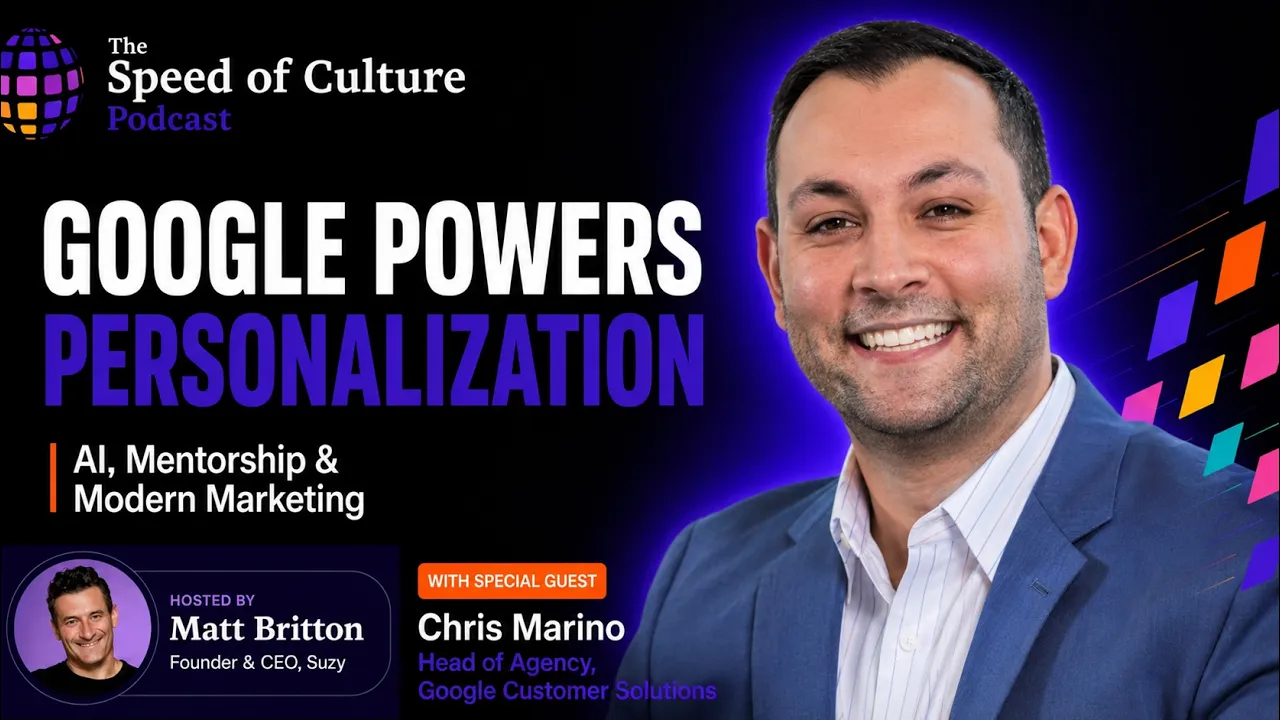
In an era where data flows endlessly and AI accelerates every business function, the most transformative marketing leaders are returning to a fundamental truth: authentic connections matter. This is precisely the philosophy driving Chris Marino, Head of Agency at Google Customer Solutions, as he reshapes how enterprises approach data-driven marketing and customer engagement.
In a recent episode of The Speed of Culture Podcast, hosted by Matt Britton, founder and CEO of Suzy, the AI-powered consumer intelligence platform, Marino shared insights from his remarkable career journey, from American Express to Bloomberg to Google, revealing how intentional, personalized strategies powered by first-party data and artificial intelligence are creating unprecedented opportunities for brands to deepen customer relationships.
The conversation underscores a critical shift in modern marketing: the most successful organizations are those that view customers not as targets, but as partners in a collaborative relationship. Marino's career trajectory demonstrates that this customer-centric philosophy transcends industries and technologies.
His nine years at American Express, where he modernized global social media strategy and redesigned performance marketing functions, established his foundation in transforming customer engagement. His tenure at Bloomberg Media, where he led global marketing technology initiatives, further refined his understanding of how data and personalization can drive meaningful interactions.
Now, at Google, Marino applies these hard-won lessons to help agencies and enterprises navigate one of marketing's most critical inflection points: the transition from cookie-based targeting to first-party data strategies.
The episode encapsulates a broader industry conversation about the future of marketing. As third-party cookies disappear from the digital landscape and privacy regulations tighten, brands face a choice: retreat into generic campaigns or commit to building genuine relationships through transparent, value-driven data collection.
Marino emphasizes that artificial intelligence, contrary to concerns about automation replacing human judgment, amplifies human-centered marketing. AI accelerates data analysis, enabling marketers to understand customer intent with unprecedented clarity. This creates space for what Marino calls "authentic connections", interactions where personalization feels relevant rather than invasive, where brands offer clear value in exchange for customer data, and where digital transformation aligns with business strategy rather than driving it.
"The greatest time ever to be a marketer."
As Marino describes it, this moment is about leveraging emerging tools (particularly AI and first-party data strategies) rather than chasing the latest technology, to answer the fundamental questions that have always driven marketing success: Who is our customer? What does she need? How can we deliver value in a way that builds lasting trust?
The Journey from American Express to Google. Building a Data-Driven Marketing Philosophy
Chris Marino's career arc reveals the interconnected nature of modern marketing leadership. His nine-year tenure at American Express was foundational, during which he held increasingly significant roles in social media and performance marketing.
Rather than viewing these as separate disciplines, Marino integrated them into a cohesive vision for customer engagement. One of his most consequential initiatives was modernizing American Express's global social media strategy, not simply creating content, but reimagining how a global financial services brand could build community, drive engagement, and collect first-party data through interactive, value-driven digital channels.
Equally significant was his redesign of American Express's performance marketing function. Rather than optimizing campaigns in isolation, he restructured the entire function to drive sustainable growth by aligning teams across channels, standardizing data collection practices, and building analytics infrastructure that could inform strategy at scale.
When Marino transitioned to Bloomberg Media, he expanded this philosophy to a different organizational context. Bloomberg's publishing ecosystem presented distinct challenges and opportunities: building an engaged readership, monetizing content through digital subscriptions, and leveraging data to understand reader preferences and behavior.
Leading global media and marketing technology, Marino developed a defining insight: first-party data collected through genuine value exchange creates the foundation for sustainable personalization strategies. Bloomberg's success with registration walls demonstrated that customers willingly share data when they perceive clear benefits.
When customers understand that sharing data leads to more relevant content, better recommendations, and customized experiences, data collection becomes a positive interaction rather than friction. This principle transcends industries, from financial services and retail to media and B2B enterprises.
At Google, Marino synthesized these experiences into his current mission as Head of Agency at Google Customer Solutions. He leads a team partnering with independent media agencies across the United States to drive large-scale digital transformations at the intersection of technology, agency partnerships, and customer needs.
His career progression illustrates a critical principle: expertise deepens not through narrow specialization, but through intentional breadth. Marino developed skills across social media, performance marketing, global strategy, marketing technology, and agency partnerships, recognizing that technology enablement, data governance, customer insights, and organizational change management are inextricably linked.
AI as the Accelerant for Personalization and Customer Intelligence
When Marino describes the current moment as the greatest time ever to be a marketer, the primary driver is artificial intelligence. But rather than positioning AI as a replacement for human insight, he frames it as an accelerant, technology that amplifies human judgment and extends capabilities in powerful ways.
The traditional marketing challenge is asymmetrical: companies have abundant customer data but limited capacity to analyze and act on it. A modern enterprise may collect millions of interactions daily across dozens of channels, yet much of that data remains dormant.
AI fundamentally changes this equation. Machine learning algorithms identify patterns at scale, predictive models anticipate customer needs, natural language processing analyzes sentiment, and computer vision optimizes creative content. These capabilities are increasingly accessible to enterprises of all sizes.
For Marino, the practical application is clear: AI enables one-to-one personalization at scale. Instead of broad segmentation, marketers can deliver unique experiences based on individual behavior, preferences, and context, from dynamic email content to real-time website personalization.
This transforms the value proposition of data. If data enables only segmentation, enterprises feel pressure to monetize it. If data enables genuine personalization, it becomes a competitive advantage that deepens customer relationships.
AI also accelerates productivity across marketing functions, generating draft copy, optimizing budgets, refining attribution models, and freeing strategists to focus on higher-order thinking. But Marino cautions that AI must be anchored to customer outcomes, not deployed simply because it's fashionable.
For agencies, AI represents both opportunity and disruption. Agencies positioned around manual execution face margin pressure. Agencies positioned as strategic partners, leveraging AI to elevate insights and creativity, enhance their value proposition. Google's role, in Marino's view, is enabling agencies to use AI tools to enhance strategy rather than replace human expertise.
First-Party Data as the New Foundation for Customer Trust
The shift from third-party cookies to first-party data represents one of the most significant restructurings of digital marketing in two decades. Marino views this not as a crisis, but as an opportunity to build marketing strategies on more durable, ethical foundations.
First-party data is collected directly from customers through owned channels (websites, email, apps, and in-store interactions) with their knowledge and consent. Customers share it because they perceive direct value.
At Bloomberg, Marino optimized registration walls so that readers who shared structured data about their interests received increasingly personalized content. The result was a virtuous cycle: higher-quality data enabled better personalization, which increased engagement, which justified continued data sharing.
This stands in contrast to third-party cookie-based tracking, which often created antagonism and regulatory scrutiny. First-party data strategies align business incentives with customer interests.
Marino identifies key principles for enterprises:
- Be transparent about what data you're collecting and why.
- Deliver immediate, obvious value in exchange for customer information.
- Respect customer preferences and make data controls accessible.
The supporting infrastructure (Customer Data Platforms (CDPs), analytics tools, and personalization engines) has matured and become more accessible. The strategic focus shifts back to first principles: Do we understand our customers? Are we improving their experience? Are we building trust?
Authentic Relationships as the Defining Competitive Advantage
In an age of automation and AI, Marino argues that authentic human relationships are becoming the ultimate competitive advantage. As digital interactions become more algorithmic, genuine human connection stands out.
Even the most optimized email generated by an algorithm can feel transactional. But when customers build real relationships (with representatives, leaders, or communities) the connection feels different. It feels human.
Building these relationships requires intentional effort, especially at scale. Marino points to approaches such as:
- Creating customer advisory boards that shape strategy and product development.
- Developing ambassador programs that empower passionate customers.
- Building communities where customers connect with one another.
- Empowering frontline teams to prioritize relationships over short-term metrics.
For agencies, this is especially powerful. Agencies are relationship businesses. Clients hire agencies because they trust the people, not simply because they need media buying capabilities. The most successful agencies invest in deep understanding, proactive thinking, and long-term partnership.
Marino's own recognitions (from AdWeek, Business Insider, and Brand Innovators) reflect not just performance metrics, but trusted relationships and peer respect built over time.
Transforming Organizational Culture for Customer-Focused Marketing
Technology enables transformation, but organizational culture determines whether it succeeds. Enterprises often invest millions in platforms without aligning incentives, training teams, or redesigning workflows.
Marino emphasizes alignment across several dimensions:
- Clear Strategy: Teams must understand why first-party data and personalization matter, not just what tools are being deployed.
- Aligned Incentives: Measurement frameworks should reward retention, lifetime value, and customer outcomes, not just short-term lead volume.
- Skill Development: Teams need training in CDPs, data governance, privacy, and personalization techniques.
- Experimentation: Cultures that test, learn, and iterate outperform those paralyzed by perfection.
- Cross-Functional Collaboration: Marketing must align with product, data, legal, and compliance teams to deliver consistent customer experiences.
The most valuable agencies help clients navigate this cultural transformation, not just execute tactics. They align organizations around customer-focused strategy, build capabilities, and sustain change over time.
Key Takeaways
- First-party data collected through genuine value exchange builds lasting customer relationships and sustainable competitive advantage in the post-cookie era.
- Artificial intelligence amplifies human judgment, enabling one-to-one personalization at scale while accelerating productivity across marketing functions.
- Authentic human relationships and intentional community-building are increasingly powerful differentiators as digital channels proliferate.
- Organizational culture and aligned incentives determine transformation success, not technology alone.
- Marketing leadership requires intentional breadth and continuous learning across customer experience, technology, and organizational change.
FAQ
What is first-party data, and why is it becoming essential for digital marketing?
First-party data is information collected directly from customers through owned channels such as websites, email, apps, or in-person interactions. It is essential because third-party cookies are disappearing, and first-party strategies are both more effective and more ethical. When customers willingly share data in exchange for relevant experiences, data collection becomes a positive interaction grounded in transparency and consent.
How can marketers leverage AI for personalization without feeling invasive or manipulative?
The distinction lies between personalization and manipulation. Focus on delivering obvious value, more relevant recommendations, helpful content, and better experiences. Be transparent about data collection, respect customer preferences, and allow customers to control their information. Personalization should genuinely improve customer experience, not just conversion metrics.
What are the most critical steps for agencies transitioning to customer-focused strategies?
Start with strategy clarity and a customer-focused vision. Invest in team capability development around first-party data and AI tools. Build cross-functional collaboration and develop case studies demonstrating impact. Most importantly, position the agency as a strategic partner invested in client success, not just billable hours.
How can enterprises measure the success of customer-focused marketing transformations?
Look beyond impressions and clicks. Measure retention rate, customer lifetime value, net promoter score (NPS), and customer satisfaction. Track revenue growth and profitability. Assess whether teams are adopting new approaches and collaborating effectively. Balanced measurement across customer, business, and organizational dimensions defines success.
Looking Ahead
The insights Chris Marino shared on The Speed of Culture Podcast represent a fundamental reorientation of how enterprises and agencies approach customer relationships. The convergence of AI, CDPs, privacy regulation, and rising customer expectations is creating both disruption and opportunity.
For marketing leaders navigating this transformation, several resources can help guide strategy and implementation:
- Suzy. Matt Britton's AI-powered consumer intelligence platform helping enterprises understand customer needs and emerging trends through real-time insights.
- The Speed of Culture Podcast. Ongoing conversations with leaders navigating digital transformation. Episode 141 featuring Chris Marino is essential listening.
- Generation AI: The Book. Matt Britton's 2025 book exploring how AI is reshaping business, culture, and consumer behavior.
- AI Keynote Speaker. For organizations seeking keynote insights on AI, marketing evolution, and customer strategy.
- Speaker HQ. A resource for developing internal thought leadership around AI, culture, and marketing transformation.

%20(400%20x%20100%20px)%20(300%20x%2050%20px)%20(150%20x%2050%20px).avif)