Entering a New Age of Connection: How Verizon Value’s CMO Cheryl Gresham Is Transforming Wireless Marketing
Episode Date: November 21, 2023
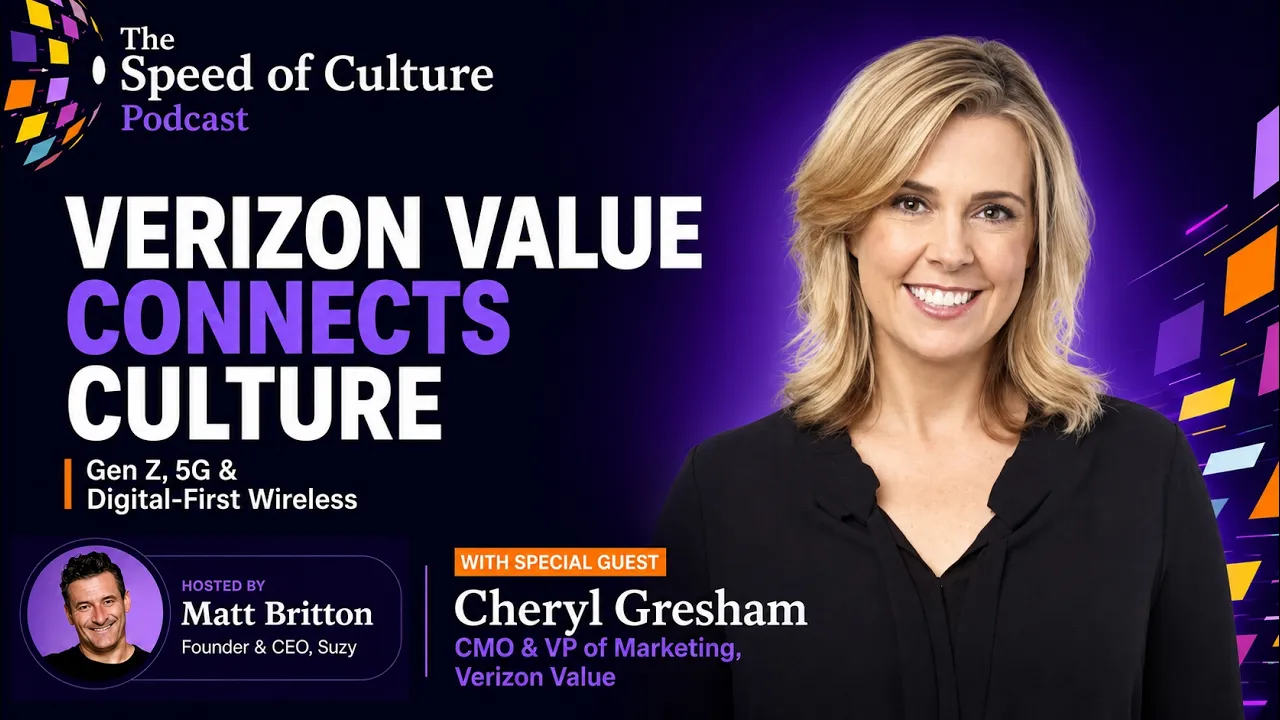
Featured Guest: Cheryl Gresham, CMO and VP of Marketing at Verizon Value
Podcast Host: Matt Britton, Founder and CEO of Suzy
Introduction: Leadership Meets Consumer Intelligence
In a rapidly evolving telecommunications landscape, where consumer expectations shift faster than network speeds, effective marketing leadership requires more than data, it demands curiosity, innovation, and the ability to anticipate cultural shifts before they happen. In the latest episode of The Speed of Culture podcast, Matt Britton, founder and CEO of Suzy, the AI-powered consumer intelligence platform, sits down with Cheryl Gresham, Chief Marketing Officer and Vice President of Marketing at Verizon Value, to explore how strategic marketing vision is reshaping the wireless telecommunications industry.
This conversation represents a pivotal moment in wireless marketing evolution. As a CMO leading one of Verizon’s most ambitious growth initiatives, Gresham oversees marketing strategy for an expansive portfolio of prepaid wireless brands, including Total by Verizon, Visible, StraightTalk, TracFone, Simple Mobile, SafeLink, and Walmart Family Mobile.
Her journey from advertising agencies to brand leadership at iconic companies like Taco Bell, Google, and TikTok provides invaluable lessons for executives navigating digital transformation and consumer behavior shifts.
The episode title, “Entering a New Age of Connection,” encapsulates Gresham’s philosophy: in an era of 5G networks and always-on consumers, the telecommunications industry must transcend traditional value propositions and create deeper, more meaningful connections with diverse customer segments.
For marketing leaders, brand strategists, and business executives seeking to understand how to build resilient, growth-focused marketing operations in competitive markets, this episode offers actionable insights grounded in real-world experience and data-driven decision-making.
From Agency Dynamics to Brand Mastery: Cheryl Gresham’s Path to CMO Leadership
Cheryl Gresham’s marketing career trajectory exemplifies the power of curiosity and strategic risk-taking. Her foundation in advertising agencies proved transformative, providing what she describes as a “college” in brand building and consumer psychology.
Her transition from agency life to brand-side marketing began with a defining moment at Taco Bell, where she describes the experience as an “MBA” in brand building. During her tenure, Gresham played a key role in the “Live Más” campaign, which targeted millennials and repositioned the brand as culturally relevant and aspirational.
The campaign coincided with critical challenges, including the “beef crisis,” which required rapid response, creative agility, and sophisticated consumer communication strategies. These experiences taught Gresham that effective marketing extends beyond advertising, it encompasses crisis management, brand defense, cultural timing, and authentic consumer engagement.
The Silicon Valley Crucible: Google and TikTok
When Gresham moved into technology sector marketing at Google, she encountered a fundamentally different worldview. At Google, she faced an engineer’s perspective that:
“You only need marketing if you have a crappy product.”
This skepticism forced her to reconceptualize marketing’s role within technology companies, shifting from brand awareness and emotional connection to demonstrating clear ROI, measurable consumer behavior change, and transparent attribution.
Her subsequent role at TikTok proved even more transformative. TikTok’s explosive growth and cultural dominance represented an unprecedented phenomenon in social media, a platform that didn’t just facilitate content sharing but fundamentally altered how culture was created, distributed, and consumed.
She specifically recalls the Dogg Face viral video moment, noting that TikTok’s team could “turn that creative around in about 48 hours,” demonstrating speed and cultural relevance that traditional marketing organizations struggled to match.
- Real-time cultural responsiveness: Identifying emerging trends and capitalizing on them within hours, not weeks.
- Creator economy dynamics: Understanding that influence flows through creators, not traditional advertising.
- Algorithm-driven distribution: Recognizing that platform algorithms determine reach and visibility.
- Authenticity as currency: Inauthentic messaging faces immediate backlash.
Verizon Value: Redefining Wireless Marketing for Diverse, Connected Consumers
In her current role as CMO and VP of Marketing at Verizon Value, Cheryl Gresham oversees marketing strategy for one of the most diversified portfolios of wireless brands under a single strategic umbrella.
The Verizon Value Portfolio: Strategic Diversification
The Verizon Value organization manages eight distinct brand entities:
- Total by Verizon. Community-focused brand emphasizing price transparency and no-rate-increase guarantees.
- Visible. All-digital wireless carrier designed for digitally-native consumers.
- TracFone. Long-established prepaid brand with significant multicultural customer base.
- StraightTalk. Flexible prepaid service option available through major retailers.
- Simple Mobile. Value-oriented prepaid brand.
- SafeLink. Federally supported program for eligible low-income consumers.
- Walmart Family Mobile. Exclusively distributed through Walmart ecosystem.
- Verizon Prepaid. Direct prepaid offering from Verizon’s main brand.
This portfolio approach represents a radical rethinking of wireless marketing strategy. Rather than treating prepaid as a secondary business, Verizon Value positions prepaid wireless as a legitimate, strategic choice for consumers prioritizing value, flexibility, and reliability.
Breaking the Prepaid Stigma
Gresham’s strategic vision centers on breaking the false dichotomy between postpaid versus prepaid in wireless marketing. Historically, prepaid services were positioned as secondary options for price-conscious consumers with credit challenges.
Verizon Value’s repositioning argues that prepaid wireless represents a conscious consumer choice, selected by digitally sophisticated consumers who value flexibility, price transparency, and the ability to change services without long-term contracts.
Understanding Diverse Consumer Segments
A critical insight from the episode centers on audience composition: approximately 45–50% of the Value organization’s customer base consists of multicultural consumers, with particular emphasis on Hispanic/Latino audiences.
Total by Verizon’s Super Bowl debut featured a Spanish-language advertisement during Univision’s broadcast, signaling Verizon’s commitment to culturally relevant messaging.
Marketing to multicultural consumers demands more than translation; it requires cultural adaptation, values alignment, and genuine representation.
Marketing Innovation in the Retail Era: Omnichannel Strategy and Distribution Excellence
Verizon Value’s marketing strategy extends beyond traditional advertising into retail strategy and distribution partnerships. As Gresham explains:
“We are reliant on retailers like Walmart, Target, and Best Buy.”
The Store Expansion Strategy
In 2023, the organization planned to open several hundred Total by Verizon stores, with more than 100 locations in the Los Angeles area alone.
This represented Verizon’s largest media investment in wireless marketing history, incorporating traditional above-the-line advertising complemented by digital, social, and online video channels.
For prepaid wireless consumers, physical retail locations serve critical functions:
- Consumer education on service options and data allowances.
- Device experience through hands-on testing.
- Trust building in local communities.
- Conversion facilitation from retail traffic to activations.
Addressing Industry Pain Points
Verizon’s research identified core industry pain points:
- Lack of price transparency
- Price volatility
- Poor customer service
- Network quality concerns
Total by Verizon addresses these with “no price hikes,” equivalent network access leveraging Verizon’s 5G infrastructure, and responsive customer service.
The Curiosity Imperative: Continuous Learning in a Rapidly Shifting Landscape
Perhaps the most actionable insight from Gresham’s conversation on The Speed of Culture centers on curiosity and continuous learning.
“There have been times when an opportunity has come my way… But saying yes, taking that leap of faith and trying, I think… say yes to your curiosity.”
She emphasizes:
“As marketers, you have to be like a student at all times, no matter if you’re 50 or if you’re 25.”
For Gresham, continuous learning manifests as staying attuned to cultural trends, understanding platform evolution, studying consumer psychology, and learning from failure.
Five Key Takeaways for Marketing Leaders
- Embrace Curiosity as Career Strategy: Diverse experiences create adaptive leadership advantages.
- Learn Continuously Across Industries: Each sector enriches overall marketing perspective.
- Adapt Quickly to Organizational Culture: Develop cultural fluency across environments.
- Value Relationships and Mentorship: Career progression flows through networks.
- Focus on Innovation While Respecting Brand Heritage: Balance new growth with brand equity.
The Speed of Culture Podcast: Your Portal to Marketing Leadership Insights
The episode featuring Cheryl Gresham represents one of dozens of conversations on The Speed of Culture, where Matt Britton engages with CMOs and marketing leaders from leading brands.
Subscribe on your preferred platform:
FAQ: Verizon Value, Prepaid Wireless, and Strategic Marketing
What is Verizon Value’s Strategic Objective?
Verizon Value aims to capture market share in the prepaid wireless segment by positioning prepaid services as premium choices for value-conscious, flexible consumers rather than budget-constrained options.
How Does Cheryl Gresham’s Technology Background Inform Verizon Value’s Marketing Strategy?
Her experience at Google and TikTok shaped her understanding of data-driven decision-making, algorithm-driven platforms, and cultural relevance in digital channels.
What Makes Prepaid Wireless a Growth Category for Verizon?
Prepaid increasingly appeals to sophisticated consumers valuing flexibility, price transparency, and the absence of long-term contracts.
How Does Verizon Value Address Multicultural Markets?
With approximately 45–50% of customers representing multicultural demographics, the organization develops culturally specific marketing strategies and invests in targeted media channels.
Looking Ahead: The Future of Wireless Marketing and Consumer Connection
As consumer expectations evolve, wireless marketing will likely emphasize authentic diversity representation, transparent value communication, omnichannel integration, personalization at scale, and community building.
For deeper insights into AI adoption and emerging consumer trends, explore:
Cheryl Gresham’s leadership at Verizon Value exemplifies how curiosity, continuous learning, and consumer-centric marketing strategies drive competitive advantage in dynamic markets.

%20(400%20x%20100%20px)%20(300%20x%2050%20px)%20(150%20x%2050%20px).avif)