Opening
The advertising landscape has undergone a seismic shift. Brands no longer operate within siloed channels, awareness here, consideration there, conversion somewhere else. The fragmentation that once defined digital marketing is giving way to integrated ecosystems where a single brand message can follow a consumer from initial discovery through final purchase.
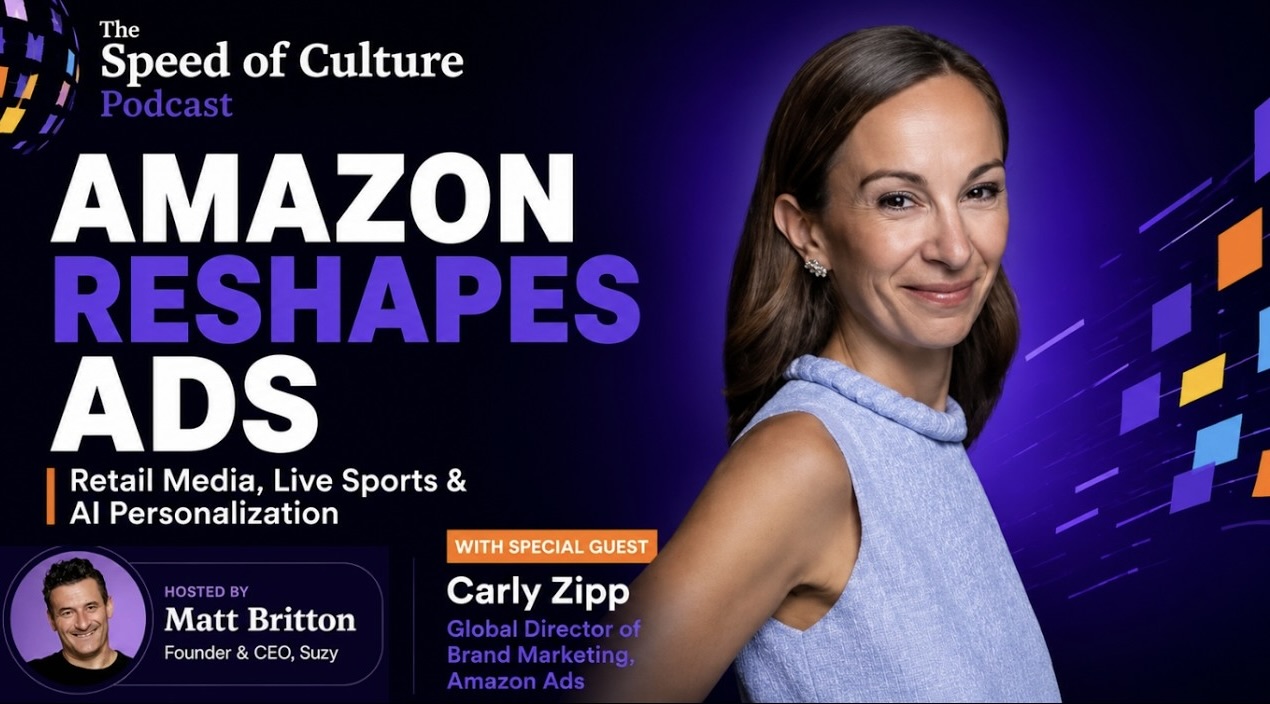
This transformation sits at the heart of Episode 201 of the Speed of Culture Podcast, where Matt Britton, founder and CEO of Suzy, the AI-powered consumer intelligence platform, sits down with Carly Zipp, Global Director of Brand Marketing at Amazon Ads, to explore how Amazon is fundamentally reshaping the advertising game.
"Messy But Worth It."
The episode title captures the essence of modern brand strategy in an age of complex data, artificial intelligence, and an evolving consumer journey. For decades, marketers have obsessed over the funnel as a linear path: top-of-funnel awareness, mid-funnel consideration, bottom-funnel conversion.
But what happens when a brand can own the entire funnel simultaneously, within a single ecosystem, backed by first-party data and powered by AI? That’s not just a better strategy, it’s a fundamental reimagining of how brands connect with consumers at scale.
Amazon’s evolution from a retail platform to a comprehensive advertising ecosystem has created unprecedented opportunities for brands willing to think beyond traditional attribution and embrace a more holistic, messier approach to marketing. Through Prime Video integration, live sports sponsorships, creator collaborations, and AI-powered optimization, Amazon has built a full-funnel powerhouse that delivers measurable results across every stage of the customer journey.
In this article, we dive deep into the insights from Carly Zipp and explore why this approach, though complex and requiring a shift in mindset, represents the future of brand marketing in 2025 and beyond.
The Evolution of Amazon as an Advertising Powerhouse
Amazon’s transformation from a retail giant into a diversified advertising platform is one of the most consequential shifts in marketing over the past decade. What began as simple sponsored product listings has evolved into a sophisticated, multi-channel advertising ecosystem that rivals traditional media networks in scope and impact.
The turning point came with Amazon’s expansion into streaming media through Prime Video and the acquisition of rights to major sports events like Thursday Night Football. Suddenly, Amazon wasn’t just a place where consumers made purchase decisions, it became a place where brands could build awareness and emotional connection.
This dual positioning creates a unique advantage: Amazon owns both the awareness stage (through video and streaming) and the conversion stage (through retail). Few platforms can claim this integrated ownership.
According to Carly Zipp’s insights shared on the podcast, this positioning allows brands to execute true full-funnel strategies within a single, first-party data ecosystem. A consumer watching Thursday Night Football might see a national brand advertisement, and then, days later, encounter a Sponsored Display ad while searching for products on Amazon.
The seamless flow from awareness to purchase, all connected through Amazon’s data, enables unprecedented measurement and optimization.
Amazon’s annual ad revenue now exceeds $68 billion, with significant growth driven by advertisers embracing full-funnel strategies. This growth trajectory reflects a broader industry recognition that fragmented, channel-by-channel advertising is giving way to integrated approaches that follow consumers across touchpoints.
The key insight here is one of ecosystem advantage. When a brand operates across multiple disconnected platforms, measurement becomes murky, attribution becomes speculative, and optimization becomes difficult. Amazon eliminates this friction by housing multiple advertising formats under one roof, all connected to a unified customer record.
Prime Video and Live Sports: The Awareness Engine
If Amazon’s retail ecosystem is the conversion engine, Prime Video and live sports are the awareness engine. The addition of streaming and live sports to Amazon’s advertising portfolio represents a strategic masterstroke that fundamentally altered the competitive dynamics of brand advertising.
Carly Zipp emphasizes that Prime Video isn’t just another streaming platform, it’s a mainstream media property. Thursday Night Football draws millions of viewers, and the ads served during these games reach audiences at moments of high attention and engagement.
For brands seeking to build awareness at scale, this is the equivalent of reclaiming traditional TV advertising but with modern data and personalization capabilities.
What makes Amazon’s approach to live sports particularly innovative is the application of audience-based creative. Rather than serving a single advertisement to all viewers of Thursday Night Football, Amazon enables brands to deploy different creative variations to different audience segments, all watching the same game simultaneously.
This level of personalization at scale was previously impossible in traditional media. Television advertising has always been one-to-many; everyone watching sees the same commercial. Amazon introduces one-to-one personalization within a mass-media context, blending the reach of traditional TV with the precision of digital targeting.
The implications for brand strategy are profound. Brands no longer face a choice between mass awareness and targeted reach. Amazon enables both simultaneously.
AI-Powered Optimization and the Accessibility Revolution
Perhaps no aspect of Amazon’s full-funnel strategy has greater democratizing potential than artificial intelligence. In previous eras, sophisticated marketing campaigns required large teams, deep expertise, and substantial budgets. Not every brand could afford a sophisticated marketing infrastructure.
Amazon’s AI-powered solutions are fundamentally changing this equation. Carly Zipp discusses how Amazon’s AI-powered DSP (Demand-Side Platform) is making advanced marketing capabilities accessible to smaller and mid-sized brands.
The AI handles tasks that traditionally required significant human expertise: campaign structure optimization, audience identification, creative testing, and real-time performance optimization.
What’s particularly significant is how Amazon’s AI approaches full-funnel optimization holistically. Rather than optimizing campaigns within individual channels, the system recommends campaign setups across Sponsored Products, Sponsored Brands, Display, and Streaming TV, then optimizes them in concert.
This systemic approach addresses a longtime pain point for marketers: how do you allocate budget across channels when each channel claims to be the most important? Amazon’s AI system answers this question empirically.
The accessibility revolution extends to creative generation as well. Amazon’s AI tools are helping brands generate, test, and optimize creative at scale, allowing smaller teams to produce the volume and variety of creative assets that full-funnel advertising demands.
Creator Collaborations and Authentic Brand Storytelling
While AI optimization handles the performance side of Amazon’s advertising ecosystem, creator collaborations represent the artistry and authenticity side. In an era of increasing ad skepticism and rising demand for authentic brand narratives, creator partnerships have become essential to effective marketing.
Carly Zipp’s background includes leadership roles at TikTok and Outfront Media, giving her deep expertise in creator ecosystems and experiential storytelling. This perspective is evident in how Amazon approaches creator partnerships, not as an afterthought to programmatic advertising, but as a core element of full-funnel strategy.
The beauty of integrating creator collaborations into Amazon’s full-funnel approach is the ability to measure authentic storytelling against performance outcomes.
This integration solves a longstanding measurement challenge in influencer marketing: how do you quantify the ROI of creator partnerships when attribution is murky? Within Amazon’s ecosystem, the answer becomes clearer.
The Messiness and the Mastery: Embracing Complexity
The episode title, “Messy But Worth It”, gets at something fundamental about modern marketing. The full-funnel approach that Carly Zipp champions requires brands to embrace complexity and resist oversimplification.
In previous eras, marketing could be cleaner and more compartmentalized. Each channel had a clear purpose and clear metrics. There was a satisfying clarity to this approach.
Full-funnel advertising is messier. It requires balancing multiple objectives simultaneously. A Sponsored Products campaign isn’t just about conversion, it also serves an awareness function. A Prime Video ad isn’t just about awareness, it sets up conversion opportunities downstream.
This interdependency means that optimizing for a single metric can undermine full-funnel performance. The brand that chases conversion at the expense of awareness may win in the short term but lose in the long term as the funnel depletes.
The mastery lies in embracing the messiness. It means recognizing that not every dollar will show direct attribution to a sale, and that’s okay if the overall strategy drives profitable growth.
Budget Allocation and the 40-30-30 Framework
If full-funnel marketing is genuinely complex, brands need frameworks to guide budget allocation decisions.
A recommended baseline for established brands is the 40-30-30 framework: 40% of budget allocated to top-of-funnel awareness activities, 30% to mid-funnel consideration, and 30% to bottom-funnel conversion.
This allocation represents a significant shift for many brands that have traditionally over-indexed on conversion. By shifting budget toward awareness and consideration, brands build a foundation that supports more efficient conversion over time.
Real-world results validate this approach. H&R Block, implementing Amazon’s full-funnel strategy, achieved a 26% improvement in CPM with OLV campaigns, while overall CPA efficiency improved 35% year-over-year. Most significantly, the complete strategy delivered a 144% total increase in conversions compared to display-only campaigns.
Key Takeaways
- Full-funnel advertising within a single ecosystem eliminates fragmentation and enables unprecedented measurement and optimization across the entire customer journey.
- Prime Video and live sports integration allow brands to build awareness at scale while maintaining audience-level personalization and downstream data connectivity.
- AI-powered optimization democratizes access to sophisticated marketing capabilities, enabling smaller brands to compete strategically.
- Creator collaborations provide authenticity and measurable storytelling that strengthens full-funnel performance.
- Success requires embracing complexity and shifting toward strategic budget allocation designed for long-term profitable growth.
Frequently Asked Questions
What exactly is a full-funnel advertising strategy, and why does Amazon call it “messy”?
Full-funnel advertising means coordinating campaigns across awareness, consideration, and conversion stages within an integrated strategy backed by unified first-party data. It’s called “messy” because it requires balancing multiple objectives simultaneously and accepting that not every dollar will show direct sales attribution.
How does Amazon measure full-funnel campaign success across multiple touchpoints?
Amazon measures success through metrics spanning all funnel stages, reach and impressions for awareness, engagement for consideration, and sales and ROAS for conversion, all connected through first-party data within a unified ecosystem.
What’s the recommended starting budget allocation for brands new to full-funnel advertising?
A strong starting point is the 40-30-30 framework: 40% to awareness, 30% to consideration, and 30% to conversion. Brands should adjust based on objectives, market maturity, and product type.
Can smaller brands really compete on awareness with Amazon’s tools?
Amazon’s AI-powered solutions have democratized sophisticated marketing capabilities. Smaller and mid-sized brands can now access automated creative generation, audience optimization, and full-funnel measurement that previously required large teams and budgets.
Looking Ahead
The future of brand advertising is happening now, on platforms like Amazon that integrate awareness, consideration, and conversion within a single ecosystem. The insights shared by Carly Zipp in Episode 201 of the Speed of Culture Podcast point toward a clear direction: brands that embrace full-funnel thinking and leverage AI-powered optimization will outperform those clinging to fragmented strategies.
Brands like H&R Block have demonstrated that an integrated approach to full-funnel advertising generates substantially higher returns than channel-specific optimization.
To explore how AI-powered consumer intelligence can inform your brand strategy, visit Suzy. To dive deeper into the future of AI and consumer behavior, read Generation AI. For AI keynote speaker inquiries or event partnerships, visit Speaker HQ or contact Matt Britton directly.

%20(400%20x%20100%20px)%20(300%20x%2050%20px)%20(150%20x%2050%20px).avif)