Opening
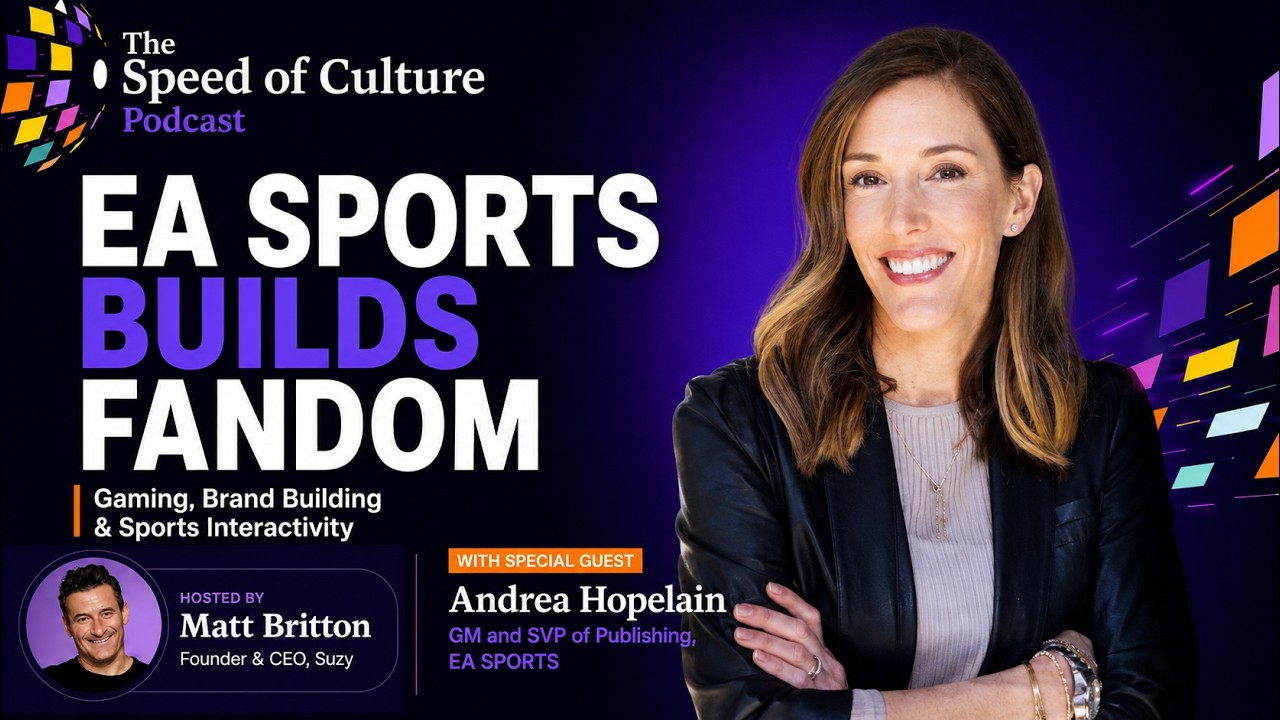
For the Speed of Culture Podcast's 100th episode milestone, Matt Britton, founder and CEO of Suzy, the AI-powered consumer intelligence platform, sits down with Andrea Hopelain, GM and SVP of Publishing at EA SPORTS. This conversation explores one of the most transformative moments in gaming and sports entertainment history: how EA SPORTS successfully transitioned the world's most iconic sports franchise from FIFA to EA SPORTS FC while simultaneously redefining what it means to be a sports entertainment company in the digital age.
Andrea Hopelain brings two decades of expertise in media, entertainment, and interactive gaming to the table. Her career has spanned pivotal roles at Disney, ESPN, and Hasbro before she joined EA SPORTS to drive the evolution of digital marketing and fan engagement. During this episode, Britton and Hopelain dive deep into the strategic intersection of sports fandom, gaming technology, and consumer behavior that defines modern sports entertainment.
They explore how EA SPORTS has shifted from simply creating games to building a media platform for the next generation of fans, a generation that increasingly defines their sports fandom through digital experiences, virtual communities, and interactive play.
The conversation is particularly timely, coming in the wake of one of the largest entertainment rebrands in history. When EA SPORTS separated from the FIFA license in 2023, many industry observers wondered whether the franchise could survive without the iconic name that had defined it since 1993. Instead, EA SPORTS turned this potential crisis into an opportunity.
The company rebranded FIFA as EA SPORTS FC, launched the "Welcome to the Club" campaign, and achieved unprecedented success: 14.5 million active player accounts in just 24 days, with the marketing campaign generating 201 million impressions and exceeding engagement targets by 18 percent. This was a strategic repositioning that reflected deeper changes in how consumers engage with sports and entertainment.
What makes Andrea's perspective particularly valuable is her understanding of the broader cultural context. She recognizes that roughly 50 percent of sports fandom is now being defined by age 14, with younger generations experiencing gaming as a primary entry point to sports engagement. Generation Z's values around equity, inclusion, and authenticity directly influence how EA SPORTS develops its products and marketing strategies.
When a third of Gen Z individuals in the United States identify as gamers, the traditional boundaries between "sports fans" and "gamers" disappear entirely. EA SPORTS is capturing these consumers before they form loyalty to competing platforms, while simultaneously building the infrastructure for a completely new model of sports fandom.
The podcast episode reveals the methodical strategy behind this transformation. Rather than viewing the FIFA rebrand as an ending, EA SPORTS saw it as the beginning of something larger. The company had the opportunity to push beyond the FIFA brand's constraints and create something more expansive, a platform that could encompass not just football, but the entire ecosystem of sports entertainment, technology partnerships, and fan experiences.
This conversation provides deep insights into how leading consumer brands navigate massive disruption and transform potential catastrophe into competitive advantage.
The Evolution of Digital Marketing in Sports Entertainment
The sports entertainment landscape has undergone a seismic shift over the past decade, fundamentally altering how consumers discover, engage with, and consume sports content. EA SPORTS has been at the epicenter of this transformation, and Andrea Hopelain's leadership during this evolution reveals critical lessons for any brand navigating digital disruption.
Digital marketing in sports has evolved from a simple distribution channel into a comprehensive ecosystem that encompasses advertising, community building, influencer partnerships, live streaming, social media engagement, and real-time fan interaction. Traditional sports marketing relied heavily on television commercials, stadium sponsorships, and print media.
Today's sports entertainment landscape is infinitely more complex, requiring brands to excel simultaneously across dozens of platforms, formats, and consumer touchpoints.
EA SPORTS' approach to digital marketing reflects this complexity. The company doesn't view digital marketing as a separate function from game development or community management, instead, it has integrated these disciplines into a cohesive strategy focused on creating what Hopelain describes as a "media platform for the next generation."
This means the company thinks about every interaction a consumer has with the brand, whether playing the game, watching streamed content, engaging on social media, or participating in community tournaments, as part of a unified experience.
The strategic pivot toward viewing sports gaming as a media platform rather than merely a software product represents a fundamental philosophical shift. Traditional gaming companies measured success by units sold and active users. EA SPORTS now measures success through engagement metrics, content consumption, community participation, and fan lifetime value.
This perspective acknowledges that modern consumers do far more than play games: they inhabit them, create within them, compete in them, and most importantly, watch other people engage with them.
This evolution has profound implications for marketing strategy. Instead of selling people on the idea of purchasing a new game annually, EA SPORTS must now convince consumers to invest time, attention, and money into an evolving digital ecosystem. The company must constantly deliver new content, maintain competitive balance, respond to community feedback, and create moments of cultural relevance that extend far beyond the gaming industry.
The success of the FIFA-to-EA SPORTS FC rebrand demonstrates how comprehensively EA SPORTS has mastered this evolved digital marketing landscape. Rather than relying on a massive television campaign or celebrity endorsements, the company deployed a sophisticated, multi-channel "Welcome to the Club" campaign that generated 201 million impressions and successfully communicated the rebrand's core message: change the name, not the experience.
Within 24 days, the game achieved 14.5 million active player accounts, proving that a digital-native marketing approach could outperform traditional sports marketing tactics.
Understanding the Role of Fandom in Brand Building and Engagement
Fandom represents one of the most powerful and underutilized forces in modern marketing. While many brands attempt to create fandom through advertising and promotional campaigns, genuine fandom emerges from something deeper: authentic engagement, community belonging, and the opportunity to participate in something larger than oneself.
Andrea Hopelain's leadership at EA SPORTS demonstrates how companies can architect the conditions for authentic fandom to flourish.
EA SPORTS has recognized that fandom in the digital age operates differently than in previous eras. Historical sports fandom centered on loyalty to teams, athletes, and leagues. Digital fandom still includes these elements but adds new dimensions: the ability to play as your favorite athletes in a game environment, to compete against other fans globally, to customize and create content, and to participate in real-time communities with millions of other enthusiasts worldwide.
The significance of age 14 as a critical threshold for sports fandom development cannot be overstated. Andrea emphasizes that roughly 50 percent of sports fandom definition occurs before age 14, yet many traditional sports properties focus their marketing efforts on adult consumers.
EA SPORTS has strategically positioned gaming as a primary entry point to sports engagement for young people. When a 12-year-old can play as their favorite football player, compete in global tournaments, and interact with a community of millions of other fans, the gaming experience becomes inseparable from their sports identity.
This understanding has profound implications for how EA SPORTS structures its games and marketing. The company invests heavily in youth-friendly features, diverse athlete representation, inclusive community standards, and content that reflects the values of younger consumers.
When EA SPORTS includes women athletes across its sports franchises, it is recognizing that Gen Z consumers value equity and representation, and will form their fandom preferences based partly on whether the brands they engage with reflect these values.
The concept of "fandom infrastructure" is critical to understanding EA SPORTS' strategy. The company provides multiple layers of engagement:
- Casual play for entertainment and accessibility.
- Competitive play for skill development and mastery.
- Content creation tools for creative expression.
- Community features for social connection.
- Spectatorship opportunities for passive enjoyment.
A consumer might enter through casual play, discover competitive opportunities, begin creating content, build a following, and eventually become an influencer or professional competitor. Throughout this journey, they remain engaged with the EA SPORTS ecosystem, and their sense of fandom deepens.
EA SPORTS has also recognized that modern fandom is increasingly participatory and democratic. Fans want agency in how their games develop. They want to influence which features are implemented, which players are included, and how communities are moderated.
The company's investment in community feedback channels, beta testing programs, and player councils reflects the recognition that fandom requires genuine co-creation between the brand and its consumers.
How EA SPORTS Bridges Sports, Technology, and Fan Experiences
The intersection of sports, technology, and fan experience represents the future of sports entertainment, and EA SPORTS stands at the forefront of this convergence. Andrea Hopelain's strategic vision demonstrates how technology can enhance rather than replace traditional sports engagement, creating a complementary ecosystem where gaming and physical sports reinforce each other.
EA SPORTS' approach to technology integration extends far beyond graphics processing and gameplay mechanics. The company has developed sophisticated systems for managing millions of concurrent players, implementing fair competitive play, analyzing consumer behavior at scale, and personalizing experiences to individual preferences.
Behind the scenes, artificial intelligence powers recommendation systems, predictive analytics inform product development, and data science drives strategic decision-making.
But the most innovative aspect of EA SPORTS' technology strategy is how it creates bridges between digital and physical sports experiences. The company has executed strategic partnerships that blur these boundaries.
For example, EA SPORTS collaborated with Nike to create custom Air Max 90 sneakers that could be purchased both in-game and in physical retail stores, allowing digital players to express their gaming identity in the real world. Similarly, the integration of Ted Lasso and AFC Richmond into EA SPORTS FC created a cultural moment that unified entertainment media, sports entertainment, and gaming communities.
These partnerships represent a sophisticated understanding of how modern consumers operate across multiple platforms and contexts. EA SPORTS' strategy recognizes this omnichannel reality and ensures that its properties strengthen consumer engagement across all these touchpoints.
The technology underlying EA SPORTS FC also enables unprecedented real-time responsiveness to global sports events. When a football player has a standout performance, that achievement can be reflected in the game within hours. When a transfer happens in real-world football, EA SPORTS FC can update its digital equivalent immediately.
This real-time connection between the digital game and physical sports creates a powerful feedback loop where each reinforces the other.
The rebranding from FIFA to EA SPORTS FC exemplified the company's technology sophistication. Rather than requiring a complete game rebuild, EA SPORTS maintained all underlying gameplay, leagues, and athletes while changing the brand identity.
The triangular logo design, inspired by in-game elements, unified gaming and football culture visually and aesthetically. From a technical perspective, this redesign required reimagining how the brand communicated across digital and physical touchpoints while maintaining backward compatibility for millions of existing players.
The FIFA to EA SPORTS FC Transition: A Case Study in Strategic Marketing
The decision to rebrand FIFA as EA SPORTS FC represents one of the most significant marketing decisions in sports entertainment history. When FIFA doubled its licensing fee demands from $150 million to over $300 million annually, the company faced a choice: pay unprecedented sums for a brand that ultimately belonged to another organization, or build a brand it owned completely.
Andrea Hopelain and her team chose the latter path. The decision to rebrand was inherently risky. FIFA had been synonymous with the game for 30 years.
By removing FIFA's name, EA SPORTS was gambling that the game's core product (authentic football gameplay, real athletes, competitive features, and global community) could retain consumers even without the FIFA association.
The "Welcome to the Club" campaign addressed this risk directly through messaging that was simultaneously reassuring and forward-looking. The campaign acknowledged change while emphasizing continuity.
The results exceeded expectations dramatically: 201 million impressions, 52.3 million reach, and 4.5 million engagements, exceeding targets by 18 percent. More importantly, the game achieved 14.5 million active player accounts within 24 days of launch.
From a financial perspective, the rebrand saved EA SPORTS $150 million annually in licensing fees while maintaining access to all league licenses, player rights, and stadium data through separate agreements.
By developing its own brand identity, EA SPORTS gained complete control over its future. The company no longer depended on FIFA's governance, and FIFA's geopolitical challenges no longer directly impacted EA SPORTS' reputation.
The FIFA-to-EA SPORTS FC transition also revealed deep truths about modern consumer behavior. Once EA SPORTS FC offered equivalent functionality in a thriving community, the FIFA brand name proved less essential than marketing conventional wisdom had suggested.
Rather than attempting to hide the change or minimize its significance, EA SPORTS' marketing leaned into the transition as an opportunity. The company explicitly acknowledged that it was rebranding, explained why, promised continuity in what mattered most, and invited players to help shape the new brand's direction.
The Future of Sports Entertainment: What EA SPORTS' Strategy Reveals About Consumer Culture
EA SPORTS' evolution under Andrea Hopelain's leadership provides important insights into the direction of sports entertainment and consumer engagement more broadly. The company's strategic choices reflect deeper truths about how younger generations define fandom, how technology will reshape industries, and how authenticity and community will determine competitive advantage in the coming decade.
Gen Z's approach to sports and entertainment differs fundamentally from previous generations. The distinction between watching, playing, creating, and competing becomes blurred in a continuous stream of engagement.
This cultural shift has profound implications for how entertainment companies must operate. Success increasingly requires simultaneous excellence across multiple formats and platforms.
Andrea's emphasis on fandom as an infrastructure that evolves as consumers age also suggests important implications for lifecycle marketing. A child who forms their sports identity through EA SPORTS FC may maintain engagement through their adulthood, potentially purchasing for their own children and becoming a long-term contributor to the ecosystem.
The role of women athletes in EA SPORTS' strategy reflects another crucial evolution. By including women athletes, the company expands its addressable market, appeals to younger and more diverse consumers, and positions itself as culturally progressive.
Looking forward, the continued convergence of gaming, sports, and media suggests that companies like EA SPORTS will increasingly function as media companies that happen to make games, rather than game companies that occasionally engage with media.
Key Takeaways
- Fandom infrastructure requires intentional design. EA SPORTS deliberately architects multiple pathways for engagement, from casual play to competitive esports, ensuring that consumers at every skill and interest level can find meaningful participation.
- Digital marketing's evolution demands integrated thinking. Social media, influencer relations, advertising, community management, and product development must reinforce each other as a coordinated ecosystem.
- Authenticity and transparency build trust during disruption. By acknowledging change and explaining its rationale, EA SPORTS transformed potential catastrophe into competitive advantage.
- Technology enables human connection. Real-time updates, customization tools, and community features matter because they facilitate emotional investment and belonging.
- Younger consumers define the future. By focusing on age 14 as a critical threshold, EA SPORTS shapes the preferences and expectations that will define sports entertainment for the next 40 years.
Frequently Asked Questions
How did EA SPORTS successfully transition from FIFA to EA SPORTS FC without losing its player base?
EA SPORTS' success derived from a multi-layered strategy. The company launched the "Welcome to the Club" campaign, maintained all functional benefits that made FIFA popular, and framed the rebrand as an opportunity rather than a retreat. The result was 14.5 million active accounts within 24 days, demonstrating that community and gameplay mattered more than the legacy brand name.
Why does EA SPORTS emphasize age 14 as a critical threshold for sports fandom development?
Research indicates that approximately 50 percent of sports fandom is defined before age 14. By investing in younger audiences, EA SPORTS shapes preferences early, increasing lifetime value and long-term engagement while influencing broader household entertainment decisions.
How does EA SPORTS balance commercial interests with community values like equity and inclusion?
EA SPORTS understands that for Gen Z, authenticity and alignment with personal values influence brand loyalty. Including women athletes and promoting diverse representation expands the addressable market while aligning with consumer expectations.
What role does influencer marketing play in EA SPORTS' strategy?
Influencers and professional gamers demonstrate gameplay, create content, build community, and influence purchasing decisions. EA SPORTS empowers creators whose values align with the brand while allowing authentic creative voice, generating powerful network effects across the ecosystem.
Looking Ahead
The insights from Andrea Hopelain's appearance on The Speed of Culture Podcast reveal a sports entertainment industry fundamentally transformed by technology, younger consumer preferences, and the demand for authentic engagement.
For brands navigating similar transformations, the lessons are clear: invest in understanding your consumers' values and behaviors; design infrastructure that enables authentic engagement; communicate transparently during disruption; and recognize that younger consumers' preferences will define your industry's future.
To explore more insights about modern consumer behavior and AI-powered intelligence, visit Suzy, the AI-powered consumer intelligence platform founded by Matt Britton. For additional episodes featuring industry leaders across entertainment, technology, sports, and consumer culture, explore The Speed of Culture Podcast.
Learn more about Matt Britton's research and perspectives through Generation AI: The Book, which explores how artificial intelligence is reshaping consumer behavior and business strategy. For speaking opportunities featuring insights into generational trends and technology's impact on society, visit Matt Britton as an AI Keynote Speaker or explore Speaker HQ. To inquire about availability, visit the contact page.

%20(400%20x%20100%20px)%20(300%20x%2050%20px)%20(150%20x%2050%20px).avif)