Opening: A New Era of Cruise Marketing
The cruise industry stands at an inflection point. Once perceived as a niche travel segment catering primarily to retirees and families, cruise lines have undergone a dramatic transformation in how they market to consumers, engage with emerging audiences, and position themselves within an increasingly competitive travel landscape.
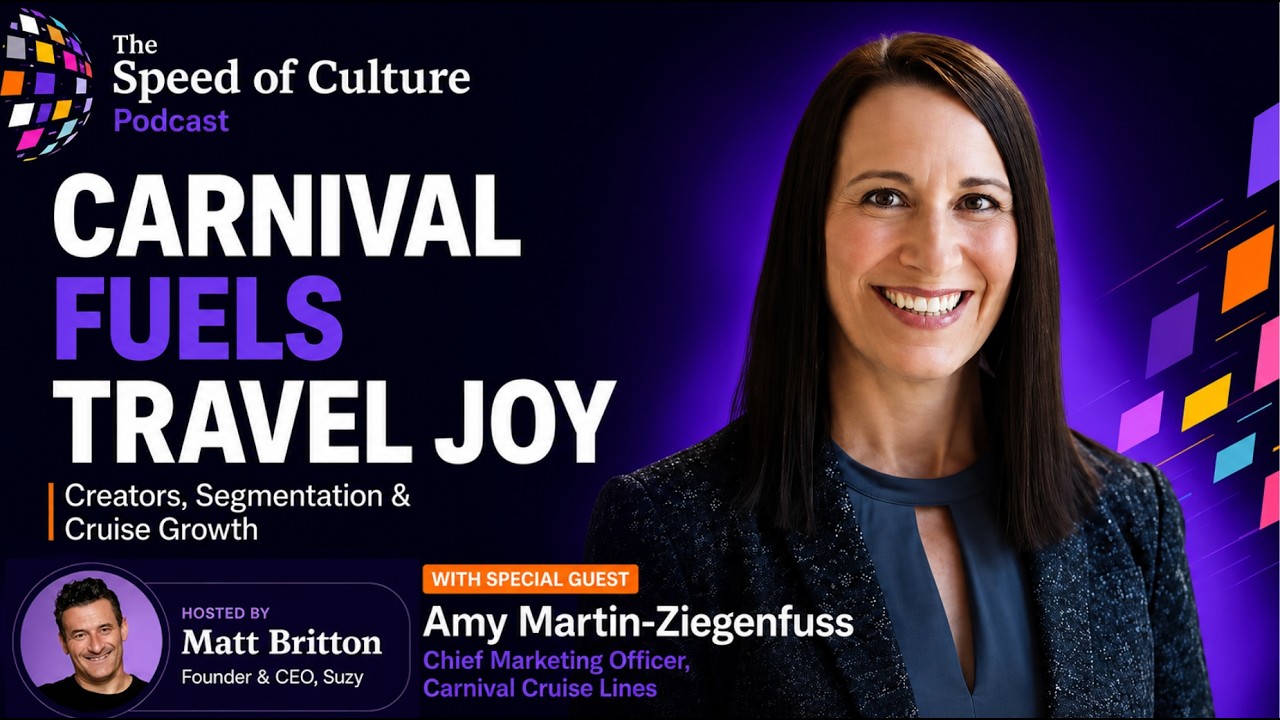
Speed of Culture Podcast Episode 136, which aired on October 29, 2024, brought this evolution into sharp focus through a conversation between host Matt Britton, founder and CEO of Suzy, an AI-powered consumer intelligence platform used by Fortune 500 companies, and Amy Martin-Ziegenfuss, Chief Marketing Officer of Carnival Cruise Lines.
The episode explores how one of the world's largest cruise operators is not only surviving but thriving in a post-pandemic travel environment marked by shifting consumer expectations, technological disruption, and a fundamental reimagining of what hospitality means. Martin-Ziegenfuss, who brings over 25 years of marketing expertise from her tenure at Hilton and Choice Hotels, reveals how Carnival is leveraging mindset-driven targeting, first-party data personalization, celebrity partnerships, and experiential marketing to reposition the cruise industry for a new generation of travelers.
The insights shared in this episode are critical for any marketer or executive seeking to understand how legacy travel brands adapt to generational shifts, what consumer intelligence reveals about travel behavior, and how data-driven personalization creates competitive advantage. The conversation underscores a larger trend: hospitality is about creating unforgettable experiences that align with consumer values, identity, and lifestyle aspirations.
For marketing leaders, business strategists, and professionals in the travel and hospitality sectors, Episode 136 serves as a masterclass in brand repositioning, consumer segmentation, and the role of authentic partnerships in building trust with skeptical, well-informed audiences. The episode also highlights why organizations like Suzy, which provide real-time consumer intelligence, have become indispensable tools for CMOs navigating rapid market changes and evolving customer expectations.
From Perception Problem to Category Leader: How Carnival is Redefining the Cruise Experience
For decades, the cruise industry carried stigma. Popular perception positioned cruises as floating retirement communities or cheap, overcrowded family getaways, lacking the prestige of international travel or the intimacy of land-based vacations.
Carnival, as the world's largest cruise operator by passenger volume, bore the brunt of this reputation. Yet within the last five years, particularly following the pandemic, the narrative has shifted dramatically.
Amy Martin-Ziegenfuss's appointment as CMO in May 2023 marked a strategic turning point for Carnival. Her mandate was clear: modernize the brand's marketing approach to appeal to younger, more diverse audiences while maintaining loyalty among existing customers.
Rather than relying on traditional demographic segmentation, Martin-Ziegenfuss implemented a mindset-based targeting strategy that shifts focus from age and income to attitudes, values, and desired experiences.
This approach proved transformative. The percentage of cruise passengers under 40 has risen from approximately 35% in 2019 to roughly 42% by 2024, according to industry analysis. More significantly, Carnival's "new-to-cruise" customers increased by over 30% in 2025 bookings compared to the prior year, a dramatic shift indicating that the perception problem was not insurmountable but rather a messaging and positioning challenge.
The key insight Carnival discovered: cruise vacations appeal to people with specific mindsets rather than specific demographics. A socially active 65-year-old seeking lively experiences, cultural engagement, and social interaction has more in common with a 35-year-old professional seeking the same qualities than either has with age-peers pursuing quiet, isolated vacations.
By targeting mindsets, “people who thrive in lively environments,” “seekers of authentic cultural experiences,” “value-conscious travelers seeking all-inclusive convenience” Carnival could cast a wider net while maintaining messaging coherence.
This reframing proved essential for overcoming decades of misconception. It positioned cruises not as budget alternatives to “real” travel but as comprehensive lifestyle experiences that deliver social engagement, culinary excellence, entertainment, and destination exploration, precisely the bundle of benefits that appeal across demographic boundaries.
Influencer Partnerships and Authentic Brand Ambassadors: Making the Invisible Visible
If mindset-based targeting provided the strategic framework for Carnival's repositioning, celebrity partnerships and influencer collaborations served as the execution vehicle. These partnerships were not incidental marketing tactics but core components of a sophisticated strategy to overcome what marketing researchers call “the perception-reality gap.”
Amy Martin-Ziegenfuss explains the logic clearly: for many prospective cruise passengers, particularly younger consumers without direct cruise experience, the onboard reality remains largely invisible. Promotional materials and website content can describe a Guy Fieri-branded dining venue or a Dr. Seuss-themed kids' area, but these descriptions fail to convey the actual sensory and emotional experience of being on a modern cruise ship.
Celebrity and influencer partnerships solved this visibility problem by leveraging trusted personalities to bring the experience to life “through their lens.”
Carnival's influencer strategy included collaborations with diverse content creators, from family-focused influencers like the McFarland family to lifestyle creators like My Rich BFF, who could authentically showcase cruise experiences to their engaged audiences. This user-generated and creator-generated content proved far more persuasive than traditional advertising, as it came from trusted voices and highlighted the diversity of cruise experiences available.
The impact extended beyond reach and engagement. These partnerships directly addressed misconceptions.
By featuring young professionals, multigenerational families, couples, and solo travelers, all clearly enjoying themselves, Carnival's influencer strategy demonstrated that cruises were not exclusively for families with young children or retirees. This simple but powerful message reframed cruise vacations as accessible and appealing to virtually any traveler with a social mindset.
Strategic brand collaborations amplified this effect. Partnerships with Guy Fieri, Dr. Seuss, and other recognizable brands created memorable onboard touchpoints that generated conversation and social sharing.
These collaborations served multiple functions: they differentiated Carnival from competitors, leveraged familiar brand equity to build consumer confidence, and created “Instagram-worthy” moments that encouraged passenger-generated content and organic social amplification.
First-Party Data and Hyper-Personalization: The Competitive Moat
While influencer partnerships addressed perception and drove customer acquisition, first-party data and personalization engines ensured that these newly acquired customers converted into repeat, high-value passengers. This distinction between acquisition and retention, and the data strategies that enable both, forms the true competitive advantage for modern cruise operators.
Carnival possesses an extraordinary asset: decades of accumulated first-party customer data. Every passenger interaction, from initial booking through post-cruise surveys, generates data about preferences, behaviors, cabin choices, dining patterns, activity selections, onboard spending, and likelihood to recommend.
This first-party data, collected directly from customers and owned entirely by Carnival, has become more valuable as third-party cookies disappear and regulatory frameworks like GDPR constrain data sharing.
Amy Martin-Ziegenfuss highlighted how this data advantage enables two distinct marketing strategies. For repeat cruisers, Carnival uses first-party data to deliver highly personalized communications and offers, highlighting cabin types similar to previously booked accommodations, suggesting itineraries matching past destinations, or promoting dining packages aligned with onboard spending patterns.
This personalization strengthens loyalty and increases customer lifetime value by demonstrating that Carnival understands individual preferences at a granular level.
For first-time cruisers, first-party data enables sophisticated lookalike and predictive targeting. By analyzing the characteristics of passengers who converted from awareness to booking, Carnival can identify similar prospects in its broader audience and tailor messaging to address the specific hesitations or interests that these similar segments likely experience.
This data-driven approach replaces generic advertising with surgical targeting based on actual conversion patterns.
The travel and hospitality industry at large has validated the ROI of first-party data strategies. Research indicates that 81% of hoteliers implementing first-party data strategies report measurable revenue lifts. For cruise operators, the impact is even more pronounced, as the high-touch, multi-month customer journey creates multiple touchpoints for data collection and personalization.
Looking ahead, cruise lines are integrating artificial intelligence and machine learning into their data strategies. A major North American cruise line recently deployed AI-powered digital assistants utilizing voice sentiment analysis to dynamically adjust recommendations based on real-time passenger sentiment.
This represents the frontier of personalization: not simply knowing what a passenger previously preferred, but understanding their current emotional state and optimizing the experience accordingly.
Experiential Marketing in the Age of Authenticity: Beyond Transactions to Transformation
The modern consumer, particularly younger travelers, exhibits sophisticated skepticism toward traditional marketing. They recognize advertising, discount its claims, and gravitate instead toward brands perceived as authentic and aligned with their values.
This shift has profound implications for hospitality marketing, where the product is inherently experiential and emotionally laden.
Carnival's approach to experiential marketing reflects this evolution. Rather than communicating the cruise experience through promotional claims or testimonials, Carnival creates opportunities for consumers to directly experience elements of the cruise.
Influencer partnerships, as discussed above, serve partly as experiential marketing, allowing followers to vicariously experience a cruise through trusted creators' perspectives.
But experiential marketing extends beyond digital channels. Carnival has invested in brand activations, ship tours, and community engagement programs that allow prospective customers to step aboard vessels, explore accommodations, dine at branded restaurants, and experience onboard entertainment.
These activations transform abstract marketing claims (“Our ships are state-of-the-art”; “Our dining is world-class”) into tangible, embodied experiences.
The broader travel and hospitality industry is undergoing a similar shift. Research on experiential marketing in cruise and travel sectors reveals several key trends:
- Younger travelers (Gen Z and Millennials) increasingly prioritize experiences over commodities. The percentage of cruise passengers under 40 has grown steadily, driven largely by the appeal of onboard experiences (live entertainment, cultural programs, culinary offerings, and social engagement) rather than destination-focused itineraries.
- Cruise lines are investing in immersive, destination-integrated experiences. Rather than positioning cruises as floating resorts that happen to visit ports, modern cruise marketing emphasizes authentic cultural engagement, shore excursions with local experts, and partnerships with destination communities.
- Culinary and cultural experiences have become primary differentiators. Celebrity chef partnerships, cooking demonstrations, cultural enrichment programs, and partnerships with local food traditions transform dining from a commodity into a memorable experience.
Carnival's strategic positioning as a provider of diverse, high-quality experiences, rather than as a budget-friendly transportation solution, fundamentally reframes the competitive landscape. It competes not against other cruise lines but against all vacation alternatives that offer comparable experience density and value, making the cruise category itself more attractive.
The CMO's Evolution: From Campaign Manager to Consumer Intelligence Strategist
Amy Martin-Ziegenfuss's journey from her previous roles at Hilton and Choice Hotels to CMO of Carnival illustrates how the role of Chief Marketing Officer has fundamentally evolved. In previous decades, the CMO was primarily responsible for creative execution, campaigns, messaging, channel strategy.
Today's CMO must be equally skilled in data strategy, consumer psychology, technology implementation, and organizational transformation.
The evolution reflects broader market conditions. Consumer attention has fragmented across countless channels and platforms. Purchase decisions increasingly involve digital research, peer recommendations, and social validation.
Brand perception is shaped not only by advertising but by influencer commentary, user reviews, community discussions, and uncontrolled word-of-mouth. In this environment, CMOs must combine sophisticated consumer intelligence capabilities with strategic agility and creative excellence.
Matt Britton, who conducted the Speed of Culture Podcast interview with Martin-Ziegenfuss, has long argued that consumer intelligence is the essential competitive advantage in an age of rapid behavioral change.
The companies that win in the next decade won't just collect data. They'll have conversations with their consumers at scale.
Britton founded Suzy, an AI-powered consumer research platform that allows brands to conduct real-time, quantitative research at scale. Suzy enables CMOs to move beyond traditional annual brand studies or quarterly focus groups to achieve continuous, real-time insight into evolving consumer attitudes and behaviors.
For Amy Martin-Ziegenfuss and her team at Carnival, this shift toward continuous consumer intelligence informed every major strategic decision. Rather than relying on assumptions about why younger consumers avoided cruises, Carnival could directly ask these consumers about their perceptions, hesitations, and unmet needs.
This consumer-centric research underpinned the insights that drove the mindset-based targeting strategy and influenced which partnerships and experiences would resonate most powerfully.
The CMO role has also expanded to include responsibility for organizational capability development. Modern CMOs must ensure their teams have skills in data analytics, marketing technology, consumer psychology, and cross-functional collaboration.
This represents a significant departure from previous eras, when strong creative or media-buying expertise was sufficient.
Looking forward, emerging technologies including artificial intelligence, advanced analytics, and predictive modeling will further expand CMO responsibilities. CMOs will need to understand not only what consumers think and feel but how to orchestrate intelligent systems that personalize experiences at unprecedented scale while respecting privacy and building genuine consumer trust.
Key Takeaways: Strategic Lessons for Marketing Leaders
- Mindset-Based Targeting Expands Market Opportunity: Rather than relying exclusively on demographic segmentation, sophisticated brands are adopting psychographic and mindset-based targeting that identifies consumers by attitudes and values. For Carnival, focusing on “people who thrive in lively environments” rather than “adults aged 25–40” fundamentally expanded addressable market and drove acquisition of younger passengers.
- First-Party Data is the Durable Competitive Advantage: As third-party data becomes restricted and regulatory frameworks tighten, first-party data collected directly from customers has become the most valuable marketing asset. The reported 81% revenue lift from first-party data strategies in hospitality validates this approach.
- Influencer Partnerships Overcome Perception-Reality Gaps: For products and services with significant visibility gaps, authentic influencer partnerships can bridge the gap more cost-effectively than traditional advertising.
- Experiential Marketing Drives Emotional Connection and Loyalty: Investment in brand activations, onboard experiences, and immersive marketing touchpoints generates greater engagement, loyalty, and word-of-mouth amplification than traditional campaign-based marketing.
- CMO Success Requires Continuous Consumer Intelligence: Organizations that institutionalize continuous market research, real-time consumer feedback, and data-driven decision making outpace competitors operating on annual planning cycles.
Frequently Asked Questions
How has Carnival addressed the traditional perception of cruises as budget-oriented or exclusionary travel?
Carnival's strategy has involved three complementary approaches: repositioning through mindset-based targeting, building authenticity through celebrity and influencer partnerships, and differentiating through experiential offerings. These strategies have proven successful, with passengers under 40 growing from 35% to 42%, and new-to-cruise customers increasing by over 30%.
What role does first-party data play in Carnival's competitive strategy?
First-party data, information collected directly from customers across booking, onboard, and post-cruise interactions, enables Carnival to deliver hyper-personalized marketing and experiences to repeat cruisers while using lookalike modeling and predictive analytics to acquire first-time cruisers. The hospitality industry broadly reports 81% revenue lifts from first-party data implementation.
How does experiential marketing differ from traditional cruise advertising, and why is it more effective?
Traditional cruise advertising relies on promotional claims and lifestyle imagery to communicate value and appeal. Experiential marketing creates direct consumer encounters with the brand experience through influencer partnerships, brand activations, onboard experiences, or destination-integrated programming, making it significantly more effective at building authentic brand perception and driving conversion.
What broader trends in the travel and hospitality industry support Carnival's strategic direction?
The cruise industry is experiencing significant tailwinds including growing interest from younger travelers, increasing demand for personalized and immersive experiences, heavy investment in technological innovation, sustainability initiatives attracting conscious consumers, and rising demand for expedition and exploration cruises. The 2025 Cruise Industry Report projects 37.7 million passengers globally, with market growth of 7.21% CAGR through 2035.
Looking Ahead: Resources for Modern Marketing Leaders
The strategic insights shared by Amy Martin-Ziegenfuss on Speed of Culture Episode 136 extend far beyond cruise marketing. They represent a masterclass in brand repositioning, consumer intelligence, and experiential marketing that applies across industries.
- Suzy. The AI-powered consumer intelligence platform founded by Matt Britton, enabling real-time market research and consumer insights at scale.
- The Speed of Culture Podcast. Featuring conversations with leading CMOs and marketing innovators, including Episode 136 with Amy Martin-Ziegenfuss.
- Generation AI: The Book. Matt Britton's exploration of how artificial intelligence is reshaping Generation Alpha and consumer behavior.
- AI Keynote Speaker. Matt Britton's speaking engagements on AI, generational shifts, and consumer evolution.
- Speaker HQ. A resource for organizations seeking world-class speaking talent on consumer behavior, AI, and generational trends.
This article is based on insights from Speed of Culture Podcast Episode 136, featuring an interview with Amy Martin-Ziegenfuss, Chief Marketing Officer of Carnival Cruise Lines, and host Matt Britton, founder and CEO of Suzy. The episode aired on October 29, 2024.
%20(400%20x%20100%20px)%20(300%20x%2050%20px)%20(150%20x%2050%20px).avif)