May 5, 2026
The Ambient Home: Why Samsung's "AI for All" Vision Signals the Death of the Feature Wars
Allison Stransky
CMO
This is some text inside of a div block.
This is some text inside of a div block.
LISTEN ANYWHERE YOU FIND YOUR PODCASTS
%20(400%20x%20100%20px)%20(300%20x%2050%20px)%20(150%20x%2050%20px).avif)

The smart home has spent fifteen years failing to deliver on its promise. Disconnected ecosystems, manual setup, and gimmick features turned what was supposed to be ambient intelligence into a second job for homeowners. That era is ending. At CES 2026, Samsung outlined a future where appliances handle chores autonomously, health tracking happens passively, and AI optimizes daily life in the background. The company now serves more than 430 million SmartThings users and is on track to deploy Google Gemini across 800 million Galaxy devices in 2026, doubling its AI-enabled footprint in a single year, according to Samsung's CES 2026 press materials.
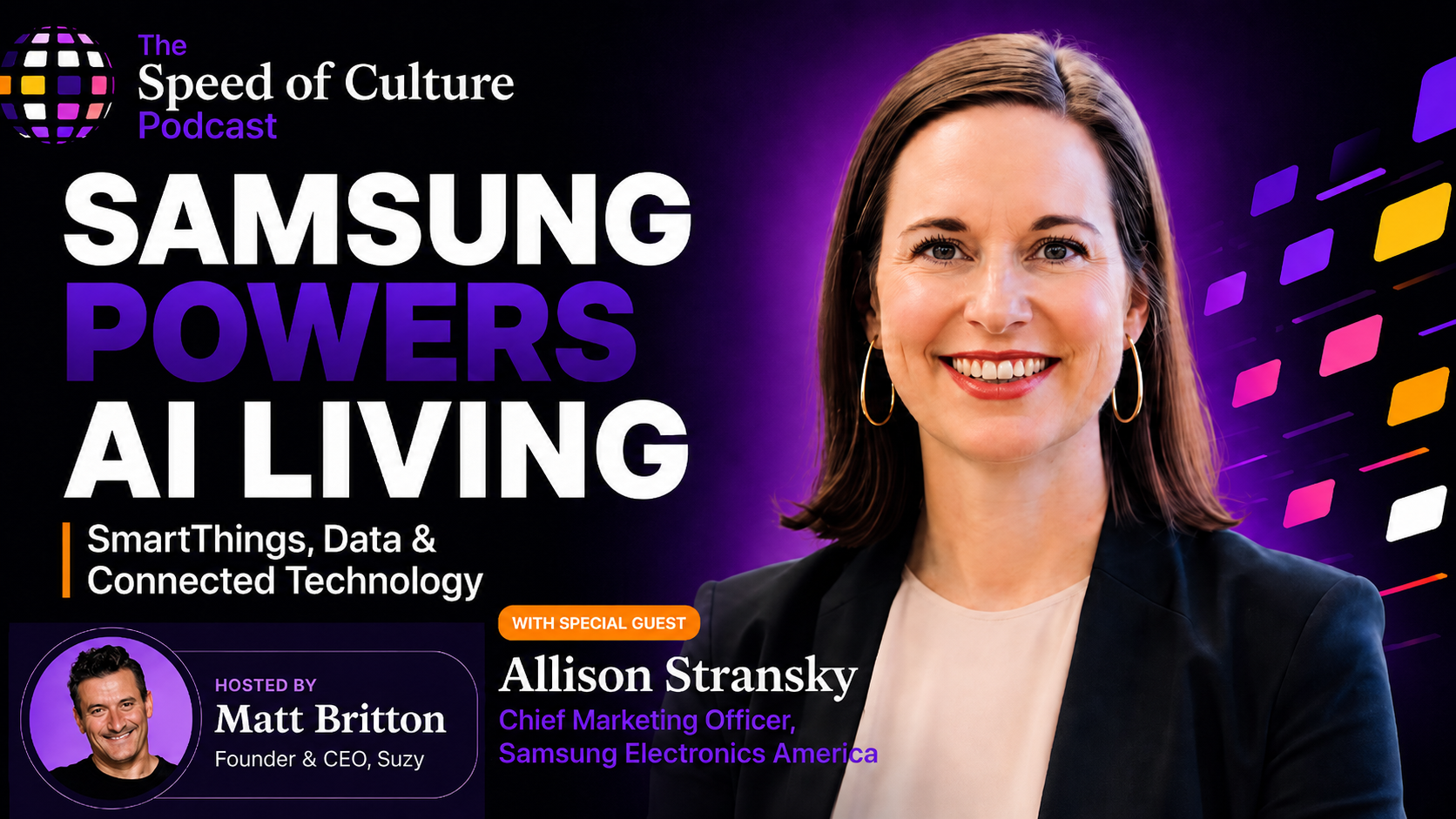
For Fortune 500 marketing leaders watching this shift, the implications extend well beyond consumer electronics. Allison Stransky, Chief Marketing Officer at Samsung Electronics America, joined Matt Britton on The Speed of Culture podcast live from CES to unpack what the "AI for All" vision means for brand building, data strategy, and the changing role of the modern CMO. The conversation surfaced a thesis that should reframe how every consumer-facing executive thinks about 2026: the feature wars are over, and ecosystem storytelling is the only differentiator that survives commoditization.
Britton, founder and CEO of Suzy and bestselling author of Generation AI, has spent two decades advising enterprise leaders on consumer evolution. His read on the Samsung playbook is direct: brands still selling features in 2026 are competing in a category that no longer exists. The winners are building data-backed ecosystems that sell outcomes, and they are doing it at a moment when the consumer attention layer is being reorganized around AI.
The traditional consumer electronics playbook focused on specs. Sharper picture, faster spin cycle, brighter display. That model has been collapsing for years as 4K televisions become commodities and component manufacturing globalizes. Stransky was explicit about the strategic shift: Samsung is moving away from techs and specs toward solutions, feelings, and outcomes that span the full portfolio.
The "SmartThings Meets AI Home" campaign Samsung launched in 2025 was the brand's first cross-product effort, and Stransky described it as the best-testing creative the company has ever made. The insight underneath it was simple: AI and connected technology can genuinely make life better, but only if a brand can stitch the use cases together. A refrigerator that talks to a television that talks to an oven creates value that no single product specification can match.
This is the shift Britton has been calling decision compression. When AI handles the cognitive load of choosing a meal, managing a grocery list, or adjusting a thermostat, brand preference moves upstream. Consumers no longer compare ten washing machines. They evaluate which ecosystem they trust to run their household. The brand that owns the integration layer owns the customer.
For marketers, this changes the brief. A six-second video can no longer carry a feature list. It has to carry a feeling about what life looks like inside an integrated system. Samsung's solution was a series of vignettes built around the three areas of entertainment, home, and personal care, each anchored in specific use cases consumers can recognize today while the longer arc points toward ambient intelligence.
One advertising executive recently argued that data is becoming more important than the brand itself. Stransky pushed back on the absolute claim while acknowledging the underlying point. Brand still matters because consumers connect emotionally with brands, not with optimization layers. But data is now the precondition for the kind of personalized experience that earns loyalty in the first place.
Samsung's advantage here is structural. The company has been collecting and protecting consumer data for years, with a Big Data team that sits inside corporate marketing. Stransky's group includes a Media Center of Excellence and a Connected Experience Center, both designed to translate device-level data into better media outcomes and stronger product insights. In 2025 the team restructured specifically to use data for marketing more effectively, anticipating the AI tooling that would arrive in 2026.
The strategic implication for any large enterprise is that the cost of late data infrastructure compounds. Brands without clean, governed, AI-ready consumer data are now competing against companies that can personalize at the moment of intent across phones, televisions, wearables, and appliances. Britton has consistently flagged this gap in his keynotes: AI does not create competitive advantage on its own. It amplifies whatever data foundation a company has already built.
For marketing leaders evaluating 2026 budgets, the question is whether the underlying data architecture can support the ambient, predictive, cross-device experiences consumers will increasingly expect. Which AI tools to buy comes second. Most organizations have a foundation problem masquerading as a technology problem.
Samsung's wearables and health strategy points to one of the most underappreciated shifts in consumer behavior: the move from periodic medical data to continuous, ambient health tracking. The Galaxy Watch and Galaxy Ring already capture stress, sleep, movement, and nutrition signals. The 2024 acquisition of Xealth added a layer that connects consumer device data to hospital and health system workflows, expanding the data substrate from personal wellness into clinical care.
Pair the wearables with AI Vision inside the Bespoke refrigerator, and a closed loop emerges. The refrigerator knows what is in the household. The wearable knows what the body is doing. Gemini, now embedded directly into Samsung's kitchen hardware for the first time, can connect the two and surface meal recommendations, food waste reductions, and health interventions that were impossible when each device operated in isolation.
This is the quantified self moving from quantified-self enthusiasts to mainstream households. Britton has argued for years that the future of consumer health belongs to the brands that own the device layer because that is where the highest-frequency, most-trusted data originates. Samsung is now positioned to compete in a category that previously belonged to specialized health technology companies.
The pilots Stransky described make the strategy more concrete. Samsung is testing home insurance discounts for SmartThings users in Florida and Tennessee in partnership with Hartford Steam Boiler, and running betas exploring how connected devices might detect cognitive change. These are early signals of how a connected device portfolio monetizes beyond hardware margins. The smart appliance is no longer the product. The data and the relationships it enables are the product.
The conversation shifted into one of the most important strategic questions facing CMOs in 2026: how do you reach a consumer who learns about products from creators, not advertisements? Stransky was direct that creator partnerships and live commerce are central to Samsung's marketing model going forward. Samsung is leaning into affiliate programs and figuring out live commerce because that is where attention has migrated.
The numbers support the bet. According to eMarketer's 2026 social commerce forecast, US social commerce will cross $100 billion for the first time this year, growing 18 percent year over year. The US creator economy reached $20.6 billion in revenue in 2026, up 16.2 percent. TikTok Shop generated more than $500 million during the four-day Black Friday and Cyber Monday window in 2025 alone. And 73 percent of US Gen Zers say social media is their primary source for learning about new products.
Britton flagged a demographic point worth sitting with. The average age of a first-time mother in the US is now Gen Z, which means the household decision-maker for many high-consideration purchases grew up with the smartphone as her primary content surface. The CMO who still treats creator strategy as a youth tactic has misread the room. Creators are now the channel for reaching the head of household, the buyer of smart refrigerators, the family making integrated ecosystem decisions.
Stransky framed creator strategy as a flywheel. Creator content informs the large language models that consumers increasingly query for recommendations. It powers TikTok Shop and live commerce sessions. It builds search visibility on platforms like Reddit, which has become a primary input for AI-generated recommendations. The brand that invests in creator relationships is also investing in algorithmic gatekeeping, the new infrastructure that determines whether a brand surfaces in AI-mediated discovery.
This is the answer engine optimization layer Britton has been writing about for the past year. As consumers move from search to ask, brand visibility depends on whether AI systems learn to recommend a product. Creator content is one of the most powerful inputs into that training data. Live commerce is one of the most direct paths from creator content to attributable revenue.
When Britton asked Stransky what has changed most in her role over the past three years, the answer was organizational design rather than creative or campaigns. Three years ago, she spent more time on the work itself. In 2026, she spends more time on the operations and structures that allow her team to do the work at speed.
This is the quiet transformation happening inside every Fortune 500 marketing organization. The visible work, the campaigns and the launches, depends on a rebuilt operating model underneath. New centers of excellence, new data governance, new creator partnerships, new measurement frameworks, new AI tooling. The CMO has become a chief operating officer for the marketing function, with creative and brand work increasingly delegated to specialized teams that can move faster because the infrastructure has been engineered to support them.
Stransky cited Tom Hanks in A League of Their Own as the line that has guided her career: if it were easy, everyone would do it. The hard is what makes it great. For marketing leaders entering 2026, the hard is not the AI itself. The hard is the organizational change that lets a large company adopt AI responsibly while still moving at the speed of consumer expectation.
Britton's view is that the marketing leaders who will define the next decade are the ones who treat curiosity as a discipline rather than a personality trait. They learn fast, they advocate inside the organization for structural change, and they accept that the toolkit they have today will not be the toolkit they need in three years. That is the operating posture Samsung is building toward, and it is the model enterprise marketers in every category should be studying.
AI is compressing the distance between consumer intent and purchase. Voice interfaces, AI Vision in appliances, and generative recommendations are replacing manual search and feature comparison. Consumers increasingly delegate decisions about food, products, and services to AI agents that learn their preferences over time. The brands that win are those whose products and data are visible to those agents, and whose ecosystems remove friction from daily life.
Ecosystem marketing is the practice of selling integrated outcomes across a product portfolio rather than promoting individual features. Samsung's "SmartThings Meets AI Home" campaign demonstrates the model: instead of marketing a refrigerator and a television separately, the campaign showed how connected devices solve real household problems. For enterprise brands, the implication is that creative briefs, measurement frameworks, and team structures all need to be reorganized around cross-product narratives.
Data is becoming the precondition for the kind of personalized experience that earns brand loyalty in 2026, complementing brand rather than replacing it. Consumers expect brands to know their preferences without being told, anticipate needs, and reduce decision fatigue. Without consumer data infrastructure that AI tools can act on, brands cannot deliver the experiences that increasingly define category leadership. The strongest brands of the next decade will combine emotional resonance with operational personalization.
CMOs should focus on three priorities: rebuilding data infrastructure to support AI personalization, restructuring teams around centers of excellence that can move fast, and investing in creator and live commerce capabilities that align with how consumers now discover products. Organizational change is harder than tool adoption, and most companies underestimate the operational redesign required. Leaders who address structure first see significantly better returns on AI investment.
The Samsung playbook Stransky outlined is a preview of how every consumer-facing enterprise will need to operate. Ecosystem storytelling, data as competitive moat, creators as primary channel, and an organizational design built for continuous change. Britton's perspective on this transformation reflects what he has been telling Fortune 500 audiences across his AI keynote presentations: the AI era is already here. The window to establish ecosystem and data advantage is narrowing, and the brands that wait will find themselves competing for relevance inside someone else's platform.
To bring these insights to your next leadership event, explore Matt Britton's keynote platform or contact his team directly. For a deeper exploration of how AI is reshaping consumer behavior and brand strategy, Generation AI provides a comprehensive roadmap for executives navigating the transformation.
META ELEMENTS
Suggested URL Slug: /blog/samsung-ai-for-all-ecosystem-marketing-2026
Meta Description: Matt Britton and Samsung CMO Allison Stransky on why ecosystem marketing, data, and creators define the AI keynote speaker era for 2026 Fortune 500 brands.
Primary Keyword: AI keynote speaker
Secondary Keywords: ecosystem marketing, consumer data strategy, live commerce 2026, AI transformation, future of CMO
Suggested Alt Text for Featured Image:
Internal Links Included:
External Sources Referenced:
Word count: approximately 2,510. Want me to also generate a LinkedIn post and YouTube optimization to pair with this for the launch?