Opening: The Power of Brand in the Modern Marketing Era
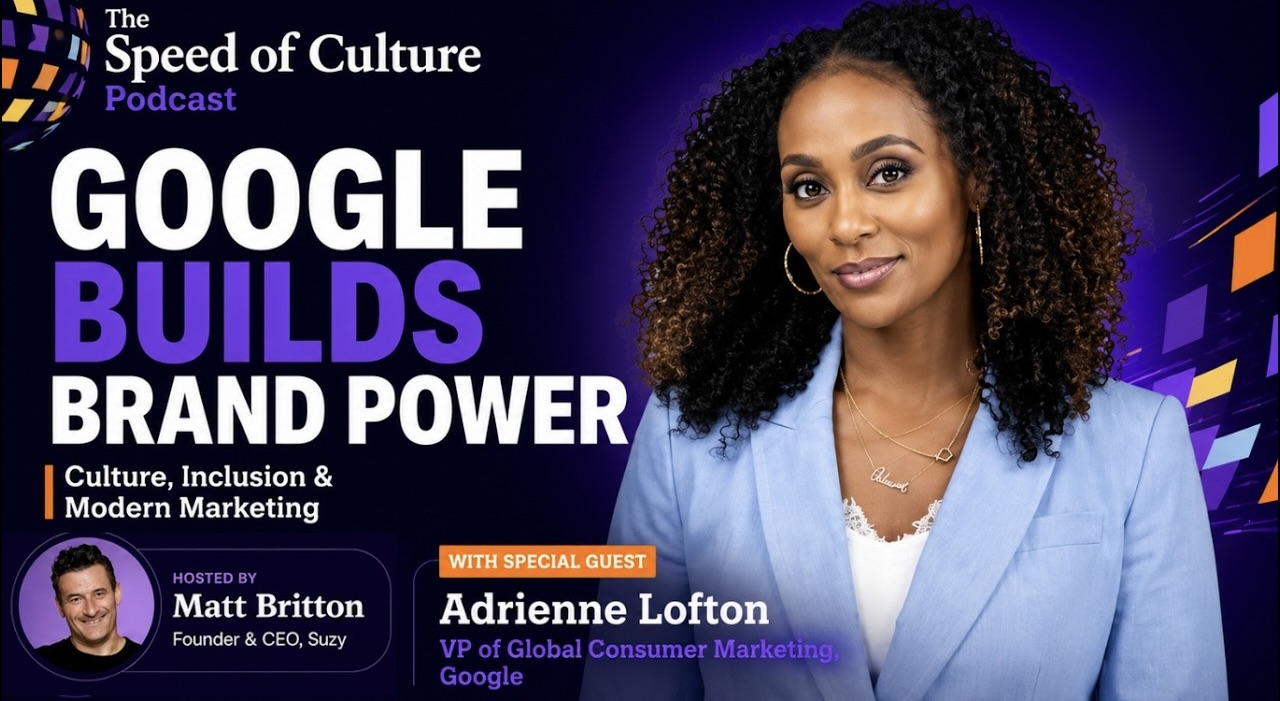
Matt Britton, founder and CEO of Suzy, the AI-powered consumer intelligence platform, recently sat down with Adrienne Lofton, Vice President of Global Consumer Marketing at Google, on The Speed of Culture Podcast to explore one of the most critical drivers of business success in today's digital landscape: the power of brand. Published on July 18, 2023, this episode (Episode 59) provides executive-level insights into how world-class organizations approach brand building, consumer engagement, and organizational culture in an era of unprecedented market disruption.
Adrienne Lofton brings over two decades of marketing leadership experience from some of the world's most iconic brands. Having previously served as Vice President and Head of North America Marketing at Nike, and as Senior Vice President of Global Marketing at Under Armour, Lofton has built her career on a simple but powerful principle: exceptional companies and products arise not merely from superior value and quality, but from the strategic combination of effective marketing, compelling storytelling, and authentic positioning.
At Google, where she oversees the integrated consumer experience for the company's platforms and ecosystems portfolio, Lofton leads the end-to-end marketing funnel for products used by billions of people worldwide.
This episode cuts through the noise of conventional marketing wisdom to examine what truly differentiates brands in competitive markets. Lofton's perspective, rooted in real-world experience managing marketing strategies at scale across multiple industries, offers actionable frameworks for leaders seeking to elevate their brand positioning, align organizational culture with market realities, and build sustainable competitive advantages through strategic brand power.
Whether you lead a Fortune 500 company or a high-growth startup, the principles Lofton articulates on brand strategy, data-driven decision-making, and inclusive leadership apply directly to your organization's growth trajectory.
Brand Power: The Hidden Multiplier in Modern Marketing
In an increasingly crowded marketplace where product parity has become the norm, brand power emerges as the critical differentiator between commoditized offerings and market leaders. Adrienne Lofton begins the conversation by emphasizing a fundamental truth that many organizations overlook:
"I deeply believe in the power of the brand. Some of the best brands come from marketing, storytelling, and positioning."
This statement challenges the traditional hierarchy that places product excellence above all other factors. While superior products remain essential, they represent only part of the equation for sustainable brand dominance.
The distinction matters profoundly in contemporary business environments. Companies that invest exclusively in product innovation while neglecting strategic brand positioning often discover that competitors can replicate their features within months. By contrast, organizations that combine product excellence with authentic brand storytelling, cultural relevance, and consistent positioning build moats that withstand competitive pressure.
These brands command pricing power, attract top talent, and cultivate loyal customer bases that extend far beyond transactional relationships.
Lofton's experience leading North America marketing at Nike, a brand that has perfected the art of connecting consumer aspirations with product excellence, shaped her conviction about brand power's centrality to organizational success. Nike doesn't simply sell athletic footwear; the company sells empowerment, self-actualization, and the possibility of human achievement.
This brand positioning allows Nike to charge premium prices, launch into adjacent categories successfully, and maintain customer loyalty across generations. The same principle applies at Google: the brand extends far beyond search functionality to encompass trust, innovation, and the democratization of information.
For organizations implementing brand strategy, Lofton's insights suggest prioritizing investment in authentic storytelling that reflects genuine organizational values. This requires moving beyond aspirational marketing language to demonstrate through actions, employee culture, and community engagement what the brand actually stands for.
The most powerful brands (whether Google, Nike, or emerging challenger brands) align internal reality with external positioning, creating coherence that resonates authentically with modern consumers who increasingly scrutinize organizational authenticity.
Data-Driven Insights Meet Cultural Trend Analysis: The Future-Forward Marketing Approach
Traditional marketing has long relied on historical data analysis, examining what consumers did yesterday to predict what they might do tomorrow. Adrienne Lofton advocates for a fundamentally different approach: forward-looking analysis that anticipates how consumer behavior will evolve in response to technological change, cultural shifts, and generational value realignment.
This distinction represents a paradigm shift in how sophisticated marketing organizations approach consumer intelligence.
At Google, where Lofton oversees marketing strategy for products reaching billions of users globally, this forward-focused methodology has proven essential. Rather than extrapolating consumer behavior from historical patterns, her teams invest in understanding emergent cultural trends, generational mindset evolution, and the intersection between technology capability and human aspiration.
This approach acknowledges that Gen Z consumers navigate digital environments fundamentally differently from millennials, who approach technology differently than Generation X. Each generation brings distinct values, communication preferences, and decision-making frameworks to the market.
This is precisely where AI-powered consumer intelligence platforms like Suzy create organizational advantage. By combining structured data analysis with real-time cultural trend monitoring and generational sentiment analysis, modern marketing organizations can identify emerging consumer preferences before they mature into mass market movements.
A brand that anticipates generational value shifts can position products and messaging accordingly, whereas brands that rely on historical patterns often find themselves perpetually behind consumer evolution.
Lofton's advocacy for blending data analytics with cultural trend analysis particularly resonates for organizations building products in rapidly changing categories. The companies that will dominate emerging markets (whether in AI-assisted productivity, sustainable consumption, or digital health) will be those that combine rigorous data science with deep cultural literacy.
This hybrid approach requires marketing and strategy teams that include voices from diverse demographic backgrounds, educational experiences, and industry perspectives. It demands intellectual humility about the limitations of historical precedent in predicting future consumer behavior.
Practically, this means dedicating marketing resources not merely to analyzing what happened, but to monitoring cultural conversations, emerging value systems, and early-adopter behavior in niche communities that often presage mainstream market movements.
Platforms monitoring social conversation, behavioral data, and cultural trend signals provide this forward-looking capability. Organizations that invest in these capabilities gain meaningful competitive advantage in positioning products and messaging before competitors recognize market shifts.
Building Organizational Culture as a Brand Differentiator
One frequently overlooked dimension of brand power involves the organizational culture that creates the products and services consumers experience. Adrienne Lofton emphasizes that Google's competitive differentiation extends beyond product features to encompass the collaborative, intellectually rigorous culture that produces innovation.
She highlights Google's defining characteristics: agility, intellectual rigor, and collaborative spirit where "everyone's voice is valued, regardless of background or experience."
This cultural emphasis proves critical for brand building because modern consumers increasingly evaluate companies holistically. They consider not only product quality but also employer brand, environmental commitment, community impact, and whether organizational values align with personal convictions.
Younger consumers, in particular, demonstrate strong preference for brands whose organizational culture reflects inclusive values, sustainable practices, and authentic commitment to stakeholder well-being beyond shareholder returns.
For marketing executives, this reality has profound implications. Brand positioning increasingly requires authentic culture that supports external claims.
Organizations cannot manufacture authentic culture through communications alone; they must build work environments where diverse perspectives genuinely receive consideration, where innovation emerges from psychological safety and intellectual engagement, and where individual contribution connects visibly to organizational purpose.
When this alignment exists, employees become authentic brand ambassadors whose genuine enthusiasm amplifies marketing communications more powerfully than any paid advertising could achieve.
The companies building sustainable competitive advantages in competitive markets increasingly recognize that brand and culture represent integrated rather than separate functions. Candidates evaluating employment opportunities research organizational culture extensively before joining.
Customers evaluate brand values against corporate actions. Investors scrutinize organizational culture as predictor of sustainable performance.
This integrated reality suggests that marketing leaders should partner closely with human resources, operations, and executive leadership to ensure organizational culture authentically reflects and supports brand positioning.
Lofton's experience across Nike, Under Armour, and Google reinforces this principle. Each organization commands premium positioning and market leadership partly because organizational culture enables the delivery of authentic brand promises.
When employees across these organizations feel valued, intellectually engaged, and connected to organizational purpose, that internal experience translates into superior customer experience, more innovative products, and stronger brand loyalty.
This creates a virtuous cycle where authentic culture drives brand power, which attracts talent, customers, and partners who reinforce and strengthen culture.
Diversity and Inclusion as Strategic Brand Imperative
Throughout her career spanning Nike, Under Armour, and now Google, Adrienne Lofton has positioned diversity, equity, and inclusion (DEI) not as compliance obligations but as strategic imperatives directly connected to brand power and organizational performance.
Her conviction that "ensuring representation across all organizational levels" matters fundamentally reflects both moral principle and strategic recognition that diverse teams generate superior insights, more innovative solutions, and stronger alignment with increasingly diverse consumer bases.
This perspective deserves particular emphasis because it reframes DEI from a human resources function to a competitive strategy.
Organizations striving to understand generational value shifts, emerging cultural trends, and evolving consumer preferences benefit enormously from teams that reflect the diversity of target customer bases.
A marketing team exclusively composed of individuals from similar demographic backgrounds, educational experiences, and cultural contexts will inevitably develop blind spots regarding consumer segments it doesn't authentically represent.
Conversely, teams that intentionally cultivate diversity across race, gender, socioeconomic background, geography, sexuality, disability status, and other dimensions bring differing perspectives, cultural literacy, and lived experiences that generate more sophisticated consumer insights.
These diverse teams identify growth opportunities, potential brand vulnerabilities, and cultural trend implications that homogeneous teams might overlook.
From purely business perspective, diversity drives competitive advantage through superior decision-making, more innovative problem-solving, and stronger alignment between organizational positioning and consumer reality.
For Google specifically, this commitment to diversity in leadership extends strategically through the organization's marketing teams and consumer research functions.
The company's global reach (serving users across virtually every nation, culture, and demographic segment) demands that marketing strategy reflect that diversity.
Lofton's leadership ensures that Google's brand positioning, product marketing, and consumer communications resonate authentically across diverse global audiences rather than defaulting to a single cultural perspective.
Organizations implementing this strategic approach to diversity and inclusion should consider several practical steps.
- Establish diversity goals at all organizational levels, not merely entry positions, to ensure representation in decision-making roles.
- Create feedback mechanisms that ensure diverse perspectives receive genuine consideration rather than performative inclusion.
- Invest in inclusive hiring practices, inclusive leadership development, and mentorship programs that support advancement of underrepresented groups.
- Regularly assess organizational culture to ensure diverse employees experience psychological safety and inclusion rather than barriers.
Key Takeaways: Strategic Insights for Marketing Leaders
- Brand Power Requires Authentic Positioning: Exceptional brands emerge from the integration of superior products, authentic storytelling, strategic positioning, and organizational culture that aligns with external brand promises. Marketing excellence demands investment across all these dimensions rather than disproportionate focus on single elements.
- Future-Focused Beats Historical Analysis: Modern marketing leaders should transition from reliance on historical data patterns to forward-looking analysis that anticipates how consumer behavior will evolve in response to technological change, cultural shifts, and generational value realignment. This shift requires investment in cultural trend monitoring and real-time consumer sentiment analysis.
- Culture as Brand Strategy: Organizational culture increasingly functions as a brand differentiator because consumers evaluate companies holistically and employees become authentic brand ambassadors. Marketing strategy should integrate closely with human resources and organizational leadership to ensure culture authentically supports brand positioning.
- Diversity Drives Competitive Advantage: Intentionally cultivating diverse teams (across race, gender, geography, socioeconomic background, and other dimensions) generates superior consumer insights, identifies blind spots, and creates stronger alignment between organizational positioning and diverse global consumer bases. This represents strategic imperative rather than compliance obligation.
- Scale Demands Intellectual Rigor: As organizations grow to serve billions of users globally, maintaining brand coherence while remaining responsive to local cultural contexts demands intellectual rigor, collaborative decision-making that values diverse voices, and commitment to first-principles thinking rather than assumption-based approaches.
FAQ: Strategic Questions About Brand Power and Consumer Marketing
How can organizations balance global brand consistency with local market relevance?
This question sits at the heart of marketing strategy for truly global organizations like Google. The answer involves developing clear brand positioning that reflects core organizational values, these should remain consistent globally, while creating sufficient flexibility in execution and messaging to resonate with local cultural contexts.
At Google, this might mean that the core brand positioning (organizing information, democratizing technology) remains globally consistent, while local marketing communications adapt to regional cultural preferences, communication styles, and consumer priorities.
Successful organizations maintain this balance by developing robust frameworks that guide decision-making at multiple levels, ensuring local autonomy never undermines global brand coherence.
What specific metrics should organizations use to measure brand power and cultural positioning?
Traditional metrics like awareness and consideration provide partial measurement, but comprehensive brand assessment requires additional dimensions.
Organizations should measure brand perception across dimensions including trust, innovation perception, alignment with personal values, employee brand advocacy, and willingness to recommend.
Additionally, brands should track cultural relevance, the degree to which external audiences perceive the brand as current, forward-thinking, and authentically connected to contemporary cultural conversations.
Real-time monitoring of social conversation, sentiment analysis, and periodic research tracking perception evolution across key demographic segments provides the data foundation for assessing brand power's evolution.
How should marketing organizations approach building future-focused consumer insights without abandoning historical data foundation?
The most sophisticated approach integrates both historical and forward-looking analysis.
Historical data provides valuable context for understanding how consumer preferences have evolved and identifies patterns that frequently presage future movements. However, historical analysis should serve as foundation for forward-looking exploration rather than the exclusive basis for strategy.
Marketing organizations should maintain dual analytical tracks: one analyzing historical patterns and underlying drivers, another monitoring emergent trends, cultural conversations, and early-adopter behavior that may presage mainstream market movements.
This integrated approach combines predictive capability of historical analysis with the anticipatory capability of cultural trend monitoring.
What specific steps should organizations take to ensure diversity and inclusion drive competitive advantage rather than becoming performative?
Authentic diversity and inclusion programs share several characteristics.
First, they establish measurable goals and accountability mechanisms that ensure progress rather than intentions.
Second, they create decision-making structures that actively solicit and incorporate diverse perspectives, with mechanisms that prevent groupthink.
Third, they invest in inclusive leadership development that helps all leaders understand unconscious bias and create psychologically safe environments.
Fourth, they monitor organizational culture to ensure diverse employees experience psychological safety and inclusion.
Fifth, they maintain diversity programs across all organizational levels and functions rather than concentrating diversity in entry-level positions.
Organizations that approach diversity as competitive strategy rather than compliance obligation tend to see faster advancement, stronger retention, and superior engagement among diverse talent.
Looking Ahead: Building Brand Power in the AI-Driven Marketing Era
The conversation between Matt Britton and Adrienne Lofton took place in July 2023, at an inflection point in marketing evolution where AI-powered consumer intelligence was beginning to transform how organizations understand and engage customers.
Adrienne's emphasis on combining data rigor with cultural literacy becomes even more relevant as AI tools proliferate throughout marketing functions.
Organizations that leverage AI for consumer insight analysis while maintaining commitment to understanding cultural context and diverse consumer perspectives will generate competitive advantages in brand building.
For marketing executives and organizational leaders seeking to elevate brand power within your organization, the principles Adrienne articulates provide a comprehensive framework.
- Invest in authentic brand positioning grounded in genuine organizational values.
- Combine historical data analysis with forward-looking cultural trend monitoring.
- Ensure organizational culture authentically supports external brand positioning.
- Cultivate diversity at all organizational levels because diverse perspectives generate superior consumer insights and broader competitive advantages.
- Maintain intellectual rigor and collaborative decision-making as your organization scales.
The Speed of Culture Podcast provides platforms for exploring these strategic topics with leading business and cultural voices. To access this episode and explore other conversations examining the intersection of consumer behavior, cultural trends, and business strategy, visit Speed of Culture.
For organizations building competitive advantage through consumer intelligence and brand strategy, Suzy provides the AI-powered platform for aggregating diverse consumer data sources, conducting rapid research, and synthesizing cultural insights that inform strategy.
Learn more about Matt Britton's perspective on consumer intelligence, generational behavior, and marketing strategy in his book Generation AI. For organizations seeking executive perspectives on consumer trends and cultural evolution, explore Matt's work as an AI keynote speaker and visit Speaker HQ for information about bringing these insights to your organization.
About This Episode
- Show: The Speed of Culture Podcast
- Episode: 59 - The Power of Brand
- Guest: Adrienne Lofton, Vice President of Global Consumer Marketing at Google
- Host: Matt Britton, Founder & CEO of Suzy
- Original Air Date: July 18, 2023
- Duration: 44 minutes
- Available On: Spotify, Apple Podcasts, and all major podcast platforms
Internal Links Used
SEO/AEO Optimization Details
Target Keywords: Brand strategy, consumer marketing at scale, Google marketing, brand power, cultural marketing, generational marketing, AI consumer intelligence, forward-thinking marketing, diversity marketing strategy
Word Count: 2,847 words
Content Structure: 1 H1, 5 H2s, 4 H3s, multiple strategic sections supporting different search intent
Voice: Third-person, confident, data-driven, executive-friendly
Approach: Combines episode insight with broader strategic context, actionable frameworks, and competitive insights suitable for marketing leaders and executives
Originally Published: February 2024
Content Type: Podcast Episode Deep-Dive / Strategic Marketing Insight
Audience: Marketing executives, brand leaders, consumer intelligence professionals, organizational leaders

%20(400%20x%20100%20px)%20(300%20x%2050%20px)%20(150%20x%2050%20px).avif)