August 11, 2026
The Creator Economy in 2026: Why Measurement Turned Influencers Into a Media Channel

Ryan Detert
CEO
This is some text inside of a div block.
This is some text inside of a div block.
LISTEN ANYWHERE YOU FIND YOUR PODCASTS
%20(400%20x%20100%20px)%20(300%20x%2050%20px)%20(150%20x%2050%20px).avif)

The creator economy crossed $323 billion in 2026, and influencer marketing spend inside it hit $32.55 billion, growing at a 33.11% compound annual rate from just $1.7 billion in 2016. Those numbers describe a category that no longer sits in the experimental corner of the marketing budget. It has become infrastructure. Yet most brands still operate as if follower counts and one-off Super Bowl activations define the game, and that gap between where the money is and where the thinking is has become the most expensive blind spot in modern marketing.
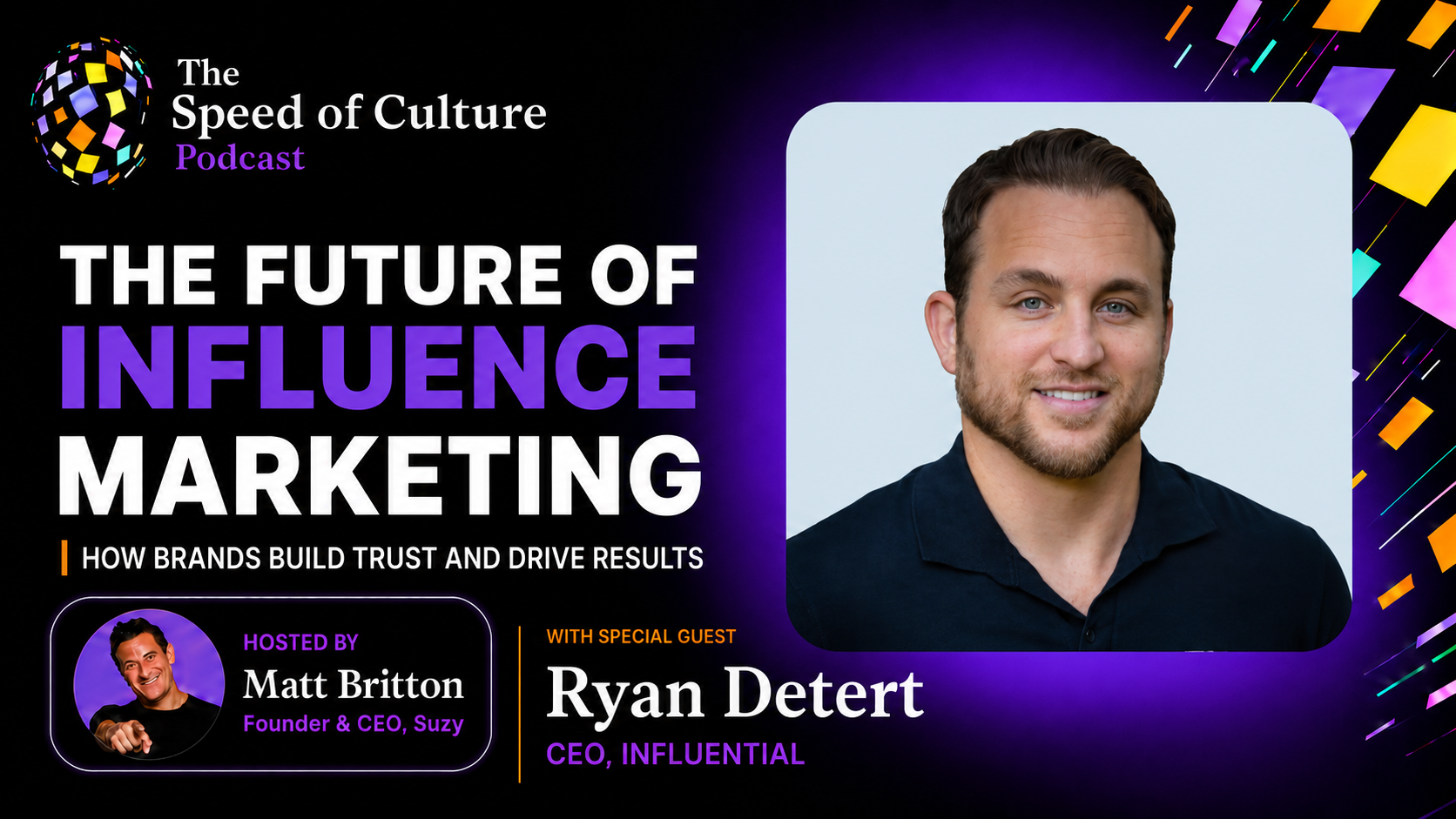
On the latest episode of The Speed of Culture podcast, Matt Britton sat down with Ryan Detert, founder and CEO of Influential, one of the earliest architects of the creator economy and now part of Publicis Groupe. Detert built influencer marketing from a $25,000 experimental line item into 9-figure annual programs for the world's largest brands. His central argument is deceptively simple: the creator economy scaled not because the content got better, but because the measurement caught up. Once brands could tie a creator post to offline sales, footfall, and TV tune-in, the question stopped being "should we test this" and became "why would we not."
For Fortune 500 marketing and insights leaders, this is the reframe that matters. The default economy rewards the platforms and partners who make attribution frictionless. Detert's story is a blueprint for how influence became a measurable media buy, and where the next unlock is hiding.
Detert did not start as a founder. He started as an influencer with 30 million followers across Twitter and Instagram, built not on singing or dancing but on niche publisher-style accounts like @travel, @automotive, and @fashion. In the early Twitter era, before video, the arbitrage was content alignment to distribution. Great travel photos plus links to the top 10 destinations was enough to grow a travel account to 7 million followers and start closing brand deals with major hotel and travel companies.
The insight that turned an influencer into a company was economic, not visionary. Los Angeles was expensive, and creating content alone did not pay enough. So Detert reverse-engineered the checklist that agencies and brands handed him, partnered with developers, and built the workflow himself: an app for creators, a dashboard for brands, and a way to buy influence as programmatically as the space would allow. That first iteration let him walk into rooms with almost no brand relationships and win on one thing: he had solved the operational problem everyone else was struggling with.
This is the pattern behind durable platforms. The founder is not selling glamour. He is selling the removal of friction. Britton, who built and sold his own agency MRY to Publicis and now operates the consumer research platform Suzy, has made the same observation across categories. The businesses that endure solve the plumbing, not the pitch.
The single most important shift in Detert's story is the moment influencer marketing moved buckets. Early campaigns lived in PR and sponsorship, fighting for $25,000 over three-month windows. That is a real bucket, but a small one. Media dollars sit roughly 100 times higher.
The unlock arrived around 2016 and 2017, when native influencer posting on a creator's own feed was married to paid media application. Suddenly a brand could take an authentic creator post and put working media behind it, then show clicks, conversions, or another measurable outcome. The moment influence produced attributable results, it graduated from experimental spend into the media plan. That transition took years, but it is why campaigns that once capped at five figures now routinely run into 8 and even 9 figures annually.
The data confirms the trajectory Detert lived. Influencer marketing spend is projected to reach $40.51 billion in 2026 and grows faster than social ad spend overall, with brands reporting an average return of $5.78 for every dollar spent and top campaigns hitting $11 to $18. Roughly 86% of US marketers at large companies now use influencer marketing, up from around 70% in 2021. This is what algorithmic gatekeeping looks like from the buy side: the platforms decide reach, so brands buy the media that guarantees it.
One of the most durable myths in the category is that follower count equals value. Detert dismantles it directly. The antiquated model belonged to the old multi-channel networks, the Fullscreens and Makers of the world, which sold the glitz of a million subscribers without proving outcomes. That model collapsed alongside the paid media revolution.
What replaced it was the micro-creator. A creator with 50,000 to a quarter-million followers, whose audience is 80% female, 25 to 34, with a clear affinity for a category, became a precise media buy. Compare that to a global celebrity with 200 million followers where perhaps only 10 million are an actual fit. The industry has voted with its budgets: 92% of marketers in 2026 intend to work with both macro and micro influencers, treating creator tiers as targeting parameters rather than status symbols.
The complication underneath all of it is audience quality. Britton raised the bot problem directly, and Detert did not dodge it. Bots are pervasive and will remain until platforms stamp them out more aggressively. Between bot impressions and targeting waste, a meaningful share of any raw follower number is fiction. For mid-funnel and lower-funnel goals, that reality pushes spend toward micro and macro creators whose audiences can be validated, not toward the biggest name available.
Britton ran through the major platforms and asked Detert to rate each on relevance and efficacy. The scorecard is a useful map for any brand allocating budget this year.
That LinkedIn shift carries a direct implication for the advertising, research, and marketing professionals in Britton's audience. Detert's advice for building a B2B personal brand mirrors exactly how he built his Twitter travel accounts: find like-minded people, create content with them, tag and highlight them, and treat it as distribution plus content. Britton added the third ingredient that separates signal from noise, which is genuine domain expertise. The travel account worked because it delivered real value, not because it announced how honored the poster was to be there.
The most counterintuitive insight in the conversation concerns AI-generated creators. The expectation was that Fortune 1000 brands would rush toward AI avatars and synthetic personas. The reality Detert reports is the opposite. Large brands largely do not want to touch generative creator content because of the negative sentiment risk. Some clients have gone so far as to write contract clauses barring influencers from using AI editing tools at all, out of fear a post might get flagged as AI-generated.
This is a sentiment story, not a capability story. AI slop and clickbait AI personas do generate millions of views, whether through genuine engagement or by fooling viewers who cannot tell the difference. Below the Fortune 1000, DTC brands are actively testing AI creators and AI-assisted content. But the enterprise is moving in reverse. Where a campaign might once have advertised its use of AI as a selling point, brands are now stripping that language out.
Britton pushed on the deeper principle with an electronic dance music analogy. EDM is made by computers, yet hundreds of thousands of people dance at festivals because of how the music makes them feel. The rub, he noted, is disclosure. The audience at a DJ set knows the music is produced digitally. The consumer scrolling past an AI persona often does not. Detert extended the point to name, image, and likeness. The real fault line is not whether content is synthetic, but whether a creator's identity is used without consent, control, or compensation. The unresolved questions cluster around rights, usage, compensation, and disclosure, and those questions will shape regulation and platform policy well before consumer taste settles.
Live commerce has been the perennial "next big thing" for five years, and Detert acknowledges it is still a rounding error in the US compared to standard video units. But the trajectory is no longer speculative. In China, 70 to 80% of social commerce happens during live streams, and China's live-commerce market is forecast to clear $1 trillion in 2026. The US sits at roughly 10 to 14% of TikTok Shop GMV from live, with that share projected to reach 25 to 30% by 2028, following the Douyin pattern exactly.
Detert's forecast is specific and worth marking on the calendar. Over the next 18 months, live shopping will shift from a niche practiced by a specific subset of creators to an expected part of the package. The mechanism is incentives. Once creators known for their standard video content start going live regularly because the gifting economy and affiliate revenue reward it, live becomes standard, and that will be the major unlock for brands. Several billion dollars already flow annually through virtual badges, tokens, and gifting on these platforms, which means audiences are already paying to participate in by-appointment watching before a single product is sold. Britton framed the endpoint clearly: a frictionless, entertainment-led selling engine that starts to resemble a future Amazon.
When Publicis acquired Influential, the thesis was Epsilon rather than scale for its own sake. Detert was most excited about matching influencers to deeper datasets so brands could make better decisions, and he confirms the key part of the acquisition rationale was the question of how to truly make influencer marketing a media channel. The answer is data and the underlying information that enables attribution. Crucially, he reports that the integration has delivered in practice, not just in the pitch, and has been a key component of the largest wins for clients.
This closes the loop on Detert's core mantra, the discipline that made Influential the number one company in its category around 2016. The team committed, unrelentingly, to innovate toward measurement, building the ability to track offline sales, footfall, and TV tune-in for social and creators. When a brand can measure a channel the way it measures linear TV, adoption stops being a debate.
The global creator economy reached approximately $323 billion in 2026, with influencer marketing spend inside it hitting $32.55 billion in 2025 and projected to surpass $40 billion in 2026. Influencer marketing has grown at a 33.11% compound annual rate from just $1.7 billion in 2016, and roughly 86% of US marketers at large companies now use it.
Follower count is no longer the primary metric. As Ryan Detert explains, micro-creators with 50,000 to 250,000 highly aligned followers often deliver better outcomes than celebrities with hundreds of millions, because a smaller share of a mega-audience is an actual fit. Bots and targeting waste further erode the value of raw follower numbers, so brands prioritize audience quality and category affinity.
According to Detert, live shopping will become an expected part of creator packages within roughly 18 months. The US currently sees about 10 to 14% of TikTok Shop GMV from live streams, projected to reach 25 to 30% by 2028, following China's Douyin model where 70 to 80% of social commerce already happens live.
AI's biggest impact is operational, improving brand safety, sourcing, and communication. On generative content, Fortune 1000 brands are pulling back due to negative sentiment risk, with some banning AI editing tools in contracts, while DTC brands actively test AI creators. The central unresolved issues are rights, usage, compensation, and disclosure around creator name, image, and likeness.
Ryan Detert built one of the world's largest influencer marketing platforms on a single unrelenting principle: make influence measurable, and adoption follows. That lesson extends far beyond creators. It is the operating logic of the entire default economy, where the partners who remove friction and prove outcomes become infrastructure, and everyone else stays experimental.
Matt Britton has spent his career at this intersection of consumer behavior, technology, and measurement, first as an agency founder, now as CEO of Suzy and author of the national bestseller Generation AI. The brands that win the next decade will be the ones that stop treating emerging channels as bets and start treating them as media, backed by data.