The premium spirits category is being rewritten in real time. Agave was the only major alcohol category to grow in the US in 2024, and super-premium tequila is continuing to expand even as vodka, whiskey, rum, and cognac are bottoming out at negative 4.56 percent growth through year-end 2025. At the same time, Gen Z is drinking less but more intentionally, with the average number of alcohol categories consumed per occasion falling from 2.8 to 1.8 in just two years according to IWSR. The brands that win the next decade will not be the ones that chase the loudest cultural trends. They will be the ones that build craftsmanship into every touchpoint and earn the shrinking number of premium occasions consumers are still willing to pay for.
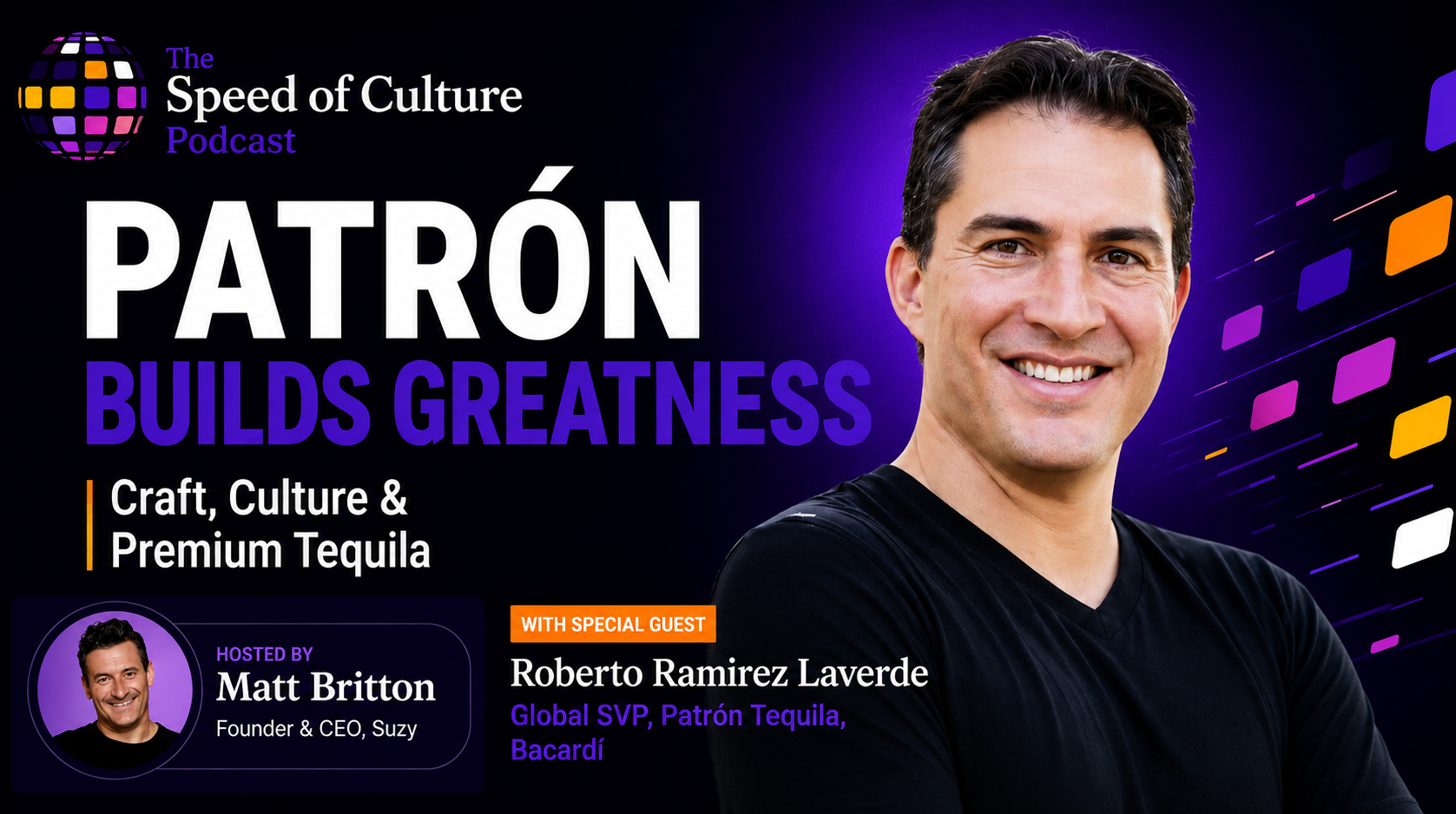
On the latest episode of The Speed of Culture podcast, Matt Britton sat down with Roberto Ramirez Laverde, Global Senior Vice President of Patrón Tequila at Bacardí, to unpack how the world's number one super-premium tequila is navigating this shift. Patrón just launched The Perfect Pour, a cinematic short film directed by Oscar-winning filmmaker Guillermo del Toro and produced with BBH USA, which premiered March 18, 2026 on ESPN. The campaign, anchored by a new global platform called The Pursuit of Greatness, is the brand's most ambitious cultural bet in years, and the strategic logic behind it is instructive for every CMO building a premium brand against a backdrop of category disruption.
The conversation delivered a clear framework for how legacy brands maintain leadership when the playbook that built them no longer works. Patrón's pivot reveals where premium consumer strategy is heading, and the implications extend well beyond spirits into every category where craftsmanship, authenticity, and cultural fluency now determine who captures the premium margin.
The Tequila Category Is Still Growing, But the Rules Have Changed
The tequila boom has been one of the most consequential consumer stories of the past decade. According to SipSource, tequila and agave are forecast to deliver roughly one percent rolling growth through mid-2026, with sustained consumer interest in the premium tiers priced between $20 and $100. More than 720 new tequila brands have entered the market since 2019, many of them backed by celebrities, according to industry coverage. The category grew up fast, and the space has become crowded enough that every incumbent needs a new answer for how it retains its premium positioning.
Matt Britton, founder and CEO of Suzy and author of the national bestseller Generation AI, has been making a related argument in his AI keynote presentations for Fortune 500 audiences. As AI compresses the consumer decision journey for commodity purchases, premium consumption polarizes. The middle collapses. Consumers either default to the cheapest algorithmic recommendation or trade up to something unmistakably crafted. Patrón sits firmly at the second pole, and Ramirez Laverde was explicit in the interview that the brand's strategy is to protect that position without lowering standards to chase volume.
The move is more strategically sophisticated than it sounds. In a category where new entrants are using celebrity endorsements as their primary differentiation, Patrón is leaning into the opposite play. The brand is using Guillermo del Toro not as a celebrity endorser but as a creative partner whose own refusal to compromise mirrors Patrón's production philosophy. That distinction matters. Endorsements fade. Authentic cultural collaborations compound.
Why the Celebrity-Owned Spirits Playbook Is Already Peaking
One of the most strategically important observations in the interview came when Ramirez Laverde was asked about the wave of celebrity-owned tequila brands that has defined the category for the past decade. His answer was direct. Consumers are developing real expertise, they are becoming more discerning, and they are shifting their preference back to craftsmanship over the name on the camera. This is a significant signal for every CMO who has been evaluating celebrity partnership strategies in 2026.
The data supports the read. NielsenIQ research cited by industry analysts shows that Gen Z buyers of alcohol represent just 11 percent of households and 7 percent of dollars but have outsized cultural influence, and their buying criteria are led by taste at 63 percent and price at 48 percent, with brand reputation a distant 16 percent. The implication is that the brands that win the next phase of the tequila category will be the ones whose story about how the product is made is strong enough to stand without a famous face attached. Patrón's three-ingredient formula of blue agave, water, and yeast, combined with its additive-free positioning, is precisely that kind of story.
This is a case study in what Britton has described as the default economy in his writing for Fortune 500 marketing leaders. When algorithmic feeds and AI-powered search engines are doing the work of filtering brand claims, the brands that survive are the ones whose substantiation is tight enough to hold up under compression. Patrón's Censored Truth campaign last year, which made headlines during a dispute with tequila's regulatory body over the use of the term additive-free, is the backstory that makes The Pursuit of Greatness credible. Consumers can verify the claim. That verifiability is what separates a craft brand from a marketing exercise.
The Perfect Pour: Why Premium Brands Must Now Compete on Content
The Perfect Pour is a three-minute short film that transforms the act of pouring a single glass of tequila into a cinematic production, filmed on location at Hacienda PATRÓN in Jalisco with a Mexican-led crew. Del Toro employed motion capture performers to create a stylized skeleton crew representing the more than 60 hands that touch every bottle. The creative premise, as the brand itself framed it, is that hiring an Oscar winner to direct a pour shot may seem excessive, which is exactly the point. The film mirrors the lengths the brand goes to craft every bottle.
Ramirez Laverde's framing of the media environment is worth every CMO's attention. He laid out three realities about the modern consumer. First, they do not want to hear about brands. Second, their attention span has collapsed. Third, they are bombarded by thousands of messages at a time. The only way through those filters, he argued, is an integrated 360-degree approach that combines paid media with the kind of content and experiential activations that consumers actually choose to engage with.
This is the content versus advertising distinction that most premium brands still get wrong. The brands that are cutting through in 2026 are the ones treating creative as product rather than promotion. Del Toro's name and aesthetic are the vessel for a story that explains why Patrón costs what it costs, far more than decoration on top of a tequila commercial. The economics of this approach work because cultural content earns distribution that paid media cannot buy, and the brands that invest at this level compound brand equity over time rather than renting attention on a quarterly cycle.
The Intentional Drinker: Gen Z Is Reshaping Premium Spirits
Gen Z's relationship with alcohol is one of the most misread consumer stories of the decade. The narrative that they have abandoned alcohol is wrong. According to IWSR Bevtrac research from September 2025, Gen Z participation in alcohol is stable year over year and higher than in 2023. What has changed is how they drink. They are drinking fewer categories per occasion, choosing fewer but better moments, and prioritizing authenticity, provenance, and craft. Ramirez Laverde called out this shift directly. They want to know what is in the bottle, where it came from, who made it, and what it stands for.
This intentionality has fundamental implications for how premium brands allocate marketing spend. Harris Poll research cited in industry coverage found that 43 percent of Gen Z consumers are more likely to try a new drink product marketed to align with a sober curious lifestyle. The paradox is that premiumization and moderation are coexisting inside the same consumer. Gen Z is drinking less, but the drinks they do buy are higher-spend, more storied, and chosen for specific occasions rather than default consumption.
For Patrón, the strategic answer is to double down on the craft story that has always been the brand's differentiator. For other categories, the lesson is broader. Brands that win Gen Z dollars are the ones that can explain, at a substantiated level, why their product deserves to be the chosen purchase. Everything else is filler, and filler is the first line item that gets cut when consumers consolidate spend. This is the same dynamic that Britton has been documenting across every consumer category from beauty to financial services to real estate, and it is why his keynotes on Gen Z consumer behavior have become standard programming for Fortune 500 leadership offsites.
Packaging, Place, and the On-Premise Advantage
One of the most commercially important moments in the interview came when Ramirez Laverde dropped a number that most CMOs underweight. Packaging is the second driver of brand awareness after media. For Patrón, the bottle is so iconic that it functions as a standalone visual asset, and the brand just completed a design refresh that optimized shelf and back-bar visibility while incorporating tactile agave silhouette details that deepen the sensory connection with consumers. This was the first packaging refresh since the brand launched in 1989.
The on-premise dynamic Ramirez Laverde described is equally important. Roughly 70 to 80 percent of spirits sales happen off-premise at retail, but the on-premise channel is where brand equity gets built because bartenders, servers, and staff are the cultural ambassadors who shape consumer preference before the off-premise purchase ever happens. Investing in on-premise advocacy is disproportionately high-leverage because it turns every bar and restaurant into an unpaid content studio.
The implication for CMOs in other categories is that the most leveraged marketing investments are often in the channels where consumers experience the brand in community rather than in isolation. For spirits, that is on-premise. For luxury fashion, it is retail experience. For financial services, it is advisor interaction. The brands that treat these moments as a cost center get out-competed by the brands that treat them as the foundation of the brand experience.
Music, Experience, and the Expansion Beyond the Bottle
The second lever Patrón is pulling is a systematic expansion into cultural experiences. The brand has built partnerships with Becky G, Karol G, and Live Nation, and recently became the official tequila partner of the 2026 Grammy Awards. Ramirez Laverde described pop-ups inside festivals like Lollapalooza as experiences within experiences, designed to give consumers something they could not get anywhere else.
This maps to one of the most reliable macro trends in consumer strategy. Recent research suggests 84 percent of consumers value experiences over products, and Ramirez Laverde cited internal Patrón data showing more than 70 percent of the brand's consumers now prefer experiences over gifts or products. The brands that can attach themselves credibly to cultural moments compound attention, loyalty, and premium pricing power in a way that traditional paid media cannot. Britton has called this the experience barbell in his keynotes to Fortune 500 leadership teams, and it is the single most important allocation question for any consumer brand this decade.
The strategic caution worth flagging is that experiential activations only compound if they are connected to the brand's core story. Patrón's Grammy partnership works because it reinforces the brand's craftsmanship and cultural excellence narrative. The same partnership for a challenger tequila brand without that substantiation would function as rented attention. The difference is whether the experience is an extension of the brand or a substitute for one.
Key Takeaways for Business Leaders
- Bet on craft over celebrity. The tequila category is moving past celebrity ownership as a primary differentiator. Build substantiation into the product and the story, and let the product do the cultural work over time.
- Treat creative as product, not promotion. Cultural content that earns its own distribution compounds brand equity in ways paid media cannot match. The Perfect Pour is a template worth studying across categories.
- Understand the intentional consumer. Gen Z is still buying premium, consolidating spend into fewer, more storied purchases. Brands that explain why they deserve to be chosen will win those dollars.
- Treat packaging as the second medium. Packaging drives awareness more than almost every line item except paid media. Audit the sensory and narrative signals your packaging is sending, and refresh when the consumer has moved.
- Invest in the on-premise equivalent of your category. Every consumer category has a channel where the brand is experienced in community. Prioritize it even when the transactional volume sits elsewhere.
- Attach the brand to culture with discipline. Experiential partnerships compound only when they extend the brand's core narrative. Reject activations that function as rented relevance.
Frequently Asked Questions
How is Gen Z reshaping the premium spirits market in 2026?
Gen Z is drinking less but more intentionally. According to IWSR, the average number of alcohol categories consumed per occasion has fallen from 2.8 to 1.8 over two years, and Gen Z buyers prioritize taste, craft, and provenance over brand reputation. The result is that premium and super-premium tiers are growing while volume in the broader category softens. Brands that can substantiate their craft story are capturing disproportionate share of a shrinking but higher-value consumer.
Why are celebrity-owned tequila brands losing momentum?
Consumers are developing real category expertise and shifting their preference back toward product quality and production process over celebrity endorsement. With more than 720 new tequila brands launched since 2019, the celebrity differentiation has been commoditized. Patrón and other legacy super-premium brands are benefiting because their production stories, built over decades, cannot be replicated quickly by new entrants. The celebrity-owned playbook still works for initial launch velocity but has a shortening half-life.
What makes The Perfect Pour different from traditional spirits advertising?
The Perfect Pour is a short film directed by Guillermo del Toro rather than a conventional commercial, and its premise is that the effort of hiring an Oscar winner for a pour shot mirrors the effort Patrón invests in crafting every bottle. It is designed to earn organic distribution across cultural channels and behind-the-scenes content, rather than rely on paid placement alone. This content-as-product approach is increasingly how premium brands compete for consumer attention in a saturated media environment.
How should consumer brands think about experiential marketing in a premium category?
Experiential marketing compounds brand equity only when the activation extends the brand's core story. Patrón's Grammy partnership and Live Nation festival pop-ups work because they reinforce the brand's craftsmanship and cultural excellence positioning. For CMOs in any premium category, the discipline is to say no to activations that function as rented relevance and say yes to the ones that let the consumer experience the brand's differentiation firsthand.
Bring These Insights to Your Next Event
The premium consumer is not going away. The rules for earning that consumer are being rewritten in every category, and the brands that adapt fastest will compound advantage through the next decade. The ones that continue to run a pre-2020 playbook will find their premium margin eroded by new entrants with sharper stories and better-aligned cultural fluency.
Matt Britton has delivered more than 500 keynotes to Fortune 500 leadership teams on the intersection of AI, consumer behavior, and the future of premium brands. To bring these insights to your next event, explore Matt Britton's keynote platform or contact his team directly. For the full conversation with Roberto Ramirez Laverde, listen to the latest episode of The Speed of Culture podcast on Apple Podcasts, Spotify, or wherever you get your podcasts.
.avif)
%20(400%20x%20100%20px)%20(300%20x%2050%20px)%20(150%20x%2050%20px).avif)