The most consequential shift in enterprise marketing software is about who is doing the work, more than about interfaces. For two decades, marketing cloud platforms sold knobs and dials to specialists who learned to operate them. That era is ending. Gartner has projected that up to 25 percent of traditional search volume would shift to AI chatbots and virtual agents by the end of 2026, and the data is already confirming it. ChatGPT now accounts for roughly 20 percent of search-related traffic worldwide, 60 percent of Google queries now end in zero clicks, and enterprise marketing budgets are being forced to reallocate in real time. The operators who understand this shift are building the playbook. The ones who do not are about to get disrupted.
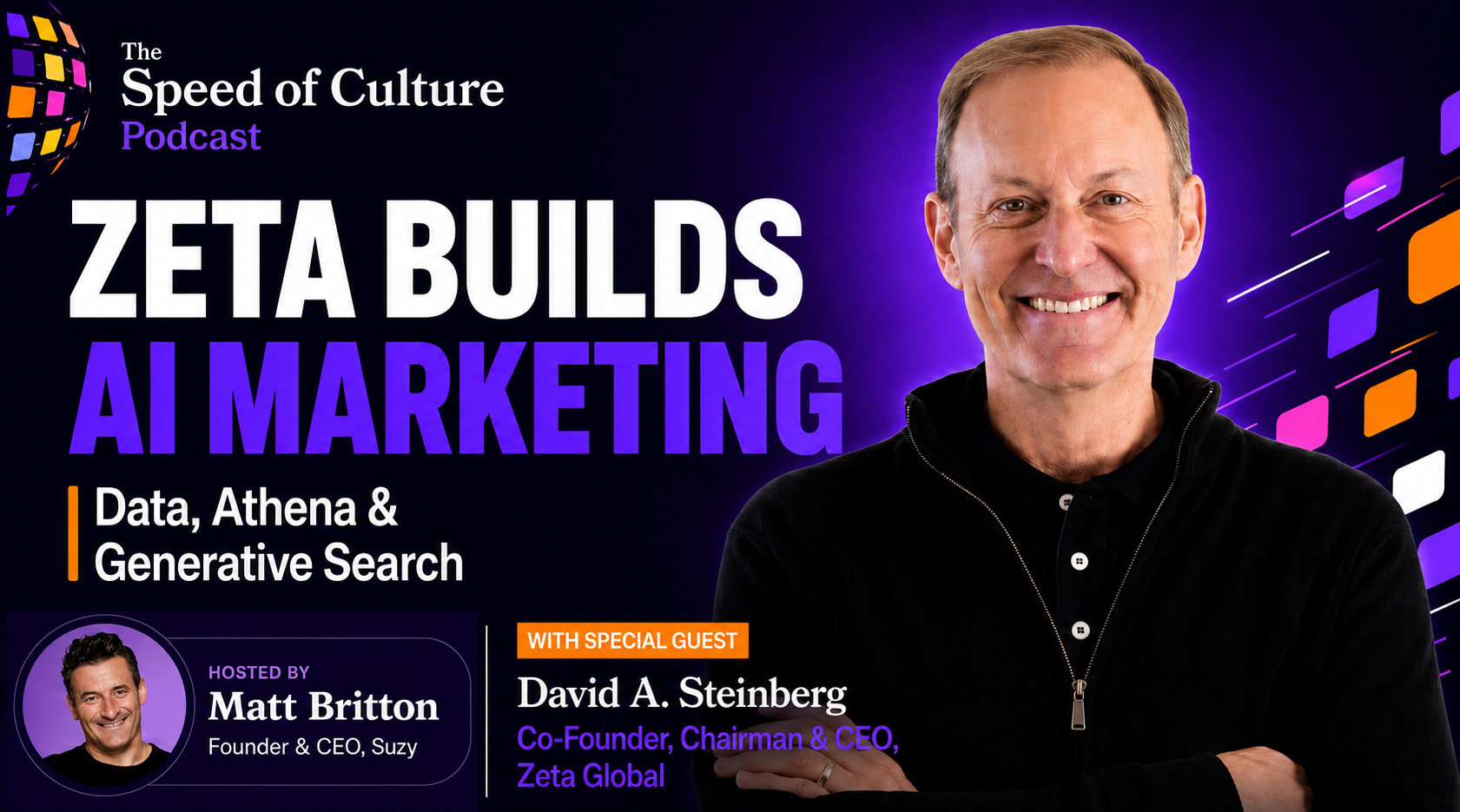
On the latest episode of The Speed of Culture podcast, Matt Britton sat down with David Steinberg, Chairman and CEO of Zeta Global, one of the most instructive operators in this transition. Zeta just announced a strategic OpenAI partnership at CES 2026 to power Athena, its superintelligent agent built for enterprise marketing, with full rollout to all customers by the end of Q1 2026. The company posted 30 percent top-line growth in 2025, delivered $1.305 billion in full-year revenue, and guided to another 30-percent-plus year in 2026. Against the backdrop of a so-called SaaS apocalypse, Zeta is doing what most marketing clouds cannot. It is compounding growth while the rest of the category stalls.
The conversation with Steinberg delivered one of the clearest articulations of where enterprise marketing is headed that Fortune 500 CMOs will hear this year. For leaders navigating AI transformation, the tactical and strategic implications span data architecture, organizational design, and the complete reinvention of how paid media gets planned and bought.
Why Proprietary Data Is the New Competitive Moat
Steinberg's opening argument deserves attention from every CMO who has been asked whether their company should feed first-party data into a public large language model. His answer, delivered without hedging, was that Fortune 500 companies will never hand their proprietary data to foundational LLMs. Zeta ingests first-party data from 603 enterprise clients, including 51 percent of the Fortune 100, into a proprietary consumer data platform that is then merged with 552 million opted-in identities and an average of 5,000 to 7,000 data elements per person. None of that data has ever been fed into a public LLM, and none of it ever will.
This is the architecture decision that most enterprise buyers have been under-scrutinizing. As AI moves from experimentation into production across the Fortune 500, the boards that rubber-stamped early generative AI pilots are now asking harder questions about data sovereignty, intellectual property leakage, and the long-term strategic cost of training a competitor's model on your customer base. The companies that win the next decade will be the ones that treated their first-party data as a defensible asset class from day one.
Matt Britton, founder and CEO of Suzy and author of the national bestseller Generation AI, has been pressing this point in his AI keynote presentations for the past two years. The framework Britton delivers to Fortune 500 leadership teams is that every enterprise now needs to draw a bright line between the commodity layer of AI, where public LLMs provide horizontal intelligence, and the proprietary layer, where first-party data becomes the flywheel for competitive advantage. Zeta's architecture is a textbook example of the second category, and the 600 to 700 percent return on ad spend the Forrester study validated for its clients is the downstream economic consequence.
From Dashboards to Answers: The Agentic Marketing Shift
The most strategically important moment in the interview came when Steinberg described the thesis behind Athena. Most marketing software, he argued, is a 747 jet for a platform that clients have learned to fly like a Cessna. Enterprises pay for 100 percent of the product and use 10 percent of it. Athena's design premise is that voice is the natural interface for humans, who have been communicating this way for hundreds of thousands of years and only adopted the keyboard in the 1950s. The agentic model removes the friction between the marketer and the capability.
The early data is striking. Zeta's prior voice-enabled product, Zoe, drove 250 to 275 percent higher platform spend among clients who adopted it. TKO Group, which owns UFC and WWE, participated in Athena's Early Access Program and reported that it streamlined segment-based reporting and performance comparison. Steinberg's explicit goal for Athena is to push client ROI from the current 600 to 700 percent range to 1,000 percent. That is a fundamental repricing of what marketing technology can deliver.
For enterprise leaders, the implication is that the role of the marketing specialist is about to change. When a CMO can simply tell an agent to drive two million incremental customers at a seven percent cost savings this quarter and get a decision-ready plan in seconds, the bottleneck in marketing operations is no longer the specialist who knew how to configure the campaign. The bottleneck is the strategic clarity of the goal itself. This is decision compression at enterprise scale, and it is the same dynamic Britton argues will define AI transformation across every category from financial services to real estate.
The Change Management Playbook Most CEOs Are Getting Wrong
Steinberg's description of how Zeta reorganized for AI internally is a case study in change management that every Fortune 500 CEO should study. The inflection point came after a family safari in Kenya when Steinberg returned agitated, sleep-deprived, and convinced that the company needed to be rearchitected with AI at its core. Within months, he and COO Steve Gerber had built three workgroups, seeded engineering pods with the best AI-native talent money could buy, and shifted the entire engineering organization toward Anthropic's Claude and other AI coding tools.
The tactical moves matter. First, every employee got Copilot on day one, no approval cycle. Second, Zeta did not threaten employees who were slow to adopt. It publicly celebrated the ones who were using the tools well and asked them to teach their peers. Third, rather than trying to convert all one thousand engineers simultaneously, the company moved pod by pod, buying top AI-native talent at whatever cost and letting the productivity data speak for itself. The result is that existing engineering output is now 125 percent of where it was 12 months ago on a net basis, with gross productivity gains of 150 percent before QA adjustments.
Fourth, and most strategically relevant, Steinberg was direct about the employees who did not embrace the tools. Zeta moved on from them. This is the uncomfortable conversation that most CEOs are avoiding, and the data on AI adoption suggests it is the single biggest predictor of whether a company will survive the transition. A recent MIT study estimated AI can complete about 65 percent of text-based tasks at a minimally acceptable level, potentially reaching 95 percent by 2029. The organizations that are compounding productivity gains are the ones that made adoption non-negotiable. The ones that framed it as optional are watching their competitive position erode in real time.
Generative Engine Optimization: The New Paid Media Frontier
One of the most underreported structural shifts in marketing is now showing up in Zeta's product roadmap. A year ago, 97 percent of Google searches resulted in a click off the platform. Today, by Steinberg's framing, 60 percent of answers resolve on-platform, a pattern confirmed by multiple industry analyses showing that zero-click searches now dominate Google and that over 30 percent of ChatGPT referral traffic goes to just 10 domains. The net effect is that the total demand for answers has not declined. The mechanism for delivering those answers has.
Steinberg confirmed Zeta is already monetizing this shift through a comprehensive Generative Engine Optimization platform that helps clients get their brands surfaced and cited inside ChatGPT, Claude, and Gemini answers. This is the same category, which Britton has been calling AEO, or answer engine optimization, that FutureProof has been building against for the past 18 months. The strategic logic is straightforward. When consumers make decisions inside AI interfaces, the brands that are cited in AI-generated answers capture the attention. The brands that are not become functionally invisible. The Washington Post reported that visitors arriving from AI platforms convert at four to five times the rate of traditional search visitors, which means the ROI math on GEO investment is already favorable even at today's relatively modest traffic volumes.
The second-order effect is what Steinberg described as the price-per-click compression in paid search. Google and Meta have historically controlled roughly 50 percent of digital marketing spend. As more queries get answered on-platform, fewer clicks escape to advertisers, which drives cost-per-click up while diminishing the marginal return on budget. Enterprise CMOs are, for the first time, asking Zeta how to move wallet share away from the duopoly. This is the opening that every challenger platform in advertising has been waiting for, and Zeta's OpenAI advertising partnership positions it to capture meaningful share as the channel mix rebalances.
The Inference Economy and What It Means for Enterprise Software
Steinberg's framing of the AI maturity curve is worth memorizing. The first generation of AI investment, he argued, funded the foundational layer of large language models, which required massive compute, energy, and training data. That work has been largely completed by Big Tech, governments, private equity, and hyperscalers. The next generation, which Steinberg calls the inference generation, is where the applications and agents that actually do work get built. These require far less energy, far less data, and far less time to make a decision, and this is the layer where Zeta has been operating since 2017.
This framing matters because it clarifies where enterprise value will accrue. The foundation model layer will consolidate around three to five winners. The inference and application layer, in contrast, will fragment into vertical and domain-specific leaders with deep proprietary data and deep enterprise sales motions. Steinberg's point that LLM vendors will not build expertise in procurement, data security, SOC 2 compliance, and CIO-level integration is the key insight for any enterprise software CEO reading this. The LLM companies will partner with companies like Zeta. They will not replace them.
For Fortune 500 leaders, the allocation implication is to distinguish between horizontal AI infrastructure, which should be treated as a cost center, and vertical AI applications, which should be evaluated on whether they are creating measurable revenue lift. Zeta's positioning as a revenue center returning six to seven dollars for every dollar spent is precisely the frame that every AI software vendor should be required to justify.
Advice for the Next Generation of Operators
Steinberg closed the conversation with a piece of career advice that runs counter to the dominant narrative in business schools and at elite firms. He has noticed a Hunger Games dynamic around internships at the top banks, consulting firms, and tech platforms. His counsel to young operators is to go somewhere else. Go where you can get hands-on quickly, where the new AI tools are available, where you can find a real problem and try to solve it.
The underlying logic is one Britton has been making in his keynotes on the future of work for the past three years. AI is eliminating the traditional scaffolding of entry-level white collar work, which means the path from analyst to CEO through sequential credentialing is narrowing. The path that is widening is for operators who use AI tools to leverage themselves into outsized responsibility earlier. Every major CEO of an ad tech or marketing holding company today started somewhere unconventional. The next generation's path will be even more unconventional than that, and the soft skills, creativity, and relationship-building that Steinberg flagged as critical are the skills that remain defensibly human.
Key Takeaways for Business Leaders
- Treat first-party data as a defensible asset class. The Fortune 500 boards approving AI partnerships in 2026 need a hard line on what proprietary data gets fed into public LLMs versus what stays inside proprietary consumer data platforms.
- Move from dashboards to answers. The software your teams use should reduce the friction between strategic intent and executed action. If your current stack requires specialists to translate goals into campaigns, you are paying for legacy architecture.
- Make AI adoption non-negotiable, then reward the adopters. Public celebration of power users beats mandates. Move on from employees who refuse to adopt. The productivity delta compounds quarterly.
- Build a GEO capability inside your marketing organization. If your brand is not being cited in AI-generated answers today, it will be invisible inside the interfaces where decisions are being made tomorrow.
- Plan for paid media channel rebalancing. The Google and Meta duopoly is not collapsing, but its marginal ROI is compressing. Start testing alternative channels, including emerging AI advertising surfaces, now.
- Never waste a crisis. Steinberg's mantra, borrowed from Machiavelli, is the single most useful framing for AI transformation. The opportunity cost of organizational change is lowest when the pressure is highest.
Frequently Asked Questions
What is agentic marketing, and why does it matter for enterprise CMOs?
Agentic marketing refers to AI systems that take goal-directed action on behalf of marketers rather than simply presenting data for humans to interpret. Zeta Global's Athena, built with OpenAI models, is one of the first enterprise-scale examples. A CMO can state a business objective in natural language, and the agent builds and optimizes the campaign. The implication is that specialist headcount declines while strategic clarity becomes the new bottleneck.
How is AI changing paid search budgets in 2026?
As more consumer queries are answered inside AI interfaces like ChatGPT, Google AI Overviews, Claude, and Gemini, fewer clicks reach advertisers. This has driven cost-per-click up while flat or declining click volumes compress marginal ROI. Enterprise CMOs are reallocating budget toward Generative Engine Optimization, emerging AI ad surfaces, and first-party channels. Google and Meta still dominate, but their share of incremental AI-era spend is starting to shrink.
Why are Fortune 500 companies refusing to share first-party data with public LLMs?
The concern is data sovereignty and competitive leakage. Once proprietary consumer data is used to train a public model, the intellectual property advantage that data represented becomes a commodity available to every competitor. Platforms like Zeta Global ingest first-party data into proprietary consumer data platforms that never feed public LLMs, which preserves the enterprise's ability to maintain a data-driven competitive moat.
How should enterprises think about generative engine optimization?
GEO is the practice of structuring content, data, and brand signals so AI platforms cite the brand when users ask relevant questions. Early data shows AI-driven visitors convert at four to five times the rate of traditional search traffic, which means even modest citation volume can produce outsized revenue impact. Enterprise marketing teams should audit AI visibility today, invest in earned media and community platforms like Reddit and YouTube that LLMs cite heavily, and continuously refresh content to maintain AI visibility.
Bring These Insights to Your Next Event
The shift David Steinberg described on The Speed of Culture is already rewriting the rules of enterprise marketing. Boards are approving new data architectures, CMOs are rebalancing channel mix, and operating leaders are rebuilding their organizations around agentic AI. The leaders who adopt early and execute against the change will compound advantage through the next decade. The ones who wait will find themselves explaining to shareholders why their marketing spend is producing less every quarter.
Matt Britton has delivered more than 500 keynotes to Fortune 500 leadership teams on the intersection of AI, consumer behavior, and enterprise transformation. To bring these insights to your next event, explore Matt Britton's keynote platform or contact his team directly. For the full conversation with David Steinberg, listen to the latest episode of The Speed of Culture podcast on Apple Podcasts, Spotify, or wherever you get your podcasts.
.avif)
%20(400%20x%20100%20px)%20(300%20x%2050%20px)%20(150%20x%2050%20px).avif)